NINE MEN'S MORRIS.
Reading edition
BY JAMES OTIS.
As an in-door amusement, a very interesting game is that of Nine Men's Morris, or Shepherd's Game, as it is known by some. A board may be made of anything at a moment's notice, and bits of paper, peas, beans, or anything of that sort may be used for men.
To make the board, draw three squares, one within the other, with a space of at least an inch between them; then draw four lines to connect each of the sides, and it is complete.
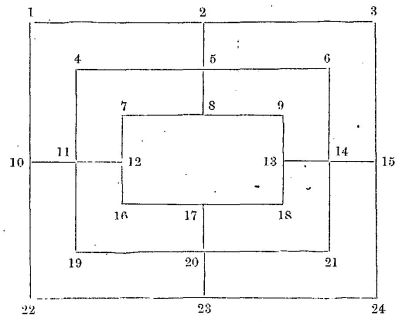
Each player has nine men, it making no difference what they are made of, so long as one set may be readily distinguished from the other.
Then each player places alternately a man on any one of the intersections, which on the plan are numbered from 1 to 24 simply for the purpose of better explaining the game. The first point is for one of the players to get three men in a line; that is to say, have them on three direct stations, as 16, 17, 18, or 10, 11, 12, but not on the angles, as at 1, 4, 7. If either player succeed in so placing his men, he can remove one of his adversary's men from the board; this is called pounding. One of three men in a line can not be pounded, provided there are any others on the board.
As the game is really divided into three distinct phases of playing, it may be well to illustrate each phase, taking the work of placing the men first, and allowing Black to open the game:
Black.White.
911
1318
1415
87
52
64
21 pounds 1116
1217 pounds 12
1224
By this play White has the best of the game, and then the moving begins, which consists in moving a man from one intersection to another which is not occupied, never passing over a man or out of the direct lines. For example, a man at 11 might move to 10, 19, 4, or 12, provided those stations were not occupied.
To continue the game illustrated: Black has only one man which he can move, and that is from 21 to 20. White moves 2 to 3, and pounds 20, selecting that one because 6, 14, or 20 must be removed, or a line could be made by Black, who would have pounded 7, and had the advantage. Black then moves 14 to 21; White, 15 to 14; Black, 21 to 20; White, 3 to 2—White now being able to make a line at 3, 15, or 24 whenever he chooses, despite Black. Black now moves 20 to 21. At this point it would be possible for White to block the game by moving 17 to 20; but in the hope of winning, even though he gives his adversary an advantage, he moves 2 to 3; then—
Black.White.
5 to 24 to 5
21 " 2014 " 15 pounds 20
13 " 1417 " 20
9 " 1324 " 23
14 " 2118 " 17 pounds 21
8 " 923 " 24 pounds 12
6 " 1424 " 23 pounds 13
Black has now but three men; and when either party is so reduced in numbers he can jump to any part of the board, regardless of men or intersections, provided the station at which he wishes to stop is not occupied.
To illustrate this latter portion of the game: Give White seven men, on stations 3, 6, 8, 9, 11, 17, and 18, and Black three men, at 7, 12, and 15. White moves from 6 to 14; Black, 7 to 13; White, 17 to 20; Black, 15 to 7. By this last move of Black's he can jump to 16, make a line, and pound. White moves 3 to 15; Black, 13 to 16, and pounds 14.
When Black is reduced to two men he loses the game, and this would have occurred had he pounded any other man but 14, as otherwise White could have made a line by the next move.
The game is continued by—
White.Black.
15 to 1416 to 13
20 " 2113 " 16 pounds 9
8 " 97 " 13
11 " 1913 " 7 pounds 9
18 " 177 " 20
This portion of the game calls for the most skillful playing, since White can also jump when he has but three men left; and as his men stand now, he could complete a line in one or two moves despite Black, provided he could jump. Black must therefore play to gain the advantage of position rather than to pound:
White.Black.
14 to 612 to 18
21 " 1416 " 21
17 " 1618 " 17
6 " 5
Now if Black should make his line by jumping from 21 to 23, and pound one of White's men, White could make a line in two moves by jumping to 6, 11, or 12, and thus win the game; but in such a position, between equal players, the game should be a draw.
It is possible to display quite as much skill in Morris as in checkers. But the one, although it looks so simple, requires quite as much study as the other.
In playing, avoid crowding all your men on two squares. If you have the first move, take the corners, and try to make a cross with three men. Keep your adversary blocked as much as possible, and leave your own men free to move. Do not try too hard to form a line while placing the men, or your adversary will have an opportunity to place his for position, and you will be beaten easily when the moving begins.
When possible, try to arrange men so that you can make two or three lines by successive moves, as, for example, men on 9, 13, 18, 20, and 23. Then 18 can move to 17 and make a line, back to 18 for another, and so on.
Before reducing your adversary to three men, and thus giving him an opportunity to jump, try to arrange your men so that you will be able to form your lines in successive moves. For example: Black has eight men, at 2, 11, 13, 15, 16, 19, 21, and 24; White has four, at 3, 9, 12, and 22. Black moves 24 to 23; White, 22 to 10. If Black made a line at 14 or 20, White, being reduced to three men, could jump either to 20 or 14, whichever was vacant, and thus prevent the second line from being made; but if Black moves 2 to 5, White can not prevent him from making a line either at 4, 14, or 20, even if he can jump.
THE MUSIC-ROOM.