OUR POST-OFFICE BOX.
Reading edition
Newark, New Jersey.
There are four of us children in this house to enjoy Harper's Young People, besides our little wee baby, and we gave four subscriptions on Christmas-day as presents to our little cousins, and they enjoy the papers so much! But what we want to tell you about is our little brother M., who is only four years old. A few days ago he took his papa's mucilage bottle and brush, and pasted it all over his little sister's face. They thought it was fine fun at first, but lying down almost immediately to take a nap, when she woke up she was fast to her pillow. Her crying brought us, and when we saw what was the matter, we made him quite ashamed of what he had done, and he didn't want us to tell his papa when he came home from business. When he said his prayers at night he said, "Dear Dod, pease dive me more ense [sense] o me won't do my little ister o any more."
Lena and Eulalie McD.
Fort Apache, Arizona.
My papa is in the army, and we travel about a good deal. We have no schools out here, but I study with papa. I have a big sister, who rides on horseback. There are lots of Indians about these mountains. The soldiers had a battle with them last August. I suppose you read about it in the papers. General Carr was in command. My papa was wounded, but he is well now. I take Young People, and love it very much. My sister takes St. Nicholas. We have only one mail a week; the mail-day is Wednesday. There are not any girls here, or even boys. I like the story called "Talking Leaves" very much. I am afraid my letter is too long, so good-by.
Bessie G.
Your letter is not too long, dear. You might have told us how you amuse yourself without any little companions. How glad you must be that your papa's wound is healed!
Monroe, Iowa.
My name is Johnny. I am eight years old. I have a little brother, Joe, six years old. We both have the whooping-cough badly. I have to stay at home from school, and don't like it a bit. I have a big cat that looks just like a tiger. She has no name yet. What shall I call her? I can set type just a little for papa's paper.
Johnny V.
We are very sorry that you and Joe have the whooping-cough. It is one of the few things it is right to be very selfish about. You must be ever so careful not to give any of it away, you know, and that's why you have to stay at home from school. One comfort is that next winter your mamma will say, "I am not afraid of whooping-cough any more, for my boys have had it." At least she will not be afraid of your having it very severely again. Perhaps some of the little correspondents will send you a name for Madame Puss. We think Mouser is as good as any. Is it difficult to set type?
Nachitoches, Louisiana.
I have been going to school ever since the new year began. Our teacher is good; she has twelve scholars. We are doing very well. I read all of the letters in the Post-office Box, and I thought I would write to you. I have a horse and gun, and go hunting very often. The river runs right in front of our house, and the ducks are plentiful. Recently my brother and I went hunting, and brought home a good many ducks. I have three brothers and one sister. She is just learning her letters. I think she is anxious to learn. Our teacher has a little book in which she marks off our lessons. She has a page which she calls the Black List. She has not marked me yet, and I am not going to get on that list. I spent my Christmas holidays at home. Our greatest fun was in popping fire-crackers. The river rises every winter, so we have to use a boat to cross. This is tiresome to little boys who are lazy.
Elisha W. B.
Has that good teacher a Roll of Honor for the well-behaved as well as a Black List for the naughty scholars? We hope so, because we are sure that if she has, your name will appear on that.
Dobbs Ferry, New York.
I am a little girl nearly nine years old. I do not take Harper's Young People, but my grandma does. I have a little sister who was three weeks old yesterday. I hold her very often. She is a real sweet little thing. She is ever so fat. And she can smile, too. I heard that the Editor wants all the little girls to tell about their pets and dolls. I have no pets except two cats, a mother cat and a kitten. The mother's name is Mollie, and the kitten's name is Dot. I have a beautiful doll that I got on Christmas. She has lovely golden curls, and little pink socks, and everything to complete a baby's toilet. We haven't very good coasting, for the snow is so deep. We have in front of our house a great big snow-drift that is higher than a man.
Isabella T. N.
Foochow, China.
I shall be eight years old next month. I came here from Massachusetts a year ago with my mamma and two little brothers to stay with my papa, who has been in Foochow a good many years. Our house is on the river, and we can see a great many sampans and junks. When we go out to ride, we go in a chair on two poles, and it is carried by two or three coolies. We had ten rabbits, but we gave away the three old ones, and now have the seven young ones left. It is not cold enough for snow or ice here, so there is no chance for coasting or sliding, but the flowers blossom all winter.
I am getting a lot of nice stamps for my book; I have over three hundred. I like Harper's Young People very much, and get two or three by every mail, twice a month.
Amy C J.
We felt the more interested, Amy, in your little letter, which left Foochow just before Christmas, because the very day it came we had been talking with a lady who had spent many years in China, and who told us some very interesting things about its people. We will be pleased to have you write again, and tell us whether you intend to learn to speak and write Chinese while you are in the Flowery Land. We would try to do so if we were there, difficult as it is.
Georgetown, D. C.
Can you make room for a stranger who would like very much to see her letter in the Post-office Box? I think one of the nicest stories in your paper is "The Little Dolls' Dressmaker." In No. 118 there was a short article called "Home Gymnastics for Stormy Days," which I think I shall try. I am a little girl just twelve years old, and have one brother and one sister, both grown-upers.
Virginie T. B.
Eutawville, South Carolina.
I am a boy of nine. I am spending the winter at my grandfather's plantation in South Carolina, but my home is in the Pennsylvania mountains. The Santee River is near here, and a deep swamp with bears in it. There are many young lambs here, and one day the buzzards caught two little weak ones. Another boy and I drove them off from getting another. The birds are very gay, and the woodpeckers tap on the house like mad. Love to the Editor.
E. B. C. Jun.
Poor little lambs! We are so glad you and your friend were in time to drive off the cruel buzzards before they carried away any more of them. Have you ever happened to meet a bear, or do they hide themselves in the swamp? What would you do if one came along? And are you studying the habits of the birds, so that when you go home again you will have acquired a fund of information about the warblers of the South?
C. Y. P. R. U.
Perhaps some of you would like to know how to make pretty scrap-books, either for your own pleasure or to give to little friends. These scrap-books are sources of enjoyment to children who have been ill and are getting stronger—who are what we call convalescent—and some of us know crippled children, or even grown people, who are shut in from busy life by weakness or disease. We ought to try to brighten their lives if we can. Gather together all the illustrated newspapers and books with pictures that you can command. Black and white pictures are as good as colored, and the two look well together. Cut these out neatly and carefully, with smooth edges. Torn and worn-out picture-books usually have something left which will do to cut out, and be thus saved from being wholly lost. Then there are the Christmas, New-Year, and birthday cards, of which nearly all of us have some. Take for the pages of your book, paper, muslin, or common glazed cambric; cut this into pieces ten inches long and eight inches wide. Three or four pages will make a book large enough to begin with. The cambric may be all white, or any color you prefer—pink, blue, red, or a part of each color. On these pages paste the pictures neatly on both sides, using your taste as to which pictures look well together and fit in nicely. The covers may be made of the cambric, neatly lined; but if you aim at durability, take light pasteboard covered on both sides with cambric, and sewed together over and over, or what is better, in button-hole stitch in colored worsted. Then with the scissors make holes through all, and tie the covers and pages together with a narrow ribbon or twisted worsted.
We are sure that none of you who can play and sing will neglect to learn the beautiful melody which we give you in this week's Post-office Box. We shall think we hear you singing it as we follow the paper in its flight over land and sea to the thousands of homes where little hands are outreached to welcome its arrival.
Here is a bit of wise counsel from Charles Kingsley about the best way to study history:
"If you would understand history, you must first try to understand men and women. For history is the history of men and women, nothing else; and she who knows men and women thoroughly will best understand the past work of the world, and be best able to take a share in its work now.... If, therefore, any of you ask me how to study history, I should answer: 'Take, by all means, biographies—wheresoever possible, autobiographies—and study them. Fill your mind with live human figures, people of like passions with yourselves; see how they lived and worked in the time and place in which God put them.' Believe me that when you have thus made a friend of the dead, and brought them to life again, and let them teach you to see with their eyes and feel with their hearts, you will begin to understand more of their generation and their circumstances than all the mere history books of the period would teach you."
A. C.—St. Mary's Free Hospital is an Episcopal institution. We can not answer your first question.
We offer the C. Y. P. R. U. this week a variety of articles from which to choose. Mr. James Payn begins another of his thrilling stories of "Peril and Privation" on the great deep; the presence of mind and courage shown by little Alice Ivy will appeal to readers of all ages; Mr. Allan Forman gives us a glimpse into ornithology in his amusing article on "Mr. Thompson and the Bird with a Lantern"; and there is no small amount of information in regard to natural history to be gleaned from Mr. J. C. Beard's article on "Mr. Barnum's Show in Winter-Quarters." Capital entertainment for long evenings will be found in the game of "Nine Men's Morris," which Mr. James Otis gives us full and clear directions how to play.
PUZZLES FROM YOUNG CONTRIBUTORS.
No. 1.
A DIAMOND CROSS.
Centre diamond.—1. A letter. 2. To strike. 3. Expanded sheets. 4. A fold. 5. A letter.
Upper left-hand diamond.—1. A letter. 2. An animal. 3. Parts of a ship. 4. To mistake. 5. A letter.
Upper right-hand diamond.—1. A letter. 2. To sup. 3. Edges. 4. A plant and its fruit. 5. A letter.
Lower left-hand diamond.—1. A letter. 2. A surface. 3. Bottoms. 4. A favorite. 5. A letter.
Lower right-hand diamond.—1. A letter. 2. An affirmative. 3. Marine animals. 4. Cunning. 5. A letter.
Bob.
No. 2.
ENIGMA.
Find my first in church, but not in building,
And in barn my second, not in house.
Find my third in crayon, not in pencil,
And my fourth in bread, but not in cake,
And my fifth in sleep, but not in wake,
And my sixth in squirrel, not in rabbit.
Only little children need my whole.
Willie B. W. (aged 7).
No. 3.
RHOMBOID.
Across.—1. A priest. 2. Small reptiles. 3. Fast. 4. To gain knowledge. 5. Started with fright.
Down.—1. A letter. 2. A preposition. 3. A dowry. 4. A small bird. 5. Outer surfaces, 6. A Persian monarch. 7. A Latin numeral. 8. A French adverb. 9. A letter.
Buster Benzine.
ANSWERS TO PUZZLES IN No. 119.
No. 1.
Satisfactory.
No. 2.
YIELD
IDLER
ELEGY
LEGAL
DRYLY
No. 3.
Lexington. Abraham Lincoln. Franklin. Australia. Yenisei. Erie. Ticonderoga. Texas. Egypt.
Lafayette.
No. 4.
It was the time when lilies blow, And clouds are highest up in air, Lord Roland brought a lily-white doe To give his cousin Lady Clare.
No. 5.
Ethel. Lethe.
No. 6.
H
COT
CANES
HONESTY
TESTY
STY
Y
Correct answers to puzzles have been received from N. Y. C., Flora C. McGregor, Murray Cheston Boyer, "Lodestar," Clara, Bertha, Mary E. Nesmith, William A. Lewis, Harry H. Rousseau, "Sam Weller, Jun.," Charley Lamprey, Florence Cox, E. Knowles Webster, "Little Violet," Guilford D. Eggleston, Mallie M., Edward Lee Haines, Istalina Beach, Stella Scofield, Edward S. Lea, A. H., H. V. Gunnere, Willie Volckhausen, Edith E. Grice, Willie Curtis, Percy Brotherhood, "Fill Buster," Leland Burr, Maud M. Chambers, Louis R. Little, Albert Earle, Georgie Wardell, Mary Wardell, Francis, Harry A. McCarthy, Johnnie W. King, M. S. French, "Queen Bess," Horace M. Dobbins, J. U. Merrick, Mitford D. Rogers, Willie B. Wood, Ruby Wickersham, Arthur F. Dornin, Fred. W. Loudon, Emma L. Gilbert, Katrina, C. Will Eggers, Eva Darlington, Elsie C. Ruggles, Alice Blandford, Addie Goodnow, Sallie Rose, Kate Wily, Paul Renno Heyl, Louis Starrett, "Lora," M. F. Tomes, Hattie E. Conant, Lizzie Hill, Mrs. Nesmith, Hattie Wiesel, Connie W. Smith, Newton D. Holbrook, Jun., Ernest L. Meeker, Eloise, Josephine Harrison, Marie Blanche Y. Shannon, Charley Graves, Cyrus Hill, Annie E. Little, Ruth Shirley Hawkins, "Robin Redbreast," Katie Huckaus, Harold B. Fobes, William Cowan, "A Regular Subscriber," Laura C. Brinton, Felix S. Meigs, Augusta Low Parkes, Mamie B. Purdy, Henry Berlan, Jun., Ella E. Atwater, Melvin S. Rosenthal, Mattie Ingalls, Harry D. Schwartzchild, Belle R. McGahey, Mabel V. Darrighues, Percy L. McDermott, "Reader," "Al. Bert," "Al-fa-ra-ta," G. C. L., Emma Roehm, Mary Agnes Hale, Thomas Mullett, Emily Atkinson, Lawrence La Forge, J. A. E., Mannie G. Hagur, Mattie and Eleanor Smith, C. C. Jacobus, Harry J. Guntzer, "Æsthetic," Kate M., H. A. S., Laura Williams, Clare B. Bird, and Rosa M. Benedict.
[For Exchanges, see 2d and 3d pages of cover.]
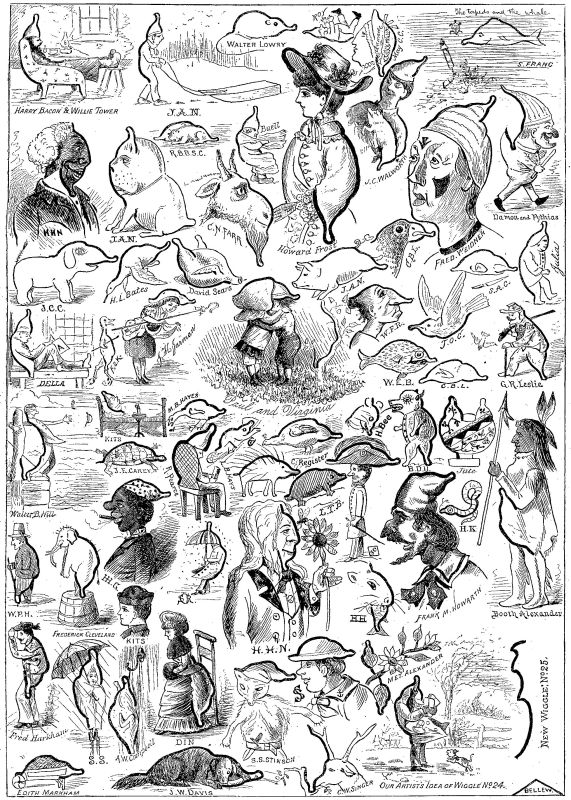
SOME ANSWERS TO WIGGLE No. 24, OUR ARTIST'S IDEA, AND NEW WIGGLE, No. 25.