THE GAVOTTE.
Reading edition
BY MRS. JOHN LILLIE.
A dear old friend of mine once showed me a fragment of manuscript music by John Sebastian Bach.
This bit of music was part of a gavotte; and as in this paper I mean to tell you Bach's story, and his special association with that quaint dance-music, I think we had better first see what the gavotte and the chaconne, the passacaille and the sarabande, mean. All of this music was popular in Bach's day.
In a French gallery there is a picture of splendidly dressed ladies and gentlemen dancing the gavotte. They wear the costume of the latter part of the seventeenth century. They have smiling faces, nourish large fans, and wear high-heeled slippers, which they lift gracefully; for the gavotte was a very brilliant dance in its movement.
The name came from a people in Dauphiny, known as Gavots. They danced it more wildly than the stately people of Louis's court; but the music of every gavotte seems to me to be best suited to them. One can fancy them on their village green clattering away to the quaint gay music, flinging their arms about, or beating time with their hands. But when the gavotte was introduced into the upper classes, and with it various other dances of the people, it became more refined, dignified, even more serious.
Bach wrote many gavottes, some singly, some in what are called suites, or sets of short pieces of music. Just now all who can play well at all are interested in this dance-music of the eighteenth century. It holds its own perhaps as much from the fact that its form is very generally classic as from its charming melodies.
It is always well, even for beginners, to understand the principle on which any kind of music is written. You will find your practicing much more interesting if you look deeper than the mere sounds. Suppose we take some simple gavotte, and examine into the way it is written. Here, for instance, is the first strain in one of Bach's most popular gavottes:
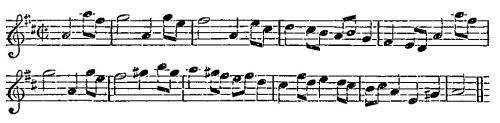
Now let us see what the few rules created for its composition are. They are these:
It must be in common time, which really means equal time, two or four beats to the bar, although the term is generally applied to that of four crotchets to the bar, marked by the Italian C.
The movement is rather quick, and it is generally in two parts. These parts are, in accordance with a custom peculiar to old dances, repeated.
Originally the gavotte consisted of four bars in the first part and eight bars in the second; but if the gavotte is only one of various parts of a suite, no fixed number of bars is given. Now, as a general rule, the gavotte begins on the third beat of the bar, so that you will see, if you calculate, that each part must finish with a half-bar containing a minim, not two crotchets.
I know that to many of my young readers this may sound very dull and useless; but if you will only give a little careful study to a few rules which apply to your first "pieces," lessons in real harmony and thorough-bass will seem much more interesting to you later on. The chaconne and the passacaille, the passaglia and the sarabande, are all dances of about the same period as the gavotte, and have certain governing principles. The chaconne is slow, and is usually written in the major key. This is always a semitone greater than the minor.
The passacaille is written in the minor key. What is called the theme[1] in the chaconne is invariably in the bass; in the passacaille it may be in any part. The passacaille has a very curious kind of interest, since in the last century composers made use of it to show their skill—what is known as contrapuntal skill. It must consist of a short theme of two, four, or eight bars. Bach, Frescobaldi, and Handel all wrote famous passacailles.
The sarabande is more stately in its movement. It was a popular dance in the sixteenth century, and some say it was introduced then by a famous dancer called Varatanda. I think that it might often have formed part of very picturesque scenes in the sixteenth and seventeenth centuries, when people were full of a certain kind of poetry, and enjoyed whatever was splendid and stately. Sometimes dancers were hired to perform it; sometimes ladies and gentlemen of quality danced it for their sovereign.
Old songs are full of references to sarabandes as being danced at times when sadness or even deep regret filled the minds of the performers; so that we may picture it as a slow, pathetic movement, with melancholy and sweetness in its train.
And from these dances of olden time we come to a great name—to the story of a great man who wrote, amidst hundreds of finer things, the most exquisite gavottes, chaconnes, and passacailles that we know. I mean John Sebastian Bach.
In a certain part of Germany lived the Bach family, famous for generations for their musical ability. Finally we hear of one of them living in the quaint town of Eisenach, and having a little son named John Sebastian, who from his tiniest years glowed with musical fire. All the genius of that family seemed to have taken root in him, yet when his father died, his elder brother, with whom the boy lived, seemed to think it better for him not to study.
Well, little John Sebastian craved music. I fancy the house in Eisenach in the year 1695 was very dull. German children then as now were kept very strictly, and when the elder brother forbade music to the little boy, he did not know the pain he was inflicting.
YOUNG BACH COPYING MUSIC BY MOONLIGHT.
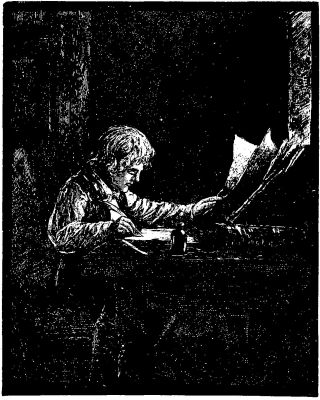
In the old house John Sebastian well knew that there was a rare old book of manuscript music, and this he longed to copy. It was hidden, locked away in a cupboard; but the door had a lattice-work panel in it, and so the child watched his opportunity, climbed up, and pulled the book through the lattice. But even then it was hard to know how to copy the music, since candles or lights were refused him. So he waited for moonlight nights, and on every one worked hard in his window, finally succeeding in copying the entire book. I have often thought of the picture of the dear little German boy working away in his old-fashioned room, the moonlight tenderly bathing his head and eager fingers, and the manuscript page on which he worked. How little he knew that two hundred years later all music-loving nations would reverence his name.
How he worked on with many trials, the usual ups and downs of an earnest life, I can only tell you briefly, but employment and leisure in which to compose came to him quite young in life, and he had the happiest kind of a domestic circle.
Bach was twice married, and his children inherited enough of his musical ability to make it a pleasure for him to instruct them. The young Prince of Anhalt-Cothen loved him so dearly that he could scarcely bear to be separated from him, and later he was given an important position at Leipsic.
One grief clouded his later years. From overwork in copying and writing music he became quite blind—a calamity which all his dear friends felt deeply. In 1750 he died suddenly.
Now in Bach's lifetime great progress had been made in piano-forte music. Among other things, he invented a new style of fingering. In Bach's day the thumb and little finger were rarely used. This he changed entirely, and our present ideas are due to his influence.
When I spoke of him as the composer of famous gavottes it was only because that form of composition is one which is peculiarly adapted to young students, which is now newly popular, and which he wrote with wonderful grace. But Bach, as you may hear later, filled the world with many grander sounds. They come in solemn majesty in his famous Passion Music. They come, filling the air with sweetness, in his many preludes and symphonies. They are in concertos and sonatas. Bach worked with his heart full of exaltation. About him was the court of Frederick the Great, of George II. in England. Piano-making was beginning to be a studied question. People saw the need of good music at home as well as in public. Bach passed through those years when piano-forte music was, you might say, on trial, well knowing what it might one day be.
Peace and gentleness were always about him. He was a kindly, keen, busy man, full of generosity and goodness, and he lived and died believing in the future of his art.