PINKETY WINK.
Reading edition
Miss Pinkety Wink she had eyes that would blink, And small feet that turned out at the toes; She had neat little hands, hair braided in bands, And her cheeks they were red as a rose, And she always was dressed in fine clothes. Miss Pinkety Wink, I am sure you will think, Was a very nice Dolly indeed; She was pretty and still, and she never got ill, For the doctor there never was need; To her mistress she always gave heed. But Pinkety Wink (I'm afraid you will sink When I tell you how sad was her fate), For an airing gone out, and while riding about In her fine little carriage in state, It turned over, oh, sad to relate! Poor Pinkety Wink, with her eyes that would blink, From her shoulders had dropped off her head! Little Carrie, she cried, while vainly she tried Her dear Dolly to mend; then she said, "I'm afraid my sweet Pinkey is dead!" Now what do you think? Well, Pinkety Wink She carried right straight to mamma, Who melted some glue, and made her quite new; And now Carrie is laughing, "Ha! ha! Was there ever so nice a mamma?"
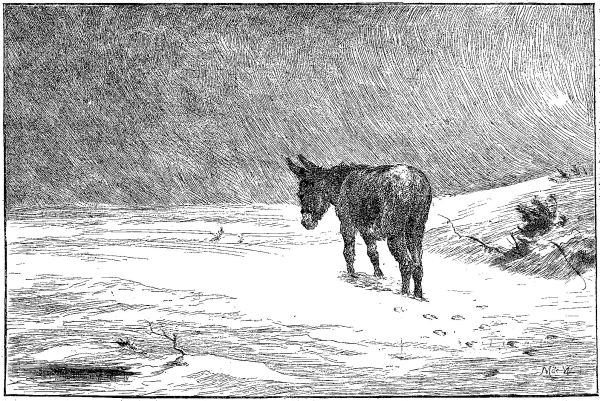
HOMELESS.
Last week we had Valentine's Day, and this week brings us a holiday of a different kind. Americans celebrate Washington's Birthday because that great and good man was our leader in the war for our separate existence as a nation. Many of you study the history of your country at school, and so you have learned that George Washington was born February 22, 1732. His father died when he was only eleven, but he had a good mother, and he early learned to honor her in all things. We have not room to tell you much about Washington's boyhood, but one thing we will say, because you little folks who are going to school may imitate George in this particular: his copy-books were always as neat and clean as possible, and are models of beautiful writing. You see, he was conscientious in little things. Now if you want to refresh your memories about the French and Indian War, the Revolution, and the early days of our Independence, you can not do better than to begin reading those portions of our history in the week that brings Washington's Birthday.
Brooklyn, New York.
I have three pet cats, but Mr. Tibbs is the wisest. One morning it was so cold there was ice on the window so that you could not see out, and Tibbie is very fond of looking out of the window; so, as he could not see, he took his tongue and licked a place big enough for him to look out. It was so cunning. He is a very high jumper. Every meal-time all the cats come around Mr. Tibbs, and then he cries for all of them. He is very large, and weighs sixteen pounds.
I go to school, and learn music, and I am very fond of it. When I grow older, I am going to take singing lessons and lessons on the organ. I also have my dolls. I have a large French doll, which has everything like a little girl. Then my baby is very sweet, with big brown eyes and golden curls. My French doll has blue eyes, and dark brown hair, like myself; I also have brown eyes. I have been a constant reader of your paper ever since it was published. I have a dear little turtle which is as large as a quarter of a dollar, but he sleeps all the time now.
Nettie M. T.
Washington, D. C.
I am a little girl just nine years old, and I am the only girl my papa and mamma have got, and the only grand-girl my two grandpapas and one grandmamma has, too, but I tell you he has lots of grand-boys, though.
I have four little brothers, all younger than I am, and once we had some cows, and Harvie—that's one of my brothers, who is eight—came running into the house, and told our nurse, Buty, he was "afraid to go out into the yard where the married cow was"—he meant the one that had the calf. Everybody laughed so much when mamma told them, and I have read some things not any funnier than that, so I thought it would be a nice thing to put in my letter to you. Harvie says I must put how old he was then, because you all might think he did it when he was eight. He was nearly four when he was frightened so badly. My aunts in Virginia take Harper's Young People for us, and Harvie, Lewis, and I like it ever so much. Lewis is just five, and wears pants, too. Maurice sits up and looks as though he knew what mamma was reading; but he don't, though. Isn't this a long one? I did not write it all the same day. If you can, I wish you would please copy this in the paper you send Harvie, Lewis, and me. I don't see many letters from Washington. Harvie says he just bets you won't.
Serena Helen S.
Oh, Harvie boy, you shouldn't bet, especially when you bet so foolishly. Rena's letter is "copied" right here by the types, and now we shall be expecting, one of these days, another letter from Rena's brother.
Keokuk, Iowa.
I am a little girl almost six years and a half old. I think Young People is the nicest paper published. Papa and auntie have read every number to me since the first. My dear mamma is in heaven, and I live at grandpa's with my auntie. Papa comes to see me three times a day, and every Friday he stays all night with me. Young People comes that night, and papa reads it to me. I think Jimmy Brown's stories are so funny. I liked "Lady Rags" so much! Then I thought I would try and help the poor, too. The Christmas number was very nice! After I read my paper I send it out to my grandma in the country; they have no little children there, but they like it ever so much. I have the nicest play-house; it is built out in the yard, is furnished like a big house, and will hold six or eight grown people. I have so many dolls that I can not tell you all about them. Yesterday I felt so badly! I took my newest doll out to walk; it was a gentleman, and I called it Frank, after my papa. I let it fall, and broke its head all to pieces. But papa got me another right away, just like the first. I have a kitty named after Toby Tyler. I do not go to school, but I study at home. I can spell very well, and print, but can not write yet, so my auntie is writing this for me. We read all the letters in Young People, and like them very much. I sometimes see the names of those who send money for the Young People's Cot; if I knew how to send it, I would send some also. I am getting a collection of picture cards. I have over four hundred now. Will you please publish this, for I have never seen a letter from Keokuk.
Lulu W.
We are glad you have a kind auntie and a dear loving father and grandma, since God has taken your mamma to live in the home above. About sending money to Young People's Cot, it is very simple. You need merely write a little letter, inclose your money, and address it to Miss E. Augusta Fanshawe, 43 New Street, New York city. This lady is Treasurer of the Cot Fund, and she will duly acknowledge all the money received by her, whether the amount be large or small.
How nice it was that your papa was able to buy a new head for his namesake so soon! Now if we should fall and break our heads, we could not get new ones so easily.
Charlotte, North Carolina.
I have a black-and-tan dog; his name is Bismarck—for short, Bis. I think he is beautiful—short, stubby, bandy-legged, and very fat, and wobbles when he runs. Papa got him for a pure-blooded rat terrier, but I do not think him very pure. Will B. and Willie S. caught a mouse and put it in a dry-goods box, and put Bis in with the mouse. The mouse ran all over Bis, and Bis would not touch it. So one held Bis's mouth open, and the other caught the mouse with the tongs and put it into Bis's mouth. Bis caught the mouse in his teeth, but was careful not to hurt it. It is dinner-time now, and I will close my letter.
Ned L.
Custer City, Pennsylvania.
I am a little boy seven years old. Papa reads the stories to us. We want the man to write about Toby Tyler some more; and Jimmy Brown is the "boss" boy.
There are lots of wells here, with deep holes and high derricks. They get oil out of the holes, and send it to the 'finery, and they make it into 'finery oil for the stores, and they sell it to the people to burn in lamps. They get thick par'fine out of the wells too, and the men come with pails and kegs, and sell it to the factory, and they make candy and chewing-gum out of it for stores to sell to boys and girls. I am tired. That's all.
Joe A. V.
P.S.—I can't spell good, 'cause I've been sick 'bout four weeks.
Joe.
New York City.
Papa has given my brother and me Harper's Young People, both years, bound, but this year we are taking it by the week, because we thought we would have more time to read it, and we could make out the Wiggles. I have four brothers, all older than myself. We have a very large black Newfoundland dog called Carlo, and a white setter called Bob. We have a gray cat, and a cunning little black kitten, which papa called Janauschek, after the actress. This is the first letter I have ever written to any paper, and I hope you will print it.
Agnes R. L.
Booneville, California.
I am eleven years old, and live in the mountains in California, among the big redwood trees. I have a doll that shuts her eyes and opens them again. We have twenty-six geese and a lot of sheep—but they are dying now—and a pet lamb. To-morrow father and brother Simon go out in the mountains to get two wild hogs that Bob Bawles killed for us to-day. I have five sisters and three brothers.
Sarah A. R.
San Antonio, Texas.
Dear "Young People,"—Mamma gave us a year's subscription to your dear self for a birthday present, and when that expired, renewed it for a Christmas present. There are four of us boys, and our great favorite of all the papers we read, or get mamma to read to us, is Young People. We love Mr. Otis, and feel well acquainted with him and the dear Postmistress, and our little friends' letters are such pleasure to us! We copy them very often. We send you a small bouquet of violets in a box, and hope you will get them; they will be mailed with this letter. We have violets, pinks, roses, and tuberoses almost all winter. We would have sent some long ago, but mamma was too ill for us to think of anything pleasant. Our climate is so very mild that flowers, even geraniums, begonias, ice-plant, etc., grow out of doors all winter. Sometimes a frost comes and kills a few, but not often. Dear Young People, we all love you so! and when we go to New York we will call to see you. Grandpapa has been a subscriber to Harper's Monthly ever since it was first published. Mr. Nic Tengg, the bookseller here, ordered Young People for mamma, as we get all our papers through him. We will soon send something for Young People's Cot.
We can all swim, even four-year-old Edward, and ride our pony, and three of us can drive mamma's buggy all over town. We take lessons on the piano, and can sing several songs.
Your loving little admirers,
George C. F. Joseph F. F. Sterling I. F. Edward F.
"What can be in this little box, so soft, yet so bulky, and oh! so sweet?" we said, when, the other day, a box came to our office. Opening it, dear boys, there were your violets, wrapped so nicely in the wet cotton that they, were still blue and beautiful. It took us quite a little while to discover who were the kind donors, for your letter was one of a great many which came to our Post-office Box that day. But when we did find out, we stopped writing and reading long enough to waft a kiss all the way to San Antonio. How nice it is for you to be able to ride, drive, and swim, as well as to sing and play! Each of these accomplishments will have its use, and give you pleasure all your lives. We are glad your dear mother is better, and if you come to New York, we will be much pleased to see you.
Stamford, Connecticut.
We have two little guinea-pigs, an old cat named Tomas, and four little bantams. I drive the old rooster all about the yard, harnessed to a little wagon. We have a nice horse named Saxon, which eats sugar. The little guinea-pigs drink coffee and eat brown paper. I am a little boy nine years old.
Willie R. D.
It must be fun to drive a rooster in harness, and the little wagon must look "cute." Did you begin when he was a little chick? Are you not afraid the guinea-pigs will have "nerves" if you give them coffee?
I haven't any pets to tell about, but I have six dolls. I live in Philadelphia all winter, but in the spring I go to Mayville, on Chautauqua Lake, near the Sunday-school Assembly Grounds. I go there a great many times, and I think it is very nice.
I have a horse of my own in Mayville. Her name is Daisy. I ride horseback on her. Once she threw me, and nearly broke my arm. It was bruised so I couldn't use it for a week.
I am beginning to get together a cabinet of curiosities. I will exchange a 25 and 50 cent stamp from Germany, a 2 and 5 cent from Finland, and 15 and 25 cent from France, and some silk cocoons and spun silk, for ore; shells, minerals, or anything fit for a cabinet.
Lodie Tourgee, 303 S. 11th St., Philadelphia, Penn.
deer Mister Harper,—my Pa tok yor paper for me. i be much plaes wid it. i tink "Torkin laves" is very inrestin. i got a cro an I named um Toosulom out ob de book. i cotched a Rabet an de way he did run! you ought to se um blink whin I put um in de kage. Put dis note in de paper kos I want to se how it looks.
Jacop Washington J.
Did you mean to be as funny as you could, young gentleman? We fancy it took not a little trouble to get up that bad spelling, and to put instead of capital I's those modest little i's. After all, it does not look so nicely as the letter you are going to write us next week, with every word spelled correctly, and all the capitals and stops in the right places, as prim as young ladies at a party. When you send that letter, please remember to write your address plainly in the upper right-hand corner.
Meadville, Pennsylvania.
I have been a sick boy. But as I am now much better, I hope to be well again soon.
I have asked my mamma to write for me. Mamma reads a great deal to us, and we have Harper's Young People and St. Nicholas.
We have them bound at the end of the year, and we think the two volumes of Harper's Young People the very nicest books we have. I have two sisters and one brother, and we have several pets—a white pony, a canary-bird, a black cat, and some mice.
Mamma read to us about having mice for pets in one of Harper's Young People, and I thought I would try to have some. I made a cage out of a starch box; on one side I fastened a large baking-powder can, and I put some cotton in that. I put wire netting over the front, and then I tried to catch the mice.
When I caught one, I put it in the cage, and after a few days he looked lonely, and seemed to have grown thin, so I caught another and put him in, and now they are fat, and seem very happy.
They keep pretty still all day in the dark, but at night come out in the box, and eat and nibble just enough to keep their teeth sharp, I guess.
They are cunning little creatures, and I think very nice for pets, and perhaps if you should publish this letter some other little folks would like to try the same plan.
We always enjoy the stories in Young People, but we liked "Toby Tyler" best of all.
Louis de V. M.
Omaha, Nebraska.
My little sister and I take Harper's Young People. She is nine, and I am twelve. My brother has a cat nine years old. He is gray, and striped with black. My aunt has a Maltese cat twenty-seven years old. I go to the Central School, and I am in the sixth class. There is a parlor game called capping rhymes. One person gives two or three lines of some piece of poetry, and some other person takes two or three lines of another piece, the first word beginning with the first letter of the last word of the preceding person's verse.
Blanche A.
An easier way to play at rhymes is this: I begin, for instance, by saying:
"The moon came up in the clear night sky."
Sarah follows, making a line to rhyme with mine, thus,
"As round and full as an apple-pie."
Tom's turn is next, and he says,
"Some people think it is made of cheese."
And then Theodore takes it up with,
"But that is silly, as any one sees."
Bartle, Indiana.
I am a little boy ten years old. We live in the country, on the Knobs. It is very high land; my pa says it is a thousand feet above the level of the sea. We have lots of fruit trees, mostly peaches. I have lots of peaches to eat in summer. I know a word longer than the one sent by L. L. H., of Orange, New Jersey. It is A-ber-con-way-co-pen-ha-gen-nic-o-de-mus-an-a-bap-tist-dal-a-mu-tha-o-ba-di-ah. My pa learned this word when he went to school.
Frank C. P.
Exchangers will please address Alice C. Little, formerly of Institution for the Blind, Janesville, Wisconsin, at Oberlin, Ohio.
A Word to Exchangers.—Do not write with pale ink, green ink, blue ink, yellow ink, red ink, or brown ink. Do not write with a lead-pencil. Write very plainly, please, with black ink, on white paper or on a postal card. Before beginning to write, think over what you have to offer, and state it as briefly as possible. We can not make room for any exchange which covers four pages of note-paper. Observe our standing notice, and always communicate by mail with the boys and girls with whom you desire to exchange before sending away your own treasures. Remember that letters which are not fully prepaid will probably go to the Dead-letter Office, and in sending heavy articles, take pains to have them weighed, and put on a sufficient number of postage stamps.
C. Y. P. R. U.
Lucy wants to know something about the agate. She has a very pretty one set as a breastpin, and her brother prizes agates as among the most valuable things which he collects and exchanges. They have an interesting history.
Agates are composed of layers of quartz, generally of different varieties, intimately joined together, and are found of all colors, sometimes exceedingly vivid. In modern mineralogy this stone is an impure variety of chalcedony, which derives its name from Chalcedon, that once famous city of Bithynia, in Asia Minor. The rocks near this place, which is not far from the present Scutari, contain this stone in considerable quantities. Chalcedony consists of silica and alumina, and comprises besides agate, heliotrope, onyx, plasma, and sard, differently colored by metallic oxides. It is found in grape-like masses, but more frequently in rolled pebbles. The finest Oriental chalcedony presents in its interior a fine mottled appearance.
The first engraved gem that Pliny mentions is an agate that belonged to Pyrrhus, King of Epirus. This was in the first half of the third century before Christ. The same monarch is said to have had in his possession an agate on which were figured the nine Muses, and Apollo holding a lyre; the work not of an engraver, but of Nature herself! The veins in the stone were said to be arranged so naturally that each of the Muses had her particular attribute.
At a late period, and even in the Middle Ages, it was a popular belief that the engraved gems found in digging the ground of ancient sites were natural objects, and that the representations on them were a mere natural indication of the special power or quality each possessed.
Busts and heads in full and bass relief were executed by the Romans on chalcedony in the grandest style; the finest specimens of these that we possess are the Marlborough "Medusa," and the bust of "Matidia," supported on a peacock, and three inches high. The chalcedony was supposed to cure lunatics, and make them "amiable and merry."
The agate was an object of the most fanciful delusions to the ancients. Orpheus says, "If thou wearest a piece of the tree-agate on thy hand, the immortal gods shall be pleased with thee; if the same be tied to the horns of thy oxen when ploughing, or round the ploughman's sturdy arm, wheat-crowned Ceres shall descend from heaven with full lap upon thy furrows." He adds that every kind is an antidote to the asp's bite, if taken in wine.
By burning the agate it was believed that storms would be averted, the proof of their efficacy being that if thrown into a caldron of boiling water they immediately cooled it; but in order to do good, they must be strung on the hair of a lion's mane. The stone, colored like a hyena's skin, was believed to be the cause of domestic strife, and was viewed with horror.
What do you think of the wardrobe of Queen Elizabeth, girls? It must have been about the most varied and extensive ever recorded in royal annals, to judge from a list of her wearing apparel recently gathered from the State papers. When the Maiden Queen was sixty-eight, and might therefore have been supposed to have outlived some of her youthful vanity, she possessed 99 complete official costumes, 102 French gowns, 100 robes with trains and 67 without, 126 antique dresses, 136 bodices, and 125 tunics, not to mention such trifles as 96 mantles, 85 dressing-gowns, and 27 fans. With all these dresses, however, it is curious to note that Queen Bess owned only nine pairs of shoes. When she died, in 1603, three thousand articles of apparel were found in her wardrobes, duly catalogued.
"A Germantown Girl."—Thanks for your cordial indorsement of the article on cigarette smoking in No. 117. We hope you will ask the boys of your acquaintance to read it, and we are sure that you and your girl friends will do much to put an end to the bad habit in your set if your young gentlemen friends know that you disapprove of it.
Among the thousands of young people who read this paper there must be some who suffer from timidity or bashfulness. The Postmistress wishes all such to read the following quotation from an address made to children at a recent service in Westminster Abbey by Dr. Bradley, the successor of Dean Stanley, of whom you all have heard:
"Dean Stanley was, as I said, a man whom not only children, but all persons, rejoiced to meet, because, as an American whose name is known all over Europe said, at a great meeting held close by the other day, 'he was so pleasant'; simple words, but very true. Yet, strange to say, he was in his childhood and boyhood so shy and timid that his mother and his father—who, besides being a very good man, could tell stories all day about birds and insects and country life, and could draw children after him as a magnet draws the needle—were alarmed about him. They could not teach him to enjoy games like other children; and though he was not unhappy at school, they were much distressed because they could not get him to speak a word or seem happy in company. He seemed not to like—some of you, perhaps, know the feeling—to notice anything, or to be noticed when others were by him that he did not know quite well. He cured himself of this so completely that if it were not for the many letters describing him as he was then, no one would now believe this about him. How did he do so? By always trying to instruct himself about other things, and to interest himself about other people.
"It was not merely because he was so clever, and wrote such good poetry, that boys christened the corner where his little study was 'Poet's Corner,' that the Rugby boys were so fond of him, but because he was so affectionate, pure-minded, warm-hearted, and kind; and years afterward we young men, as we were at Oxford, learned to love him as our tutor, not because he was becoming famous in the land, but because he cared so much about us, and was always ready with a kind word and act, and we thought him so good. If any of the children to whom I am speaking suffer very much now, as boys and girls often do, in a way their elders never know of, from this same shyness and timidity, let them learn from the story of Dean Stanley the best way to cure themselves, and be of good cheer."
The members of the C. Y. P. R. U. will find in this number an interesting article, by Mrs. John Lillie, entitled "The Gavotte," giving a description of this picturesque old dance, together with a sketch of the boy life of the famous musician John Sebastian Bach. Our boy readers will be interested in the description of "Mr. Barnum's Show in Winter-Quarters," some of them may be inclined to try the Indian game of "Tchungkee," and others may like to busy themselves in the construction of "A Novel Chair-Sleigh." The girls will be interested in the story of "The Milkmaids of Dort."
PUZZLES FROM YOUNG CONTRIBUTORS.
No. 1.
DIAMOND.
1. A letter. 2. To descry. 3. A vulgar woman. 4. One of the United States. 5. A place where watches are manufactured. 6. A loud noise. 7. A letter.
Bob.
No. 2.
FOUR EASY WORD SQUARES.
1.—1. Low, wet ground. 2. Part of a circus. 3. Kingly. 4. An animal. 5. Parts of a building.
Jimmy Brown.
2.—1. A present. 2. Unemployed. 3. To run away. 4. A bird.
3.—1. Pulverized grain. 2. A name. 3. An exclamation. 4. Final.
Nelson M.
4.—1. A number. 2. A metal. 3. Empty. 4. Extremes.
Captain Kidd.
No. 3.
ENIGMA.
My first in heart as well as hand.
My second figures in the land.
My third appears in every plain.
My fourth is found in every train.
My fifth in hope, but not in fear.
My sixth in sound, but not in hear.
My seventh rides in every drive.
My eighth's in all, and in alive.
My ninth's in crown, but not in ring.
My tenth's a favorite with the king.
My eleventh may be seen in sail.
Also in storm, though not in gale.
My whole's a well-known mountain chain
That's girdled round by grove and plain.
Poets have added to my fame,
And Cooper often wrote my name.
Dollie.
ANSWERS TO PUZZLES IN No. 118.
No. 1.
PP
InvadeR
LO
GG
RefineR
IE
MS
SpongeS
BB
YU
JaveliN
OY
HA
NankeeN
Pilgrim's Progress, by John Bunyan.
No. 2.
LuteJarsGate
AnneAlpsRoof
DimeNoonElms
YoreEaseYear
Lady Jane Grey.
No. 3.
MOTHOGRE
OLIOGREW
TIPSREDE
HOSEEWER
No. 4.
Snow-storm. Whittier.
No. 5.
Tongue-tied. Cap-a-pie. Blackboard.
No. 6.
WHEATTRASH
HEATRASH
EATASH
ATSH
TH
Answer to Enigma on page 240—Courtship.
Correct answers to puzzles have been received from "Helen of Troy," Ludwdg L. Dessoir, "Commodore Nutt," Ella Price, "Fanchon," Gustave D. Mott, Georgie Wardell, Edith Abbey, Mary Hathaway, M. F. Tomes, H. L. Pruyn.
[For Exchanges, see 2d and 3d pages of cover.]
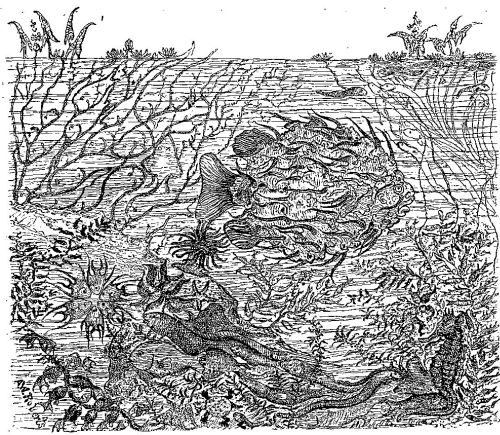
A QUEER AQUARIUM.