RUTH'S OPPORTUNITY.
Reading edition
BY BELLE WILLIAMS.
brighter morning never dawned on the little township of Greenville than that of a certain day in the summer of '81. The sun rose with a fierce glare, boding intense heat before night-fall. Every ray seemed like a fiery dart sent down to destroy the few lingering traces of verdure, for rain had not fallen in weeks, and plants and animals were alike consumed with thirst.
The sun had wide range for havoc on Mr. Leonard's farm, and it blazed relentlessly down upon his well-tilled acres, upon his roomy barns and stables, which sheltered the panting cattle, and upon a little "root-house," used as a storage for winter vegetables, that stood half underground and covered with earth. But on this retreat the tyrant cast his beams in vain. The shadowy room within was delightfully cool, and there in the doorway lay little Scott, the five-year-old baby of the household, with his chin resting on two chubby palms, his elbows planted in the damp earth, and heels beating the air, intently watching a swarm of ants. The old root-house had been a favorite haunt of the little fellow during the hot, sultry days of summer, for it was so near the kitchen that he never felt lonely there.
"Breakfast 'most ready, Ruthie?" he called out, still surveying the interesting ant colony.
"Almost, little man," said sister Ruth, appearing at the porch door to see what the small lord was about.
Ruth Leonard made a charming picture as she stood there shading her eyes with her hand, framed in by a clustering mass of honeysuckle vines. Yet no one called her a pretty girl. Though only sixteen, she was very tall and strong for her age; every well-formed limb indicated the possession of muscular strength, and her broad shoulders seemed just fitted to bear burdens. Her thick brown hair was brushed plainly back from a low forehead and braided, but the braid was oftener coiled up in a loose knot to "get it out of the way." Not a suspicion of a curl was to be seen, for Ruth always forgot to "put up her hair," and Nature had evidently intended it to hang straight. A pair of keen gray eyes that often grew dark with unsatisfied longing, yet hid in their depths a world of conscious power, a straight nose, and full red lips, complete the picture—a picture which had become to father and mother as their daily bread.
Ruth turned away smiling, and went on with her work of setting the table. Suddenly a shrill voice echoed through the room. "Hi, Betty! ho, Betty! it's all in m'eye!" came with piercing distinctness from the open doorway, accompanied by scuffling as of a brigade of robbers, and boisterous Hal presented himself.
"Now, Hal—" began Ruth.
"Now, grandmother," reiterated Hal, striking an attitude, "don't reel off more than a yard of lecture before breakfast."
"Henry, behave," commanded a stern voice from the other side of the room, which caused a noticeable decline in Hal's spirits.
There stood Mr. Leonard, having just come down-stairs unnoticed by the young scapegrace. He held little Lou by the hand, a delicate, sensitive child, older than Hal, though scarcely taller than her sturdy brother.
"Here come the provisions," remarked Hal, as Ruth brought in a smoking omelet from the kitchen.
"Go call Scott," said his father; which, cruel mandate obliged the young gentleman to remove his admiring gaze from the repast.
"Ay, ay, sir," he responded, and in a few minutes he reappeared with Scott, who was very red in the face, and howling most frantically. Hal had the little fellow's skirts gathered tightly in one hand, while with the other he firmly grasped the neck of his dress, just as he had picked him up from the ground, "making him walk Spanish," as he termed it.
The family gathered around the table, and Mr. Leonard asked a blessing on the food in a sad, pleading voice. For several minutes the children seemed awed into silence. At length Ruth broke the stillness.
"Did you see the doctor again last night, father?"
"Yes, daughter."
"What did he say?" she eagerly asked.
Mr. Leonard could not at once trust himself to speak, but after a moment he replied, in a husky voice, "The doctor says your mother will never walk again."
The quick tears sprang to the girl's eyes as she thought of the dear little Quaker mother upstairs, lying so patiently on her bed of suffering, who only a year ago, before that terrible fall which hurt her back, had been well and happy.
Lou began to sob outright, and great-hearted Hal again brushed his coat sleeve over his face, but this time to wipe away the tears.
"Does mother know it?" asked Ruth.
"Yes."
"How does she feel about it?"
"Cheerful as ever," replied Mr. Leonard. "She never thinks of complaining, but only of comforting us."
The children brightened up a little at these words, for their blithe spirits refused to be long downcast, especially when they felt sure of seeing the same bright, loving mother unchanged—all except Ruth; her sober face too well expressed her thoughts.
"Oh, father," broke in Hal, presently, "Jake Murphy says the fire has caught over at Liberty."
"Yes," replied his father, absently, "they are having a desperate struggle with the fires this summer."
Lou's great blue eyes had grown brighter and brighter while they were talking, and a pink spot glowed in each cheek as she asked, "Do you think it could get here?"
"No, I think not; the wind is decidedly westward, and the people of Liberty will probably take all possible measures for checking its progress."
Mr. Leonard sighed as he spoke, and he seemed to be looking straight through Ruth rather than at her. Perhaps he was wondering how the four bairns and the sick wife were to be fed and cared for all winter if no rain came to save his failing crops.
Just then a low call was heard for Lou.
"Yes, ma'am," answered the little girl, running to the foot of the stairs.
"Will thee bring mother a nice glass of cold water?"
"I will, mother," rang out Ruth's cheery voice; "I'm coming up anyway."
Ruth went out to the well with her tin water pail, that her mother might have a draught fresh and sparkling. As she lowered the bucket, peering down into the mossy depths, she noticed how low the water was—lower than she had ever seen it, for their well was never known to fail, and in these times of drought the neighbors from far and near drew their daily supply from Farmer Leonard's spring. "We'll have to be very careful of it," she thought, "or it will give out."
Ruth returned to the house with her cool refreshment, and taking one of the best goblets from the pantry, gave an extra polish with a fresh towel, and filled it with the water, "because it would taste so much better out of that."
"I thank thee, deary. How good it looks!" said the invalid, drinking eagerly. "Thee takes a deal of trouble for thy mother."
"And why shouldn't I? Thee is the best of mothers," responded the girl, tenderly hugging her.
Ruth now began to busy herself about the room. She wheeled out a big arm-chair by the window, padded it out with pillows into comfortable proportions, placed in front of it a little stuffed cricket, and threw a large soft shawl over the whole arrangement. She then gathered up all the stray dishes, placed everything in order, and carefully dusted the room.
A pair of loving eyes watched these operations, following every motion; but not a word was spoken, not a word of the doctor's decision, not a word of the life-long suffering in store.
"Now, mother," said Ruth at last, pausing in front of her, "we'll have thee up in a twinkling;" and with one strong motion she quickly lifted the slender form, so light in its best days, and so reduced by pain and suffering now, into the chair.
When she had settled her comfortably, and arranged the blinds so as to make a pleasant shade in the room, she brought the mate to the little stuffed cricket, and sat at her mother's side.
"What is it, daughter?—what troubles thee?"
"Oh! a great many things, mother," answered Ruth, laying her head on the sympathetic breast.
"Well, suppose thee tell mother the greatest trouble, and then the second, until thy mind is unburdened?" and the soft hands gently smoothed the brown hair.
"Well, the first is about thee;" and the tears would come in spite of her.
"Why, my dear child, do not grieve over that. Almost a year has gone by, and another will soon pass; and think what a calm, peaceful time I may have with so busy a little housekeeper to do everything."
"Ah! but that is just the trouble, mother," said Ruth, earnestly, as she lifted her tear-stained face. "I feel so good-for-nothing when I have only the same homely little duties every day. I do so long for a chance to be great and good."
"My daughter"—and Mrs. Leonard took both trembling hands in her own—"does thee know that the only way to be good and great is to do faithfully the work that is nearest thy hand? Let thy whole heart be drawn into each homely duty, and when an opportunity comes to do a great work, it will find thee ready."
Ruth said nothing, but the deep, strong look in the gray eyes expressed a firm resolve.
Presently there was a clatter of stout boots heard on the stairs.
"Harry is coming," said the mother with a smile.
In burst the noisy urchin, all aglow with excitement, his hair flying, eyes blazing, and breath so nearly spent that he could hardly speak.
"Don't you smell the smoke?" he gasped. "Something's up! Father—and a crowd of men—have gone off—into the woods—to see what's the matter. There's danger, I tell you. Come on, Scott, let's sit on the big post and watch."
"Thee'd better go down and see about it," said Mrs. Leonard to Ruth, as the two sat staring blankly into each other's faces.
"I will, mother," assented Ruth, recovering her wonted energy, as she ran down the stairs.
A strong wind greeted her upon opening the outer door, blowing into her face a sickening smell of burned wood. The whole sky seemed overcast, and a thick, heavy haze was settling down upon fields and buildings as far as the eye could reach.
"Harry! Harry!" she called, excitedly, "where's father?"
"Gone to the woods, I told you. Oh, there he comes!" and Hal peered into the gloom as he looked in the direction of the woods.
Ruth saw a dark moving object coming toward them. She waited for no second look, but sped away like the wind into the nearest field.
"Oh, father, what's happened?" she cried, breathlessly, running up to him and catching his arm as she turned to keep pace with his long strides toward the house.
"We're going to burn out," he answered, with set teeth, "and there's no time to lose. Go get your mother ready to move, while I harness the horses. We must reach the lake within an hour, or—"
"How can we?" uttered Ruth, aghast. "Ten miles!"
"It must be done. Quick, daughter!"
The girl needed no further bidding, but ran homeward, calling to Hal as she passed, and charging him to keep near the house with Scott.
Ruth made straight for the store-room, and filling her arms with a pile of blankets, she carried them to the door and threw them on the ground, ready to spread in the wagon. She then hastened to her mother's room, and found her pale and composed, trying to quiet Lou, who was sobbing hysterically.
"Mother, we're gone. Not a thing can be saved. Father's getting the wagon ready to drive us to the lake;" and Ruth began to dress her mother, slipping on a loose wrapper, and covering her with shawl after shawl as a protection from the scorching air.
"Try and gather up some of the clothing, Ruth, if there's time," said Mrs. Leonard, controlling herself into calmness.
Ruth obeyed, pulled a sheet from the bed, and crowded into it such articles as were nearest at hand.
"Oh, mother!" screamed Lou, and hid her face, as a blinding smoke burst into the room enveloping the place in darkness.
"We must go," Ruth, cried, as she snatched her mother up in her arms, and stepped firmly toward the door, clasping her burden tight to her breast, and followed by Lou, clinging frantically to her skirts.
Hurriedly Ruth groped her way down the staircase and through the lower rooms, stumbling over the furniture, until they reached the scorching blast without. Upon emerging from the house a burning shower of cinders met them.
Not a sign of father or the wagon.
"Come, put your dress over your head, Lou," panted Ruth, whose hands were smarting with pain.
There was not a moment to be lost. They must flee somewhere, for the house was already ablaze. An awful yellow glare lit up the dense darkness, and on every side the crash of falling trees filled the air with a terrible din. On they rushed through the blistering heat, scarcely knowing where, Ruth still bearing her precious burden, and the children clinging to her in wild despair.
How long they pursued this headlong flight no one knew. All sense of time was lost; it might have been minutes, or it might have been hours. Suddenly Ruth lost her balance. She gave utterance to one piercing shriek, but she never let go her burden, and then she slid down, down, down. The terrified children screamed as they rolled over and over, and then all was silence and darkness.
Ruth was the first to recover.
"Mother?"
"I'm safe. The children?"
"Oh, where are we?" moaned the little ones, creeping on their hands and knees toward the familiar voices. They managed to reach the sheltering embrace of mother, who lay unhurt amid her wrappings just as she had slipped from the stanch arms that saved her life.
Ruth began to feel around; for even the ghastly light of the flames had vanished, and not an object was visible in the thick, deep gloom. Brambles and briers and low bushes upon all sides. With each turn the dry twigs and leaves crackled, and in attempting to move, the girl found her clothing caught upon thorns that projected on all sides. It was with difficulty that she managed to extricate herself, bruised and benumbed as she was, but it was necessary to explore further. The ground felt hard and clayey, and was covered with stones. Turning halfway round, Ruth found a little clear space, and creeping forward, soon came to rising ground. Catching hold of a bush, she pulled herself a little way up the slope, when an idea of their situation suddenly flashed upon her.
"Why, we're in the creek—the dry creek down by the meadow lot," she called out. "Where are you all? I've lost you."
"Here," replied her mother's voice not three yards away. "Is Scott with thee? Harry and Lou are safe."
"No," answered Ruth, aghast, hastening with all possible speed to her mother's side.
"Where is the child?" she cried, immediately calling aloud with all her strength, "Scott! Scott!"
But no answer.
"He must have hidden somewhere when the darkness came," was the mother's despairing conclusion.
"The root-house!" Ruth's words told the awful story.
"If I could save him!" And with a silent prayer for strength, she once more dashed into the stifling smoke.
Hour after hour crept by; it seemed to the terrified children as if they must have sat there for days; and they were so hungry! and Ruth never would come!
Presently, after long waiting, the darkness began to lift somewhat, and they could see each other's faces. Little by little the gloom cleared away until the whole atmosphere was of a dusky hue. And still they waited. At length, starting up with an exclamation of joy as rapid footsteps approached, they heard their father's voice.
"Ruth? Hal?"
"Here," roared Hal, starting to his feet.
In a moment more Mr. Leonard bounded down the steep bank of the creek, and with him Jake Murphy, who had started from the village to warn Mr. Leonard, reaching the farm just as that first overwhelming darkness dropped upon the village.
They had found shelter in the old well, for Mr. Leonard was overtaken in his preparations for flight, and could not reach the house before it burst into flames. When the crisis was past, almost wild with grief and despair, he commenced a search for wife and children, fearing at every step to come upon their lifeless bodies. For a moment he stood overcome with thankfulness as he found them unharmed.
But two were missing. Mrs. Leonard hurriedly told of little Scott's disappearance, and of Ruth's effort to save him.
The two men hastened to the root-house. It was still standing, though blackened and charred, and no sign of life appeared. The door was tightly closed, and upon opening it a sight met the father's eye which almost overpowered the strong man. There lay Ruth, white and still, tightly clasping the little fellow to her bosom.
It was but the work of a moment to carry them out of the dark building. Both were unconscious, though they bore few traces of the fire. Might there not yet be a chance of life?
Quickly the men bore the motionless forms to the creek. All the remedies which they could obtain were applied, but it seemed in vain; the loving ones could do little but watch and wait.
At last Ruth stirred, and slowly opened her eyes. The brave heart once more began to beat, though for many a long, weary day the blistered hands and arms refused to move. But Ruth was spared.
Little Scott lay there for hours, until it seemed that the family must lose their baby, when he wonderingly gazed around upon the anxious group, and inquired, "Did you try to cook me for dinner?"
All the pent-up feelings found vent in a tearful laugh, and then the laugh turned to joy, and the joy to thanksgiving.
When the flaming hurricane had swept onward in its mad course of destruction, and the sun, which had risen in such fierce glory, sent a last sickly glimmer through the murky air, it revealed the little village of Greenville a waste of smoking ruins. But the fire had mercifully stopped upon reaching Farmer Leonard's grassy meadow, and thus had the fugitives in the creek been saved.
The strong men set to work with a will. It took but a few hours to raise a little shed for protection; and day after day his prospects brightened, as the timely aid and sympathy of friends helped him to rebuild his ruined home.
It would have been hard to find a happier household than this reunited family. Slowly strength returned to Ruth's wounded arms, and a sweet peace shone through the gray eyes as she once more became able to enjoy the blessings which had so nearly been taken from her.
Her great opportunity had come, and it had found her ready.
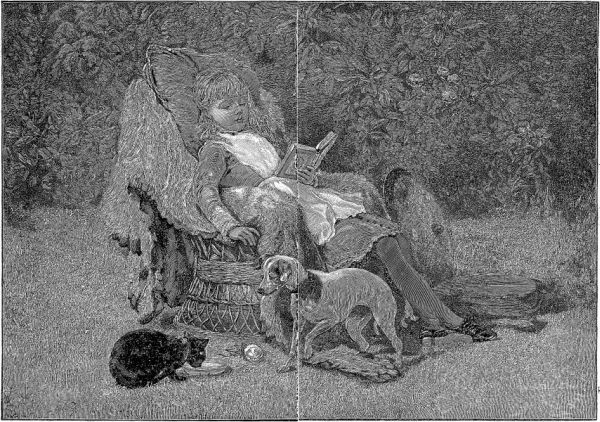
"WAIT FOR PUSSIE, FIDO!"