HISTORICAL TREES OF MEXICO.
Reading edition
BY HELEN S. CONANT.
Certain species of trees live to a very great age. There are trees in existence which are supposed to be more than a thousand years old, and many of them are intimately connected with historical events of the past. In Morat, a town in Switzerland, where in 1476 a great victory was won by the Swiss over Charles the Bold, is a famous lime-tree under which Charles and his Generals sat down to rest before the battle; and in another Swiss village a lime-tree is still standing, flourishing and green in its old age, upon whose trunk in 1530 was pasted the proclamation of the Reformation.
Many of our youthful readers will remember the account of some historical trees of the United States given in the second volume of Young People, and the interest it awakened for collecting and exchanging leaves and twigs from these noble old landmarks, and we think they will be interested to hear about two magnificent cypress-trees near the city of Mexico. The oldest trees in the world are supposed to exist in the cypress forests of Mexico. These cypresses grow to an immense height, and the trunk which supports the great crown of feathery foliage is sometimes more than one hundred feet in circumference.
When in 1519 Cortez landed on the Mexican coast, at the point where the city of Vera Cruz is now situated, he found the country populated with Indians, who received him in the most friendly manner, and very soon he was visited by two messengers, who came from a certain great King called Montezuma. They brought him rich presents, but entreated him to leave the country. Now Cortez was a man of very determined character. He had come to Mexico to make new conquests for the Emperor Charles V.; so he paid no heed to Montezuma's message, but prepared himself and his Spanish soldiery to march inland, and see the great magnificence which he was told existed at the court of this powerful King. Fearing that a portion if not all of his army might desert him, he burned his ships, and thus cut off all means of retreat.
After a long and weary march, Cortez and his men arrived at the city of Mexico, where the beautiful sight that appeared before their astonished eyes made them feel as if they had reached the gates of an enchanted realm. This capital of the great Aztec nation was built in the centre of a large lake, and was connected with the surrounding country by broad causeways. The surface of the lake was dotted with floating gardens, and in the city great towers and temples and palaces of solid masonry rose above the trees. Many of the streets were broad and well paved, others were waterways like those of Venice, and crowded with canoes that went back and forth loaded with fruit, flowers, and all kinds of merchandise.
But in the midst of this fair city was a terrible spot, where dreadful deeds were done, for which the people well deserved the punishment which soon fell upon them. It was the great Temple of the Sun, and upon its summit stood a huge hideous idol of stone, which the people worshipped, and before which they sacrificed many thousands of poor men, women, and children.
THE FAVORITE TREE OF MONTEZUMA.
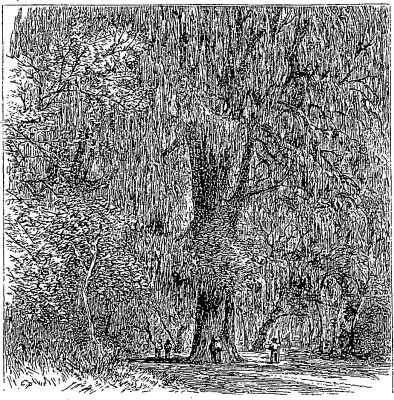
Montezuma, the great Aztec King, thought himself a very wise ruler. He had magnificent palaces and pleasure-gardens filled with flowers and noble trees. One of his favorite palaces was situated several miles from the city. It was built on a hill, and from its windows the King could overlook the beautiful valley in the centre of which stood the city, and watch the great volcano of Popocatepetl, which at that time often threw forth smoke and burning lava. At the foot of the hill, all around the palace, was a great park, in which grew many large cypress-trees. One was Montezuma's favorite tree. He had a seat built under it, and was accustomed to meet his warriors there and confer with them. That was more than three hundred and sixty years ago, but the tree still stands, strong and flourishing, and showing no signs of decay. It is thought to be one of the oldest trees in the world. On sunny afternoons little Indian boys and girls play around its enormous trunk in the shade of its broad-spreading foliage, and they will all tell you that it is Montezuma's tree under which they are playing, for it still is remembered in connection with its ancient owner. This wonderful tree has witnessed many strange events. It saw the downfall of Montezuma, and the end of the terrible human sacrifices; it was a silent witness while the Spaniards held rule over New Spain, as Mexico was for a time called; it stood safely through the great revolution of sixty years ago, when the Mexicans fought for liberty, and throwing off the Spanish yoke, founded a republic of their own. In 1847, the bullets of American soldiers whizzed through its branches, as our army, led by General Scott, stormed under it and up the hill to take the Mexican fortress built on the heights where centuries ago stood the pleasure-palace of Montezuma. During the three years' rule of the French in Mexico, from 1864 to 1867, when the republic was crushed, and Maximilian of Austria was Emperor, this old tree shadowed the pathway where Maximilian and his Empress passed on their way to their beautiful pleasure-palace, which crowned the height above as in the days of Montezuma. This hill was called Chapultepec by the ancient Aztecs, which signifies the hill of grasshoppers, and it bears the same name still.
"THE TREE OF THE NOCHE TRISTE."
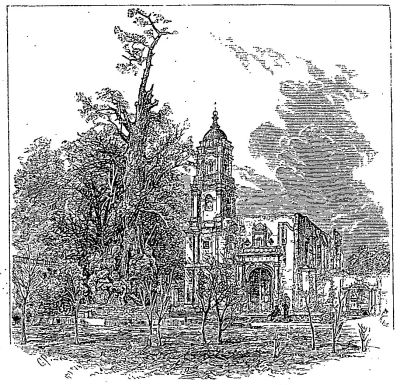
The other historical cypress-tree stands on a village green about three miles from the city of Mexico. Until nine years ago it was a noble tree, but one night a party of Indians kindled a fire which burned out the entire centre of the immense trunk, and left it only a scorched wreck of its former splendor. Many of its branches are still adorned with feathery foliage, and it is draped with hanging gray moss, similar to that which grows on many trees in the Southern United States, which gives it a venerable and hoary appearance suited to its great age. It is called "The Tree of the Noche Triste," meaning the sad night. To understand its name, we must follow the adventures of Cortez and his men after their arrival at the city of Mexico.
Montezuma, although very suspicious of these white-faced strangers who came riding on horses, which were animals unknown to the Aztecs, and bringing with them great cannon which made a noise like thunder, received them kindly, and gave splendid banquets in their honor.
But Cortez had not come to Mexico to live in luxury, but to gain possession of the country, and the horrible human sacrifices which he daily witnessed strengthened his resolution to break down the Aztec power at any cost, and to establish the government and religion of Spain. The task was difficult, for he was alone in a strange land, with only a handful of men at his command. His first attempt ended in disaster. He succeeded in seizing the person of Montezuma, the King, but the Mexicans rebelled against the rule of the Spanish soldiery. In one of the battles Montezuma was killed, which only increased the fury of the Mexicans against the strangers with white faces. After losing many of his men, Cortez finally decided to retreat from the city. It was a dark rainy night in the summer of 1520 when with the remnant of his army he passed out over one of the great causeways, closely pursued by the furious Mexicans, who fired showers of sharply pointed arrows after him. When at last he found himself in the open country, free from his enemies, who had returned to their strongholds, Cortez sat down under the great cypress-tree to rest. For the first time his heart failed him, and all alone, in the dark stormy night, the stern warrior shed bitter tears. And to this day the tree preserves the memory of that sad hour in the name by which it is known.
The determination of Cortez to conquer Mexico became stronger than ever after this bitter defeat. He immediately set to work to re-enforce his army by making friends with tribes who had suffered oppression from the powerful Aztecs. Fresh troops also arrived from Spain, and in a year after the sad night, Cortez saw conquered Mexico at his feet, and its great cities in the hands of Spanish soldiers. The temples stained with the blood of so many unfortunate victims were overthrown, and in their places churches were built, with towers bearing the sign of the cross. Idolatry and human sacrifice on Mexican soil were ended forever.
FEEDING HIS PETS.