HOW TO MAKE A TOY CANOE.
Reading edition
BY C. W. FISHER.
The building of a birch-bark canoe of sufficient size and well enough made for actual use would rather tax the mechanical skill of most boys; but with no better tool than a jackknife, and with a little ingenuity, a small model may be easily made.
There are few localities where the material—the white birch—can not be obtained. The dimensions given here are those of one which hangs above us as we write, and are only given to make the explanations clearer. Of course it can be built of any size, and the young builder may make such other changes in its construction as taste or necessity may suggest.
A tree not more than eight inches through furnishes the best quality of bark, flexible enough to be readily handled, and tough enough to be durable. Woodsmen tell us that in stripping it we should avoid "girdling" the tree—that is, removing the bark the entire distance round—but should leave a piece several inches wide, that the flow of sap shall not be wholly stopped. Having determined upon the size of the canoe (ours is twenty-four inches long), select a part of the tree as free from knots and imperfections as possible. Make two horizontal cuts for three-fourths of the girth, and about two feet apart. Connect these by two vertical cuts at their ends, and peel off the piece between the cuts. This will be of an oblong shape, and about twenty-four inches by eighteen. The bark consists of many layers, and the outside one should be pulled off and discarded, those beneath being much handsomer in color and finish.
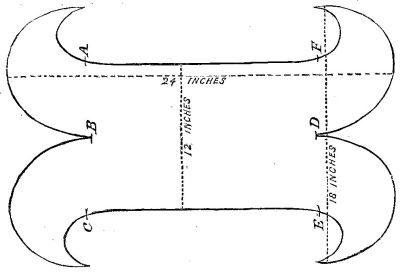
The diagram shows the shape in which the piece is to be first marked with pencil, and then cut with knife or shears. The edges from B round to A and C, and from D round to E and F, are next to be joined, and sewed with an X stitch in colored silk or thread. The natural curve of the bark shapes an excellent bottom to the little craft, and a gunwale, which prevents splitting, and gives a more ship-shape appearance to it, is easily prepared by taking a thinner piece than that of which the body of the canoe is made, cutting two strips an inch wide and long enough to extend from A to F, folding them lengthwise, and stitching them as before, crease uppermost, over the edges. A better curve, and perhaps added strength, may be secured by running a small wire under the crease, but this is both troublesome and unnecessary. Two or three thwarts can be made without difficulty from a bit of soft pine, and held in place just under the gunwale by small brads.
Two coats of thin shellac give a beautiful, and lasting finish to the work, and one is really surprised at the pretty result of so slight an expenditure of time and labor. Suspended from a hook or an archway by bright ribbons attached to the prow, stern, and sides, and filled with dried grapes, or, better still, lined with a shaped tin vessel containing moss and planted with ferns, the canoe becomes a graceful household ornament, as well as a charming reminder of a summer's holiday.