WILLIE'S ADVENTURE.
Reading edition
A True Story.
BY E. M. TRAQUAIR.
"Mamma," said Willie Beetham, "may I go down to the beach this morning?"
"No, my boy; you know I don't like your going down there by yourself, and nurse is too busy to take you and Lucy out just yet. You can go there with her after luncheon."
Willie looked very much disappointed. "There's no fun going out with nurse," he said; "she won't let me do anything. It is always: 'Now, Master Willie, don't go there; you'll soil your shoes. Master Willie, come back; you'll tumble into the water.' Going with her is all very well for girls and babies; but I am a big boy now. You said so yourself to papa the other day. I can take care of myself quite well."
The "big boy" was a bonny little fellow of six years' old, with golden hair, and a sunny smile that won every one's heart. He was a bold, thoughtless boy, always getting into mischief, but of such an affectionate disposition, so sorry for having done anything to vex those he loved, that no one was ever angry with him long. This made him less careful, perhaps, in being obedient than he ought to have been.
"No, my boy, you can't be trusted to go by yourself just yet. You can go into the garden and play with Lucy for a little. When nurse is ready, she will take you both out for a walk on the beach."
Willie was very fond of his little sister, who cared for nobody so much as for him. So he drew her about for a while in his little cart, ran races, and pulled daisies with her in the field. But all would not do. He wanted to go down to the shore. Where he stood he could see the bright waves rolling in to land. He forgot all that had been said to him, and resolved to go. He would not stay long.
"Lucy, I am going down to the beach for a little while. Wait here till I come back, and don't tell any one where I have gone. I'll be back in a quarter of an hour."
Off he ran without waiting for a reply. Lucy remained quietly sitting, pulling the daisies, and plaiting them into a long chain, thinking how it would please her brother. The quarter of an hour passed, half an hour, an hour. Willie did not appear. Lucy was too faithful to leave her post; but time was beginning to hang heavy on her hands, and, besides, she was growing frightened at his absence. Lucy began to cry.
What was Willie about meanwhile? On reaching the shore, which was only about five minutes' walk from the house, his delight knew no bounds at being able to scamper about everywhere without being perpetually called to order. He ran races with the waves that were rolling in, clear and shining, and breaking in white foam on the yellow sands, and shouted with glee when he just saved his distance, and escaped without even wetting the toes of his boots. Then he tossed about the great heaps of brown weed and tangle, and searched for the lovely crimson sea-weed his elder sister used to gather and set so prettily on white paper when she came home for the holidays. Then, as the tide was low, he scrambled in among the rocks, and in the clear pools he found crabs and cockles and beautiful red and striped sea-anemones. Willie was very fond of natural history, which his papa used to teach him occasionally, and he became so absorbed in examining these pretty things that he not only forgot what his mamma had said, but also his promise to his little sister of returning in a quarter of an hour.
He was still busy poking about in the clear water of the pool, when he suddenly felt a cold plash on his foot. Starting up, he saw, to his dismay, that the water had been gradually creeping up and surrounding the low rock on which he was standing looking into the pool. At first he could not think how that had come about, as the sands had been quite dry toward the land side when he first went on to it. Suddenly it dawned on him that the tide must be rising. He did not know very well what the rising and falling tide meant, as his parents had not lived very long by the sea, but he remembered hearing his papa speak of people having been caught by the high tide and drowned. If he had started at once, he might still have got safely to shore by wading. But he was too much terrified to think of trying it. Looking about him, he saw a large flat rock near, and with some difficulty he succeeded in scrambling on to it. He thought it must be high enough to shelter him, until the tide should fall again. Had he not heard papa say that the tide fell as well as rose?
Placed thus, as he thought, in a position of safety, Willie's spirits began to rise again. All his fear had vanished, and he began to pretend to himself that he was a shipwrecked sailor cast away on a desert island; and he could not help laughing with glee when the merry little waves, dashing against the rock he was standing on, sent up sparkling showers of spray that seemed trying to reach him, but couldn't.
"Aha!" he thought, "you'll be clever if you catch me here on this big rock. I wish you'd be quick and go lower, though. I want to go home to mamma and Lucy."
Instead of going lower, however, the water kept rising higher and higher, until at length a wave, in breaking on the rock, sent a shower of spray in Willie's face.
The tide had been rising so fast that the shore seemed a long distance away now. The rock where he had been standing looking into the pool was now completely covered with water.
Oh, how he wished himself now sitting with Lucy plucking daisies in the field! How he repented of having been so disobedient to his kind mamma, who, he remembered now when it was too late, never forbade him anything except for his own good! How he resolved that he would never, never more be disobedient if he should ever again reach the land! But still the water kept rising.
In the mean time poor little Lucy sat crying on the lawn with her lap full of daisies.
"Miss Lucy! Miss Lucy! come in and get on a clean pinafore before luncheon."
"Lucy tan't tome in yet, nursie; Lucy p'omised to wait here for Willie."
"Why, I thought Master Willie was here with you. Where is he gone to?"
"Lucy no tell oo where Willie is don to. Lucy p'omised no tell 'at Willie is don to de beach."
"Gone down to the beach, indeed? Well, his mamma will be real angry, and his papa too."
Lucy began to cry again at the thought of papa and mamma being angry with Willie; but nurse carried her off to get her clean pinafore on before luncheon.
"Are the children ready, nurse?" called papa from the dining-room. Papa liked to have his little people about him at meal-times.
"Miss Lucy is a-coming, sir; but she says Master Willie has gone down to the shore."
"To the shore! impossible!" says mamma. "I told him this morning he was not to go alone."
"Well, ma'am, all I know is that Miss Lucy says so; and, as I can't find him nowhere, I think it must be so."
"Run down to the beach and see if he is there," says papa. "If he is disobedient like this, we must be more severe with him in future."
They began luncheon.
Suddenly, in the midst of carving a fowl, Mr. Beetham dropped the carving knife and fork.
"My dear," he said to his wife. "I hope it is not a spring-tide to-day. If it be, and that boy has got among the rocks, it might be a bad business."
The almanac was consulted, and announced a high spring-tide for that day. Any little boy or girl who had seen the dismay on Mr. and Mrs. Beetham's faces on learning this would have resolved never to be disobedient again so as to grieve such kind parents.
Mr. Beetham was starting up to go himself in search of the naughty little truant, when nurse rushed in to the room.
"Oh, sir!" she cried, "Master Willie is standing on a rock far out in the sea. He is waving his handkerchief and shouting, but there is no getting to him."
"Run for Fisherman Ralph," said Mr. Beetham.
"My dear," to his wife, "don't be afraid. Ralph's boat will soon get him ashore. Mind little Lucy while I run down and help to get it out."
But he was very much afraid, for all that, when, on reaching the beach, he saw his little boy standing on a point of rock that threatened every instant to be covered with the rising water.
"Ralph," he cried, as the fisherman—a tall, stalwart figure in a blue cap and corduroys—came up, "where is your boat?"
"Jack's gone a-fishing in it," said Ralph.
"Heavens! what shall we do?" cried Mr. Beetham. "My boy will be drowned before my very eyes."
"Not if I can help it, sir," said Ralph, throwing off his jacket. "I'm big enough. I'll see if I can't wade to him."
"He'll never reach him," cried Mr. Beetham, running up and down the beach in an agony of anxiety, which was shared by all the by-standers, as the strong man strode on with the water above his waist, and the rock still not reached. It was nearly up to his shoulders before he got to where Willie stood.
"STEADY! STEADY! YOUNG MASTER! I'VE GOT YOU SAFE ENOUGH NOW."
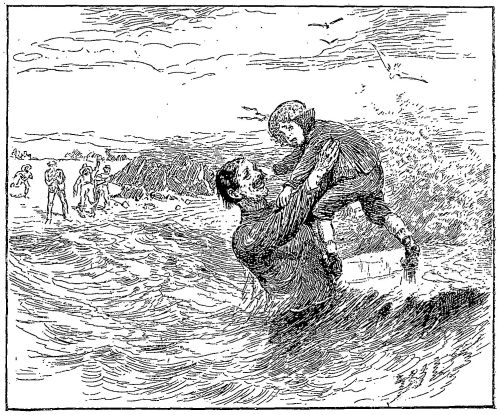
"Steady, steady, young master. Don't be afraid of a wetting, and don't hold on so fast. I've got you safe enough now." And so, half wading, half swimming, the gallant fellow, battling with the great waves that were now rolling in heavily, brought poor Willie, drenched and cold, to land, and laid him in his glad father's arms.
Another minute and the rock had disappeared.
Willie learned a lesson that day which he has never forgotten, and after papa, mamma, and little Lucy, there is no one he loves so much as big Fisherman Ralph, who saved his life on the day of the high tide.