Part I.
Reading edition
This is the story of a boy who had red hair, a good appetite, and much else in common with other boys; one who rose very high in the world, who came down and rose again, not so high, but in a better way. He was not a genius, or I should not tell his story; for there are so many boy geniuses nowadays in books that the record of a common red-haired child may be more interesting, as a change.
One day fifteen years ago there had been a county fair in Langham. The grounds were full of people even at six o'clock in the afternoon. But under the tent the gay bed-spreads, the oil-paintings, the hair flowers, and the wax-works were being taken down, while the farmers' wives were exchanging compliments, sample biscuit, and currant jelly. Outside the canvas the men were taking away the cattle—the great oxen with prize tickets on their horns, or sheep, or swine, or poultry. Everywhere there was bellowing, grunting, shouting, scolding, and some grumbling. This last was chiefly done by a noisy party who came to the fair, not to bring the grain or cattle raised by their industry, but to stare at the two-headed calf never raised by anybody, to bet on horses, to steal water-melons, and to join at last the crowd that was elbowing around a man with a balloon, in which he was to go up when ready. This balloon, already inflated, was fastened by a rope to a well-driven stake, and floated a little way above the ground. Among the lookers-on, some who pretended to know declared that it was not a very good balloon, and must surely come to grief.
After a while the man drew down the car low enough to get into it, and cried out: "Does anybody wish to accompany us in our grand aerial flight?" He said "us," as sounding fine; but he immediately explained that he would take a light gentleman only.
In a moment there shot from the crowd a long-legged, keen-eyed boy about fourteen years old, who nimbly stowed himself into the car, amid great laughter and shouts of "There goes Billy Knox!" "Good-night, Billy!" "Bring us down a star, Billy!" and like efforts at wit.
"Did you ever see a chap so ready and willing to risk his life for nothing?" asked somebody; and another man answered, coolly, "'Tain't no loss if he does break his neck; nobody owns him, and the world will be well rid of him."
Billy heard the heartless words, and turned to look at the speaker, while the owner of the machine arranged the ropes before getting into the car.
BILLY'S FIRST RISE IN THE WORLD.
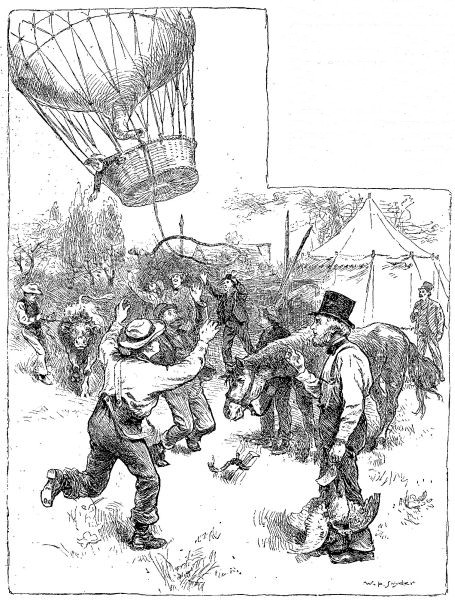
Suddenly, like a bubble from a pipe bowl, up rose the balloon, Billy in and the man out! The crowd gave a gasp of surprise, the man stared stupidly, and then, just too late, leaped up like an acrobat, and clutched—only air. Billy, moving slowly up, sat like a statue; but loud and clear came down from the car a cry, not of terror, almost one of triumph.
"He'll be killed, sure," said the former speaker, emphatically, and his companion echoed, "Don't seem to care a bit about it either, just as you said."
Some of the people thought it a trick of the owner of the balloon, but his frantic denial and his evident distress at the loss of his property proved it to have been a mishap. Meanwhile the news flew like the wind over the field, and in a moment hundreds of faces were upturned toward the vanishing balloon. Everybody hoped the boy would not meet a dreadful death, though a goodly number said it might better be Billy than any one else; and all alike watched, not sorry, if such a thing must happen, that they were there to see it.
Up, up, went the car, and "nobody's boy" was rising far above the earth. The sunset light smote his red hair, and made it glitter like gold. But Billy was soon too far away for the crowd to jeer at him, even if the roughest could have done so while the boy was in such terrible peril.
Billy looked down once and shouted. Then he began to wish that his conveyance would travel sideways, instead of rising so steadily.
It occurred to him at last that if the man who owned the balloon were in the car, he would probably turn some "stop-cock" or other, and let himself down. However, Billy was not sure that he wanted to go down even if he could.
As he rose higher and higher, the people on the ground below him began to look like small things crawling, and the great white tent almost like a card-board house. He questioned whether or not he should meddle with any mysterious part of the balloon. He remembered, not unpleasantly, having heard some one early in the day say it would certainly collapse of itself. If collapse meant to come down, to meddle with it might be to turn on steam and send him beyond the sun and moon, where he had no desire to go. He sailed across a forest, over a river, lost sight of the fair ground, and then began to come nearer earth, slowly nearer, then faster, the car rocking in a way that threatened to dump him out.
"We are surely 'collapsing,'" thought Billy. He grew a little dizzy, the earth seemed coming to meet him, and all the houses, barns, and hay-stacks were inflated, in their turn, and getting bigger. At last a gnarled old tree that had been charging straight on the balloon ran into it, upset, tore it, and after entangling Billy in ropes and branches, tearing his clothes, scratching his hands and switching him like an old-time school-marm, let him fall roughly down to earth. He was glad to lie quiet, thinking first of the torn balloon, then of himself.
While he was thinking, the words that he had heard that afternoon as he entered the car came back to him: "Nobody owns him, and the world will be well rid of him."
Heretofore he had been proud of the fact that nobody owned him. He had never thought of himself as a nuisance to the community. Billy had not much sentiment, but to-night his heart ached as well as his limbs. He thought of all his past life as intently as a boy could think. He had begun to take care of himself when he was only eight years old. He dimly remembered his poor mother as always enveloped in the steam from hot soap suds, a practical kind of a halo, the result of her efforts to feed him with honestly earned bread. She died and left him to the care of a drunken father, who two years later followed her to the grave.
The town gave Billy a home in the poor-house, but he staid there only three days. At the end of it he resolved to start out into the world and earn his own bread. He ran away to the nearest city, where he blacked boots, sold papers, learned a certain amount of evil in the streets, and some good, in a night school. Finally he tired of city life, and started for California, but after getting ten miles on the way, his money gave out, and his courage too. He found himself in the town of Langham, and there he staid, doing odd jobs when he could get them, and at other times amusing himself as best he could.
There never was a fire that Billy was not close behind the hose-cart, or a circus that he did not ride the kicking donkey, or a county fair where he was not present looking out for anything in the way of fun that offered. His last undertaking was going up in a balloon. Now here he was, down again, and the question was, what should he do next?
A boy in a book would have decided to become a judge, or a merchant, or an artist; but Billy had another ambition. He desired to become a negro-minstrel. He knew one, a man who wore fine clothes and had plenty of money. He earned it by being funny—oh, so extremely funny.
While Billy was considering the matter, he heard a voice, and looking up saw a man following a cow. Naturally enough, the balloon, attracted the man's attention, and he came near enough to discover the boy.
A conversation followed, in which the whole story was told.
"Well," said Billy's new friend, who proved to be a tailor in a very small way of business, "how do you feel now?"
"Lonesome and sort of empty."
"Do you mean hungry?"
"Perhaps that's it," said Billy.
"Then you may come home with me to-night," said the man, "and after supper I'll see if the balloon is spoiled.'
"It is only collapsed," said Billy, very pompously; but when on getting up to walk he found his clothing reduced to about half what he had before, he assumed a meeker tone, and followed his new friend thankfully. The cow going first, turned down a lane bordered with sunflowers, and stopped by the door of a wee red house. A moment after, a small figure with a tin pail came out of the house, and sat down to milk the cow.
"This is my son Ben," said the host.
At first Billy had taken the child for a girl, for the little boy's checked apron came down to his copper-toed shoes, and he wore a green sun-bonnet, under which Billy saw soft white hair, and a very sweet face. They entered a kitchen, small, bare, but very clean, where a table was spread with blue dishes, brown-bread, baked apples, and cold pork. In the chimney-corner sat a little old woman, who sang as she rocked. She was very deaf, but she smiled on Billy, on the tailor, and on her little grandson. She would have smiled on anybody, as to that. But a grandmother's kind face being new to Billy, he thought it beautiful. He found the supper exceedingly good, if not very abundant, and he was interested in watching Ben. The child soberly washed the dishes, and neatly swept up the crumbs, saying very little. The reason for his silence was after a while apparent to Billy: little Ben stuttered.
After supper, the room being warm, and Billy being tired, he dozed in a corner of the old lounge. While he slept the tailor went to see about the balloon, and staid a long time.
Later in the evening Billy was awakened by a voice. Ben was reading to his grandmother. She had her cap off, and her hair was as white as snow. She was warming her feet over the last coals, while Ben held a candle in one hand, and bent over an old book.
"'He shall call upon me, and I will answer him,'" read the boy, in his awkward, stuttering tones. "'I will be with him in trouble. I will deliver him, and honor him. With long life will I satisfy him, and show him my salvation.'"
Billy did not catch the last word, for the child could scarcely pronounce it, but he asked, abruptly, "Who will do it?"
The old grandmother heard the boy's voice, and answered: "God will do it all for those who love Him."
"Folks like you, old and good, I suppose," added Billy, as she tottered away to bed.
Once she would have stopped to teach him some holy lesson, but now she had crept in her feebleness so close to the door of heaven that she was forgetful of all darkness that might be behind her for younger travellers. Billy fell asleep again, then waked up blinking. The outer door was open, and Ben was pulling, bracing, and otherwise guiding his father into the house.
When the tailor was safely dumped into a wooden chair, he began to jabber about the "b'loon, you know—scientif'—experiment. If I got a chance—like to own b'loon myself—always was scientific."
"Humph! that's it, is it?" said Billy, stretching out again for the night. He had seen too much of life to be either shocked or surprised. Doubtless Ben could get his drunken father to bed alone; and the child did indeed do it, as he often had done it before.
[to be continued.]
THE RABBIT HUTCH.