Part 1 — AIDS FOR YOUNG ANGLERS.
Reading edition
BY A. W. ROBERTS.
How often has it happened that on reaching a camping ground, hotel, or boarding-house near river or lake, where pickerel, bass, and large perch abounded, I have found no provision for the angler's sport but a boat; no lines, sinkers, or floats; no nets for catching live bait, and no bait but worms! For sunfish, cat-fish, and small perch, worms are very fair bait; but for pickerel, bass, and large perch, live bait is best. Under such trying circumstances, I have learned to get up at short notice and at small expense many make-shifts and aids that may be of great assistance and consolation to other young anglers when placed in a similar position.
Fig. 1.
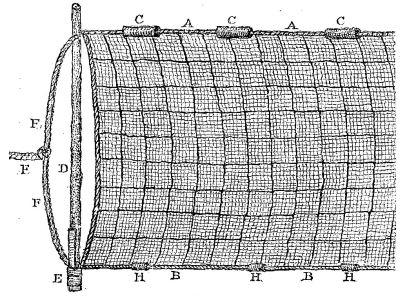
Fig. 1 is an end section of a mosquito-net seine for taking live bait. The length of the seine is thirty-eight feet; depth, five feet. The "cork line" (A A) consists of a small-sized clothes-line. Corks not always being obtainable, I have used pieces of thoroughly seasoned white pine three inches in length and one inch in diameter (C C C). Through these rounded pieces of wood holes are bored, through which the clothes-line passes. These floats are placed eight inches apart, and are kept in position by the clothes-line fitting tightly in the holes. At the bottom of the seine another clothes-line is sewed to the netting; (B B). This is called the "lead line," and is for the purpose of keeping the lower part of the seine close to the bottom of the water. On the "lead line" pieces of sheet-lead one inch in length are fastened (H H H) twenty-eight inches apart. The "staff" (D) is a well-seasoned piece of hickory six feet long, to the lower end of which sheet-lead is also fastened (at E) to keep it down. To the staff is attached the staff line (F F F), thirty feet long, which is for the purpose of drawing in the seine after it has been cast.
Fig. 2.
A seine of this size is generally worked by two persons and two boats. Each person takes one of the staff lines in his boat, and rowing toward the shore with the extended seine, describes a semicircle between the boats. As the shore is approached, each boat closes in, thereby causing the two staffs to meet, and imprison, all the fish that have come within the bounds of the seine. When one person works the seine, one of the staff lines is tied to a rock or stake on the shore, and the other line is taken into a boat, or the operator wades out, and causes his end of the seine to describe a circle until the two staffs meet. Great care must be taken to keep the lead line close to the bottom, otherwise the fish will escape. In the selection of the seining ground always avoid stony bottoms, snags, and brush, which will cause the seine to "roll up" and tear.
The cost of the above-described seine ranges from three to four dollars, and is capable of lasting two seasons if carefully handled and spread out on the grass to dry after using it. A much superior article to mosquito net is bobinet, which will last several seasons.
Fig. 3.
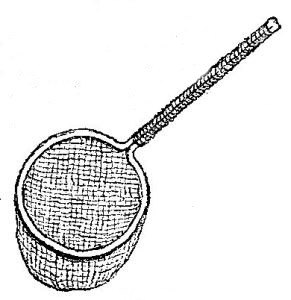
Fig. 4.
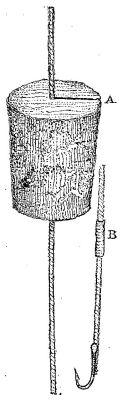
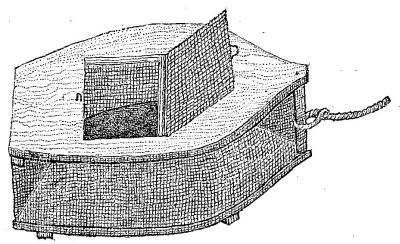
Fig. 2 is a bait boat, for keeping the bait alive. It is towed behind or kept by the side when fishing. The top and bottom pieces consist of half-inch pine "stuff"; in the centre of each piece square openings are cut; that on the top is protected by a door made of wire-cloth of quarter-inch mesh, fastened to two small staples, which answer the purpose of hinges; over the opening in the bottom piece wire-cloth is nailed, to admit of a free circulation of water. Under the back end of the top piece a cleet is nailed, also two cleets on the bottom piece, as shown in the figure. At the bow of the boat an upright piece of wood is fastened to the top and bottom of the bait boat by means of screws. The sides of the boat consist of one piece of wire-cloth, the ends of which meet at the upright piece of wood at the bow, and are nailed with broad-headed galvanized nails. The top and bottom edges of the wire-cloth are also fastened with nails to the edges of the top and bottom of the boat, as shown in the figure. A tow-line is fastened to the bow, and the boat is complete.
When handling the bait a small hand-net (Fig. 3) is used, consisting of a stout piece of wire bent as shown in the figure; the straight parts of the wire are bound together with fishing-line, and constitute the handle; to this frame netting is sewed to form the net bag.
Fig. 5.
When fish are caught, they ought to be kept in water to keep the scales soft, otherwise they become dry and set, and are troublesome to clean.
For a make-shift float I have found nothing better than a good-sized bottle cork, into which a cut has been made with a sharp knife or razor, extending from the side to the centre of the cork. Into this cut the line is drawn as shown in Fig. 4, A.
Fig. 6.
Sheet-lead is always a useful aid in make-shift fishing-tackle, and for light lines makes excellent sinkers when bent and compressed around the line, as shown at Fig. 4, B.
For a pole nothing is nicer than a light and straight piece of the aromatic sweet-birch. I am not a convert to hundred-dollar fishing-poles with polished mountings, but have reasons to still believe there is much virtue in birch.
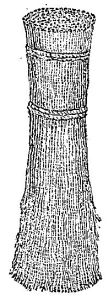
For cleaning out a boat a stiff whisk-broom made of fine birch twigs bound together with wire or fishing-line, as shown at Fig. 5, will be found very useful.
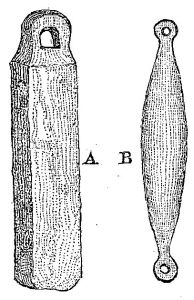
Fig. 6, A and B are hand-made sinkers beaten and carved out of old lead pipe. The carved one, B, is first roughed out with a jackknife and finished up with fine emery or sand paper. A is beaten into shape with a railroad spike on an anvil or smooth stone. This beating and carving of lead is very pleasant work, the lead being of such an easy and good-natured temper.
Fig. 7.
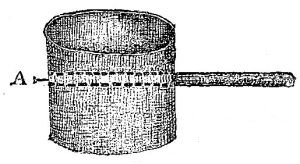
For a cheap and easily obtainable bailer I have made use of an empty tomato or corned beef can, as shown in Fig. 7. A hole sufficiently large to admit of the handle is punched in the side of the can, the inside end of the handle is champered off so as to fit close to the inner side of the can; through the can and into the end of the handle a stout nail is driven, as at A.
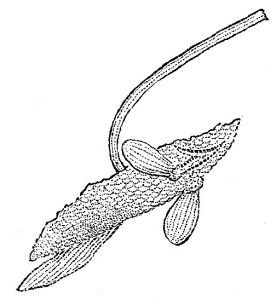
A good bait for large fish is a strip cut from the under side of a small pickerel, perch, or sunfish, which is placed on the hook as shown in Fig. 8.
Fig. 8.
For black bass I have found the black field and house crickets most excellent bait. Within the last two weeks I have taken good messes of horned pouts (cat-fish) with set night lines baited with "cat-worms" (so named by the inhabitants of the lake where I am camping). These "cat-worms" are those elderly, corpulent, and well-to-do angle-worms, that pay their respects to one another on dewy, moonlight nights. When using angle-worms I place them in damp moss for three days, to rid them of all earthy matter; this toughens them so that they may be run on the hook with more certainty and less bother; and, besides, they have more squirm in them, which is a decided gain.