TOM FAIRWEATHER'S VISIT TO THE SULTAN OF BORNEO.
Reading edition
BY LIEUTENANT E. W. STURDY, U.S.N.
Our sailor-boy, Tom Fairweather, leaned over the ship's side, watching the return of the steam-launch.
A message had been sent to no less a personage than the Sultan of Borneo, or perhaps I should have said an embassy. So grand a personage as a Sultan calls for such a ceremonious term. Don't you think so, young people?
The ship lay in the Chinese Sea off the coast of the island of Borneo, and some fifteen miles from the town of Bruni, or Borneo, as it is sometimes called.
As Tom stood there, a succession of wise thoughts coursed through his head; wise, that is, for a young gentleman of his age—twelve, by-the-way. These thoughts included the position of the equator. Tom felt himself to be quite old friends with the equator by this time, so often had he "crossed the line."
When he had first studied geography he had regarded such a performance as quite remarkable, and on a par with sailing or sledging to either pole. The thoughts of geography brought to his mind the book he had used at school, Maury's Manual, which contained a number of illustrations. Tom distinctly recalled a picture in this book, beneath which was written "The Sultan of Borneo." The Sultan was resplendent in a flowing flowered robe, which Tom supposed to be of brocade. He wore Turkish trousers, a turban on his head, and mutton-chop whiskers. The only touch of carelessness about his costume was his bare feet. He reposed in a grove of palms, and in one hand held a long hookah. Take him all in all, he bore a strong resemblance to the Sultans in the Arabian Nights Entertainment, one of Tom's favorite volumes, and who, as other boys and girls are well aware, were all very wealthy and lordly people indeed.
As Tom had never seen a live Sultan before, he was most anxious to visit his Sultanship of Borneo. He therefore broke out in a whistle of pleased expectation, for it was distinctly understood that he was to be of the party making the formal visit.
The Sultan, it appeared, had graciously signified his entire willingness to be called upon; so Tom made a few additions to his toilet, which he considered were called for by the magnificence of the occasion; that is to say, he put on his watch and chain, as well as a ring with a large red stone, which the man in Ceylon of whom he had bought it had told him was a ruby. He felt extremely important and a little overawed when he was seated in the launch on his way to the Sultan's abode.
To begin with, he was somewhat surprised at the appearance of Bruni as they neared it. "Huts!" he said, in astonishment. "With thatched roofs. Are all the houses like these? Why, this doesn't look like a city at all. Maury's Geography said this was the capital. This is a high old capital, I must say."
"There are capitals and capitals," returned his father. "Did you expect something like Washington? I must admit that the splendor of Borneo is rather down at heels—but so it goes."
The residence of the Sultan was a thatched hut, very much like those of which the rest of the town was composed. It was built on piles driven into the river-bed, and was entered by steps leading down to the water. There were other houses thus set up on piles, and behind those still others, until finally the rest of the town straggled against and on top of the river-bank.
Tom followed his father up the steps with feelings in which disappointment struggled with curiosity. His expectations had already received a series of shocks, but this was too much. A King's palace to have dwindled down to this shabby little hut!
They entered into the royal presence. Captain Fairweather and his officers were received by two interpreters, who made them welcome in very broken English, and then led the way to the head of the room, where stood the Sultan. He was almost a hundred years old. Don't suppose from this that such is the average age of Sultans. But this particular one, Abdul Momin, had actually attained that ripe old age, from which we may gather that his dignities agreed with him. There is something impressive in old age, whether it be that of prince or peasant; but beyond this the old man before whom Tom found himself bowing politely was certainly not in the least remarkable. He was a very shabby old man indeed. He wore a single soiled garment—a gown which reached to his feet. As though to make him as unlike the Sultan in Maury's Manual as possible, he wore slippers (such as they were); and finally there was a common little cap on his head instead of the silken turban, bound with pearls, of Tom's imagination.
The Sultan could not speak English, and the officers could not understand him, so that the conversation would have flagged had it not been for the interpreters referred to above. One of these was the Funny Man one meets all over the world, who sees a joke in everything, and laughs at it himself, whether you are amused or not. But this man was really very funny. He rubbed his hands and bowed and laughed over everything that was said, until it was impossible not to be in good spirits. He evidently considered it quite a good joke that so many fine gentlemen in uniform, with gold epaulets and clanking swords, should have taken the trouble to look up such a seedy old Sultan as Abdul Momin. Having made the presentations in due form, he proceeded to do the honors of the one-roomed palace. There was very, very little furniture to look at; but the officers showed a determination to be pleased, and admired all that this interpreter, in his flourishing way, pointed out to their notice.
"That's a nice rug," said Lieutenant Jollytarre.
"Yes; Sultan borrow that when he know you coming," replied the interpreter.
"Those are nice pipes," proceeded Tom, following in the wake, as he was in the habit of doing, of his friend Lieutenant Jollytarre.
"Borrowed too," rejoined the interpreter, with a wink.
Coffee was handed around, served in pretty little cups of Japanese ware. Captain Fairweather, by way of making conversation, in his turn, admired these cups. "Ah! Kioto ware?" said he.
"Kioto; yes, yes," replied the interpreter, to whom the remark was addressed. "Chinaman keep shop in Bruni. Sultan borrow cups of him." Thereupon he winked more decidedly than before.
"Well!" exclaimed Tom; "don't the Sultan own anything? I suppose the slippers on his feet are his at least."
"Borrowed," ejaculated the interpreter, with a chuckle.
Tom was now convulsed with laughter; seeing which, the interpreter winked again—this time gravely.
Captain Fairweather finally took out his watch, and remarked, "We must be off if we wish to see anything more of Bruni."
With ceremonious politeness the officers took leave of the Sultan, all of which impressed Tom as highly absurd. On shore there were, as stated, more thatched huts—these too were set on piles in order to prevent the venomous reptiles native to these shores from crawling in and out the open doors.
"Lots of tribes in Borneo," piped up the interpreter. "This tribe Muruts—head-hunters."
THE HEAD-HUNTERS OF BORNEO.
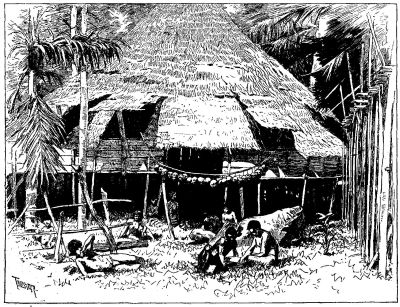
Tom stood transfixed in mute, horrified astonishment in front of the nearest hut. Its steep projecting roof had fallen somewhat into decay; the thatching in some places had fallen quite off. Before the doorway a group of natives were gathered, attracted by the strangers. They stared at the strangers, who in turn stared back with equal curiosity. Suspended across the doorway was a string of human heads—yes, horrible to relate—of human heads in different states of decomposition. "He great head-hunter," said the interpreter, pointing to the owner of the hut. "Count heads—one—two—three—"
"Twenty," announced Tom, solemnly, completing the count.
"These fellows bring home a head as a token of their prowess, just as a North American Indian brings home a scalp," explained Mr. Jollytarre. "They make a raid into another tribe, kill a man, and back they come with it as an evidence of their courage and skill. The more heads a man takes, the greater distinction he attains in his tribe. Nothing is thought of him by his own people until he chops off a head."
Tom looked again at the string of heads, and exclaimed, "Faugh! it makes me ill. I almost wish I hadn't come."
But disagreeable things are short-lived in a boy's mind. The head-hunters and their ghastly trophies faded away as he asked questions upon questions about Borneo, on his way back to the ship.
"The third largest island in the world," he repeated to himself. "Australia, New Guinea, Borneo—and if you don't count Australia an island, it's the second. Well, well, it's a queer place anyway, and I don't think much of it, whatever its size may be."