CAPTAIN EDWARDS'S BIG WHALE.
Reading edition
BY EESUNG EYLISS.
"Uncle Horace, I have just been down to the foot of Wall Street to see the whale."
"I am very glad you have done so, Bennie. What did you think of it, and what did it look like?"
"When I went in, the great creature was lying on a board floor under a large canvas tent, and about twenty persons were examining it. Oh, it was so fat! Great gashes had been made in its sides, and through them you could see what they called the 'blubber.' I saw Captain Edwards there too. He was talking to another gentleman, and telling him all about how he caught the whale."
"Well, and how was it?"
CAPTAIN EDWARDS.
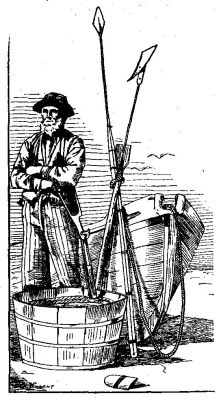
"Why, you see, the Captain was aboard his ship, the Fanny Sprague, and they were sailing along the coast of Long Island, between Amagansett and East Hampton. This whale had been seen about there several times, and they were just after it. Well, one morning—I remember the very date; it was March 15—they caught sight of it. The boats were lowered, and away the whalemen went in pursuit. As they came alongside, Mr. Fee, the mate, who was in the bow of one of the boats, ready with harpoon in hand, hurled it in deep just below where the shoulder-blade would be. This astonished the whale, and it dived at once, splashing the water all around, and staving in the side of the boat with one of its flukes. The water was shallow, though, and the fish soon came up again to spout, and then started to run up the coast at the rate of sixty miles an hour. This was about ten o'clock in the morning. They had also thrown another harpoon into the fish, and the boat was being towed almost alongside, near the tail. After towing them some fifty miles, the whale began to grow tired, and then they stabbed it several times with the lance. It soon died."
"Bravo, Bennie! Now how did you remember all that?"
"Why, I was perfectly certain you and auntie would want to know all about it, and I just listened with all my might, so as I could tell you. I do wish, though, you could have seen it for yourself."
"Suppose now that I did. I have seen many whales, both living and dead, but such things always interest me, and I went in yesterday also to look at this one."
"Oh, Uncle Horace! What did you think of the monster? Did you ever see any other fish so big as that?"
"I am glad you asked your question in that shape, Ben. We will have a little talk about whales. People generally have such incorrect ideas concerning them that I think it is really worth while to give you some instruction, and at all events to start you right, for we shall have time now to make a start, and no more. In the first place, Bennie, always remember a whale is not a fish, and in no way allied to fishes."
"Why, Uncle Horace! What do you mean? Not a fish? I am sure I have read about whale-fishing, and I know they live in the water like fish."
"There is where you are wrong, Ben. They live in the water, but not like fish. Fish breathe under water, and die if taken out of it; whales can not breathe under water any better than you could, and if kept there would be drowned without fail. Whales have warm blood like ours; the blood of fishes is cold."
"But how do whales breathe, then, Uncle Horace?"
"You have read of whales spouting, I am sure, Bennie. Their spouting is their breathing. They go under water for their food, etc., holding their breath while they are below. A sperm-whale can hold his breath an hour at a time; a right-whale only about fifteen to twenty minutes. When he comes to the surface he blows out his breath through his 'blow-holes,' which in the right-whale are on the top of the head. This blowing is of course done with great force, and makes a sound which can be heard at quite a long distance, and the water and mucus which the blow-holes contained are driven out in a cloud of spray many feet in height. That is the spout of a whale. You see always in pictures a column of water represented; that is all foolishness. There is no such thing; there is a puff of spray, and nothing more."
"I should think it was a hard way to live, Uncle Horace, to have to come up to the surface every time I wanted to breathe."
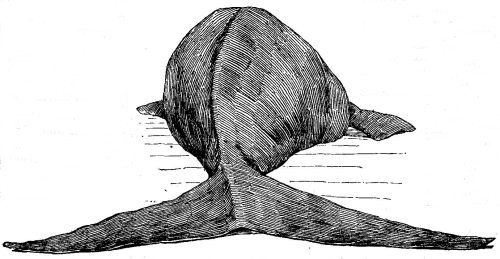
"Perhaps the whale does not think so, Bennie. He comes to the surface as naturally as you open your mouth. All his motion is made by the strokes of his tail, which the whalemen call his 'flukes.' Now look at this drawing of his flukes. It is shaped, you see, somewhat like a fish's tail, but then it is not placed like one. The tail of a fish always has its flat sides 'up and down,' so that when he strikes with it he swims ahead or to either side as he chooses, and if he wishes to come to the surface, he has to turn his tail in order to do it. The flukes of a whale lie 'flat,' and every blow drives him ahead, or upward or downward. A blow upward sends him flying toward the surface like a shot, and he doubtless has no more idea of hardship in breathing than you have."
"Did you ever see any other whale as large as this one, Uncle Horace?"
"This is one of very good size for its kind, but compared with many that I have seen, it is small. And I am glad to correct for you, Bennie, the statements which have been made about the size of this whale. It was said to be sixty-nine feet long, and forty-five feet in circumference. I measured it. Its length is not quite forty-nine feet, and its circumference a little less than twenty-five. It was also said that there were three kinds of whales, sperm-whales, fin-backs, and right-whales; this one was called a right-whale. Now, Bennie, I can count up over thirty species of whales at this moment, and there are probably several others. There are two groups of them, bone-whales and toothed whales, the first having whalebone, and the second, teeth instead."
"But, Uncle Horace, have not all whales bones?"
"Yes; but that may not mean whalebone."
"That is queer. What other kind of bones can a whale have, I should like to know? I should think they would be whalebone any way."
SIDE VIEW OF THE MOUTH.
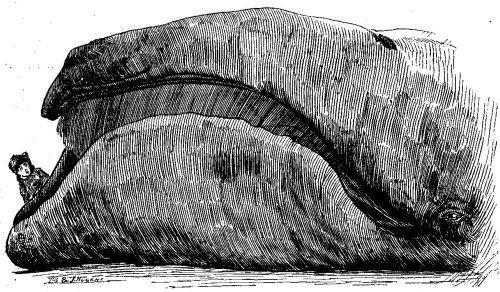
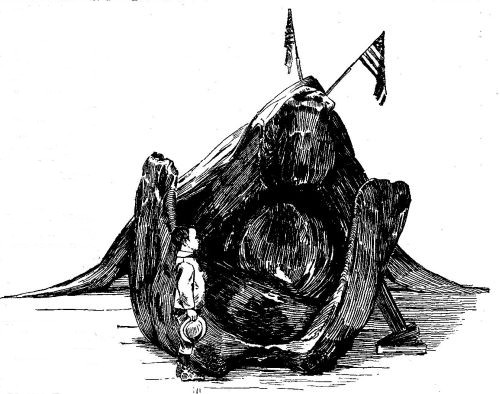
"I put it in that way, Ben, so as to draw your attention sharply to it. Whalebone is not bone at all; it is a totally different substance. Look at these two drawings of the mouth of the whale you have just seen. The first is made from the front, looking into the great opening, and the figure of a child is placed there. This has been done to show you how large it really is. And by-the-way, Bennie, in the mouth of a whale of the largest size a grown man would appear no larger in proportion than this child does now. The other is a side view of the mouth, lips, etc.; inside the lips you can see the whalebone. This consists of a series of flat plates, attached to the skull in the roof of the mouth, and hanging down in a long row on each side between the great fat tongue and the lip. They are longest in the middle of the length of the mouth, and grow shorter toward the front and toward the rear. In the one here represented I thought the longest plates would measure between five and six feet, but I have seen many of them, taken from the whales of the Northwest coast, which were fourteen to fifteen feet long. Each 'slab' of bone is broadest at the top, and tapers downward, and its edge is split into a sort of fringe, and it is by means of that that the bonewhales secure their food. Look at those enormous lips standing up. The whale drops his lips until they lie flat, and then, swimming slowly along, the small molluscous animals on which he lives drift into his mouth. When he thinks he has enough for a mouthful, he raises his lips, and with his great tongue forces out the water between the plates of bone, through the mat of fibres. The mollusca are caught on the fringe, licked off, and swallowed. Seems like small food for such great animals, perhaps, but this is their mode of living."
FRONT VIEW OF THE MOUTH.
"Is this one a right-whale, Uncle Horace?"
"No, it is not. They call it so, and they probably are honest in their statement, for the two species are very much alike. But the right-whale is an arctic species, and is larger, being sometimes sixty-five feet long; this species is, I think, never over fifty, and lives in the Atlantic Ocean, not the arctic."
"Is sixty-five feet as long as any whales grow?"
"Oh no. Some of the fin-backs have been measured which were one hundred and ten feet long, and I am sure I have seen them as long as that. Whalemen, however, seldom kill them, for they make but little oil, and they fight sometimes very fiercely when they are attacked."
"But isn't it strange, Uncle Horace, that such monstrous animals can be killed. I should think they would kill the men who tried to fight them."
"So they do sometimes, but not very often. You have learned from Captain Edwards of the instruments that are used to kill them—a harpoon and a lance. When the whale-boat comes near enough to the whale, the harpoon, to which a long rope is fastened, is thrown into him. The barb on the harpoon prevents its being pulled out, and the poor whale swims off, dragging the boat by the rope. When he becomes tired, the boat is drawn up, and he is killed with a thrust of the lance. Sometimes the blow of the harpoon kills him, but not often. Bomb-lances are now often used; they are fired from a heavy gun, and explode after entering the body of the whale, and of course kill him."
REAR VIEW, SHOWING THE FLUKES.
TOLLING THE BELL.