THE RATS AND THE MEAL.
Reading edition
BY PALMER COX.
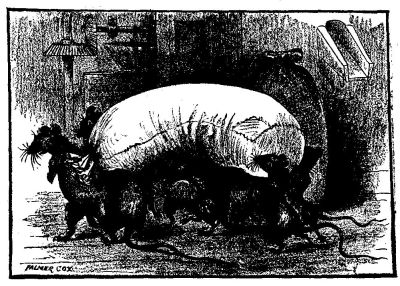
One summer's night when all was still, And motionless the wheel, Some rats ran through the village mill, And stole a bag of meal. And hurry-scurry, tooth and nail, They dragged it to the door, And then upon their shoulders soon Away the treasure bore. But as they hastened from the room, Along a narrow plank, The heavy load went in the flume, And to the bottom sank.
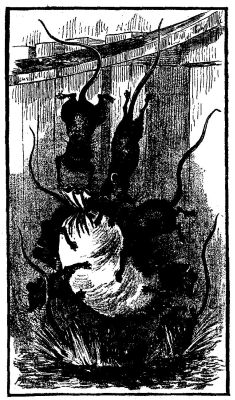
And downward with the bag of meal, Ere they could loose their hold, With many a frightened squeak and squeal. The thieves together rolled.
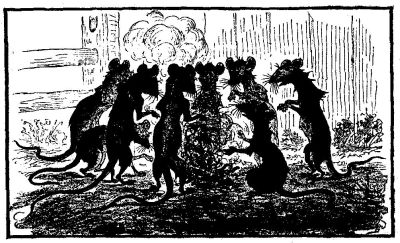
So then for life they had to swim, But when they reached the shore, They dried themselves around a fire, And vowed to steal no more.

When the showers of April Are falling so fast, Just think, little dears, That they soon will be past, And the grass will be springing, The birds will be gay, And soon, little dears, We'll have flowers and May.
Little hands up! Who has found the darling trailing arbutus? You, little Susie, and you live in Virginia? What New England girl will report first about the wild flowers that grow near her home? Which of the boys has seen the robins building? and who has been working out-doors with father, doing that hard spring work which will be so well repaid when summer and autumn come? Here are some more jingles for the wee ones:
Rain, rain, go away, Come again another day.
A sunshiny shower Won't last half an hour.
Patter, patter, patter—see the dancing drops! Clatter, clatter, clatter—and the shower stops.
Twinkle, twinkle, twinkle, there's the sun again! April is a pleasant month, spite of sudden rain.
I am a boy eleven years old, and my home is in Indiana, a mile from the State line of Ohio. My papa owns a farm here, and we are farmers, so that I have plenty to do in the summer-time working in the garden and around, and evenings and mornings I help to milk the cows. In the winter I go to school. I like to go first rate, especially when Miss Y. is our teacher. When we do not go to school, my brother Elmar and I and some more boys and girls who live near by go over to my grandpa's an evening or two in every week, and grandma teaches us. I like to study geography especially. My brother Elmar is older than I, and we take Harper's Young People together. When we meet at grandpa's, Elmar and I take our Young People along, so that the rest of the children who go can hear the nice stories in it, and after lessons are recited, grandma reads to us all. I liked "A Battle of Icebergs" in No. 124; we all did. And I like the letters in Our Post-office Box, especially where they write from Europe. I should like to sail on the large steamers to Europe. I would want to visit Switzerland, where William Tell and his brave little Albert lived. And I would like to see Lake Geneva, and the tall white peaks of the Alps reflected in the clear water. And I think it would be gay fun to go to Berne in their holidays, and see the people marching around in the streets wrapped in bear-skins, "playing" they are bears. But we have some good times here. My grandma wrote a story, and read it to us last week after lessons. The story was concerning a lady who made a party to please a lot of young people. When the names were announced at the door, they were all our own first names. The surnames were changed. I will ask grandma for the story to send with this letter, and hope the Postmistress will please print both. If they should be printed week after next, I would read them for my piece at our exhibition.
Irving P.
The Postmistress is sorry that she has not room for your grandmamma's story in Our Post-office Box with your letter. She has put it safely away in a drawer of her desk, and perhaps one of these days she will be able to find a niche for it. You were very kind to copy it so plainly. Although you have not visited Europe, your letter shows that you have read and studied about its peoples and places, so if you ever do go there, you will be prepared to enjoy the new scenes intelligently.
We are pleased to hear again from our correspondent Alberto, who has written to us from several places which he has visited in Europe. We are glad that his bright eyes see so well what the little ones at home will find pleasure in reading about:
Verona, Italy.
Perhaps some of the young people would like to hear about the Carnival of Rome. Mamma hired a window in the Corso twice, and also a carriage, so that when we got tired of our balcony we could see all the fun and frolic of the crowd. From the balcony we could see how gay the whole Corso looked, with flags and banners flying, and bright-colored strips of cloth hanging out of all the windows, and over the balconies, which were full of people. The street was filled with carriages going up and down, and a merry crowd on foot darted in and out among them, dressed up in comical costumes.
Then commenced the throwing of the coriandoli, which were little lumps of clay covered with chalk. People seemed to take great pleasure in throwing these at each other. This they followed by showering every one with small bouquets of flowers. I think the flowers were better than the coriandoli, as they did not hurt so much.
The fun every day closed with a horse-race. The horses had no riders, but attached to their flanks were leaden balls with sharp points, which urged them on like spurs. When the signal was given they dashed through the crowd, which just opened a moment to let them pass, and tore along until they were stopped at the other end of the Corso, where the judge sat to proclaim the winner. But the last night was very gay, for then every one had little candles, and the fun was to keep one's own light burning and blow out one's neighbor's. Some held a taper in one hand, and a fan made of feathers in the other for blowing out the candles. When the tapers were blown out all would cry "Senza moccolo," which means without light. The Carnival finished with a grand procession; maskers carried colored lanterns, which represented fruit, flowers, animals, moon, and stars; finally, a huge car came, in which was the King of the Carnival in a dying state, and a crowd of people behind weeping over him. It was a grand sight, and I wish that some of the readers of Young People could have seen it also.
Alberto dal Molin.
Monticello, Illinois.
I have a doll, and it wears No. 1 baby's shoes and baby dresses. My sister has a canary that will sing just as loud as it can when she plays the music it likes. I had a little dog eight years old, and some one poisoned him. His name was Dick. I have a boy doll. He was dressed in a little black velvet suit when I got him; I named him George. I think Harper's Young People is the nicest little paper I ever had. My brother Willie has a wagon, and he takes me out riding every day; but the wagon is broken now, and he can not take me. I do wish Jimmy Brown would write some more funny pieces; I like to read them so much! I would like to get acquainted with him. We used to have three white rabbits, but a stray cat caught them.
Lena W.
Brother Willie must get the wagon mended.
The little sentence which inspired this graceful poem was written by Victor Hugo, the venerable poet of France, in the album of a young girl who had begged for his autograph. Victor Hugo is a lover of children, as our own Longfellow was. Shall we translate the French for those who do not read that beautiful language? It means "like glass to quiver," or answer back to the touch; "like brass to resist." The poem will help you to understand the meaning of this sentiment. "À vos pieds, mademoiselle," means "At your feet," or, as we would say, "Your most obedient, miss."
FROM YOUTH TO AGE.
BY AGNES M. ALDEN.
"De verre pour frémir, d'airain pour résister." "À vos pieds, mademoiselle." "Hugo Victor." Maiden, with thine eyes of blue, Flow'ret gemmed with morning dew, Let thy stalk grow hard and strong, That when fiends of hate and wrong Bluster through thy youth's domain, Thou mayst well thyself maintain: Pour résister, sois l'airain. When pure angels of delight O'er thy garden wend their flight, Show'ring magic gifts on thee, Music, art, and poesie, Then thy dewy heart lay bare To the loving, vibrant air: Alors, frémis comme le verre.
Maryville, Tennessee.
My papa gave me Harper's Young People for a birthday present. I like it very much indeed. L. Pearlie S. said she had a hen that killed all but the black ones in her brood. Mamma says she once had a hen that did not like black chickens, so she tried to kill all she saw in her brood, and others too. I like chickens very much. I have twenty-one chickens—nine hens, one rooster, and eleven little chicks. One year I had thirty-eight chickens, two turkeys, and four Pintados.
I don't see how any one can help liking sweet, gentle, loving cats. I have a cat nearly four years old. She can't do any tricks; she only curls up under the stove when she can't get into my lap. But I like her very much; she is the only pet I have. I have no brother nor sister, except a grown sister who is married.
I have a flower and a vegetable garden. I like to go to school very much, but I do not go now, as I was sick and had to stop. I think Jimmy Brown's adventures are so very funny! I make a good many Wiggles, but I have never sent any. I often see some just like mine, though.
I am making two quilts. One is made out of the pieces that are too little for the other, and the other is a "memory quilt." Maybe some of the little readers would like to know what a memory quilt is. It can be of any pattern, provided it has a light-colored piece in the middle. The little girl who has it makes a square, and gives it to one of her friends, who makes another like it for her. The name can be worked or printed in the middle. When all her friends have made one, she puts them together, and has a quilt.
I would be very glad to see this in print, as no one knows I am writing it except mamma. Good-by.
Susie S. B.
The birthday verses which follow were written by a little girl to please her sister, and the Postmistress thinks they are very sweet. Mother did quite right in advising Maggie to send them to Our Post-office Box:
Behold our little darling In gorgeous garb arrayed! Her presents are before her, On the table nicely laid. She smiles so sweetly upon all— She's neither proud nor haughty; She's sometimes very mischievous, But hardly ever naughty. Her lustrous eyes, of a dark brown hue, Are a match for her wavy hair; And of birthday queens our Annie dear Is the fairest of the fair. Maggie J. L. Jericho, Long Island.
Sioux River, Wisconsin.
I am a little girl ten years old, and live nine miles from Bayfield. There is no school, church, or Sunday-school here. My sisters are older than I, and they stay in Bayfield and go to school. I am pretty lonely when they are all away and I am here with papa and mamma. But I have my pets as well as some other girls. I have a black cat which I call Pussy. I play with her, and I like her ever so much. I have ten dolls, and mamma says some of them are dilapidated. My oldest doll is a rag doll, which my aunt gave me when I was six months old. We live in Sioux River Valley, and the river is full of trout. I caught one in a little brook that runs past the door. A great many people come here in the summer to fish. There are some very large hills, all around us, covered with pine-trees, and pretty both in summer and winter. I never saw any hills, pine-trees, or rocks until we came here two years ago. About a mile from here is what we call the rapids. It is just beautiful! Such large rocks, covered with such pretty green mosses! I wish you could all see them, for I can not describe them. From the sitting-room we can see a "slide," and I love to watch the logs come tumbling and crashing down until they fall in the river.
Alberta S.
Hackensack, New Jersey.
Mamma says I may tell you two funny stories, because they are true:
There are two old colored people living at Fort L., near the school-house. Their names are Toby and Isabel. Toby keeps the school-house clean, but Isabel is so old and fat that she can not work much. One day my aunt met her on the road, and asked her where she had been. She said, "Oh, I've been helpin' Tobe in de school." "Why, you can't help him sweep, can you?" said auntie. "No; but Tobe he make so much dust when he sweep, an' it make him cough so, I t'ought I would go an' stand by him, so some of de dust would go down my froat, an' den Tobe wouldn't get so much on his lungs to make him cough so."
My sister teaches a school in the country, and one of her pupils is a little colored boy by the name of Nick. The other day he came into the room, crying bitterly, and said, "Teacher, the boys are all the time calling me names." She said, "What do they call you?" "They call me Nicholas, and that isn't my name; it's Nicky."
Emma S.
Thanks for your stories, dear. Isabel was very kind to Toby; and as for little Nick, we hope the boys were prevailed upon to stop teasing him.
Whitstable, Kent, England.
My uncle, who lives in New York, sends us Harper's Young People and Harper's Weekly, both of which we like very much. I must tell you about my pets. I have a black-and-tan terrier named Tiny, and a jackdaw which talks quite plainly. My sister has a tabby cat and a canary-bird. We have not had any snow this winter. We have had primroses and daisies in bloom all the time.
I went over the Canterbury Cathedral, and saw the tomb of Edward the Black Prince, and the shrine of Thomas à Becket, the murdered Archbishop of Canterbury. The stone in front of the altar is worn into hollows where the pilgrims used to kneel. Last Saturday Colonel Brine and Mr. Simmons went up in a large balloon from Canterbury, to cross the Channel from Dover to Calais. The wind changed, and they came down in the middle of the Channel, and were picked up by the mail-packet, and brought back to Dover. We are very sorry Barnum has bought our elephant Jumbo. I hope he will be stubborn, and won't go, for I'm sure we want him more than the little American boys and girls do. I hope I have not made my letter too long to go in your Post-office Box.
Fred P.
Going up in a balloon would be much better fun if people could only be sure that they would not come plunging down on the top of a high mountain, into the depths of a wood, or, like those unfortunate gentlemen, plump into the middle of a body of water. Why did you feel so badly about letting your little American friends see Jumbo? By the time you read this perhaps we will understand how it was that the English children were so fond of this big elephant that they grieved over sparing him to us. We wish we had some huge American pet to send over the Atlantic to take his place in your affections.
Irvinwood, Virginia.
I am fourteen, and a fond reader of Harper's Young People. I have been papa and mamma's little housekeeper for four or five years, as mamma is often not able to leave her bed.
I never went from home to school in my life. Mamma has always taught us at home. Besides my other studies, I have map-drawing, French, Latin, and music, with an abundance of excellent reading, so I'm very busy.
Do you like to darn stockings, Postmistress? I don't enjoy it, though I have done it for four years, and mamma says I do it beautifully.
I have just read Ellen McC.'s letter, of Palmyra, Missouri, and am so sorry for her. I "always sew the paper." I hope she will be able to get out in the open air when the "leaves and flowers come." I should like to take her with me in some of my nice long walks to the tops of these high hills; to one especially, from which we can see a great deal of the country, and the mountains in the distance which bound the Shenandoah Valley—the beautiful Blue Ridge east, and the Alleghany Mountains west. Our farm is in a pretty miniature valley, with woods in front and in the rear, great oak-trees that wave and toss their huge arms in this raging March wind. Massannuten Mountain bounds our view on the north, and South Mountain on the south. About ten miles distant is the "Old Stone Church," the first Presbyterian church in the Valley of Virginia, built in colonial times, and used as a fort of defense against the Indians, and also as a "meeting-house." It is known now as Augusta Church, and is situated in a beautiful oak grove. In the suburbs of Staunton there is a large old-fashioned house that was occupied for a while by the Hessians during the Revolution. We live about three miles from Staunton.
May H. S.
Yes, dear, strange as it may seem to you, the Postmistress is fond of darning stockings, and when she is tired of other things, she finds it a restful occupation which composes her nerves. She hopes your nerves do not need to be soothed. It is pleasant for you to be your mamma's housekeeper, and she is to be congratulated on having so useful a little daughter. Your home is in a very beautiful part of our country. You must enjoy your walks and rides over the charming roads in the valley of the winding Shenandoah.
Rapidan, Minnesota.
I think "The Talking Leaves" has been so nice. So many write about pets, but the only pet I have is my baby sister Maggie. I read about the violets that the little boy in Texas sent you. Last winter I went into my grandma's garden when the snow was about a foot deep, and pushing it away, found pansies as bright as in the summer. Papa, mamma, and I got that Monogram Puzzle right. I know three real nice games for playing in the house. One is "Forty Questions and Three Guesses." One player thinks of something; for example, the player chooses the word "Steel," but does not name it aloud; then the others ask questions about it—what it looks like, what its use is, and everything they can think of. By-and-by they find that it is a mineral, and they may guess three times as to what mineral it is. Another nice game is "Geographical Spelling." The first player spells the name of a city, river, lake, or whatever the players decide on. The next one spells the name of a lake (if it has been decided to have all lakes) the first letter of which is the last letter of the name that the first player spelled, and so they go around until the lakes are exhausted, after which you can take something else. The other game is called "Stillwater." One person is blindfolded, and stands and counts twenty. By that time the rest must have taken places, and must keep perfectly still until some one is found. The one who is first found takes the place of the one who was blindfolded. Good-by.
Edith C.
We always feel a little timid about games which require the blindfolding of anybody, as accidents sometimes happen when little performers grow too merry in their excitement. We have tried the other games, and agree with Edith in recommending them.
West Chester, Pennsylvania.
I am eight years old, and the youngest of the family except my little brother Lionel, who has just begun to go to school, and he thinks he is a man because he wears long boots, a soldier cap, and can spell "my cat."
We have a dear little canary that Aunt Belle gave my sister Fanny. We call him Peter the Great; and indeed he makes a great noise sometimes, if he is little. We have a dog too, a setter, and my brother Charlie Ross, who is now at school in Rhode Island, named him Ivan the Terrible. He can shut the door, walk on his hind-legs, sit up and beg, and can jump a stick ever so high, and only has to be told a few times.
I must tell you now about my sister Fanny, who is three years older than I am. Her birthday came February 27, the same day that Mr. Longfellow's did, so she said she would write him a letter, and she did; and—would you believe it?—he sent her a dear little printed letter (for he was too ill to write), with his autograph and the date in it.
Now don't you think he was a dear good man to do that for only a little girl? Fanny is so pleased! She says she will keep it until she is old and gray, but she don't look much like it now. We have taken Harper's Young People all its life, and expect to forever. I have written all this letter myself, and hope you will like it.
Ethel D.
Leon M. Fobes, 22 Cushman Street, Portland, Maine, wishes the address of Arch Carson, in order that he may return the latter his stamps.
William W. D.—Why not say, "I have a half-apple, or a quarter"? Than is not necessary if you wish to show that you have only part of any whole number.
C. Y. P. R. U.
How Girls may Entertain each Other.—The idea that in order to entertain company it is necessary to go to a great deal of trouble and expense prevents many young people from really enjoying themselves together. The other day I was present when Florilla asked her mother for permission to invite a number of her girl friends to a birthday party.
"I am quite willing, dear, to let you invite your favorite school-mates to luncheon or to tea, and I will provide a simple entertainment for them," said the mother, pleasantly, "but I can not consent to your having a regular evening company."
Florilla thought she could not be contented with a daytime party of any kind, so her birthday is to pass unmarked, and a dozen girls, who might have had some charming hours with each other, will all stay at home just as usual.
When you think of it, dears, it is not upon dainty eatables nor pretty dresses that you depend for enjoyment, but on the spirit which prevails, on bright talk, music, games, fun, and gay good-humor, all of which are within reach of everybody.
I have a friend who lives in a quiet little place near a beautiful sheltered bay. Her brother owns a boat. Sometimes, on a summer day, at the noonday meal, it will occur to one of the family that it would be pleasant to have a picnic in the afternoon. One child is sent off to notify the cousins up the street, and another messenger goes for Emily, or John, or Lucy, who is a favorite on such occasions. A basket of sandwiches and gingerbread is provided, and at three or four o'clock the large boat is filled, the white sail is spread, and away goes a merry party to enjoy the shining water, the salt air, and the hard, smooth beach.
A little mountain party might be arranged by girls who live among the hills, in just such an easy fashion as this.
In the city, most girls would find, now that fine weather is here, great pleasure in a morning spent in the parks, or the rural suburbs which are within a short distance of most towns. It would always be well on such occasions to ask mamma or some grown-up friend to accompany the party.
A hostess must never forget that it is her duty to see that her guests enjoy themselves. For instance, one girl may have travelled. Let her have an opportunity of telling about the lovely places she has visited. A good hostess would ask her beforehand to bring views and photographs with her. Another, who plays well, might be asked for music; but as everybody is not alike fond of even this accomplishment, the whole time should not be taken up with songs and pieces. Neglect nobody, if you wish your company to be a pleasant one, and if strangers are present, introduce them to those they are likely to find most agreeable.
We would call the attention of the C. Y. P. R. U. this week to Lieutenant Sturdy's account of "Tom Fairweather's Visit to the Sultan of Borneo," and to the story of "Captain Edwards's Big Whale," as told by Eesung Eyliss. Then there are some suggestions as to fancy kites, which will interest the boys this breezy weather.
PUZZLES FROM YOUNG CONTRIBUTORS.
No. 1.
DOUBLE ACROSTIC.
1. Highest. 2. One of the United States. 3. To vex. 4. Part of a plant. 5. Pertaining to letters. 6. A species of mineral. Primals and finals stand for idle talk.
Icicle.
No. 2.
THREE ENIGMAS.
1.
My first is in apple, but not in plum.
My second is in flute, but not in drum.
My third is in river, but not in stream.
My fourth is in whoop, but not in scream.
My fifth is in help, but not in aid.
My sixth is in wither, but not in fade.
My seventh is in wealth, but not in gold.
My eighth is in ancient, but not in old.
My ninth is in summer, but not in fall.
My tenth is in party, but not in ball.
My whole's an inventor of worthy fame,
And American annals hold his name.
Empire City.
2.
First in valise, but not in bag.
Second in hill, but not in crag.
Third in catch, but not in keep.
Fourth in otter, but not in sheep.
Fifth in house, but not in barn.
Sixth in horse, but not in colt.
Seventh in shoe, but not in foot.
Eighth in glue, but not in bolt.
Ninth in sponge, but not in shoot.
Tenth in owe, but not in earn.
My whole is a famous author.
Mary E. D. W.
3.
My first is in big, but not in small.
My second is in good, in bad not at all.
My third is in young, but not in old,
And my whole is eager, brave, and bold.
Julie R. D.
No. 3.
A WORD SQUARE.
1. A plume. 2. To attain. 3. Ardent. 4. A show. 5. A number.
Empire City.
No. 4.
THREE DIAMONDS.
1.—1. In pea-nut. 2. An animal. 3. A piece of furniture. 4. An animal. 5. In owl.
W. B. J.
2.—1. A letter. 2. An article. 3. A country. 4. The conclusion. 5. A letter.
3.—1. In snipe. 2. A cushion. 3. A fright. 4. Clamor. 5. In clams.
John P.
ANSWERS TO PUZZLES IN No. 126.
No. 1.
JOIST
OUNCE
INDEX
SCENT
TEXTS
No. 2.
HB
LEACOD
HEARTBOOTH
ARTATE
TH
T
CAT
TABLE
ELM
E
No. 3.
GREAT
REAM
EAT
AM
T
No. 4.
Ostrich. Victoria.
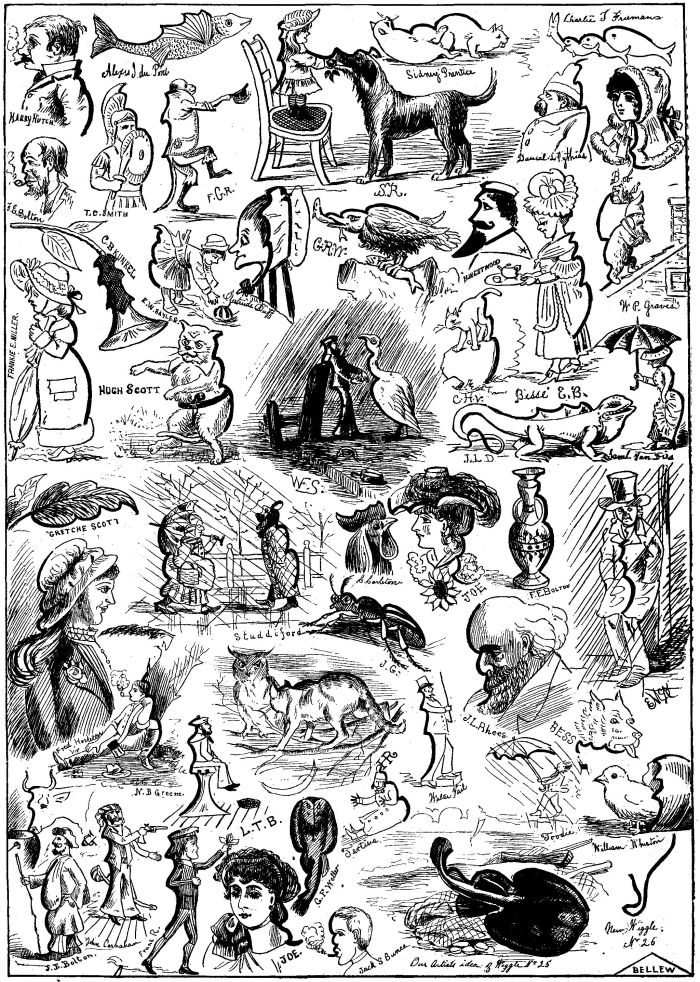
Successful Wiggler—G. F. Weller.
Correct answers to puzzles have been received from Lottie and Arthur, Anna Whitey, A. E. Cressingham, Samuel Bronson, Wroton Kenney, William A. Lewis, Jennie Day, Elsie T. Carr, Laura Richards, Johnnie Bigelow, Fred Smith, "Icicle," Georgie Wardell, Kittie Lerois, Percy Stuart, Elsie D., Grace Cooley, Eva M. Stevenson, Martin Best, Francis, "Lodestar," May Sherman, Dean Crawford, Robert Tice, and Jacob Rollauer.
[For Exchanges, see 2d and 3d pages of cover.]
SOME ANSWERS TO WIGGLE No. 25, OUR ARTIST'S IDEA, AND NEW WIGGLE, No. 26.