THE EAST-SIDE GIRL AT PLAY AND AT WORK.
Reading edition
BY DR. JANE E. ROBBINS,
HEAD WORKER OF THE COLLEGE SETTLEMENT.
A "LITTLE MOTHER."
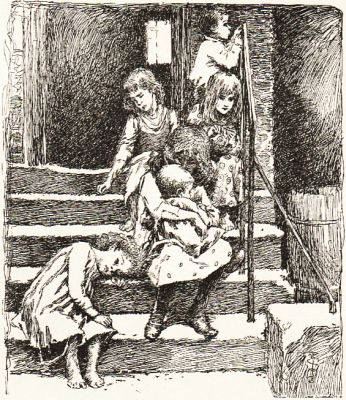
The first thing most of the New York children learn is how to mind the baby. Even a small boy soon learns how to "hush" a child in his arms, and almost all the small girls are good little mothers. The babies on our block are the most beloved little people you ever saw. There are a great many of them, and they tumble around on the sidewalks so that we have to walk very carefully; but somewhere near there is generally to be found a little girl who loves that baby with all her heart, and the more trouble the baby is the more she seems to love it. The little girl in a rich man's family may love her little sister very dearly, but the baby can't be quite so dear to her as it is to the little girl who must save every penny for car fares, so that on the hot days she can take the baby to the dock, where the air is cooler.
"My knee hurts awfully," said one little girl to me. "I just have to hop around on one foot when I am carrying the baby"; and she looked very much surprised when I said, "But you must not carry the baby while you are sick."
All through the summer months the children are kept down on the street so that they can have the fresh air. The baby is generally in his carriage, but the two-year-old child runs about, and he must be carefully watched, for there is danger of his falling under the horses' feet. Sometimes the little mother is careless and one of the youngsters is lost. Then there is a great excitement till the lost child is found at the station-house, usually busy making friends with the policemen.
By the time a girl is eight years old she has not only learned how to take good care of the baby, but she has generally learned also to run on errands, and to buy groceries, and even meat, and she can be trusted with the keys. One often sees a little girl five or six years old playing on the street while her mother is out, and holding in her hand a big bunch of keys, so that, if necessary, any of the family can get into the house. The children in all parts of the city, whether they are Italian or German or American, learn these same things.
Many of the children bring with them from Europe ways that seem very odd to us, but they soon learn from the other children the New York customs. The most marked differences are connected with the differences in the religion of their parents. Some of the children say very funny things. One little Polish Hebrew child named Rachel, while she was in the country, helped to chase an old hen and her brood until several of the chickens were killed. After they had been buried, Rachel said, "I dassent go over there; that's a Christian burying-ground." No one could find out how she knew that the chicken was a Christian and not a Jew.
JUST THE SAME KIND OF CHILDREN WE FIND EVERYWHERE.
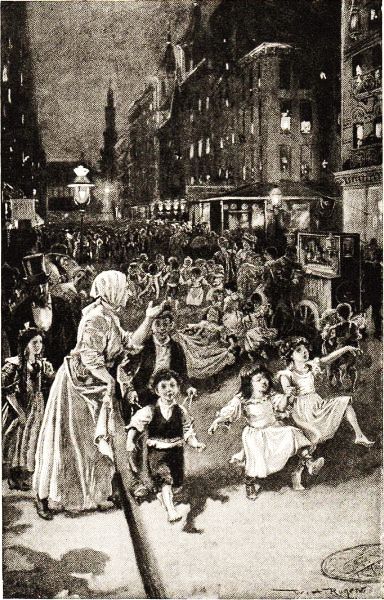
The children play a great many ring-around games in the evenings. The German children sing "Liebe Mary, dreh dich herum," and other German songs; and all over the city they sing, "Lazy Mary, will you get up?" and "All around the mulberry bush," and "I came to see Miss Jinny Ann Jones, and how is she to-day?" They play tag and hide-and-seek, and, sitting on the door-steps, they play a buttermilk game, where no one may laugh, and a great many other games. In some parts of the city the boys and girls play with one another, as they do in the country, but in other neighborhoods the girls play alone. They are fond of dancing, and the Italian man with his piano is often surrounded by fifty or a hundred little girls in the middle of the street, waltzing gracefully, and making for the passers-by a very pretty picture. In the evenings they are generally allowed to stay down on the street until nine o'clock; but that is the hour when careful mothers see that their younger girls are all at home, though the older girls are often allowed to stay out until ten o'clock. The girls go to school until they are thirteen or fourteen, and they study with eagerness, and worry over their lessons. In New York it seems to be an especially great calamity to be kept at home for even one day, and the little girls give the doctors much trouble by not telling when they have sore throats or feel sick, for fear that they will be told that they must not go to school. At half past three they come home carrying great bundles of books, and you wonder how they have time to play or to do any house-work. But Saturdays are very busy days, and they learn to scrub and to clean the house, and somehow they learn to wash, so that little girls of twelve years of age often show me dresses that they have washed and ironed themselves. They don't know so much about sewing, but most of them learn to crochet lace, and they have little crocheting schools in the summer, where they teach one another. They sit in "the yard" or in front of the house, and sometimes each girl brings a penny and they have a party. They have more pennies than country children, I am sorry to say, for they buy too many candies and cakes. They teach one another all the songs that they know, and sometimes one girl tells a story or reads to the others. When the mother knows how to sew well she generally teaches her daughters, but many of the mothers do not know much about sewing. There are sewing-classes in the public schools, but these classes are so large that the children generally seem to learn only how to sew badly.
They want to know how to sew, and nothing makes a lady so popular with school-girls as to tell them that they can have a sewing-class at her house. Then if after the sewing there can be stories and singing and games, the girls are sure to have a fine time. They save their pennies to buy the cloth on which they work. I have seen many a mother much pleased with the tiny stitches her daughter has learned to make. A blue cheese-cloth duster, neatly hemmed, makes a nice present from the youngest ones to their mothers, while the older girls make clothes for themselves or for the children at home.
In the house where I live there are a good many young women who are fond of teaching, and they have friends who come and help with the sewing-classes, so that we have seven sets of school-girls every week. They give themselves names like the Rosebuds, the Sunshine Club, the Butterflies, the Rainbow Club, and the Bluebells. There are many other girls that we know who are waiting anxiously for their chance to come, and the mothers beg us to let their daughters join the sewing-clubs. We have cooking-classes a few times a week when our cook can let us have the kitchen, and these are liked the best of all. The girls have the fun of eating what they have cooked, and they have a jolly time even while they are washing dishes. The older girls who go to work like the cooking-classes, too, and some of them, when they get home early on Saturday afternoons, make biscuit and cookies and apple-sauce for supper. One girl made cookies for the callers who came to her house on New-Year's day, and they liked them better than cake.
The girls enjoy the cooking more than sewing, because they are tired after their day's work. The younger working-girls want mostly to talk together and laugh and sing and dance. Sometimes we are very sorry for the fifteen-year-old girls, they look so young, and they work very hard, but most of them are quite light-hearted, after all. The little cash-girls often tell us what fun they have, and even the flower and feather girls and the girls in the box-factories and in the candy-factories enjoy so much being with one another that they forget all about their troubles. At the noon hour they sing and tell one another stories. They bring their lunches from home or they send a girl out to buy the lunch, and some of these are the girls who make their noonday meal of cream-cakes and pickles. They like to read the same books that girls read everywhere, but sometimes they do not understand how other lives can be so different from theirs, how other girls can have their own rooms all to themselves, and can have all the nice things that come to girls who have never lived in small rooms, with nineteen other families in the same house.
The most wonderful thing that comes into the lives of city girls who have grown up on the crowded East Side is their first trip to the country. They don't know the most ordinary things. One of my friends, who had tried every word she could think of, finally told some children to run up on the fire-escape, and they all scrambled for the piazza, as she thought they would. The country seems very lonely at first, and the dark rather terrifying. They have never known what dark is, for lamps are burning all night in most of the tenements. The stillness, too, is impressive. One little girl said, "There is not any noise here except the noise we make." When they get over their first sense of loneliness, they begin to see all kinds of wonderful things, and some of the girls I know are so much interested in the leaves and trees that they soon know more about the trees in midsummer than many a country girl. Their only knowledge of the spring is gained from the popular songs. They have heard in that way of the flowers that "bloom in the spring." They sometimes expect these songs to be literally fulfilled. "There's the farmer," said one child, "and there's the corn, but where is Johnny?" One child I found on the roof of the house where she lived playing going to the country, and she said she played it every day. We wish sometimes that we could pick up all the children, and carry them off where fresh air and green grass belong to all.
The girls in the country are sometimes surprised to see what good manners our little girls have. One girl I knew said to her father, "I never saw such polite girls; they say 'thank you,' and 'you're welcome,' and 'excuse me,' when they are just playing with one another." One reason for this is that they see so many people all the time that they are not self-conscious and shy, and when they think that it would be nice to say, "Excuse me," they are not afraid to do so. Then, too, they grow up where there are so many people that each one must learn to be considerate of his neighbor, or there would be continual trouble. We find some spoiled children here as elsewhere, but generally they have learned to give up their own way because of the younger ones, and there is really very little quarrelling. We are often surprised when we think how seldom we hear a child cry. They take care of one another and bring one another up, and though the result is that they are not so well taught as they ought to be—and I am sorry to say they don't learn obedience as they should—yet each one finds out that she must not expect too much for her own share.
A stranger in New York, seeing the crowds of people and the sidewalks swarming with children, might go away with a feeling about a tenement-house neighborhood quite different from the feeling of one who knew the people well. The houses, indeed, are often as bad as they can be, for without light and air a house is, of course, totally unfit for human habitation; and there are also some very unhappy homes; but as a rule up through the tenements at six o'clock you will find the father reading his paper or holding the baby while the mother cooks the supper, and the children come climbing up the stairs—just the same kind of children that we find everywhere.