BIRD TAMERS AND TAMING.
Reading edition
BY W. WARREN BROWN.
George Moore from New York was visiting his cousin Frank up in New England, and was being shown Frank's pet birds.
"I had a time catching that oriole," said Frank. "The nest was on the end of a slender limb of the big elm back of the barn. The oriole is the smartest bird we have, when it comes to house-building, always putting his hanging nest where even a squirrel is afraid to venture. I got Jonah, one of father's hired help, to hold the longest ladder we have under the nest while I climbed to the top of it. Even then I could barely reach the birds, and had hardly put my hand on a young one when Jonah, who was puffing and blowing with the strain of holding the heavy ladder, and me on the top round, nearly lost his balance, so I grabbed my bird, shinning down in a hurry, I tell you. The one in the last cage is a bluebird. I took him out of a hollow in an old apple-tree over there," and he pointed out to George a fine old orchard.
The following morning the cousins were up at break of day. On their way down stairs Frank said: "Father only allows me to keep wild birds in cages on condition I take good care of them. It's my first work in the morning. Come and see what I do."
The birds were wide awake, and did not seem at all afraid of their young master as he quietly withdrew the trays on the bottoms of the cages, refilling them with sand from a handy barrel. Then fresh water was supplied to each one, and they all took a drink, throwing their heads back after each sip. From a covered tin the boy filled the linnet's seed-cup, first blowing out the empty shells. To the others he gave soft food.
"They are soft-billed birds, and must have soft food," he explained, "They are now fixed for the day," said Frank; "and by the time breakfast is ready you'll hear some music."
After the birds came the ducks, chickens, and pigs, all receiving careful attention, George going the rounds, and laughing to see how the different creatures expressed their satisfaction for the meal.
Their own breakfast was now announced by a loud toot from the horn. The pure country air together with the early rising had given George a fine appetite as he sat down to the plentiful meal spread before him, and for a time neither of the youngsters had a word to say.
The clatter of the knives and forks seemed to excite Frank's pets, for the bluebird, seconded by the oriole and linnet, gave them a sweet concert.
Uncle John replied, when his young guest expressed his pleasure and surprise on hearing their fine notes: "My son has always been fond of the wild birds, wanting, when he was younger, to make a collection of their eggs. I could not allow it, as it is cruel to rob nests, but I knew the birds, both young and old, have numerous enemies. Snakes, hawks, owls, and other vermin every year kill so many of them that it's only by the sharpest lookout the old birds escape at all, while the younger are devoured as soon as found. Therefore I consented to his having these birds in the house, taking one young one from a nest of four varieties of birds he fancied. These little captives, who, if they have not their liberty, are safe and well cared for here, and besides, being taken so young with only their pin-feathers on, they do not know what freedom means as trapped old birds would do."
Breakfast over, the boys started on an excursion to Black Pond, half a mile away, a stretch of water sparkling under the sun's rays like a sheet of silver.
The route led through a winding lane. In one of the fields by the side of it, surrounded by a higher fence than usual, the city boy noticed a very large black and white cow, as he thought, and was in the act of vaulting the rail to examine her closer, when Frank caught him by the leg.
"Thunderation! Don't you know a bull when you see him?" he shouted. "He is dangerous, and I don't dare to go in that pasture, though I'm sure there is a bobolink's nest in it that I want to see."
George felt ashamed of himself at such a mistake, and determined he would not show his ignorance of the country again. By this time the boys were within a hundred yards of the pond. Frank proposed a race to see who would get there first. George was ready for anything. Away they started, running side by side till three-quarters of the distance was passed. Here George took the lead, holding it to the water's edge. Frank opened his eyes, for there was not a boy in F—— his equal in a foot-race.
"How did you do it?" he cried, excitedly.
George's eyes sparkled as he answered, "One has got to know how to use his legs to play good baseball."
Birds were numerous now, and Frank told their names, with something of their habits, to his companion as they watched them. "Look at that fellow with a gray body, in the thicket. It's a cat-bird, a good singer, and mimic besides. There are a lot of their nests about here. Black-snakes eat the young ones. They can climb bushes too. Two weeks ago on this very spot I noticed one of these beauties flying excitedly in and out of the alders. I thought something was up, and crept softly into the thicket. Sure enough, twined around a limb within a foot of a nest filled with young cat-birds was the biggest blacksnake I ever saw, over four feet long, and his body was as thick as my wrist. Luckily I had a stout stick with me. He tried to get away, but I settled his snakeship with a whack as he reached the ground."
George wanted to see a blacksnake.
This wish was soon gratified, for as they passed some granite bowlders a snake, which was sunning himself on a bit of sand near by, made for the rocks. The boys grabbed stones, throwing them at him and killing him before he could gain cover.
"The birds will thank us for that," said Frank. "I've no doubt this scamp has devoured a good many of them this summer."
The boys then made a regular hunt through the alders, finding many nests, mostly with young ones in them, as it was the first of July, the experienced country lad discovering most of them, as he knew where to look for the nest of each variety, whether on a high or low tree, or on a bush or on the ground. Still George had the pleasure of running onto two or three nests himself. One was the cat-bird of Frank's story. The young ones had flown, but an old one soon appeared, scolding and flying close to the boys' heads.
"Look sharp, George, the little ones can't be far off, I know by the way the bird acts," exclaimed Frank.
THE LITTLE CHAP COULD FLY, HOWEVER, AND REFUSED TO BE CAUGHT.
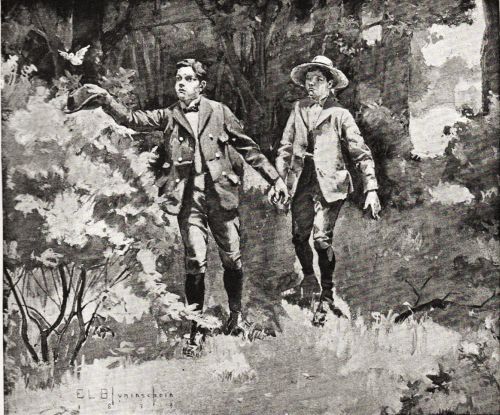
True enough, after a short and exciting search George spied one on top of a bush. He knew it was a young bird by its short tail. Creeping cautiously up, the boy made a dash for him. The little chap could fly, however, and refused to be caught, hiding himself so cleverly that though the hunters looked for half an hour, they did not see him again.
Along with the cat-bird the brown thrasher and wood-thrush rear their young. A nest of the former was discovered in the fork of a bush near the ground. The mother was on it, allowing George to almost put his hand on her before she flew, to alight close by, making a curious clocking noise. The nest contained four little ones not over a day old. The cousins admired them, but took care not to handle the naked babies or disturb their home. Frank took a small book from his pocket and wrote something in it.
"What's that for?" asked George.
"Oh, I'm putting down the date of their birth. I like to know when the different birds hatch or lay their eggs. To-night I shall transfer this note into a book full of them. You shall see it if you like."
They spent the morning and many other mornings searching the fields and woods, peeking into bird homes, and learning a good deal about them, and George, before his departure, began to love the happy days spent in this fascinating way.
Their afternoons were passed on the surface of Black Pond catching pickerel or gathering lily-pads, and giving the youngsters great sport.
George found his vacation ended all too quickly, but gladly promised to come again the next summer, inviting his cousin to his city home for the Christmas holidays.
As he boarded the cars he said to Frank, "I forgot to mention it before, but in New York there are lots of stores that sell all kinds of birds from South America, England, and everywhere, so when you are with me 'we'll take them all in.'"
This promise was so alluring to Frank that he replied, "Look for me the day before Christmas, for I'm coming, even if I have to walk all the way."