ELK AND BLUEBIRD.
Reading edition
BY FRANCES McELRATH.
"Now, look, Bluebird. See how wise the little rough-coat is. Up! Big chief! March!"
Elk accompanied his commands with expressive actions. He waved his hands upwards, threw out his chest, and strutted off along the river-bank. The young bear he was training stood up on his hind legs and comically repeated his movements.
Bluebird clapped her slender brown hands in delighted applause.
Elk gave a short, pleased laugh. He regarded his accomplished pet affectionately. "That's enough for to-night," he said, patting the brown head. "Bluebird," he added, glancing over towards the Cheyenne village among the straggly trees a few rods back from the river, "let's go see what Yellow Stripe's boy is saying to Much Tongue."
A white lad, whom Elk and his sister recognized as the son of a cavalry officer stationed at the adjacent fort, had just ridden up to the Indian camp, and was leaning across a rifle on his knees, talking to Harlow, the interpreter, called by the Cheyennes Much Tongue.
Elk and Bluebird had attended school on the reservation since their people had surrendered to the military authorities, and they understood the white man's language.
The sun was just setting. Its long last rays cast reflections across the prairie like gigantic finger-marks. It was late August, and some good-sized rabbits were abroad amongst the sage-brush at that hour. Alan stopped to fire at them now and then.
Elk and Bluebird, watching his receding figure, saw him dismount and creep cautiously along the ground for some distance once before firing. Afterwards he spent several minutes apparently searching amongst the bushes. Then he remounted his horse and rode on home.
"He's lost whatever he shot at," remarked Elk.
He and Bluebird were hunting the bear, whom they had forgotten for a moment, and who, it seemed, had run away. He was not very large; his body might easily be concealed in the high sage. They whistled and called for him.
"Here he comes," Bluebird said at length.
The bushes rustled in a line towards them, and presently they saw the little fellow. He seemed to be struggling with difficulty to reach them. They could hear him pant.
Elk sprang quickly to him. He fell on his knees beside the bear, uttering a cry.
"Oh, Bluebird, he is hurt!"
The cub's breast was covered with blood. His pink tongue lolled out of his month. He ceased his efforts to walk when Elk reached him. He sank down in a helpless heap, and looked imploringly up into his master's face.
Elk hastily parted the thick fur to discover the wound. He gave another sharp cry.
"Oh, Bluebird, my little dear one is dying! He is shot! He is shot!"
A moment later the bear fell over lifeless.
Elk flung himself upon his face in a passion of tears.
Bluebird took the bear's head between her hands and blew into his face. But he was past any aid in her power.
"Poor little thing!" she murmured, patting it gently down; "the white boy did not know who you were!"
Elk suddenly sprang to his feet. He looked across the dusky prairie to Fort Strong, where lights were beginning to twinkle, and shook his fist.
"Mean coward!" he shouted, menacingly. "I'll pay you back for this! You think because you belong to the strong white tribe that you can do whatever you choose! But I'll tell you that when a Cheyenne's heart gets bad he can find a way to revenge himself!"
"Oh, Elk, don't!" Bluebird laid her hand on her brother's arm. She looked entreatingly into his face, distorted with grief and anger. "I'm sure Yellow Stripe's boy didn't know he was your pet," she said.
"Didn't know? Didn't care!" retorted Elk.
He dropped upon his knees, and drawing the knife from the leather sheath hanging from his belt, began to dig at the darkening earth.
"I'm going to bury him," he said, in a short, hard voice.
Bluebird took out her knife and proceeded to help him.
They dug away without talking. Elk's anger grew as he worked, as if the dark silence about him was filled with a host of malicious whispering spirits.
"Lone Dog is right," he broke out, bitterly, after a few minutes. "These white people are never really our friends. They conquer us because they are rich and powerful. Then they keep us down like dogs. I'd rather we'd all been captured by the Sioux and killed outright."
"Oh, Elk, think what you're saying!" Bluebird remonstrated. "You know the soldier chiefs treat us kindly. Remember how often we used to be cold and starved in the old life, and how we lived in fear day and night of enemies, and think of the food and blankets and quiet homes we have here! And, Elk," she added, somewhat shyly, "it is good to have learned the things they have taught us. The white people's way of acting towards each other is wiser for happiness and peace of the heart than ours. We have learned that it is better not to seek revenge, haven't we, Elk?"
Elk's fierce cut at the ground expressed his mental determination to sever himself from all such opinions.
"You always talk that way, Bluebird!" he cried, irately. "But no one except a mean coward will overlook an injury, Lone Dog says."
"Oh, Elk, don't listen to the hard sour things Lone Dog says!" Bluebird beseeched.
The boy made no reply. The grave being large enough, he quietly laid the bear in it, refilled the hole, and led the way home.
"Ride away from the angry tongue which meddles in a stranger's quarrel, for the fawn with the bit ear shall recover, but if by evil counsel he is made to turn furiously on the wolf he shall surely be torn in pieces."
"Yes, mother, that is why I say I wish Elk would not talk with Lone Dog. He is the angry tongue that is always trying to stir up the boys to do mischief."
Bluebird's voice was seriously troubled. She scraped away thoughtfully at the fresh hide of a buffalo that she and her mother, Ready Proverb, were getting ready to tan.
"Lone Dog is like the lame coyote since he was put in the guard-house for stealing," observed Ready Proverb. "He will not rest until his whole band has felt the snare which caught him."
"Elk's heart is so bad over the bear's death, and he has been in Lone Dog's tepee all morning," said Bluebird.
"Elk is the grandson of my father Wise Eye," the mother responded, placidly; "he will detect the hidden iron that scorched the hide of the branded bull! He will not suffer to be led by Lone Dog, who is the dirt of the tribe! Elk shall avenge his wrongs himself in due season! He shall be the powerful warrior of the Cheyennes! He shall count his coups, and they shall be as many as the hairs on his head! He shall lie in peace at night on a bed made of scalps of his enemies!"
"Mother doesn't understand," Bluebird thought, sadly.
She suffered the intense pain the children of a people in a state of transition from savagery to Christianity must suffer in the realization that their parents have failed to grasp the new truths already embraced by their more teachable minds.
Ready Proverb, however, according to her light, was a good mother. She was proud and fond of her children.
"Elk," she presently remarked, "ate very little breakfast, and when a boy's stomach is empty his heart trails on the ground. You better go dig some turnips for his dinner. Ho always likes turnips."
Bluebird cleaned her knife in the earth and slipped it into its beaded sheath, and started at once after the wild turnips. They grew profusely among the cottonwoods half a mile below the camp.
Bluebird had nearly reached the spot when a strange noise attracted her attention. Looking around she found that it came from a large old tin kerosene can standing a short ways off. She walked towards it curiously.
All of a sudden Elk flew out from behind a tree.
"Don't touch that!" he cried, warningly.
Bluebird started in surprise at finding him so near. She glanced cautiously into the open can. She recoiled from it with a horrified look.
"What are you going to do with those rattlesnakes, Elk?" she exclaimed.
"Something." A dark flush spread over the boy's face. He looked sullen and jaded.
Bluebird forgot her consternation in a flood of compassion for her unhappy-looking brother.
"I've come to dig turnips. You'll like them for dinner, won't you?" she said, pleasantly.
"I don't want any dinner," he answered.
"But you ate hardly a mouthful of breakfast."
"I ate enough," returned Elk. "I'm not going to eat so much hereafter. We reservation Cheyennes overfeed with three meals a day. The braves grow fat and flabby. They cry like children when they're hurt." He colored shamedly, remembering how he had wept for the bear. He gave the can a shake. The snakes hissed, and his eye flashed sharply. "I'm through living the soft life of a white man," he added. "I'm a Cheyenne!"
In moving, the light sleeve of his calico shirt slipped up and revealed to Bluebird his arm covered with horrible gashes. Elk had been torturing himself to test his endurance, after the dreadful old tribal custom. Bluebird was convinced that he was acting under Lone Dog's advice. A dread of what her brother might be led to do next by the bad man formed like a layer of ice on her heart.
"Elk," she begged, tremulously, "please come home to dinner. I'm sure you've courage enough. I don't think it's weak for a brave to cry when he loses a thing he loves. If you'll eat something perhaps you'll feel differently."
Elk shook his head resolutely.
He did not return until evening. During the afternoon Bluebird's anxious eyes spied him riding along the trail skirting the Bad Lands, making for the town across the river beyond the fort. She felt certain that he had made the long circuit to avoid attention. She wondered why he was leading his second pony.
When Elk returned home he did not have the second pony. He had bartered it for an old rifle and some cartridges. He supposed the weapon was concealed beneath his blanket, but Bluebird, beading a moccasin beside the tepee door, observed it as he passed in. She said nothing about it, but the circumstances added to the weight of her anxiety over Elk's strange actions.
The next day was Wednesday. Elk had not relaxed his gloomy silence since the bear's death. He scarcely spoke to any one; he sulked off by himself.
Bluebird had an errand at the trader's this morning. She was crossing the prairie to the fort when, glancing over to the west where the hills lay, she saw Elk disappearing into the cañon beside Flat Butte. She looked after the lonely figure with a sigh.
She was kept waiting at the post trader's for quite a long time before the clerk could wait upon her. At length, while she was selecting her beads, Alan Jervis and an officer came sauntering down the long store past where she stood.
Alan carried a quirt, and he had the cruel little steel wheels which the white chiefs used to make their horses go fast attached to his boot heels. Bluebird understood that he was dressed for riding. She heard him say to the officer:
"Father said I might come out to the camp for a few days, and I'm going now in about an hour. I know the way, and Harlow has told me of a short-cut the Indians take through a cañon in the hills."
"Past Flat Butte, isn't it?" inquired the officer. "That route is considerably shorter than around the hills, but it's a bad bit of travelling through the cañon. You must look out for the fissures in the ground: the sage completely covers some of them, and you're liable to fall into one and break your neck."
"Harlow warned me," replied Alan.
The two passed on, leaving Bluebird in a strange tumult of troubled thoughts. She began all at once to connect Elk's trip to the Bad Lands that morning with Alan's intended journey through the desolate, rarely travelled cañon.
Elk's sworn purpose to revenge the bear's death, his conversations with Lone Dog, his self-torture to prove his hardiness, the grewsome can of rattlesnakes, the rifle—all these things came before her mind in an ominous jumble.
What did they all mean? What was Elk about to do?
Bluebird forgot her beads. She hurried out of the store through the rear exit, which opened onto the prairie. She started at a rapid pace across the stretch to the hills. She had no idea what she was going to do other than that she must find Elk, and in some way, even at the risk of her life, prevent an attempt on the white boy. Oh, Elk must not hurt him! Elk, when he was his right-minded self, saw, as she did, that revenge was low and cowardly, and did not mean manliness, as they had been led to believe in the old days.
Moreover, she knew that Elk would be summarily dealt with by the fort authorities if he should molest Alan. If he could not escape them by running away he would be put in prison. The white people hanged men for killing others. It was by such stern laws against wrongdoers that they kept their state of peace.
Bluebird's heart quaked and her steps went faster. It was a sunny morning. She grew very hot. The perspiration poured off her face. She flung away her blanket without stopping. Now and then she glanced hurriedly back to see if Alan was coming. She had just reached the mouth of the cañon when she saw him. She was very tired by now, but she summoned what remained of her strength, and started up the narrow pass with fresh vigor.
Alan was not many minutes behind her.
Elk stopped his pony just outside the Cheyenne village to watch Alan's horse going across the open space from the fort to the hills. He had returned from the cañon by a roundabout way, and had escaped Bluebird's observation.
"He'll soon be there," he thought. An irrepressible shudder went through him. He could not see the rider at that distance, but the sun shone on the white horse, and he knew it was Alan's.
As he watched it the memory of a game of marbles he once had played with Alan came involuntarily to his mind. Yellow Stripe's boy had played generously. After the game he had presented Elk with a large bag of marbles. He was a brave white boy. Elk always had liked him until he had killed the bear.
Elk looked after the white speck irresolutely.
"Windfoot might get there even now before his slow horse," he was thinking. His heart beat hard; his body leaned unconsciously forward towards Alan.
Impelled by a sweep of changed feelings, he suddenly raised his quirt to start up his pony, when a dark hand fell with deaden force upon his arm.
Lone Dog's evil face looked up at him. "I've put the paint sticks and a looking-glass in the twisted tree," he whispered.
Elk looked at him undecidedly a moment. Then he heavily replied, "Very good," and turned his horse slowly in among the tepees under the cotton woods.
Lone Dog smiled satisfiedly as he limped home.
Elk dismounted at his home and went in. Presently he came out with the rifle he had got the day before. He carried it cautiously concealed. The young Cheyennes were not allowed to have fire-arms.
He glanced about a moment for his mother. Then he told himself he was glad she was away from home. Reservation life certainly had the effect of making a brave weak-hearted in an enterprise. He felt a moisture about his eyes as he remounted his pony and rode on among the trees down the river to a desolate spot some distance below the camp.
Three-quarters of an hour later he emerged from the trees quite changed in appearance. He had painted yellow lines like sunrays from the corners of his eyes and mouth; on each cheek he had painted a grotesque red spot. He had braided a defiant scalp-lock on the top of his head. He was, in fact, preparing to join a band of hostiles in the north that Lone Dog had directed him to.
It would not be safe, Lone Dog had told him, to remain any longer in the vicinity of Fort Strong. Besides, it was time that he was going on the war-path and making a name for himself.
He tried to grunt "Huh!" in the savage, manly manner he had heard the warriors do. Somehow it sounded rather weak. He did not dare look round towards home as he rode rapidly off for the Bad Lands. Reservation life certainly turned men into children!
Elk had almost reached the hills when, far down to the south of him, he saw something emerge from the hills close beside Flat Butte.
His keen-sighted eyes peered sharply. It was a boy leading a horse—a white horse. And something was on the horse's back.
Elk stopped his pony and looked excitedly. Could it be possible that Alan had escaped, after all? What would Lone Dog think if he knew how relievedly Elk's heart was beating?
Why was Yellow Stripe's boy walking? The pack on the white horse was a brilliant blue. It looked familiar.
Elk, with a strange presentiment of what had happened, whipped up his pony and started wildly towards the party. He rode like a wild man to reach them. Alan stopped the horse and waited when he saw him coming.
Bluebird, her head and right arm swathed in bandages torn from Alan's shirt, sat upon the horse. She looked towards Elk. The cruel scratches on her face protruded beyond the cloths. Her eyes showed intense suffering.
Alan began explaining how, riding up the cañon, he had found Bluebird in a cut in the ground, clinging to a root of sage-brush to keep herself from falling to the bottom.
Elk scarcely heard him. He sprang off at Bluebird's side; his face had grown suddenly sharp and thin with terror.
"DID ANYTHING BITE YOU, BLUEBIRD?" HE SAID, HOARSELY.
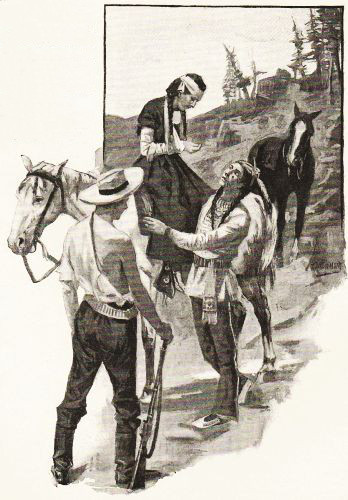
"Did anything bite you, Bluebird?" he said, hoarsely. "Do you feel yourself swelling anywhere?" His sister's soft eyes poured a flood of sorrow into his upturned face.
"No, Elk; I caught hold of a root and held on, and the snakes could not get at me," she said, in Cheyenne. A shudder went over her. "I could hear them rattling beneath me, but the brush was between us."
"I'm certain Bluebird's fall saved my life," Alan was saying, earnestly. "The bottom of that pit was fairly alive with rattlers, and my horse would have crushed right down into them, and then we'd both have been done for. Somebody had covered the hole with dry brush and rubbish and put loose earth over it. Nobody would have guessed it was a hole. Bluebird says she was running right across it. I think it must have been intended for a bear trap. Do you know there are bears about? I saw one Monday evening, and fired at it, but missed it."
Bluebird shot a swift, meaning glance into Elk's eyes. "The white boy saved my life, Elk," she said. "I couldn't have held on with one hand a moment longer. My right arm broke when I fell, I think, and I couldn't use it. But, dear Elk"—she tried to lean towards him as she added rapidly, in Cheyenne—"it's all right that only I am hurt. I went to the cañon to save Yellow Stripe's boy—and you."
Elk had a sudden conviction that the teachings of reservation life had not made his sister weak-hearted, at all events. There was an appeal in her tones that he did not attempt to resist. She was offering her own sufferings in atonement for Alan's fault. Elk did not let her sacrifice go for nothing. He took a step towards Alan, and extended his hand.
"Hough!" he cried, in a firm hearty voice, which begged forgiveness and pledged his own friendship.
Elk gave Alan his pony to carry him home. He took charge of Bluebird on the horse.
Lone Dog came limping a way out to meet them as they neared the village. His sinister eyes inquired of Elk how his villanously counselled scheme happened to miscarry.
Elk feigned not to see him. He passed him by with a high countenance. His momentary apostleship to the disturbers of the youths of the village was over, never to return. Bluebird saw that Ready Proverb was right. Now that the black veil of revengeful passion had swept by and his right vision was restored to him, the grandson of Wise Eye was not indeed to be led by the dirt of the tribe!