THE BELGIUM ARMY PLAYING AT WAR.
Reading edition
BY V. GRIBAYÉDOFF.
The hardships of militarism are, perhaps, nowhere more apparent on the other side of the water than in the little kingdom of Belgium. She lies between France and Germany—we might say between the bark and the tree—and should war break out between these two great powers, there is little doubt that her neutrality would be violated by one or both of them, and the war carried on within her borders. Such, at all events, has been the argument of the advocates of military expenditure; and that the Belgian Parliament has not turned a deaf ear to it is clear from the enormous credits voted of late years for the construction of a line of forts along the River Meuse, between Liege, the great manufacturing centre, and the fortress of Namur; also for the general strengthening of the defensive forces of the kingdom.
Here, then, is a nation of little over six million inhabitants, occupying an area about half the size of New York State, of themselves industrious and peaceable, yet obliged to contribute millions and millions yearly for the support of an army which, including the militia, exceeds two hundred thousand men. What would the tax-payers of New York, with its population of nearly six millions and its militia of twelve thousand men, say to a proposition to put them on the same military footing with Belgium?
Inconceivable as the proposition would appear to us, the Belgians are thoroughly resigned to their fate, and since the young Fleming or Walloon who draws his number knows that he must serve his time, willy nilly, he does it like a man, and even puts on an appearance of satisfaction, for it is considered bad form to betray one's disappointment. Fifty thousand young men are annually called, and of these twelve thousand are selected by the drawing. Their term of service is eight years, four under arms, and four in the reserve.
BELGIAN CAVALRY.
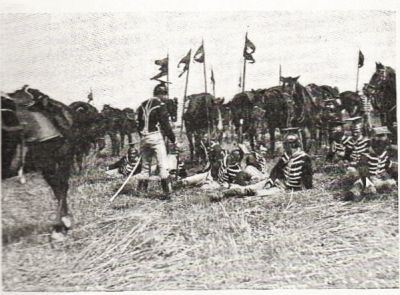
I have heard competent military men, familiar with the methods employed in the Belgian army, express the opinion that, for its size, it is one of the most perfect fighting-machines in Europe. I must say that my own experience during the regular summer manœuvres this year in the province of Namur was such as to incline me to share that belief. To begin with, the men are of excellent physique, far larger in stature than the French, though perhaps a trifle below the North German standard. A Belgian regiment contains about an equal proportion of blond and dark haired men, and it is a safe plan to class the former as inhabitants of the Flemish provinces—that is, Flanders, Antwerp, Limbourg, and North Brabant—and the latter as coming from the Walloon section—viz., Hainault, South Brabant, Liege, Namur, and Luxembourg. The Flemings are of Germanic extraction, and speak a language akin to Dutch; the Walloons are an energetic Celtic race, with a proud military history behind them. The two elements, leavening each other, form a compact yet pliable mass, the best of material in the hands of a good commander. French is the official military language; but the regulations and orders are also printed in Flemish, which has a recognized legal standing in the country.
"GUIDES" GETTING DINNER IN THE FIELD.
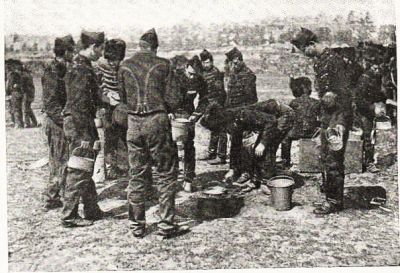
The most picturesque body of troops in the Belgian army are the dragoons, or "Guides." One of the accompanying photographs shows a party engaged in preparing a meal in an open field. The men in the foreground are wearing the forage-cap, but when on active duty they don the imposing bear-skin busby seen on one or two of the figures in the rear. They are the favorites of King Leopold, himself an ardent military man, and the barrack of the 1st Regiment near Brussels is a marvel of good accommodation and comfort. The "Guides" are picked men, the majority Walloons. I have seen a squadron of them charge furiously across a plain bestrewn with ponderous logs without a break in their line. Their horsemanship is above praise. Besides its two regiments of "Guides," the Belgian army has two regiments of chasseurs, or light cavalry, and four of lancers—all with very showy uniforms. The predominating colors of the cavalry are blue-gray, light blue, pink, dark green, orange, etc. They use the same uniform for campaigning as for state occasions; nevertheless, I did not see a really shabby-looking soldier during my stay in Belgium.
AN INCIDENT OF INFANTRY DRILL.
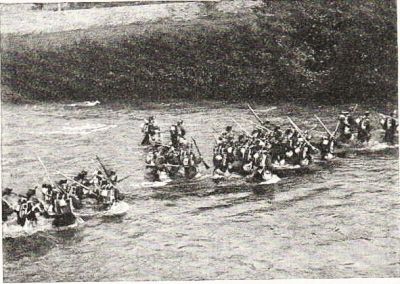
The infantry is, of course, the mainstay of the army. It is also its hardest-worked branch. The photograph showing a detachment of foot-soldiers up to their waists in water will certainly not suggest a scene at Peekskill or any other American practice-ground. It is a scene I witnessed many a time, however, in Belgium. Nor must it be imagined that the "trick is done" when the soldiers have reached the opposite shore. Weighted down with pounds of baggage—knapsacks, ammunition-pouches, weapons, and clothing—and sopping to the skin, the poor fellows often have hours of mountain-climbing to undergo before the welcome bugle-blast brings them a few hours' respite. This is warfare indeed—all but the actual killing.
The method of preparing meals is shown in the "Guides" photograph. This digging a shallow trench in the ground, making a fire of stray branches, and setting the pot on to boil would hardly impress one as being conducive of happy results, to the digestive organs. And yet I myself had the interesting experience not only of watching the preparation, of a ragout under these peculiar circumstances—that is, in the open field after a hard day's march—but also of sampling the result. How, under such adverse conditions, the regimental cooks ever managed to produce as delicious a stew as was offered me on this occasion is a mystery I have never been able to solve: the meat, the potatoes, and some gravy stock in a bottle the men carried with them in a cart. For the rest—carrots, turnips, and the "fines herbes" that constitute seasoning—they had to scour the neighborhood. Having secured these concomitants, the work of cooking seemed to them child's play.
THE TRENCH DUG IN THIRTEEN MINUTES.
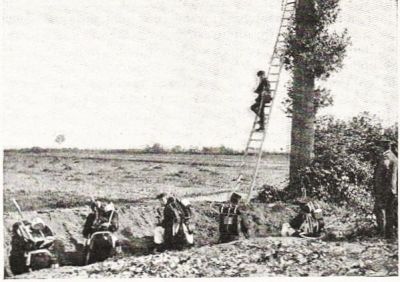
I doubt if even the French soldiers live as well as do Belgium's hardy defenders. In fact, I know they do not. The Belgium soldier's pay is very high, judged by the European Continental standard—about six dollars a month—and the government allows him liberal rations of bread and meat besides. And with what care are his interests watched by his superiors! I learned, for instance, that the officers in charge of the regimental mess of the 3d Infantry, in Ghent, had succeeded not only in providing for each soldier's comfort on 18 centimes (less than four cents) per day, but that out of this sum money was left over for extra beer and various entertainments, and at the end of a year almost 12,000 francs of savings were deposited in the bank for mutual benefit! This is good management indeed. Some of the hardest work in connection with modern field manœuvres is entailed in the necessity of constantly throwing up intrenchments, and two of the photographs show the fighting under these conditions. The modern infantryman must be an adept with the pick and the spade, otherwise he is entirely at the mercy of the modern repeating-rifle. The Belgians understand that their future war will be a defensive one against an unscrupulous invader, and the throwing up of intrenchments at short notice will constitute an important factor in their scheme of defence. Not many years ago infantry, when assailed in the open without cover would at the best lay themselves flat on their stomachs to escape the rain of shot. Nowadays the European foot-soldier also performs the duties of sapper and miner, and while on the defensive makes cover for himself by the use of pick and spade. I timed a company of Belgian infantry at this operation in a large meadow bordering a wood whence the mock enemy was emerging. The retreat of the former was cut off by a broad impassable stream, so there was nothing for it but to make a stand. At the word of command those of the men who carried the combination pick and spade, about fifty in number, commenced digging a trench. Thirteen minutes later the job was completed, and the entire force was well under cover, and began firing its volleys at the approaching foe. The trench was almost one hundred feet long, of an average width of three feet, and of about the same depth. The earth thrown up formed an épaulement of two and one-half feet, allowing each man to stand almost erect and to take careful aim. The whole operation, in addition to its rapidity, was carried through with remarkable order and coolness. The men seemed to understand their task thoroughly, and performed it without the slightest trace of confusion. If their aim is as good as their field-work, they must be formidable foes indeed!
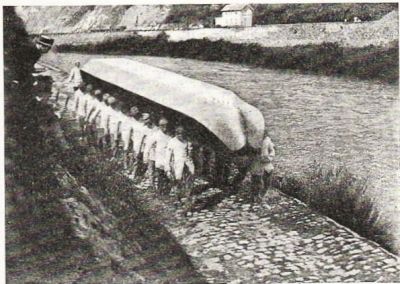
CARRYING A PONTOON.
FIELD TELEPHONE AND SIGNAL APPARATUS.
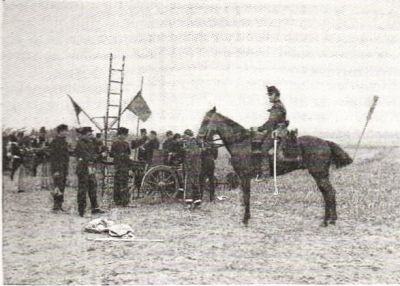
The pontoon and the field telegraph and signal services are the objects of great attention on the part of the Belgian military authorities, and I have added photographs illustrating all these branches. The country south of the Liege-Namur line, where the Germans are expected to appear some day, is intersected with more or less impassable rivers, which will often need bridging in short order. The pontoon service is consequently of the first importance among the various factors in the country's defence.
BELGIAN GENDARMES.
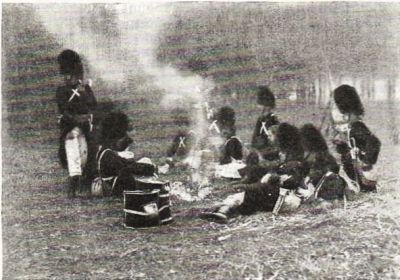
The best picture—artistically speaking—represents a group of Belgian gendarmes around a camp-fire. It is a masterpiece of artistic photography. The gendarmes are also a very important branch of the service, and their duties are most onerous, since they are not only called upon to police the rural districts, suppress strikes, and make themselves generally useful as servants of the law, but in war-time they form part and parcel of the regular army, and are obliged to fight their country's battles like the rest.