Periodicals
Reading edition
Magazine, $4.00 a Year
Weekly, $4.00 a Year
Bazar, $4.00 a Year
Round Table, $2.00 a Year

This is for Butterfly Collectors.
You say, "Some prefer to set insects on pins arranged to show their colors to the best advantage, but this is not so good a plan from a scientific point of view." Do you mean that you do not advise us to transfix the butterflies on pins? What should we use in place of pins? Is there any cure for "mites" besides camphor? How can you protect your specimens from ants? Is not chloroform as effective and less dangerous than the cyanide of potassium as a killing agent? When you go butterfly-hunting in the country, is there any particular box to keep them in until you get home? Must the contents of the bodies of the big moths and butterflies be taken out? Must their proboscis be stretched before they are stiff?
Elizabeth Castles. New Orleans, La.
The very best plan is to raise your butterflies from the caterpillar. Then you get the best specimens—best in plumpness and in color. In arranging them in a collection, use the pins, of course. What we meant to say is that arranging them in the form of stars, crosses, etc., is not the best from a scientific point of view, because when so arranged they are distributed according to color. It is better to arrange by groups, male and female, egg, caterpillar, pupa, and cocoon if it makes one.
Camphor is the best for mites and ants. Used freely, it ought to prevent both. Chloroform is not as good as cyanide of potassium. The latter need not be dangerous. To carry your butterflies home in, some provide a tin box, light, with plenty of light cotton for packing. Contents of bodies cannot be taken out and the fly preserved in good shape. The proboscis should be stretched before the fly is stiff. When putting on the fastening-board, get into as natural position as possible. Self-reared butterflies should be killed as soon as their wings are expanded and they are perfectly dry.
An Arizona Indian Delicacy.
Are you interested in a description of a great delicacy of the Hualapai Indiana, called the "army worm"? Since the heavy rains in this part of Arizona the Hualapai Valley has been covered with a species of worms called the army worm—I suppose because they travel in regular armies. They are from two to four inches in length, and of a yellow-green color. The Indians go out in the valley in parties to gather them. Each member of the party—the party is mostly made up of squaws—has a basket on her back. She first selects a spot where the worms are quite plentiful, then sits down and goes to work.
She picks up a worm between her thumb and forefinger, gives a shake of her wrist to break its neck, and then throws it into her basket. When she has her basket full she comes back to town. She takes a kettle of boiling water, drops the worms in one by one, and then strings them on a string and hangs them up to dry. When they are perfectly dry the feast commences. They say they taste just like fish, but I am willing to take Indian evidence for that.
Frankie L. Potts, R.T.L. Kingman, Ariz.
Dear Round Table.—In the issue of August 11, I saw a very interesting account of the "American Thermopylæ," but as it is probable that an injustice was done therein to the memory of Moses Rose, I determined to write to the Table concerning what I know of the affair. The gentleman who told me the story had heard it, I believe, from an intimate friend of James Bowie's.
The last fatal days of the Alamo had come, and all knew that they must die sooner or later. When the line was drawn, all crossed it but Rose, who said:
"Men, I have determined to escape from this trap. I can speak the Mexicans' language, and if I get away I will send help; if not, to die is as little as any of us can do."
They all shook hands with him warmly, bidding him godspeed, and he started on his perilous way. Fortunately he managed to elude the enemy; but the whole night he ran on, over the immense prickly-pears and cacti, in his bare feet; and when, at daybreak, he reached a friendly camp and fell insensible, it was hours before all the huge thorns which had penetrated his flesh could be extracted. Two days passed before his consciousness returned, and then his first words were, "Did you send them help?" Alas! they had known nothing of the pressing danger, and in that short while the American Thermopylæ had been accomplished.
A story is current upon the Mexican border that James Bowie was dying at the time the foes broke into the Alamo. His room was so situated that he could see everything that happened in the large hall; and when the Mexicans had despatched all the other defenders of the garrison, they made a rush for him. Bowie sprang up from his bed, and killed fourteen men in the doorway with his terrible knife, and then slowly backed toward the farther wall, a revolver in either hand, bringing down an enemy with each shot. When his ammunition had been exhausted he fell heavily from weakness, and it is claimed that he was dead when the enemy reached him. How much truth there is in this last story, however, I am unable to say.
V. Bowie.
Kinks.
No. 37.—Mathematical Riddle.
A man being asked how far it was to a certain city, repeated the familiar ditty:
"Mary had a little lamb, Its fleece was white as snow,"
and said he had answered the question. Had he, and how far was it?
No. 38.—Diamond.
A letter. A contest. Flourishes. Despoils. To get again. Immovable. A letter.
No. 39.—A Description in Verse.
For strength a very Hercules, Emblem of endless motion, And formed of what we know as well As sailors know the ocean. Man may control but not defy, For at its mercy man must die.
No. 40.—Three Easy Word-squares.
1.—1. A cardinal's cap. 2. A dwelling. 3. Colophony. 4. A proclamation. 5. Portable lodges.
2.—1. A tine. 2. A runner. 3. A yellow pigment. 4. An organ of sensation. 5. A grassy plot.
3.—1. Keen. 2. To revere. 3. To fish for. 4. Revolves. 5. A crowd.
Vincent V. M. Beede.
Answers to Kinks.
No. 33.
Solution of cross-word enigma.—Central column of acrostic, Cockade City. Cross-words of acrostic: 1. Bracing. 2. Brooded, 3 Brocade. 4. Bookish. 5. Bleared. 6. Bordure. 7. Boneset. 8. Beechen. 9. Basinet. 10. Banters. 11. Brayles.
No. 34.
Parthenope.—1. A siren who, having failed to win the love of Ulysses, threw herself into the sea. 2. A Crustacean of the Indian Ocean. 3. One of the Asteroids between Mars and Jupiter.
No. 35.—A Fleet of Ships.
1. Friendship. 2. Hardship. 3. Lordship. 4. Ownership. 5. Worship. 6. Mastership. 7. Guardianship. 8. Authorship. 9. Ambassadorship. 10. Dictatorship. 11. Judgeship. 12. Scholarship. 13. Horsemanship. 14. Apostleship. 15. Stewardship. 16. Tutorship. 17. Apprenticeship. 18. Penmanship. 19. Partnership. 20. Generalship.
No. 36.—Two Good Anagrams.
1. Alexander Hamilton. 2. Toussaint l'Ouverture.
For Amateur Journalists.
Mr. W. S. Beattie, 651 Madison Avenue, New York, says: "I extend an invitation to all amateur journalists throughout the United States, and also those in foreign countries, to aid me in compiling a 'History of Amateur Journals and Journalists.' Anybody who at any time controlled or contributed to an amateur paper is asked to send me a copy of such paper, or of any amateur paper they know of, together with the following information: When established? Number of pages? Average circulation? By whom established? When circulation was discontinued, if at all, and where was it published? Correspondents will kindly enclose stamp if an answer is needed."
William Saam, 1708 Amsterdam Avenue, New York, wants to receive copies of amateur papers, and he desires to edit a department.
Questions and Answers.
Henry W. Hill, who lives in Columbus, O., writes to know the cost of attending the Eastern colleges per year, saying that he gets the impression, from reading the newspaper accounts of football, baseball, and other games, and the list of sons of wealthy parents who attend these colleges, that they are intended mainly for the well-to-do, and that young men of moderate means or of no means are practically cut off from attending them. He especially asks the status of the poor student at Harvard or Pennsylvania. "Is he left severely alone?"
It is easy to suppose that a reading of the newspaper news concerning Eastern colleges would give the impressions here outlined. And yet we are sure that such impressions are not intended to be conveyed by the writers of the news. Let it be distinctly stated, and with emphasis, that the great majority of students at all Eastern colleges, and Western ones too, are sons of poor parents. There is no social exclusion of a poor man because he is poor—none at all. And this is emphatically true at all the colleges. In response to our inquiry, a member of the Faculty of one of the leading universities wrote thus: "Here is an average student. He maintains a creditable standing in his class, and finds time to play football, or the game his fancy dictates. He becomes acquainted with all members of his class, and many besides, and forms numerous warm friendships. He may take college honors, and is likely to receive honors on class-day. His life on the campus, in the class room, on the athletic-field, and at his boarding-club is taken as the measure of his real worth, and length of purse and of ancestry are of equally small value. And he lives comfortably on $500 a year."
Three recent Princeton classes, including honor men, were asked to give their personal expense accounts. Their replies show from $250 to $700 a year, with an average of $442.68. One student gives his account in detail thus: Dues, games, newspapers, $25; Books, $20; Car fare, $15; Clothes, $50; Current expenses, $50; and College bills, $240. Total $400.
F. C. Bears.—The origin of the term "blue stocking" is given by Brewer as follows: A woman's club met at the house of a Mrs. Montague, in London. Men were admitted, although it was a woman's gathering. One of the regular attendants was a Mr. Benjamin Stillingfleet, and he always wore blue stockings. It was one hundred years or more ago, when knee-breeches were in vogue, and the bright blue lower-leg coverings were conspicuous. Hence the name.
The New York Stock Exchange, dear Sir John L. M. Taylor, is a private not a public institution, and is maintained by fees assessed upon its members. It is not the same as the Produce Exchange and the Consolidated Exchange, which have members and buildings of their own. Peter Lindbloom, Baltimore.—The Table regrets it cannot undertake an elaborate explanation of the silver and gold question as you ask it to do. Apply to Congressional Campaign Committee, Washington. D. C., or to State or National Campaign Committee of either party. Simply write a letter containing a brief statement of what documents you desire. They are usually sent free.

This Department is conducted in the interest of stamp and coin collectors, and the Editor will be pleased to answer any question on these subjects so far as possible. Correspondents should address Editor Stamp Department.
The new Trinidad stamps are on the market, and make a handsome set. The central figure is Britannia, and the values are printed in different colors.
½penny, mauve, value in green.
1penny, mauve, value in red.
2½penny, mauve, value in blue.
4penny, mauve, value in orange.
5penny, mauve, value in mauve.
6penny, mauve, value in black.
1shilling, green, value in red.
5shilling, green, value in vermillion.
10shilling, green, value in blue.
1pound, green, value in red.
The last three are double the size of the smaller values.
The proposed New York Philatelic Club house is still in the air. Over one hundred subscriptions of $25 each have been received, and new subscribers are coming in every day, but the difficulty of obtaining a suitable house has blocked the plan for the present. The committee has been offered several houses at a rent of $2000 per year, but this is a little more than they care to pay at present. In London there has been no such difficulty.
I cannot too strongly impress upon collectors the necessity of handling valuable stamps with care. A startling instance has just come under my observation. I was shown an album the owner of which collected stamps from 1868 to 1875 inclusive. Page after page was filled, with all the stamps in the spaces set apart for them, stamps of which large dealers to-day have no stock. Had the stamps been in good condition, the value of the collection would be four or five thousand dollars. If in "first-class" condition, it would be difficult to duplicate at six or seven thousand dollars. Yet this collection was offered to all the dealers in the city for four hundred dollars, and not one of them would buy it. It was at last sold for three hundred and fifty dollars, and the dealer who bought it would have been glad to have sold it at once at an advance of twenty-five or fifty dollars. An inspection of the album by lovers of stamps almost brought tears to their eyes at seeing the way rare stamps had been maltreated. Hardly one scarce or rare stamp had escaped mutilation—perforations trimmed, pieces torn out of the body of the stamp, corners gone, backs "skinned," face of stamps rubbed, creased, or dirtied—in fact, almost every philatelic mistake possible had been made, and a fine collection utterly ruined. As a matter of course, in many instances the commonest stamps were in good, and in some cases in mint, condition. The explanation of this fact is that the commonest stamps had been replaced by better copies when the originals were torn, whereas the scarce stamps were scarce, and could not so easily be replaced.
George Werner, 277 Fairmont Ave., Newark, N.J., wishes to exchange with collectors in British colonies and South American countries.
Philatus.

'Tis wisest to economize By blending, in the home supplies, The highest worth and widest scope. Now Ivory, being pure and good For laundry, bath and toilet, would Save fully half the bills for soap.
Copyright, 1896 by the Procter & Gamble Co., Cin'ti.
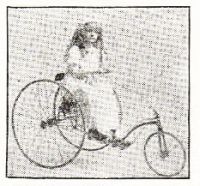
EARN A TRICYCLE.
We wish to introduce our Teas. Sell 30 lbs. and we will give you a Fairy Tricycle; sell 25 lbs. for a Solid Silver Watch and Chain; 50 lbs. for a Gold Watch and Chain; 75 lbs. for a Bicycle; 10 lbs. for a Gold Ring. Write for catalog and order sheet Dept. I