ADVERTISEMENTS.
Reading edition
A cream-of-tartar baking powder. Highest of all in leavening strength.—Latest United States Government Food Report.
Royal Baking Powder Co., New York.

This Department is conducted in the interest of Bicyclers, and the Editor will be pleased to answer any question on the subject. Our maps and tours contain many valuable data, kindly supplied from the official maps and road-books of the League of American Wheelmen. Recognizing the value of the work being done by the L.A.W., the Editor will be pleased to furnish subscribers with membership blanks and information so far as possible.
Copyright, 1896, by Harper & Brothers.
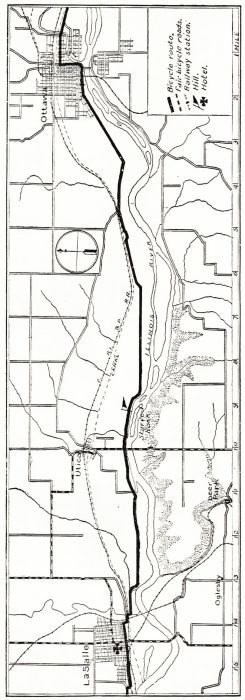
Having given in the last two weeks the bicycle route from Chicago to Ottawa, it may be well, before going into other parts of the country, to say something of the rides in the vicinity of Ottawa itself. As was said last week, there are a great many places of historic interest in the vicinity of Ottawa. The most interesting trip is from Ottawa to La Salle, and there are several ways of getting there, the best, so far as the immediate journey is concerned, being the one described as the bicycle route on the southern side of the railroad and the canal and on the northern bank of the Illinois River. Leave the Court-house at Ottawa and run westward. The roads are in good condition, whether you go north of the railroad or south of it, or, indeed, south of the river. A pleasant route is out by the County Farm and Asylum, past Buffalo Rock, and thence to the Sulphur Springs. Then, crossing the bridge at Utica brings you to Starved Rock, one of the most famous spots in the State. In the first place, it is here that one of the first settlements in the valley of the Illinois River was made. It is where La Salle first settled and made his capital of what was to be New France, and it has been the scene of many an Indian fight. From Starved Rock, a four-mile trip with some hilly road brings you to Deer Park, which is well worth seeing. From this point it is easy to find the road into La Salle itself through Oglesby. The trip may be made to extend over about twenty-four or twenty-five miles, and then, after having dinner at La Salle, the fifteen-mile run back to Ottawa by the direct route will make a day's ride of some forty miles that is as full of picturesque and historic interest as any ride of similar length in Illinois.
We have now given several trips in the vicinity of Chicago, which will of course be of special interest to the readers of the Round Table who live in or near that city. Having gone so far, although there are many other attractive trips in that district, the number of inquiries for routes along the Atlantic coast, through New Jersey, New York State, and Pennsylvania, is so great that we shall turn back towards the East, and for the next few weeks give some routes and tours in that part of the country. At the same time, if there are any particular routes of general importance which readers in Chicago wish to know about, and believe to be sufficiently interesting to general bicyclists, we shall be very much pleased to have information regarding them, and to consider publishing maps of them in this Department.
Note.—Map of New York city asphalted streets in No. 809. Map of route from New York to Tarrytown in No. 810. New York to Stamford, Connecticut, in No. 811. New York to Staten Island in No. 812. New Jersey from Hoboken to Pine Brook in No. 813. Brooklyn in No. 814. Brooklyn to Babylon in No. 815. Brooklyn to Northport in No. 816. Tarrytown to Poughkeepsie in No. 817. Poughkeepsie to Hudson in No. 818. Hudson to Albany in No. 819. Tottenville to Trenton in No. 820. Trenton to Philadelphia in No. 821. Philadelphia in No. 822. Philadelphia-Wissahickon Route in No. 823. Philadelphia to West Chester in No. 824. Philadelphia to Atlantic City—First Stage in No. 825; Second Stage in No. 826. Philadelphia to Vineland—First Stage in No. 827; Second Stage in No. 828. New York to Boston—Second Stage in No. 829; Third Stage in No. 830; Fourth Stage in No. 831; Fifth Stage in No. 832; Sixth Stage in No. 833. Boston to Concord in No. 834. Boston in No. 835. Boston to Gloucester in No. 836. Boston to Newburyport in No. 837. Boston to New Bedford in No. 838. Boston to South Framingham in No. 839. Boston to Nahant in No. 840. Boston to Lowell in No. 841. Boston to Nantasket Beach in No. 842. Boston Circuit Ride in No. 843. Philadelphia to Washington—First Stage in No. 844; Second Stage in No. 845; Third Stage in No. 846; Fourth Stage in No. 847; Fifth Stage in No. 848. City of Washington in No. 849. City of Albany in No. 854; Albany to Fonda in No 855; Fonda to Utica in No. 856; Utica to Syracuse in No. 857; Syracuse to Lyons in No. 858; Lyons to Rochester in No. 859; Rochester to Batavia in No. 860; Batavia to Buffalo in No. 861; Poughkeepsie to Newtown in No. 864; Newtown to Hartford in No. 865; New Haven to Hartford in No. 866; Hartford to Springfield in No. 867; Hartford to Canaan in No. 868; Canaan to Pittsfield in No. 869; Hudson to Pittsfield in No. 870. City of Chicago in No. 874. Waukesha to Oconomowoc in No. 875; Chicago to Wheeling in No. 876; Wheeling to Lippencott's in No. 877; Lippencott's to Waukesha in No. 878; Waukesha to Milwaukee in No. 879; Chicago to Joliet in No. 881; Joliet to Ottawa in No. 882.
Any questions in regard to photograph matters will be willingly answered by the Editor of this column, and we should be glad to hear from any of our club who can make helpful suggestions.
VIGNETTING.
A vignetted photograph is one whose background shades off gradually into white, and is made by printing through an opening placed a short distance from the plate. The difference between masking and vignetting is that the mask or cut-out, is placed directly on the negative, and when the picture is printed there is a sharp line between the part printed and the part shielded from the light. In the vignetted picture the opening is placed a short distance from the negative so that the light is diffused, and instead of making a sharp line, the picture fades off gradually into pure white.
There are many devices sold for making vignettes, but the object of the Camera Club is not to tell its members how to spend money, but how to save it, by making many of the articles used in the making of photographs.
An empty plate-box cover is easily and quickly made into a vignetter. Mark on the face of the cover an outline of a size to correspond with the portion of the negative which you wish printed. If this is in the centre of the negative, mark the outline in the centre of the cover, and if a little to one side, mark the outline to correspond. Inside this outline make several cuts, and then tear the pasteboard carefully on the line marked. Peel off the paper so that it will be thinner at the edges of the opening. Over this opening paste a piece of thin tissue-paper, which should be of uniform opaqueness. The simplest way of attaching the cover to the printing-frame is to place it on the frame and hold it in place with two or three stout rubber straps. By marking a place on the printing-frame where the box is first placed, the print can be examined at any time, and if the cover should chance to be moved a little it can be returned to its original position, thus keeping the vignette in the same place.
When printing a vignetted picture, it is better to print in the shade than in the direct sunlight, as, if printed in the sunlight, the frame must be adjusted so that the light will enter the opening in a straight line. If the frame is placed in such a position that the rays enter in a slanting direction, the vignetted portion of the picture will not be in the place designed. Instead of pasting tissue-paper over the opening, a piece of ground glass can be placed over the cover during the process of printing.
To produce a very soft effect between the picture and the white part of the paper, take a piece of cotton wadding the size of the cover used for vignetting, tear a hole in the wadding a little smaller than that in the cover, and print as directed.
Sometimes one has a negative with fine clouds in the sky; but in order to make a print of them the rest of the picture must be masked in some way, or else it will be very much overprinted. One way of masking the part which prints too quickly is to cut out of opaque paper a piece which will cover the landscape part, following the outline along the horizon as carefully as possible, and place it over the landscape till the sky is printed; then remove and print the landscape part. Unless this mask is adjusted with the greatest care, there will either be a white line along the horizon or else a heavy black one, according whether the paper overlapped or did not quite cover the line. A much easier way to make the two printings is to take a plate-box cover the size of the negative, mark the outline of the horizon on it and cut away the pasteboard, and print with this over the negative in the same way as for the vignetting. When the sky is printed deep enough, remove the cover and print the rest of the picture.
The openings for vignetting may be cut in any shape desired—oval, pear-shape, round, triangle, etc.
Sir Knight Harry Patty, of California, sends a long list of questions, which we will try to answer to his satisfaction. Is it better to take portraits out-of-doors in the shade, or is the light more easily controlled in the house; should the light fall on the sitter from his left or right side, or is it immaterial; what would be the best arrangement of light in a bay-window with three windows, the window being shaped like the half of an octagon; what are the best colors for plain light and dark backgrounds, and what material; is the flannel sheet mentioned in No. 806 white, and would a white blanket do as well; are backgrounds always placed obliquely to the lens, and at what angle; how near the camera should the sitter look for a full face; should the eyes ever look at the lens; how much above the sitter's head should the camera be placed; what diaphragm should be used for a portrait; what method is used for marking stops; how can one vignette heads; what developer gives the best printing density for portraits; does metol give flat negatives; should one use the quickest plate for portraits; and which is the best of the Seed plates. It is easier for the amateur to make portraits out-of-doors than in the house. The article referred to gives directions for managing the light in-doors. When making portraits out-of-doors it is better to arrange the background, etc., in the angle of a building, as this gives a more artistic picture than where the sitter is exposed to the full light. It is immaterial which side the light falls on the sitter. The window next to the sitter in the bay-window described should be darkened, and the lower part of the other two windows. If the sitter is an adult, and can keep still for three or four seconds, it is better to cover the glass with thin white muslin, as this gives a soft even light. The flannel sheet is white or ecru, and a blanket would do as well. It should be far enough away from the sitter to be out of focus. The best colors for a light background are a yellow, white, or light gray, and for dark a soft dull gray. The background is arranged to suit the picture, and is not always placed obliquely. If the sitter looks just to one side of the camera it would give a good position for a full face. One should never look directly at the lens but just above or at one side. A medium stop is the best to use for portraits; stops will be explained in a later article; an article on "Vignetting" appears this week; most professional photographers prefer pyro; metol should give fine negatives; a medium-slow plate is best for portraits—try Cramer Banner; the non-halation Seed's are fine plates. The camera should be on a line just above the head of the sitter, with the lens at a slight angle. This is said to give a more equal focus.
Sir Knight J. L. Goodman asks if he can salt the paper for plain paper; if the ammonia is the same as that used for washing or household purposes; and how to vignette a photograph. Directions for salting paper will be found in No. 881 of the Round Table. Ammonia for photographic purposes should be free from impurities, and the household ammonia is therefore not suitable. Buy the strong liquid ammonia at the druggists (liquor ammonia fort.), and dilute it at once with an equal amount of water, and keep it in a glass-stoppered bottle. An article on "Vignetting" appears this week.