Part 1 — CHAPTER VI.
Reading edition
None of the animals paid the slightest attention to Tommy and the ex-Pirate when they came down from their uncomfortable perch on the rafter, and strolled about the big room. The Gopher, probably emboldened by his neighbors' action, descended too, and mingled with the other beasts. But, for some reason, he managed to remain within sight of Tommy and the ex-Pirate, so that if anything bad happened to him he could have run to them for protection or assistance. Occasionally he joined them and conversed for a few moments, and then he would wander off again by himself.
"I guess they take us for a pair of animals," observed Tommy, as he glanced about at the peaceful beasts. "Some new kind," he added.
"That must be it," said the ex-Pirate, absent-mindedly; "but I wish we could find the Sheep."
"In this crowd?" exclaimed the Gopher, who came up at that moment. "Why, that's like looking for a beetle in a smoke-stack."
The three walked along for some time in silence, and they saw all sorts of queer things as they went. In a retired corner the Hippopotamus was shaving himself with a razor-backed Hog, much to the displeasure of the Hog, who kept up a perpetual snorting and grunting. Near by an old mother Pig was putting her little Pigs' tails up in curl-papers for the night. Further along the Armadillo, the Turtles, the Hedgehog, and the Porcupine, squatted on the floor together, were playing dominoes. A Leopardlike creature sat near by watching the game, looking very much disappointed and mournful.
"THEY WON'T LET HIM PLAY BECAUSE HE'S A CHEETAH."
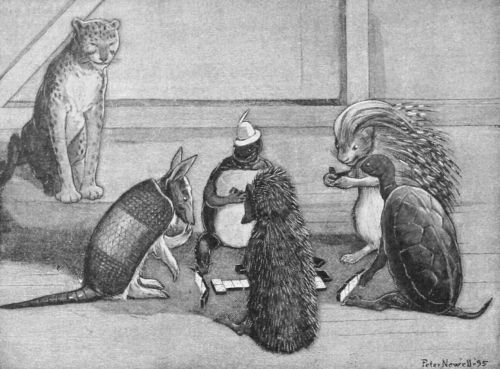
"They won't let him play," volunteered the Gopher, "because he's a Cheetah."
All this time there was much bustle and preparation going on in the middle of the hall. The Monkey tribe, of which there must have been a hundred, were bringing up tables and stools and benches from down below somewhere, and were stretching these out the entire length of the big room. They made a banqueting board much longer than Tommy had ever seen before, and then they laid plates and mugs along the edges, enough to accommodate all. The Monkeys made first-rate waiters, and the big Gorillas bossed them around, and kept them working "just like real waiters in a restaurant," thought Tommy.
"There's the Sheep!" shouted the ex-Pirate, suddenly, and he pointed out their old friend sitting on a bench about a third of the way down from the head of the long table. They hastened toward him, followed by the Gopher, who was doubtless afraid of being crowded out, for the animals were taking seats rapidly.
The Sheep was overjoyed when the ex-Pirate sat down beside him, and he moved up closer to his neighbor on the other side so as to make room for Tommy and the Gopher. The little boy sat on the bench with the ex-Pirate on his left, and the Gopher on a high stool at his right. The Lion and Lioness occupied the head of the table, some distance away, and the Bull sat at the foot.
"I have been looking all over for you," began the Sheep, "but you were so well concealed I could not find you. Where did you pick up that Gopher?"
"Oh, he's all right," answered the ex-Pirate. "He's got his ticket inside."
The Gopher almost fell off his stool. He whispered to Tommy, "Tell him not to talk about my ticket."
But before Tommy could deliver the message, the Monkeys began bringing the soup in on trays, and placed a plate full in front of each one at table. The Gopher seized his plate and lifted it greedily to his face and swallowed all at one gulp. Then he threw the plate under the table, and began snapping his fingers loudly, just as if he had not been served at all.
"You must not do that," remonstrated Tommy.
"Oh yes, I must," said the Gopher. And then he held up both hands and snapped all fingers.
"What dreadful table manners the Gopher has," said the little boy to the ex-Pirate. "Did you see what he did?"
"Yes," answered the latter. "It was very reprehensible. Worse than anything I ever saw. Worse than the Bishop of Shinnikoree."
"The Arch-Bishop," put in the Sheep.
"Arch-Bishop nothing," retorted the ex-Pirate. "He was only a Bishop."
"But he is an Arch-Bishop now," persisted the Sheep.
"He's dead now," retorted the ex-Pirate.
"Yes; and they carved him in stone, and put him up over the entrance of the Cathedral, and so he is an Arch-Bishop, ain't he?"
"Well, I suppose so. Anyhow, he was mighty queer at table."
"You never told me about the Bishop before," said Tommy.
"I know it," answered the ex-Pirate. "But if I had the third volume of my collected poems here, I could read to you about him. He was dreadful. Worse than the Gopher."
"Can't you remember about him?" pleaded the little boy.
"Part, I guess. Let me see," and the ex-Pirate reflected in silence for a moment. Then he began:
"There once was a Bishop Who tossed every dish up The moment he sat down to table; At juggling with plates Full of apples and dates He was really exceedingly able. "He would stand on his head When he buttered his bread, And his neighbors he gayly would banter, While he gave a wild whoop At the sight of pea soup Which was served in a cut-glass decanter. "With fish-balls and prunes, And fresh macaroons, The Bishop was likewise quite clever; To pile them up high, And swallow them dry, Was his constant consistent endeavor. "He could drink salad oil By the pint, and not spoil The perfect success of digestion; And having well dined, And copiously wined, He could turn a handspring without question."
"Goodness," commented Tommy. "Where did you say he bishoped?"
"At Shinnikoree," answered the ex-Pirate.
"I did not hear that last verse," broke in the Gopher, swallowing his sixth plate of soup. "Can't you recite it again?"
"No, I cannot," replied the ex-Pirate, severely. "If you don't look out I'll write a piece about you."
This seemed to frighten the Gopher, for he snapped his fingers again and took another plate of soup.
[to be continued.]

Last week this Department discussed the preparatory work and training of football-players; in this issue I want to speak briefly of team-play. The American game has now become such that team-work is its most important feature. Brilliant individual players are valuable, and every captain should be glad to have as many as he can get; but I should much prefer to captain an eleven made up of inferior players who worked well together, than a team of brilliant individuals who played each for himself. Walter Camp says that "team-work is the road to victory," and he ought to know. It is plain that if you have eleven men working as one, and directing all their force against a single point, you have a much more formidable engine than if the individuals making up the team are doing their best according to their own conceptions of the requirements of the situation.
There is a greater opportunity for team-work in defensive than in aggressive play. The former affords an excellent chance for the placing of the men so that they can concentrate their efforts to the best advantage in the resistance of the opponents' play. The captain decides beforehand who shall go through to tackle behind the line, who shall wait to see where the ball is coming through, and then block the runner, who shall wait back of the line as a reserve force, only to act if the ball is carried into his territory. There is also always plenty of opportunity for team-play in the working together of several rush-line men in the defense, as, for instance, when two or three block off the attack's interference while another tackles the man with the ball.
The best team-work in the rush-line, however, is to be obtained by the playing together of the centre and his two guards. It is absolutely necessary that these men should act like a machine, with precision and celerity, for they are the keystone of the whole team. They should not only have a perfect understanding among one another, but with the men behind them. They must watch the opposing backs, and try to let their own rear men through upon them wherever a certain defense for certain plays may seem best. The ends and tackles form another division of the rush-line which acts as a unit. It is the business of these men to stop the runs around the ends, of course, but now that the development of the game has brought in so many rushes through the line, between tackle and end, or tackle and guard, the four end men must play into one another's hands in the tackling of opponents and in the blocking of holes that the men opposite are trying to make.
The men back of the line must also have a perfect understanding among themselves as to what each one will do in certain emergencies. As in chess, they must have one or more "defenses" for known attacks, and they must know which one of these defenses it is best to use under given conditions. The backs supplement the work of the forwards in defensive play against rush-line work, but the conditions are reversed in resisting a kick. Against a kick the backs are the main defense—that is, the team as a whole depends upon one of the four men back of the line to make the next play, and each man of the four must know as soon as the kick is made which one is to get the ball. In the defense against a kick, therefore, the rushers supplement the work of the backs.
When I say that the rush-line supplements the work of the backs, I do not mean that their efforts are to be considered in any way secondary. At the beginning of a kick play it has been their work to hold the opposing line as long as possible in order to keep the attacking forwards off their own men, who are engaged in receiving and handling the kick. Frequently the ends take an important part in the defense against a kick by coming back with their opponents, bothering them as much as possible, and being always ready to block or interfere for their own back should he see a good opportunity open for a run.
Now that the rules have been amended so as to require actual kicks, it is interesting to note some of the new plays that have been adopted to give the rushers the opportunity to get possession of the ball again as quickly as possible. Last year the big college teams tried all sorts of expedients to achieve this end. One method put to the test was to kick the ball against the opponents with sufficient force to insure its bounding back out of the immediate reach of the man whom it struck. This method, although it sometimes worked, is hardly a satisfactory one, and will probably be used only as an occasional trick in unimportant games this year. Another experiment was a rolling kick between the rushers, but in a diagonal direction so extreme as to give an end or a tackle a chance of securing it.
In the same manner a diagonal kick, short, over the heads of the first men of the opponents, was exploited by some of the adventurous captains. But toward the end of the season the problem narrowed itself down to a question of the relative value of a kick, short enough, and in a sufficiently high slanting direction, to enable the rushers to get fairly well down to its falling-point, and a long kick driving the opponents back, admitting, it is true, of a run in because the rushers cannot reach the dropping-point in time to down the man receiving the ball. Both methods found strong advocates, and were used in about equal proportions.
And then as to the returning of the kick. Until the rules were changed "returning a kick" meant catching the punt of an opponent, and, without stopping for a down, punting it back again before the opponents could prevent. Naturally this was, among the big teams, much more talk than practice, for it was a rare exception when such an opportunity offered. With the new kick-off, however, there is certainly an excellent chance for a return kick. A man can make the most of his run in, and just before the opponents meet him he can get in his kick, if that is his play.
Another interesting matter is the distribution of the men on the line-up for the kick-off, and it gives ample room for the ingenuity of coaches and captains. One effective placing of the men is this:
o C
LG oo RG
LT oo RT
o QB
LE oo RE
ooo
HBFBHB
As the ball comes sailing over, the forwards swing into its direction, and become most effective running interference for whichever back catches and runs with the ball. This play, if frequently practised, can be made very effective.
In defensive team-work one of the most important things—next to watching the ball, of course—is for every man to try to discover what play the opposing eleven is going to make next. Having found what it will probably be, their endeavor must be to throw their whole force against it. It is frequently possible to determine not only what the enemy's probable move will be, but exactly what it will be. This can most frequently be done by noting how the half-backs stand, or how the quarter-back is standing or looking. Men will unconsciously glance in the direction they are about to run. If a rusher is to take the ball, it is easier to note that fact than when the leather is going to a half-back, because the rusher is bound to assume a somewhat different position from that he would take if he were only going to block, or make a hole, or break through.
As soon as the captain or any other player discovers, or feels reasonably confident that he has discovered, what the next play of the opposing team is going to be, he should impart the information to the rest of the team. He should try to do this as secretly as possible, however, or else the opponents will have time to change their signal and make an entirely different advance. It is in a case like this that quick work counts, for if you line up and give your signal quickly the opposing players can scarcely have time to notice the many little points that give away the next move, and so it is harder for them to meet it.
Quick play is essential to successful and effective team-work. After a scrimmage and a down, play should begin at once, i.e., just as soon as the centre can secure the ball. Every man in the rush-line and all the backs should be in their positions without the slightest loss of time after they are sure the man who was running is down, and all should be alert for the signal for the next play, which is given during the line-up. Nothing should ever be allowed to interfere with this rapid resumption of positions except a serious injury, and then the injured player should call to his captain for time. Any delay, even by one man, might spoil the next play, and thus injure the chances of the whole team.
And now for a few words about aggressive play. In this, team-work is fully as important as in the defense, and in some cases more so. With the majority of football elevens team-work in aggression is much better done and more fully developed than in defensive play, but it is the team that can offer the best organized defense—all other things being equal—that will stand the better chance of success. The chief aggressive move now in use, and the one that has been most widely adopted by football-players in the past five years, is the interference wedge. This play reached such a stage of development in Harvard's flying wedge, three years ago, that it was the main cause for the latest revision of the rules of the game. But the old interference wedge is a perfectly legitimate football formation, and can be made effective without being dangerous.
THE WEDGE FORMATION.
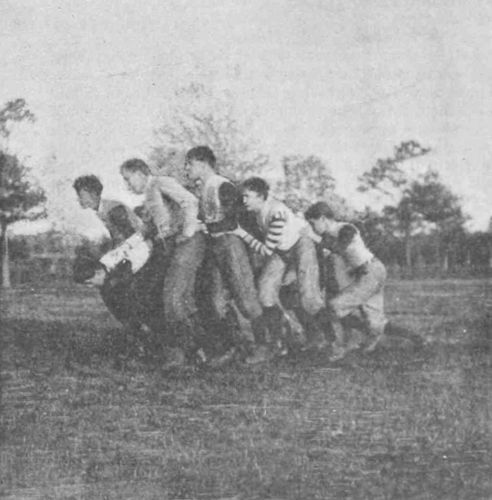
The formation of the men for this play, as every one knows, is that of a V, with the point directed toward the opposing line. The man who is to run with the ball stands inside the two walls of humanity formed by his mates, and it should be his endeavor to keep on running even after the original wedge formation has been destroyed by the resistance of the opponents. The latter, of course, never know what the runner's intention may be, whether to rush out at the apex, or through one of the sides, or to dodge out backwards and attempt a long run around the end. Consequently they cannot devote their entire force toward one point, and the possibilities of gaining ground are thus increased in the favor of the runner.
It is not well, however, for the runner to use his own discretion as to the manner in which he shall escape from the wedge after it has come against the opposing line. Team-work is invariably injured and weakened when one player holds discretionary power in a mass play. It is best to decide beforehand where the runner will break through, and have it understood by two of the rushers that they are responsible for a hole. Of course, the runner should not always pass out between the same pair. There should be variations in the play, and the Captain should decide when the line-up is made just which hole to use, judging of this from the appearance of the opposite line-up, and selecting the point of egress where he thinks there will be the weakest resistance. As a rule, it is best to use the wedge only when the opponents are restrained from advancing, as in the kick-off, the kick-out, and after a fair catch, but some of the larger college teams have of late been adopting the trick after ordinary downs. In the Harvard-Yale game of 1891, Yale, with the score 12 to 0 against her, worked a wedge from the middle of the field to the goal-line and scored. Every play was a wedge that pounded the Harvard centre, and won a few feet each time, and at the ten-yard line the quarter-back, instead of pounding, as he had been for twenty minutes, ran back and went around the end for a touch-down. But such continual wedging as that should be adopted only in the most desperate case, and could never be successful except when played by a thoroughly disciplined team in the best of physical condition. Even so, it was a severe strain on the players' staying powers.
A well-formed wedge is bound to make some gain for the side using it, but there are many ways of meeting the play. The most simple, and the one which is probably used more than any other, is that of lying down before it. There is nothing very scientific about this kind of defense, but it has the compensating advantage of effectiveness in most cases. It prevents any further advance of the mass, for the men at the peak are forced to fall over their prostrate opponents. The danger of using too many men for this sort of blocking, however, is that should the runner escape through a hole in the side, or at the opening in the rear, there are few players left to tackle him.
There are the backs, of course, upon whom this duty of tackling the runner should devolve, but rapid and judicious interference at the proper moment may overcome their efforts, and give to the enemy a clear field. Perhaps the safest way to meet an on-coming wedge is to try to force the peak—that is, to so concentrate your resistance as to change the course of the aggressors and drive them across the field. They are thus exerting just as much of their strength as if they were advancing, and yet are gaining little or no ground. Some of the other methods I have seen used are breaking into the peak by main strength (and this is the method usually adopted against a weaker team); and sending a man over the heads of the leaders, a kind play of which Heffelfinger of Yale was the best exponent.
The best team-play to defeat the object of a kick is still a matter of dispute. There are so many possibilities in the case and so many different directions for the ball to take that, after all, no method can be determined upon beforehand as the best defense. But every team should be provided with several moves for such occasions, and as usual it devolves upon the captain to decide which play to put in operation.
A very good way is to send one or two extra men up into the forward line (the quarter-back and a half-back, preferably), and then to attack the kicking side at any point along which the ball travels in its course. In other words, put as many men forward as you can with the object of securing the ball as soon after it is put into play as possible—while it is being snapped back to the quarter, while it is on its way to the half, while the half is catching it, while he is preparing to kick, while he is kicking, and just as it leaves his foot.
If the kick is safely made, every endeavor should go toward neutralizing its effect. This can be done by good and rapid team-play only, for, after all, the longest kick is of no great avail to your opponent unless he can keep the ball in the territory he has sent it into. The first thing to do, therefore, to neutralize his attack is to stop the opposing ends who are following the ball, and the next important thing is to give full and perfect protection to your own man, who is receiving the ball. It depends upon the style of the kick, however, as to which of these two moves is of the greatest importance, for if the kick is a high one little can be done against the on-coming ends, and every effort should be made to protect the catcher. On the other hand, if the kick is a long and low one, the catcher will need less protection, and more men can be spared to head off the advance of the opposing rush-line.
The final point of the play is the return of the ball, and on the quickness and coolness of the back depends its success. As a rule it is better for him to run with the ball, for the field is scattered with players, and comparatively clear, and by running the side retains possession of the ball and the chance to make one or more attacking moves that may end in a full recovery of the ground covered by the opponents' kick.
The Graduate.
"You ought to be ashamed to ride that wheel."
"Why? That's what it's made for."
"Can't you see that it's 'tired'?"
This Department is conducted in the interest of stamp and coin collectors, and the Editor will be pleased to answer any question on these subjects so far as possible. Correspondents should address Editor Stamp Department.
The Numismatist states that only 738 U. S. silver dollars were coined in 1894, and that it bids fair to rival its hundred-year older brother (1794) in rarity and value.
The National Bank-Note Company printed all the U.S. stamps from 1870 to 1872. In 1873 they turned over all the plates to the Continental Bank-Note Company which printed the U.S. stamps until the formation of the American Bank-Note Company in 1879. To distinguish the stamps printed by them, the Continental Company placed secret marks on probably every plate, although there is still some doubt as to the secret marks on the 15c. and 30c. stamps. The distinguishing marks are as follows:
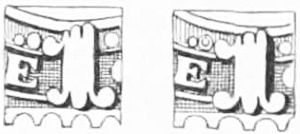
1 Cent.—A minute dash with ends up-turned placed in the pearl at the left of the numeral of value. Proof specimens show a faint trace on the ball to the right of the numeral. The balls in the original are all white.
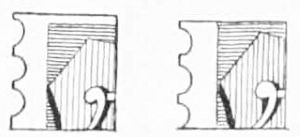
2 Cents.—The white line which encloses the words "U. S. Postage" turns up in a ball on each side; the ball above the "U" interrupts four shading lines of the frame, the "mark" closes up the inner space and leaves it solid, while in the original it is open.
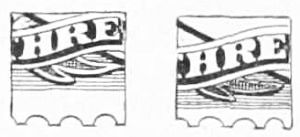
3 Cents.—The ribbon inscribed with the value has the border where it is turned under at the left side made dark; in the original it has a white edge surrounding it.
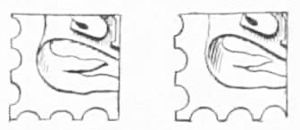
6 Cents.—The ribbon inscribed with the value has four dark lines of shading where it turns under at the left side; in the original these lines are much shorter and thinner.
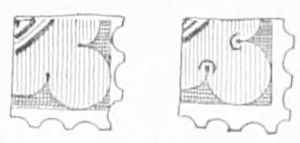
7 Cents.—The angles of the ball in the right lower corner of frame are capped by a minute semicircle of color: in the original both lower corners are the same.
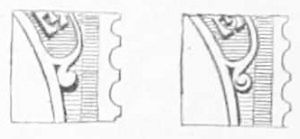
10 Cents.—The label containing the inscription "U. S. Postage" is bordered with a white line which turns up in a ball at each end. That at the right encloses a minute semi-circular mark; on the original the ball is white on each side.
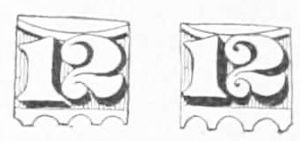
12 Cents.—The figure 2 at the turn encloses a colored dot above and below; the originals do not show color.
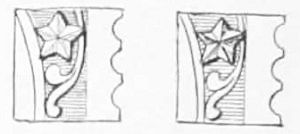
24 Cents.—The last of the half-circle of thirteen stars has the shading of the four lower points deepened; in the original the shading is equal throughout, and the same as on the other stars.
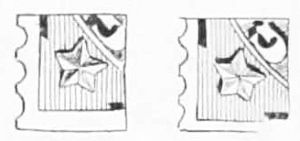
90 Cents.—The shading of the four lower points of the right-hand star has been deepened; in the original both stars are shaded the same.
15 Cents.—The secret mark on this value has not yet been satisfactorily identified. Some think that the mark lies in the outer lines of the triangle at the lower left corner, as some of the Continental printed stamps show a much heavier shading on the enclosing lines than is to be found in the National printed stamps.
30 Cents.—Also doubtful. Some claim that there is a little dot to the left of the oval frame, but this is probably only a transfer guide.
One dealer in New York supplies four varieties of the 1c., two of the 2c., three of the 3c., three of the 6c., two of the 7c., three of the 10c., and two of the 12c., nineteen varieties in all, including the re-engraved stamps, for $3.25.
M. C. H.—The best way to detach stamps from envelopes is to wet them thoroughly, when they can readily be taken off.
J. T. Delano, Jun.—The coins are worth face value only.
Philatus.