Part 1 — GREAT MEN'S SONS.
Reading edition
BY ELBRIDGE S. BROOKS.
THE SON OF NAPOLEON.
"Nineteen—twenty—twenty-one," the people in the Garden of the Tuileries counted. Then, with open ears, they listened breathlessly. "Twenty-two! Hurrah! hurrah!" they shouted. "A boy; it is a boy!" they cried. "Long live the Emperor! Long live the King of Rome!"
It was the 20th of March, 1811. A baby had been born in the palace of the Tuileries. The booming cannon announced the great event, and the people knew that for a girl twenty-one guns would be fired; for a boy, one hundred. So when the twenty-second gun boomed out there was no need for further counting. All the people knew that an heir to the throne of France had been born, and with loud acclamations they shouted "welcome" and "long life" to the son of Napoleon.
"HIS MAJESTY THE KING OF ROME."
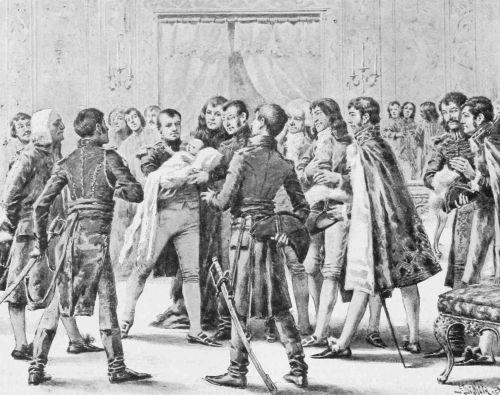
He was a bright, pretty little fellow, and his father loved him from the start. At his very first cry Napoleon caught him up, and hurrying to the great chamber in which the foremost men of the empire were waiting, presented to them "his Majesty the King of Rome!"
It was at the height of Napoleon's power. All Europe lay at his feet. Thrones and principalities were his to give away; but for his son he reserved the title that would revive the greatness and glory of the ancient days and recall the widespread sway of Charlemagne; the little Napoleon was to be King of Rome, and heir to the Empire of France.
But a King must have a royal guard. So one day in September, 1811, a brigade of boys, none of them over twelve years old, marched into the Cour du Carrousel, where the Emperor was reviewing his army, and drew up in line of battle opposite the famous Old Guard of the Emperor. And Napoleon said: "Soldiers of my guard, there are your children. I confide to them the guard of my son, as I have confided myself to you." And to the boys he said: "My children, upon you I impose a difficult duty. But I rely upon you. You are pupils of the guard, and your service is the protection of the King of Rome."
There were days of splendor and ceremonial, of fête and display, in the early life of the little King of Rome. His father was, literally, Kings of Kings; he made and unmade sovereigns, he carved up nations, and cut out states.
Suddenly came the collapse. All Europe arrayed itself against this crowned adventurer—this man who, through a hundred years, has remained at once the marvel and the puzzle of history. There came days of preparation and leave-taking, of war and battle, of defeat and disgrace. When the days of war and struggle came, the old-time fire and dash and courage of the conqueror seemed to have left him; his hopes were with his boy and that boy's future rather than in the rush and grapple of armies.
So Napoleon's star set fast. With all Europe arrayed against him for his overthrow, the great Corsican suddenly became little, and everything went wrong.
On the 25th of January, 1814, the father saw his son for the last time. Holding by the hand the boy, then nearly three years old, the Emperor presented himself before the eight hundred officers of the National Guard of Paris, assembled in the gorgeous Hall of the Marshals. "Officers of the National Guard," he said, "I go to take my place at the head of the army. To your protection I confide my wife and my son, upon whom rest so many hopes. In your care I leave what is next to France—the dearest thing I have in the world."
But disaster overwhelmed both the Emperor and the nation. The guards were powerless to guard. The armies of Napoleon were defeated; he himself was banished to Elba; and the little Napoleon with his mother escaped to the court of his grandfather, the Emperor of Austria.
With a final burst of courage Napoleon escaped from Elba and roused France once again to war. It was in vain. His power and his luck were gone. Waterloo gave him his death-blow, and the lonely island of St. Helena became his prison and his grave.
Four days after Waterloo, on the 22d of June, 1815, Napoleon issued his last proclamation. "I offer myself in sacrifice to the hatred of the enemies of France," he announced. "My political life is ended, and I proclaim my son, under the title of Napoleon II., Emperor of the French.... Let all unite for the public safety, and in order to remain an independent nation. Napoleon."
But the nation was paralyzed by disaster. Union was impossible. The boy thus proclaimed Emperor was far from France, held by the enemy. He was never to see his native land again, never to see his father, never to reign Emperor of the French.
For seventeen years the boy lived at the Austrian court, practically a prisoner. His mother cared little for him, and for years did not see him; his name of Napoleon was denied him; his titles of Emperor and King were taken from him, and he was known simply as the Duke of Reichstadt.
His grandfather, the Emperor of Austria, was kind to him, and tried to make an Austrian of him, but he grew from a bright, handsome little fellow into a lonely, low-spirited, and brooding boy, who remembered his former grandeur and the high position to which he had been born, and fretted over the knowledge that he, the son of Napoleon, could inherit no portion of his father's glory, and was denied even the empty honor of his name.
At five he was a beautiful boy, who rebelled when his tutors tried to teach him German, and delighted to play jokes on his royal grandfather; it has even been solemnly asserted that he tied the imperial coat tails to a chair, and filled the imperial boots with gravel. At seven he put on the uniform of a private in the Austrian Royal Guard, and displayed a liking for military life. His gayety began to change to reticence and a love for solitude as he grew old enough to appreciate his position. One of the Austrian Generals was discoursing to the boy one day on the three greatest warriors of the world.
"I know a fourth," said the young Napoleon.
"And who is that?" the commandant asked.
"My father," replied the boy, proudly, and walked away from the lecturer.
He was ten years old when his great father died in his exile at St. Helena (on the 5th of May, 1821). The boy wept bitterly when he was told the news, and shut himself up for several days. He put on mourning, but the Austrians compelled him to put it off, and permitted him to show no grief for his dead father.
After this he grew still more quiet and secretive; he took to his books, became quite a student, and wrote an able treatise upon Cæsar's Commentaries. When he was fifteen he was permitted to read books about his father and the history of France, and at sixteen he was instructed in the forms of Austrian government, and the false theory known as "the divine right of Kings."
When he was twenty he "came out" into society, and was made Lieutenant-Colonel of infantry in the Austrian army, but he never "smelled powder" nor saw war. Brooding and solitude weakened his constitution; ill health resulted; his lungs were touched with disease: and on the 22d of July, in the year 1832, having reached the age of twenty-one, the son of Napoleon died in the palace of Schönbrunn, of consumption.
It seems hard, but death was the only solution of what might have been a problem. Without the will, the energy, the genius, or the selfishness of his remarkable father, the son of Napoleon had yet ambition, persistence, and a reverence for his father's memory that amounted almost to a passion. Without any special love for France, he cherished that dream of empire that his father had made come true. Had he lived and joined ability to strength, his name might have raised up armies, and again drenched Europe in blood—the tool of factions or the prey of his own ambitions. He died a lonely invalid, and Europe was spared the horror of a possible "might have been."
On the plain bronze tomb that marks this boy's place of burial in the Carthusian Monastery at Vienna—near to that of another unwise and unfortunate Prince, the Austrian usurper Maximilian of Mexico—the visitor may read this inscription, placed there by the Emperor, his grandfather: To the eternal memory of Joseph Charles Francis, Duke of Reichstadt, son of Napoleon, Emperor of the French, and Marie Louise, Archduchess of Austria. Born at Paris, March 20, 1811, when in his cradle he was hailed by the title of King of Rome; he was endowed with every faculty, both of body and mind; his stature was tall; his countenance adorned with the charms of youth, and his conversation full of affability; he displayed an astonishing capacity for study, and the exercise of the military art: attacked by a pulmonary disease, he died at Schönbrunn, near Vienna, July 22, 1832.
The epitaph tells but one side of this boy's story; the other side is sad enough. A young life begun in glory went out in gloom; the Prince of the Tuileries became the prisoner of Vienna: the dream of empire was speedily dispelled, and death itself mercifully removed one who might have been a menace and a curse to Europe.
What he might have been had his father remained conqueror and Emperor none may say. But the star of Napoleon, that had blazed like a meteor in Europe's startled sky, flickered, fell, and went out in disgrace. Thenceforward the shadow of the father's downfall clung to the boy, and the son of Napoleon had neither the opportunity, the energy, nor the will to display any trace of that genius for conquest that made the name of Napoleon great in his day, and greater since his downfall and his death.