Part 1 — AT THE SEA-SIDE.
Reading edition
A Suggestion for a Summer Entertainment.
BY CAROLINE A. CREEVEY AND MARGARET E. SANGSTER.
Characters:
Charlotte Howard.Grace Everton.
Victoria Mason.Helen Sayres.
Ida Moore.Miss Sommerfield.
Olive Brandon.Miss Daisy James.
Madge Fuller.Captain Jake.
Scene.—A summer-house on the beach, in front of the Mattewan Hotel.
Occasion.—A rehearsal for an entertainment to be given in the hotel parlors for the benefit of the Sea-side Home.
Present.—Charlotte, Victoria, Ida, Olive, Grace.
Victoria. What a perfectly glorious afternoon, girls! The sunshine is dazzling. The surf is music itself; the sails out yonder are so white; and the air! I cannot breathe it into my lungs deep enough. There's no place like the sea-side after all.
Charlotte. Mamma is begging papa to take her to the mountains.
Ida. Oh, what a shame! Just as we are getting so well acquainted, and can plan so many nice things to do. It would be wicked for you to leave us.
Victoria. Have you met that new arrival, Miss Daisy James? She's English, you know. She talks about her boxes, not trunks.
Olive. She has luggage, not baggage.
Ida. Yes, I was talking to her. She's funny. She says there isn't any Gulf Stream. Says the Captain of her steamer has sailed for thirty years, and has never seen it. So, if you please, the Gulf Stream "is a myth."
Grace. She's the most disdainful thing, and uses such queer words! She says raw clams are "nasty," and she called bananas "those beans."
Olive. Perhaps she will improve on acquaintance. We mustn't be too hard on her.
Charlotte. Where are all the girls? We ought to begin our rehearsal.
Victoria. There's Madge Fuller now. She has that sweet-looking young lady who played so beautifully with her.
[Enter Madge Fuller and Miss Sommerfield.]
Madge. Halloa, girls! Am I late? I was reading, and I almost forgot our rehearsal. But I have brought a new recruit. Miss Sommerfield, girls. Miss Howard, Miss Mason, Miss Moore, Miss Brandon, and Miss Everton.
Grace. Otherwise Charlotte, Victoria or Vic, Ida, Olive, and myself, Grace. No airs, Madge.
Olive. We are so glad you asked Miss Sommerfield to help us, Madge dear.
Miss Sommerfield. I will help, but don't let me intrude. What are your ideas of an entertainment?
Grace. Ideas are just what we are after. The only settled thing is that the tickets are to be fifty cents.
Charlotte. We thought we would each recite or read something. Original preferred. The object is the Sea-side Home.
Miss Sommerfield. It is a lovely object. I went all over the one on Seney Island.
Victoria. Oh, then you can tell us about it.
Miss Sommerfield. They take sick children and babies for two weeks. The house is large and clean, and quite near the water. Verandas go around three sides on every story. All the bedrooms open on to these verandas, and there, in the open air, the babies are wheeled, or rocked, or swung in hammocks. So they breathe that invigorating air day and night. The older children, as soon as they are able, dig in the sand, sheltered by tents. They have plenty of good milk to drink, bread and biscuit, oatmeal and mutton broth. The mothers have, in addition, meat, potatoes, tea, and coffee. The babies pick up surprisingly. They go away rosy and hearty. Many a life is saved.
Olive. What a pity they must go away.
Charlotte. Well, a fortnight is better than nothing. Isn't it the sweetest of charities? I am sure everybody in the hotel will come to our entertainment.
Miss Sommerfield. I heard one of the nurses singing lullaby while rocking some darling twin babies to sleep. I thought it so pretty I have remembered it. Would you like to hear it?
All. Please do. Yes, indeed.
[Miss Sommerfield repeats lullaby.]
By-by, babies, hushaby, Night and sleep are drawing nigh, Little birdies seek the nest, Tired lambkins drop to rest, By-by, babies, hushaby, Stars are lighting up the sky, Angels come to watch your beds; Slumber, little curly-heads.
[Enter Helen Sayres and Daisy James.]
Helen. Good-afternoon, girls. I am awfully late, but I met Miss James and got talking to her, and didn't realize how time was passing. Miss James, young ladies.
[All nod rather stiffly. Miss Sommerfield extends her hand, and Miss James touches it with the tips of her fingers.]
Miss James. So happy, I am sure. I was quite by meself, do you know, and Miss Sayres kindly spoke to me. Do you not find it rather lonely here?
Olive. Oh, not at all.
Victoria. It's simply perfect. We all know each other, and how could we be lonely?
Miss James. You all know each other? Just fancy! A party of girls travelling together. How very odd!
Olive. No, Miss James, we have made each other's acquaintance since we came here. But American girls get acquainted easily.
Miss James. Only fancy that, now! It is truly a democratic country. In England, you know, at the watering-places, I stay with mamma a whole season, and we never speak to strangers. Mamma is very particular.
Madge. Well, Miss James, to make you feel easier about us, we will give you references.
Miss James. I dare say you are all right. But in England it is so different, so much more established, you know. This is the land of the people.
Grace. Have you been to Chicago?
Miss James. No; but we are going there, of course.
Grace. Chicago is fine, when you get there; but it's dangerous travelling. Great herds of buffalo wander on the plains, and bands of Indians lie in ambush for the trains.
Miss James. Only fancy! How do the trains ever pass?
Grace. It all depends on your engineer. If he understands his business, he shoots at lightning speed through Indians and buffaloes. But you can't feel quite safe till you get there.
Miss James. I must tell mamma of this. I am sure she will not go.
Miss Sommerfield. We should go on with our preparations, girls. Has anybody a suggestion to make?
Helen. I have an idea. We have among the hotel guests a fine pianist. Perhaps he would play for us.
Grace. You mean that gloomy-looking man with such a name?
Olive. With a long mustache, and eyes with white in them?
Helen. Speak of him respectfully. He plays like an angel.
Victoria. What's his name?
Helen. Stradelerewsky.
Charlotte. Oh, horrors! Say it again slowly.
Helen. Strad-e- (think of the Stradivarius fiddle) le-rewsky (think of Paderewsky). Now, say it altogether.
All. Strad-e-le-rew-sky.
Charlotte. That name alone on the programme would be worth the price of admission.
Victoria. Well, who's going to bell the cat?
Miss James. Beg your pardon? What cat?
Grace. She means who is going to ask that scowling ever-with-a-cigar-in-his-mouth musician to play for us.
Miss James. I prefer not to. I have not been introduced, and mamma—
Grace. Will you, Miss Sommerfield?
Miss Sommerfield. Oh yes, I have been introduced.
Grace. Is he French?
Victoria. No; unmistakably Italian.
Helen. Or Polish, or Russian, or some sort of a Slav.
Miss Sommerfield. Russian, I think. He speaks English and French.
Ida. Did you talk French with him?
Miss Sommerfield. Yes.
Ida. I wish I could speak French. I can't even conjugate avoir.
Miss James. It is easy: j'ai, tu es, il—
Ida. Oh, please, Miss Sommerfield, go now, there's a dear, and speak English, so that you can report what he says.
Miss Sommerfield. All right. I go. There's no time like the present. [Exit.]
Grace. Madge, she's a darling.
Madge. I knew you would like her.
Charlotte. Girls, let's go on with our rehearsal. Has any one found a poem, or written one, for this occasion?
Olive. I have found a dainty thing on sea-weeds. Will you hear it?
Madge. Please, dear.
Olive (reads):
The violet gems the forest, The daisy stars the field, And every wayside bank and brook Their fragrant treasures yield. Oh, sweet the air of summer, With thoughts of God in flowers! For bloom and beauty hand in hand Walk down the passing hours. But naught, dear child, is fairer, Nor lovelier tinting shows, Than those fair things which cradled are Where oft the storm-wind blows. The sea-weed's hues are rarer Than painter's art can trace; And only fairy looms can weave The sea-weed's floating lace.
Helen. Why, Olive, that's just sweet. Where did you find it?
Olive. In my mother's day-book. Mother writes a poem now and then, and locks it up in her drawer. She says it isn't good enough to publish.
Victoria. It is good enough. The magazines print a lot of things not so good as that.
Olive. Thank you.
Victoria. Girls, do you want anything funny? My brother Charlie dashed off some rollicking lines for me last night.
Charlotte. Oh yes. Let's have something funny.
Victoria. It's arrant nonsense.
Madge:
"A little nonsense now and then," Said good old Dr. Lee, "Is relished by the best of men. That's just the case with me."
The doctor was jumping a rope when he said that.
Victoria (reads):
ODE TO A CLAM.
Oh! clam at high-water, Here's somebody's daughter A sighing and crying your measure to take; She cares for you only, Poor bivalve so lonely, Because you are good in a Yankee clambake. Perhaps she'll shout louder To see you in chowder. Poor clam, for your sake I've a dreadful heart-ache.
Charlotte. Capital. We wouldn't miss that for anything. Who else is ready?
Ida. I have a little poem about a shell. [Reads.]
What is the song you are singing forever, Sad as the sound of a knell, Deep as the tone of a bell, Oh! sorrowful, murmuring shell, Singing and singing forever?
Grace. Mine is about sweet charity. [Reads.]
Of all things touched with heavenly clarity, There's nothing can compare with sweet, sweet charity!
Charlotte. Girls, we ought to have some singing. Do you know that old tune, "Home Again"? Why not sing that? It will please the older ones, and seem a compliment to them. It might do for the last thing on the programme.
Ida. That's beautiful.
Madge. Sing the tune, Charlotte, and let me catch the rhythm.
[Charlotte and the others sing.]
Home again, home again, From a foreign shore; And, oh! it fills my soul with joy To see my friends once more.
[Enter Miss Sommerfield.]
All. Oh, Miss Sommerfield! Did you see him? Will he? What did he say? Did he hypnotize you?
Miss Sommerfield. One at a time, young ladies. Let me tell my story, please. I found this wonderful man just where I had left him. I said, "Professor." He started, kicked over a chair, threw away his cigarette, stared at me, and said, "Pardon, mees, I was so rude." "Not at all, Professor," I said; "I am sorry to interrupt your reading." "I am most happy to be interrupted by a so charmant a young lady," he said, gallantly.
Grace. That was nice in him.
Miss Sommerfield. So then I told him about you and your request, and implored him to play for you. He listened, stroked his mustache, and toyed with his big diamond ring. "It is for the poor sick little children." "Ah!" he said, "America is von grand country for poor leetle children. They are efer doing something. Very well; why should I not play for these young ladies, and the poor sick little children?" "Then you will?" I said. "With pleasure," he said. "I do not play to eferybody. See? I do not become common. But this is different." "Oh, Professor," I said, "how can I thank you enough? Dare I ask what you will select?" And he said, "A thing from Chopin and one of my own compositions."
Miss Sommerfield. But hear the rest, and see, you naughty girls, what a position you have got me into. He said. "Do you not perform the piano, mademoiselle?" "A little, a very little," I said. "We shall then give a four-hand piece? Yes? Charmant! I have a nice thing, superb. We shall close the parlor doors, and practise together."
Madge (hugging her). The dear. See her blush. It will be simply an elegant affair.
Miss Sommerfield. But I am afraid to play with such a big musician. My heart will be in my mouth.
Charlotte. On no account, my dear. The practice will do you good. And the honor will be overwhelming.
Grace. Indeed, you are a beautiful player, and think how your name coupled with that of Skewsky will look. Everybody will turn green with envy.
Miss Sommerfield. If I don't spoil everything.
Ida. Girls, I see Uncle Jake. He's an old sailor who is hired to keep the grounds in order. He spins the most delicious yarns. I'm going after him, and let's see if we can set him a-going. [Exit.]
Victoria. What fun!
Charlotte. But we ought to let nothing interfere with our rehearsal.
Helen. Oh, bother the rehearsal! I have read these Old Sailor's yarns in Harper's Round Table, haven't you? But I never heard a real sailor talk.
Miss James. I would better be going. If there's to be a man in the party, mamma might not like—
Miss Sommerfield. You will not offend your mamma, I am sure. This old sailor is a harmless, good-natured fellow.
Grace. How does Ida come to know Uncle Jake?
Victoria. Her brother follows the sea, and naturally she makes up to sailors.
Olive. Ida is a darling.
[Enter Ida and Uncle Jake.]
Ida. I have fetched him, girls; but he says he's in a hurry, and can only say how-de. (Aside to the girls.) Do get him talking. His stories are genuine sailors' yarns.
Madge. How-de-do, Uncle Jake!
Charlotte. We are right glad to see you. Do sit and rest awhile on this bench.
Miss Sommerfield. We hope you are well, Uncle Jake?
Uncle Jake. Tol'able, ma'am, tol'able. My knees are stiff around the j'ints.
Ida. Uncle Jake, we are getting up an entertainment to be given in the hotel for the benefit of the Sea-side Home.
Uncle Jake. Now that's a good thing. Calc'late to fetch up there myself one of these days.
Victoria (laughing). But, Uncle Jake, this is not a home for old sailors. It's for sick and poor babies. You see, they would die in their overcrowded hot tenements; but they come to the home and get well.
Uncle Jake. Oh, land sakes! That must be what the old gentleman referred to. Sick babies. Yes, that's it.
Charlotte. What old gentleman?
Uncle Jake. The one I met in the Saragossa Sea.
Ida. Elegant. Girls, he's going to spin a yarn. Uncle Jake, do please tell us about that. Was it an adventure?
Uncle Jake. Quite so, miss. But I interrupt your proceedings.
Several at Once. Oh, go on. Do. Never mind the proceedings.
Uncle Jake. Well, that there was a tight scrape, and no mistake. I was second mate of the Blue Turquoise. It was a first-class voyage till we hove right inter the Saragossa Sea, and there we war becalmed and stuck as fast as a fly in mucilage. That Saragossa Sea is a curus place. Sea-weeds grow a mile long, with blossoms big as sun-flowers. Monsters swim around, and squat on the branches and squint at the ships a-lyin' becalmed. It made me kinder shiver to see them creturs' hungry looks. They knew a ship would rot to pieces, only give her time. Our Capting war powerful mad when he see he'd got inter the Saragossa Sea. But gettin' mad arter a thing is done don't do no good. Waal, it war a red and fiery ball of a sun. How I wished I could a set oncet more under a tree. Truly I'd ha' given my bottom dollar to be a settin' under that old oak that we had to hum, an' a breeze a-stirrin' the branches. Somethin' to dry up the perspiration. Willie war cabin-boy, and homesick and down in the mouth, poor youngster. The Capting's face warn't reassuring. He was plumb beat out.
Miss Sommerfield. Girls, do you recall Coleridge's "Ancient Mariner"?
Olive. Yes.
"As idle as a painted ship Upon a painted ocean."
Go on, Uncle Jake.
"WAAL, ONE NIGHT I WAR ON DECK ALONE."
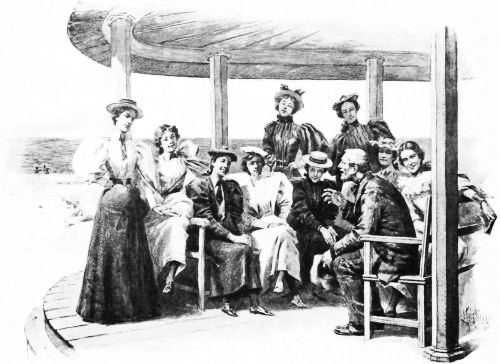
Uncle Jake. Waal, one night I war on deck alone. Willie he was thar too. The Capting he come up. "Ain't no change, mate?" says he. "No, sir," says I. "Bad business," says he. "Better soon, I hope," says I. "We're in the oidentical spot we was in two weeks ago," says he. "Mate, the perwisions is givin' out," says he, in a hoarse voice. "I know it, sir," says I. It was the wust feature of the case. Thar war Willie standin' by, mournful-like. I tried to hearten up the Capting a bit, but 'twarn't no use. "I'd ruther be in a whirlpool," says he, "than here. I'm goin' below. If there's a change call me," says he. So he went below, and pretty soon I heerd him and the rest of the crew snorin'. There warn't a solitary blessed thing for the men to do, and they war all turned in. Willie and me we staid up and watched the heavens of brass. It might ha' been midnight when I sighted a speck a long ways off. There warn't no wind, yet it came on wonderful fast. "D'ye see that, Willie, my boy?" says I. "It are a curus craft." But Willie warn't asleep. He seen it too. Come near, there war a 'nurmous shell with a fine hearty old gentleman sittin' in it, and by his side the harndsomest young lady (barrin' present company) that I ever seed. She war a beautiful cretur, with black eyes shinin' like stars, and long golden hair, which she war a-combin' out the snarls. The shell was drawed by two white sea-horses. Their backs was like great fishes, and their tails lay on top the water like fishes' tails. Their forrud part war like horses, and their manes was like tossin' waves. Bless my soul, but they made a putty pictur. When they was hove close to us the old gentleman hauled up his horses, and "Helloh!" says he to me. "Helloh!" says I. "What's the name of this ere wessel?" says he. The "Blue Turquoise," says I. "Jes so," says he. "Becalmed, ain't ye?" "You're right there, sir," says I. "What may I call you, sir?" says I. "Oh, I'm Father Neptune," says he.
Miss James. Oh, now, Uncle Jake. That's impossible.
Ida. Nothing is impossible. Don't interrupt.
Uncle Jake. I'm only tellin' ye what he said. He had a pitchfork in his hand 'stead of a whip.
Miss James. That wasn't a pitchfork. It was a trident, which had three prongs, and was a symbol of Neptune. Mamma—
Victoria. Miss James, you must be a realist. Now, please let the story go on. Pitchfork it is, Uncle Jake.
Uncle Jake. Yes, ma'am, it war. "Well," says I, "that harndsome gal is Miss Neptune, I suppose." With that the young lady laughed fit to kill. "Not by a long shot," says she. "I am Miss Lorelei." Then she giv me one of them piercin' glances of hern, and I shivered. Willie he felt oneasy too. "I beg your pardon, ma'am," says I. "Be you the pusson what sits on a rock and draws sailors to their own destruction?" "The very same," says she, and she kep' on laughin' and laughin'. "If you please, ma'am," says I, "I'd ruther not be drawed. Though 'twould be a change on staying here." "You're safe," says she. "I ain't in the drawin' business now," says she. "Father Neptune and me's takin' a trip round the world." Father Neptune he spoke up, and says he, "Ever been to America? They say it's a fine country. We're goin' there. I want to see their big ships that cross the ocean in five days, seven hours, and fifty-nine minutes. That beats me. And then their life-savin' stations, and light-houses, and sea-side homes for poor sick babies. I want to see them all. Sea-air is good for babies, eh? Good enough for me. I've lived on it several hundred years." "You're lookin' hale and hearty, sir, I'm sure," says I.
"Well, good-by, and good luck to ye," says he, pullin' at the reins.
"Hold on, your Honor," says I, for an idee had taken possession of me. "Can't ye give us a pull out er this?" He talked low with Miss Lorelei, and she didn't seem to object. "All right, throw us your hawser," says he. I was all of atremble, but Willie and me got that there rope loose in a hurry, and threw one end to Father Neptune, and made fast the other. "Ain't you afraid?" says Willie. "No, my boy," says I. "The end justifies the means." Miss Lorelei took hold of the hawser, and Father Neptune give his horses a poke with his pitchfork, and my eyes! the old thing groaned and started. The Blue Turquoise was actually under way, and them horses foamin' and prancin' for all they was wurth, 'twarn't long before we was flyin' and churnin' the waves behind. Miss Lorelei looked back with them wicked, beautiful eyes of hern, and tossed her golding hair, and, "You see I am back again in the drawin' business," says she, with a laugh like the rattle of silver.
Up come the Capting. "Got a wind, eh?" says he. "Why, no, not a breath. What in thunder makes her go?" Then he spied the hawser drawn tight over the bow, and he turned pale, his knees knocked together, his teeth chattered. You might have pushed him down with a straw. It war, no mistake, a curus position, and I never blamed the Capting for feelin' queer. "It's all right, sir," says I; "we're bein' tugged."
"Who's a-doin' the tuggin'?" says he. Father Neptune war nothin' more'n a speck on the water by this time, and Capting couldn't make him out. I told the facts to the Capting, and Willie, he j'ined in, and said it war blessed Gospel truth. But the Capting's wind was clean out of his sails. I set him a steamer-chair, and Willie fanned him with a newspaper before he fairly come to. "Lord," says I, "Capting, what's the odds how you git out of this, s'long 's you only git out?" which I hold to be a pretty good p'int.
We were pulled clear out of the Saragossa Sea, and the wind sprang up, and we made port in a week arter.
Victoria. Did Father Neptune let go the hawser?
Uncle Jake. No, miss. Ye see, I had forgot to tell him we was bound south, and nachelly he bein' headed for the Sea-side Home, was a-goin' north. We cut the hawser. But I'll never forgit the good turn he did us.
Ida. My brother's name is Willie. He is a sailor.
Uncle Jake. What's his last name?
Ida. Willie Moore.
Uncle Jake. Bless my soul, if that warn't the identical chap.
Ida. But my brother's first voyage was on the Porpoise. She sailed to the West Indies.
Uncle Jake. It war the Porpoise. Beats all, how my memory fails. The Blue Turquoise war the next ship I sailed in.
Ida. Willie never spoke of that adventure at home, Captain Jake.
Captain Jake. Ask him, ask him. 'Mind him of the Saragossa Sea, and how the Blue—I mean the Porpoise—war tugged. He'll recollect. Mention Miss Lorelei with her golding hair. But good-day, young ladies. Pleased to meet ye again.
All. Good-day, Captain Jake.
Miss Sommerfield. And many thanks for your pretty tale.
[Exit Captain Jake.]
Miss James. I fear that old man does not always speak the truth. Neptune is a pure myth.
Helen. Like the Gulf Stream.
Miss James. And I seriously doubt, Miss Moore, if that was your brother Willie.
Ida. Don't you worry.
Charlotte. I see Madge has found the old lyric mamma loves. Read it, Madge, two lines at a time, and we will sing it to the tune of "What fairylike music steals over the sea."[1]
"What fairylike music steals over the sea, Entrancing the senses with charm'd melody? 'Tis the voice of the mermaid, that floats o'er the main, As she mingles her song with the gondolier's strain. 'Tis the voice of the mermaid, that floats o'er the main, As she mingles her song with the gondolier's strain."
[Madge reads, and the others sing.]
When we have the entertainment, we'll let this be the last thing on the programme.