TILL THE GAME IS DONE.
Reading edition
BY SEELYE BRYANT.
Captain "Reddy" Alden, of the Blackwood Academy football team, was not handsome. He was not even graceful. But his chin "meant business," and there was a serene look in his eyes which was likely to make a bully think twice before taking hold of him. His nickname sufficiently indicated the color of his hair, which grew back from his forehead in a "cowlick," and showed a tendency, when of approved football length, to drop in straggling masses down either side of his freckled face.
Reddy—or more properly Mark—was nineteen years old, tall, and long-armed, with a very slight outward bend of the legs, and a chest not broad but deep. He looked wiry rather than muscular.
As he started toward the village, one Thursday afternoon, his hands were in his pockets, his leather cap was on the back of his head, and the collar of his heavy sweater fell over his shoulders above his double-breasted coat.
He walked slowly down the hill, as if waiting for some one, and occasionally turned to look back toward the academy. Soon a clear quick call stopped him entirely. "Hold on there, Reddy!" it came, and the next moment "Buck" Harris darted down the hill and caught him by the arm.
The two settled into a brisk walk, and Buck remarked, "I saw Billy Hurd just now. His knee'll keep him off the field for a month."
"Too bad!"
"Well, what are you going to do?"
"Going to do?"
"Yes. Saturday comes in two days, and with Hurd gone there's no one on the team safe enough to kick twenty yards."
The Captain smiled grimly, "We'll run, then!"
"Why not give up playing Winston this year? It's an extra game, and they're too heavy for us, anyway. Think what a strain it's going to be to face that rush-line for the two halves. And if they know enough to keep Mellen kicking, he'll about kill us before the end of the first half, making us chase the ball. Besides, he's dead sure to drop a goal from the field, if he gets any sort of an angle within decent distance of the posts."
Reddy straightened up, and his blue eyes gleamed.
"That game's no picnic for either side!" he jerked out. "The Blackwood boys'll play it for all that's in it! Our tricks are good, and I shall save you for the second half. As for me—well, I was never killed yet, and I never saw a Blackwood eleven go back on its Captain!"
This was a long speech for Mark Alden, and it had its effect upon his chum.
Seton Harris was short, thick-set, and very muscular, although his fashionable clothes and perfect grace of movement might at first deceive you in regard to his "solid contents."
He had regular features, and clear, glowing cheeks, with handsome eyes, and dark hair, whose clustering waves even the exigencies of football could not persuade him to wear at more than conventional length. He was two years younger than Alden, and a class below him in school.
Their intimacy had been the surprise of the year. When the principal heard of it he said, "Well, if anything can make a man out of Seton Harris, it is to room with Mark Alden. I am delighted with the arrangement, though I confess I do not understand it."
Others felt in the same way, and perhaps the most thoroughly astonished person in the whole academy was Seton Harris himself!
He had come to Blackwood the year before with an obliging disposition, no strongly settled principles, and more spending-money than was good for him. As a natural result, the sort of boys who voted him "a jolly good fellow," and with whose doings he soon became identified, was not the sort most likely to make his academy career a success in the eyes of his teachers.
His great lack was persistence. He hated to face opposition or to keep steadily at work on anything that was disagreeable.
Still he had plenty of energy when he chose to exert it, and everybody liked him, even the principal.
He was the fastest short-distance runner in school, and when they made him "half-back" on the football team he became the "star" of the eleven.
His occasional fits of application had results sufficiently brilliant to save him from hopeless disgrace in his studies.
But he lived under a chronic state of reprimand for general conduct, his miscellaneous offences ranging from noisiness in his room during study hours to absence from the building after proper time at night.
In fact, he had so many executive sessions with the principal that new-comers were usually informed he was "Doctor Walker's private secretary." Rumor stated that a member of the entering class was accustomed to lift his hat when Seton spoke to him!
Even at football the boy could not be depended upon.
In practice and in minor games his play was wonderful. But he was likely to lose his nerve in a close struggle. It was not that he was actually afraid. He had physical courage, only his confidence did not meet the requirements of a "forlorn hope." Once start him with the ball, and he was all right, seemed perfectly reckless of himself, made those "phenomenal rushes" that capture a grand stand by storm.
But he seemed unwilling to run after he had failed once or twice to gain ground. When sharp work was needed, he was not sure of catching the ball, and might even trip himself up in getting under way.
Besides, the managers continually complained that he was irregular about training.
This was Buck Harris at the time when steady-going, self-contained Mark Alden first showed an interest in him. Buck never told exactly how it happened, and no one ventured to ask Reddy.
But it came to pass, after one of Buck's numberless escapades, near the beginning of the fall term, that he moved his personal effects into the large corner room on the second floor where Alden had planned to reign alone during Senior year.
The escapade in question was unusually serious. The "wild set" had destroyed some abandoned buildings belonging to a farmer in the lower village. The owner did not love the Blackwood boys, and vowed to push the case to the extreme of the law.
"Jest let me git one o' them pesky young villyuns behind the bars 'nd I'll be satisfied!" he told the postmaster.
Now it chanced that Seton Harris was identified as the particular "villyun" whom he was most anxious to prosecute. Money would not satisfy the man, and matters looked black for the culprit.
But, to the surprise of the town, the case did not come to trial.
All that the public knows about it is that Mark Alden walked down to the lower village with Seton one afternoon, and that when they came out of the farmer's house, an hour after, the owner was seen to shake hands with both the boys.
The public does not know what took place as Seton and Mark sat under the academy maples waiting for supper.
"Reddy, not one of my set would do as you've done for me to-day. I believe I'd like to cut the whole tough outfit!"
"Why don't you?"
"Too hard work; besides, there's nobody else much that I know very well."
"Room with me."
Seton gasped, and turned around to look his companion squarely in the face. "Do you mean it? Wy, I'd drive you crazy!"
"I mean it."
And so it was brought about.
Saturday afternoon, and one o'clock. The old "Elm House" barge drew up promptly at the academy door. "Pete" Marston had driven that barge for the boys on every athletic occasion in the last fifteen years. No one enjoyed the successes or mourned the defeats of Blackwood Academy more sincerely than Pete.
"I vum, boys, ye look 's if ye cal'lated to start for the north pole this trip, with all them duds wound round ye!" he called back as the players tumbled in.
Sweaters, ulsters, toboggan caps, and padded suits made it difficult to tell where woollen goods left off and the boys began. Buck Harris had wrapped a huge Turkish towel around himself on top of everything else, "by way of ornament," he remarked. Buck's dark eyes were the only visible portion of him, but from the continual "chaff" he kept flying, the rest knew that somewhere was an open passage to his mouth. Everybody was talking except Mark Alden. Some were excited, and a few were gayly indifferent. Mark did not look at all worried; he simply kept quiet.
Half past three o'clock on the grounds of the Winston Normal Institute. The game with Blackwood was in progress. Mark Alden had just "tackled" a Winston player in his decided way, which left no doubt as to where the ball was "down."
"That Captain of yours is an ugly customer, I judge," said the Winston storekeeper to Pete Marston, who had put up his horses and was leaning against the fence.
"Waal no, Reddy ain't ugly 'xac'ly. He's square 's a meetin'-house—ain't afraid 'f th' inside o' one neither; only when football's on he plays the game, that's all. Don't believe he sees anythin' but the ball, or knows there's anybody here but them players. He's jes so in ev'rythin' else. 'Twouldn't be no diff'rent if 'twas drawin' trygomertry figgers on that there blackboard up 't Blackwood school. He wouldn't hev nothin' in his red head then but rules 'nd chalk-marks. He ain't jest what I call a chromo fer looks, but he's all pluck, 'nd I hain't seen no cleaner-talkin', perliter boy in the last ten years."
It was a disheartened group that gathered in the Blackwood dressing-room for the intermission when the game was half over. Winston had five points, Blackwood none. Buck Harris had fumbled the ball almost in front of his own goal. A Winston man immediately dropped on it, and in the play that followed Mellen had kicked a clean goal from the field at twenty-eight yards.
As the last man came in and shut the dressing-room door Harris dropped on the bench and groaned out:
"It's all my fault, boys, but we're beaten now. We're all worn out. The next half'll be a regular procession."
"Buck, that's enough."
The boys stared. Mark Alden seldom spoke like that, but he was stern enough now.
"Set won't fumble again, I'll answer for that. Get rubbed down, all of you, and then rest till time is called. This game is young yet."
And loosening his jacket Mark pulled a towel from the rack.
It was evident in the last "half" that Winston was on the defensive. Its players merely tried to keep Blackwood from scoring. They made some pretense of running with the ball for the sake of using up time; but their real work was done by their brilliant full-back, Mellen, whose sure kicks carried the ball far down the field whenever their goal-line was in danger.
These tactics succeeded until a few minutes of time remained. Buck Harris was doing nobly, and had nearly succeeded in getting a touch-down, but the next play gave Winston the ball. The two elevens were lining up for Mellen's inevitable kick, when Barstow, of the Winstons, passed near the Blackwood Captain.
Alden's hair was flying wildly about his face. His cheeks were flushed. He was dark under the eyes and pale about the mouth and forehead. His lips were tightly closed, and his nostrils wide apart. One stocking was half-way down his leg, his canvas jacket was torn in several places, and, in spite of the chill air, perspiration soaked him through and through.
Ned Barstow knew him well, and could not resist a bantering word.
"How d'you like it, Reddy?"
"Blackwood's never beaten till the game is done!" came through Mark's set teeth.
The ball was kicked on along slant, more across than down the field, and as the players scattered to follow it, Mark and Seton found themselves running together off at one side away from the rest. The ball, which had gone over their heads, was still in the air, but very near. Directly behind them there was almost a clear field to the Winston goal-line.
"I'll catch it, Buck," Mark whispered. "You be all right to start when I give it to you. Keep behind me when I turn around; we can't afford a foul pass!"
It was on the ground before they reached it, but Mark snapped it up and shot it under his arm to his chum, who darted up the field behind him. The two were fairly started before the others saw what had happened.
Fleet-footed Buck Harris, plus a clear field and Reddy Alden for interference!
BUCK'S BLOOD WAS UP, AND HE TURNED THE FULL-BACK COMPLETELY OVER."
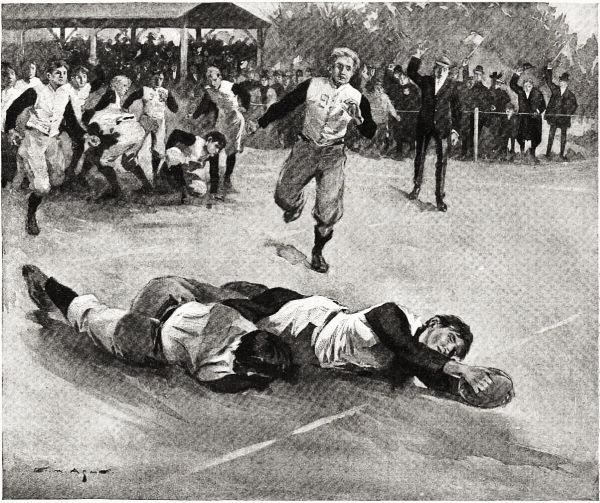
No wonder the Blackwood crowd yelled with delight. Winston men started across the field to head off the runners, but only two reached Harris. Barstow dodged Alden, and threw himself straight for Buck's knees. With a surprising wriggle the boy jumped clear over him, and left him sprawling. He was fairly caught, though, by Mellen, about a yard from the line. But his blood was up now, and by a supreme muscular effort he turned the full-back over, and together they rolled across. A touch-down!
Score: Winston, 5 points; Blackwood, 4.
Of course pandemonium reigned for a few minutes! Then the spectators calmed down, and the ball was brought out for the kick. Time was up, but the rules allowed the try for goal.
Captain Alden walked steadily toward the ball, which was held by the quarter-back, and just as it touched the ground his foot struck it fairly and drove it over the bar between the posts. A goal! Two points more.
Score: Blackwood, 6; Winston, 5.
It was Seton Harris who got the credit of saving the game, but Mark Alden did not care.
"Buck was really the only man who could make that run," he said to himself, "and it'll do him lots of good to have kept his nerve in one tight place."
Besides, Blackwood was not beaten, and the game was done!