A RACE WITH DACOITS ON MY BICYCLE.
Reading edition
BY DAVID GILMORE.
I believe I was the first man to ride a bicycle in Rangoon. I know I was the cause of much wonder to the natives, who would stare in open-eyed astonishment to see a white man scorching by on a little iron carriage with two wheels. When I chanced to dismount, they would gather around and take a look at the machine, finger the tires, ask how much it cost, and finally grunt out some such remark as "Teh goundy, naw?"—Pretty good, isn't it? It was pleasant to be the centre of all this admiration, but not so pleasant when I turned the admiration into amusement by coasting boldly down a steep hill, making a sharp turn just in time to avoid a deep ditch, and driving full speed into a most unyielding fence. It is peculiarly mortifying to be laughed at by those whom you regard as your social inferiors.
When I arrived in Rangoon, it was just after the "dacoit times." Dacoits are the highway-robbers of India. They work in gangs, and travel over the country plundering, murdering, and sacking and burning the villages in the jungle. They carry guns when they can get them; but as the English are very careful to confiscate guns found in the possession of natives, the dacoits are generally armed with dahs, as the Burmese swords are called.
Shortly before I arrived in Burmah, the country had been infested with dacoits, so that even in the outskirts of Rangoon houses were barricaded at night, and the employment of private watchmen, always common in Burmah, became almost universal. By the time I arrived there, however, the gentle custom of dacoity had been pretty thoroughly broken up. Now and then a lonely village in the jungle might be looted and burned, or an English official living in some remote town might be murdered, but we who lived in Rangoon were safe. No dacoit dared to show himself there. At least, so I was assured.
Now I had a sweetheart in those days; and have her still—no less sweet now that she shares my home. But then she lived in Kemendine, a considerable village about two miles from my own home in Rangoon. I believe that technically Kemendine lies within the municipal limits of Rangoon, but practically it is a separate community, being cut off from Rangoon proper by a considerable stretch of unimproved land. Kemendine is distinctively a native community, having a large population of Burmans, but not half a dozen white inhabitants.
I was in the habit of using my bicycle when I went out to spend an evening with my fiancée. The road was lonely, but I considered it perfectly safe.
One night, after the good-byes had been said, I started for home a little after nine o'clock. A minute or so of easy pedalling brought me to the railway track which bounded Kemendine village. The gates at the crossing were closed, in anticipation of the Prome mail-train, which was due there in a quarter of an hour. I dismounted while the Hindoo gateman opened the gates just enough to let me through. Then I walked my wheel across the track and remounted, receiving, as I rolled away, the beautiful Oriental salutation, "Salaam, sahib"—Peace be with you, sir—a pious wish strangely in contrast with the scene which was almost immediately to follow.
On crossing the railway tracks I had left behind me the lights in the village street, and the road before me was illuminated only by the waning moon, which had just risen, affording me light enough to pick my way, though not as much as I wanted before I got safely home. On my left was the Burmese cemetery, on my right the ample grounds of a kyaung—a Buddhist monastery. Of these two, the proximity of the latter was much the more legitimate cause of anxiety, as the indiscriminate hospitality of the kyaungs makes them favorite lurking-places for bad characters. But all I thought about the kyaung just then was that the bells of its pagodas jingled sweetly in the night wind. About half-way down the hill the road turned at right angles from the cemetery, and skirted along the other side of the kyaung. On the left was a little village called Shan-zu. It was as still as the grave; the villagers were evidently all asleep. Here the road began to be bordered with bushes and bamboos, which grew denser as the road left the kyaung and the village behind and began to cross the waste-land between Kemendine and Rangoon. At the foot of the hill the road passed over a little bridge.
Of course I didn't coast down the hill, lest I should come to grief at the corner. But after turning the corner the road lay straight before me clear into the town, and I let my machine go, keeping my feet on the pedals, however, that I might have control of the wheel in case anything should happen.
AS I SHOT AHEAD AN AWFUL YELL AROSE BEHIND ME.
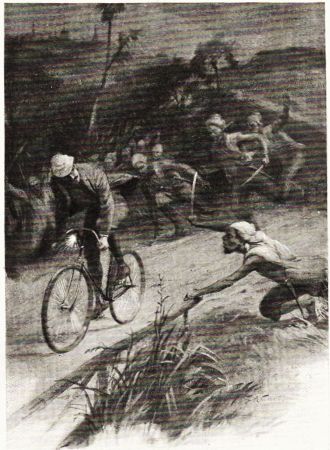
As I left the kyaung behind and was making for the bridge, I heard a few notes whistled softly just behind me. The sound seemed to come from the bushes skirting the kyaung. I should not have thought anything of this, however, if the same notes had not been whistled again, this time apparently from the fields just ahead. This was evidently a call and an answer; and it made me a little nervous, especially if the danger (if danger there were) menaced me both in front and in the rear. I looked around, but saw nothing more than I had seen many a night on that same road. Not knowing anything else to do, I went steadily ahead, keeping myself and my wheel well in hand, so as to be ready for any emergency which might arise. Passing by some gaps in the shrubbery, I saw some figures in the fields near the road making stealthily for the narrow bridge which I should have to cross before I could get into the town. I thought I could see some dahs under their arms. Then I saw the danger which threatened me. The dacoits evidently planned to intercept me at the bridge, and cut me to pieces when I should be at a disadvantage. I couldn't go back; for even if I had not had reason to think that some of the gang were lurking behind me, the time I should have lost in turning around would have put me at the mercy of my pursuers. There was only one thing to do, and it didn't take me long to decide upon it. My wheel was under pretty good headway, and I crowded on all the power I could to try and reach that bridge before the dacoits got there. As I shot ahead an awful yell arose behind me. I had been sharply watched. Immediately my ears were greeted by a chorus of shouts from the fields on both sides of the road.
My recollections of the next few minutes are not very clear. All I remember is, pedalling with all my might, with those bloodthirsty cries ringing in my ears, and my mind making incessant calculations as to the chance of getting a bullet through my body next moment. But I heard no shots, and probably the dacoits had no guns. I rolled on the bridge just as they swarmed up from the fields into the road behind me.
But I was not out of the woods yet. Before I got into town I had a long hill to climb. Now the Burman is a lightning sprinter when he chooses to sprint, and that's just what those fellows did. Racing them down hill I had the advantage, especially as they were running over the rough ground in the fields. But when it came to racing up hill they rather had the best of it, especially as they were now on the road. On a steep hill I would have had no chance at all; but the slope was gentle, and I had a start. I had a chance, therefore, for my life, and I made the best of it. The thought of those dahs put strength into every stroke I made. The worst of it was, I could not tell whether I was holding my own or not. My pursuers had stopped shouting, needing all their wind for running; and their bare feet didn't make much noise on the ground. I was bending low over my handle-bar, and didn't dare to risk diminishing my speed by straightening up to look behind me even for an instant.
But when I got to the head of the hill, and was passing the grounds of the Chief Commissioner, where there are always soldiers on guard, I felt that I could venture to take a backward glance. Then I saw that my pursuers had all disappeared.
Next day I wrote a letter to the Chief of Police, reporting my adventure in detail, and having "the honor to be, sir, his most obedient servant," according to the prescribed formula, which whosoever observeth not shall not gain the ear of the government of Burmah. In due course I received a reply, in a big brown envelope, assuring me that the matter should be promptly investigated, and having "the honor to be, sir, my most obedient servant." This was polite. The Indian government is great on politeness. But nothing ever came of it. I suppose the Superintendent did his best to ferret the matter out, but he had to work through native policemen, and they may have had reasons of their own for not being too anxious to catch the dacoits.