HARPER'S BAZAR
Reading edition
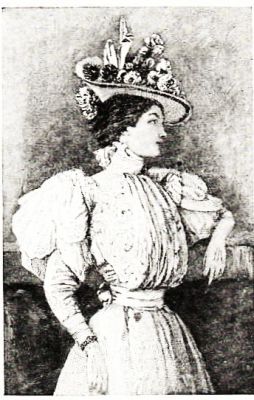
In 1897
Will be, as in the past,
AN UNEQUALLED FASHION JOURNAL
AN UNRIVALLED PAPER FOR THE HOME
4 Splendid Serials
BY
MARIA LOUISE POOL
W. D. HOWELLS
OCTAVE THANET
S. R. CROCKETT
Working-Girls' Clubs and Young Women's Christian Association Work
By LILLIAN W. BETTS
STRONG SHORT STORIES
By well-known writers.
THE EARLIEST YEARS
OF CHILDHOOD
By FRANCES FISHER WOOD
BREAD-WINNING AVOCATIONS
IN NEW LINES
By CLARE BUNCE
THE OUTDOOR WOMAN
By ADELIA K. BRAINERD
EMBROIDERY AND NEEDLEWORK
Will be illustrated by CANDACE WHEELER, ALICE C. MORSE, and others.
WOMEN AND MEN
By COL. T. W. HIGGINSON
WOMEN IN SOCIETY AND
AT HOME
By JUNIUS HENRI BROWNE
CEREMONY AND ETIQUETTE
By ANNA WENTWORTH SEARS
WHAT GIRLS ARE DOING
By a New York Girl.
10 Cents a Copy. PUBLISHED WEEKLY. $4.00 a Year.
HARPER & BROTHERS, Publishers, New York
SYMPATHY.
"Jimmie," said Mrs. Hicks, "won't you have some brown bread?"
"No, thank you," said Jimmie; "I'm afraid to eat it."
"Afraid?" asked Mrs. Hicks.
"Yes," said Jimmie. "You see, ma'am, my papa says red beef will give me red cheeks, and I'm afraid brown bread will make a darky out of me."
"Pat," said Tommie to the gardener, "what is nothing?"
"There ain't any such thing as nothin'," replied Pat; "becaze whin ye find nothin', and come to look at it, there ain't nothin' there."
An absent-minded old gentleman went into a shop to buy a new cane.
"That's a very nice one," he said, picking one up from the counter. "How much is that?"
"That's the one you brought in with you. You just laid it down there, sir," said the shopkeeper.
"Oh, really?" said the old gentleman. "Then I don't need a new one. Good-day." And he walked out.
"What is the baby crying about?" asked his mother.
"He doesn't want to get in the bath-tub without his rubbers on," said the nurse. "He's afraid he'll get his feet wet."
A WITTY DECISION.
A good story is told of Dr. Arne, the composer of the English national hymn "Rule, Britannia." He was called upon one day to judge between two singers, neither of whom was worthy of a moment's consideration. After patiently hearing them, he said to one of the contestants,
"You are the worst singer I ever heard in my life."
"Ah!" cried the other, exultingly, "then I win?"
"No," said Dr. Arne. "You can't sing at all."
"Well, my son," said the Freshman's father, "I am very glad you have gone on your class football team. Have you got everything you need?"
"Everything, father, except a new set of teeth, and I may be able to get through the year without losing those that I have," replied the Freshman.
Jack got asking his grandmother questions the other night. One of them was:
"Grandma, if you was a centipede, would you always insist on putting on fifty pairs of rubbers before you walked on the grass?"
Up to this hour the dear old lady has not made up her mind on the important point.
Li Hung-Chang, the famous Chinaman who visited this country a short time ago, made quite an impression in England for his wit and apparent ingenuousness, although it was more than suspected that some of the old gentleman's remarks were not so bland as they seemed. One incident especially amused the Britishers. It was when Li Hung-Chang met Joseph Chamberlain, who affects a monocle. The Chinaman noticed the single eye-glass, and took it for granted that the Colonial Secretary had lost the use of one eye, and he offered him his sincere condolences.
PHILOSOPHIC.
To prophesy the future would Bring more of evil than of good; So let us thank our lucky stars That no such gift our wisdom mars.
The Irish soldier seems to furnish the story-teller with many an anecdote. The following incident is said to have occurred at the battle of Fontenoy, when the great Saxe was the marshal in command.
"The password is 'Saxe,'" said the officer of the guard, as he sent off an Irish trooper with a message; "don't forget the word."
"Sure I won't, sir," was the reply. "Sacks—my father was a miller."
When he came to the sentinel and was challenged, the Irishman looked wise, and whispered,
"'Bags,' you spalpeen; let me through!"