WATER LIFE AROUND NEW YORK.
Reading edition
BY JULIAN RALPH.
What an odd thing a boatman's dream of the water life around New York would be if all the vessels and craft of every kind should take to themselves grotesque shapes and characters, as familiar objects are apt to do in human dreams! We have had some great and notable water parades in our harbor—the last and greatest being that queer hooting and tooting procession of many kinds of craft that swept around the war-ships of ten or a dozen great nations at our Columbus celebration in the early summer of 1893. But the boatman's dream of which I was thinking would be far stranger than that, because the Columbian naval review included only the handy, easily manageable steam-craft of New York, like the steamships and steamboats and tugs and tow-boats. It left out all the really queer floating things that have such shapes as to almost turn a dream into a nightmare.
The dreaming boatman of whom I am thinking would see great water-giraffes, which would really be our floating grain-elevators; and a myriad sea-spiders transformed from our darting tug-boats, and great groaning mother-gulls dragging large coveys of helpless babies in their wake Those would be the tow-boats with their long trains of canal-boats. Turtles he would see by the score—huge flat, almost round turtles—some red, some white, some brown. Those would be the ferry-boats,-which really do look just like great sea-turtles when you are looking down upon their flat backs from a high place like the Brooklyn Bridge. Like fearful black ocean sharks would be the Atlantic steamers—long and thin—out of whose way every other moving thing flies when they approach. Our huge and towering palace boats of the Sound would turn into great white elephants, trumpeting as if they had all caught cold in their long snouts. And we shall see that many another animal and creature would easily appear to the troubled dreamer without greatly altering the shapes of the queer craft that have grown out of nearly three hundred years of needs and developments in the water-life around New York.
THE CANALLERS ON THE EAST RIVER.
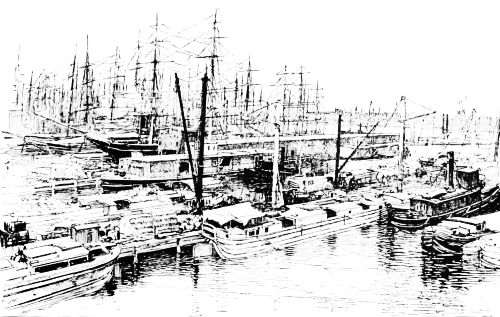
I suppose that the reader has heard that almost every Chinaman in this country comes from the water population near Canton. That must be a wonderful phase of life, where so many hundreds of thousands of persons are actually born upon the water, to live out their lives upon the water, and to die upon the water. They form a river population housed in boats that make up a city far more peculiar than Venice—a floating city of stores and work-shops, boarding-houses, amusement places, saloons, and all the rest. We have nothing of the sort around New York. The nearest approach to that condition is to be seen in the large docks on the East River near the Battery, and one at Communipaw on the New Jersey shore, where the canal-boats collect with the boatmen and their wives and children aboard them. There one sees by the kitchen smoke-stacks above the cabin roofs, by the lines of drying linen on the decks, by the sight of women sewing and knitting under cooling awnings, and by the views of children and cats and dogs playing upon the boats—by all these things one sees how truly the canal-boats are floating homes as well as merchant vessels. At night the sounds of singing and fiddling—sometimes the nasal notes of house organs—tell more of this strange water life. Some of the cabins of these canal-boats are quite attractive. They show dainty white lace curtains in the tiny square windows, carpets on the floors, boxes of flowers upon the cabin roofs, and cleanly, neatly clad mothers and little children. This is not the rule, however, and we see enough, whenever we visit the canallers, to show that there is at least some reason for their being generally regarded as a rude and rough class.
Yet, apart from these canallers, we have enough persons who live on the water to form what would be called a city out West. They are mainly men who sleep in bunks and eat in the cabins of tug-boats, steam passenger boats, freighters, and the like. A few women are among them—stewardesses of passenger boats and the wives of the captains of the other sorts of vessels. Of course I do not include here the men on the ships that sail the ocean. Their homes are really at sea. I only refer to the scores of thousands of persons who live upon boats that may be called the horses of the harbor, because they tie up regularly every night at certain piers, and every morning are sent to work, here and there, at this place or that, to carry goods or passengers, or to haul other boats. It is doubtful whether many children are born in these shifting homes, but there is no doubt that very many girls and boys sleep upon them, and are sent from them to the city's schools, and, later, to the factories and shops to earn their living.
Of all the uncommon forms that boats take, the newest, instead of being strange and complicated like most nineteenth-century inventions, are almost as simple as anything that floats. Only rafts of logs are more simple than what we call our "car-floats." They are the newest type of boats we know, and have come into being because New York city is on an island, with only a few railroads crossing to it from the mainland. The other great and little railways, which bring and take goods and people to and from New York, all stop on the opposite shores of our harbor, in New Jersey, Staten Island, and Long Island. Since the cars of one railroad often have to go past the city upon the other roads, these "floats" are used to transport them around our island, so that goods from Boston or Sag Harbor, for instance, can be sent around New York to the tracks of the roads that will carry them to San Francisco without unloading or reloading. The floats that carry these cars are merely boxes, the shape of great dominoes, with railroad tracks laid upon them. Some carry six freight-cars, some carry eight, and some carry ten cars. Tiny little propellers that we call "tug-boats" are warped or hitched alongside of these clumsy floating boxes, where they look as a little kitten would appear beside a big St. Bernard dog, or as a locomotive would look beside a house. But our queer, snorting, fussy little tug-boats march away with every floating thing to which they are hitched—even dragging huge Atlantic steamships at their sides—because they reach deep down into the water, where their big screws, driven by very powerful engines, obtain a mighty hold. Because our tug-boats are so small, and yet so strong, they are able to move swiftly when they have no burdens to carry. In the boatman's dream that I spoke of they would seem like those water-spiders that many of us have seen darting hither and thither on the top of placid pools. But there is one reason why they are not at all alike—that is, that the water-spiders are as silent as death, while the tug-boats are the most noisy, saucy, boisterous of make-believe animals—always gasping, and snorting, and whistling, and thrashing about as very little people are often apt to do.
FLOATING GRAIN ELEVATOR.
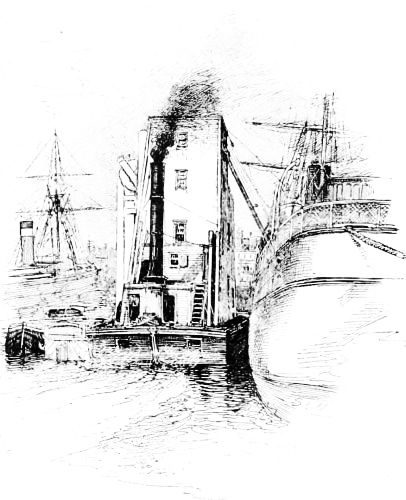
The "floats" that carry passengers around New York so that they can go to Boston from Philadelphia or Chicago without changing cars (and even without getting out of bed on the sleeping cars), are not floats at all. They are very powerful and large steamboats, with decks covered with iron plates, with car tracks on those decks, and with arrangements for locking the car wheels fast to the tracks, so that no matter how boisterous the water may be on stormy days, the cars cannot break loose and roll overboard. We have several queer sorts of boats and other floating objects that look like floating houses. Among them are what we call our floating baths, and our floating docks, and our cattle and ice barges. But there is one kind of floating building that looks like a tower or a steeple riding the waters and steering itself around. That strange thing—and we employ many such—is a floating grain-elevator. It is a tall four-sided tower built upon a squat snub-nosed boat. It has a great proboscis, that it sticks down into canal-boats full of grain, which it sucks or dips out so that it can load the grain into the holds of ships that are to carry it to Europe. Our floating baths are square one-story houses, hollow in the middle, where the bathers swim, with lattice-work or perforated boards under them to let in the water without letting out the bathers. They are decorated with little towers and flag-staffs, and look very strange indeed when they are being towed to the city in the early summer to be moored beside a wharf, or when, after the bathing season is over, they are dragged away to be laid up for the winter. Our floating docks, upon which all but the very large ships and steamboats are lifted out of the water to have their hulls painted, cleaned, or repaired, are made of many boxes joined together. These boxes sink when full of water, and thus it is possible to steer a vessel right over them. Then the water is pumped out of the boxes, and the dock (in reality a cradle rather than a dock) rises, and lifts the vessel up high and dry so that workmen can walk all around and under her to scrape off the barnacles that have grown fast to her, or to paint her bottom, or to sheathe it with copper.
ICE-BARGES IN TOW.
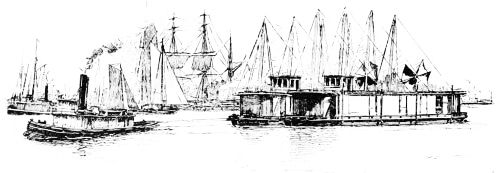
The barges for carrying cattle and those for carrying ice are just like the toys that are made for children and called "Noah's Arks." They are houses built upon strong boat hulls. The ice-barges are always white, and canvas windmill wheels are forever whirling above them, just as if they were some new kind of boats made to go by air propellers instead of wheels or screws in the water. The truth is, of course, that these canvas wheels work the pumps that pump out the water made by the constant melting of the ice. But of all the kinds of barges that work in the New York waters the hay-barges are surely the most interesting. They are very large, and the houses built upon their hulls are open at the sides, with only a railing where the walls should be. These are two-storied houses, and the floors that support hay in the winter are dancing platforms in the summer. These hay-barges are our picnic boats also. All winter long, or as long as the waters are unfrozen, they bring down hay from the Hudson River landings, but in the summer they go out of that business, and are hired out to Sunday-schools, political clubs, secret societies, church societies, and the like, to carry picnickers to what are called the excursion parks that are found along the Hudson River and the Sound at several hours' distance from the metropolis. Tug-boats drag these barges to the excursion parks, and the holiday crowds upon the two open decks of the barges dance all the time to the music of the band that they hire for the occasion. The stop at the excursion park is a short one—just long enough for luncheon and a little strolling under the trees, or bathing on the beach. Then the homeward journey is begun, and the dancing on the barge is recommenced and kept up until the city is reached, just before bedtime. Our great excursion steamboats, that run to Coney Island and Rockaway, are built on the same plan—wide open—and carry such great crowds of pleasure-seekers that they are black with passengers. These are sometimes hired by richer and more numerous bodies than those that hire the hay-barges, but I can assure my readers that the real jubilant fun is on the common barges, where the people are apt to be simple and democratic, and ready to surrender themselves to those pleasures of which they enjoy too little.
Our pilot-boats which go out to sea with many brave men, and leave them one by one on the steamships that they meet—in order that those great vessels may be safely steered into port—are very romantic boats, but they look like mere sail-boats or yachts. Some splendid yachts become pilot-boats when they grow too old-fashioned to keep pace with the faster and faster boats that we are forever building. Other such yachts become oyster-boats, and lie beside Fulton Fish Market in company with the tank-steamers that bring fish into New York. These tank-steamers go to Nantucket, or wherever the fishing-smacks are at work, and lie there while sail-boat after sail-boat fill up with fish and bring their loads to be kept in the refrigerated-tanks of the steamer, until she, also, is filled and ready to come to the city.
Of the "whalebacks," or cigar-shaped iron ships that were first made to traverse the great lakes, I will say very little, because they belong to no place in particular, and excite as much curiosity here as anywhere. Our floating pile-drivers, which look like ladders set upon boxes, are very curious-looking vessels, but are familiar at all ports. Perhaps our immigrant barges, which carry the immigrants from Ellis Island (where they are landed) to the wharves of the railways by which they are to seek homes in the West, are peculiar to New York, but they are mere hay-barges like the excursion boats I have already described. The busy craft that carry fresh drinking-water to the sailing-ships are usually very ordinary tug-boats, and are only peculiar because each one carries a great sign bearing the word "WATER" painted upon it. To see such a vessel all by itself upon a great expanse of salt water suggests Coleridge's line in The Ancient Mariner,
"Water, water, everywhere, and not a drop to drink."
If it were not for those water-bearers—serving the same purpose as the camels laden with water-bags upon the desert of Sahara—there truly would not be a drop to drink.
I fancy that what we call our "lighters" are the only descendants that recall the old days of the Dutch on Manhattan Island. They are sail-boats that are used to carry goods from or to vessels that do not come to the wharves, but lie out in the open water. They are very old-fashioned and foreign-looking, built almost solidly of heavy wood, and of a shape very like a turtle and quite as clumsy. Each one carries a short thick mast that looks as if it had been broken off, and a little narrow sail, absurdly disproportioned to the vessel. Everything these lighters carry is put upon their decks, and they are so slow and so hard to steer and so strong that all other craft give them a wide berth. It is only a fancy of mine, yet I never see one without thinking that this style of boat surely descended to us from the Dutch.