THE BILBERRY SCHOOL EXHIBITION.
Reading edition
BY SOPHIE SWETT.
Simpsy Judkins was to "speak a piece," and Viola Treddick to read an original composition; there was to be a glee sung by picked voices from the first class—it was all about the deep blue sky, and "the sky, the sky, the sky," was repeated in a very thrilling and effective manner; and Tom Burtis was to display his powers as a lightning calculator. The exhibition was to be given in the new Town-hall, and not only would all Bilberry be there, but a crowd of people from the adjacent towns as well, to say nothing of teachers and pupils from the Normal School at Cocheco; for the Bilberry Hill School exhibitions had acquired a reputation.
In the Treddick family the girls had been obliged to take the family burden upon their shoulders. When Father Treddick died, somewhat less than a month after Mother Treddick, turning his face to the wall, and saying that she had been his backbone and his underpinning and he couldn't live without her (it sometimes happens that way in spite of Mother Nature), the rocks still had the upper hands on the little farm, and Amasa, the only boy, was but eleven. Lizette, who was fifteen, went to work in the stocking factory. Every one thought it was a pity, because Lizette was fond of books and had meant to be a teacher; she was slight and delicate, too, and work in the stocking factory was hard. But Lizette believed in doing "not what ye would, but what you may," with just as good a will as if it were the former. Some people said she had taken warning by her father's example; he had always been trying to invent something in his queer little workshop that was the wood-shed chamber; that was why the rocks had not been gotten out of the farm.
It was Viola who was now spoken of as a remarkably fine scholar, just as Lizette had been before she went into the factory; she was not yet sixteen, but she hoped to get the Pine Bank School to teach in September. There were several other candidates, all older than she, but Viola was at the head of her class, and that original composition which she was to read at the exhibition was expected to make an impression upon the committee-men. The teacher had said to several people that it was really a remarkable production for a girl of Viola's age, and they thought a great deal of literary gifts in Bilberry.
Lizette was very proud of Viola, and so, indeed, was Amasa, who was fourteen now, but whose name was not on the programme at all. To tell the painful truth at once, although Amasa keenly felt the especial need there was that he should be "smart," although he tried his best to be the man of the family in a satisfactory sense, yet he was at the very foot of his class; fractions floored him, and he had a hazy idea that Timbuctoo was out West, and that Captain John Smith discovered America. When it came to chopping wood, Amasa was pretty sure to cut his toe, and if he went fishing he tumbled into the pond. And he couldn't get "jobs," like Cosy Pringle, the boy in the next house, who had money in the bank.
Cosy Pringle boasted that he always "came out top of the heap"; but some people thought he was too "smart."
When the exhibition day came, although Simpsy Judkins had been announced to "speak a piece," it was Cosy Pringle who spoke it; there was a report that he had hired Simpsy to have a sore throat. Simpsy had oratorical gifts, but he did not feel the advantages of appearing in public and having his name in the paper, as Cosy did. Cosy held the second rank in declamation, so Simpsy's sore throat gave him an opportunity to be heard. He wasn't second in his class; he came sympathizingly near to Amasa there; but he had carefully weighed opinions—which he sometimes confided to Amasa—concerning the amount of study that "paid."
Mother Nature provided one of her loveliest days, as she is apt to do for school exhibitions in June. The girls, in fleecy muslin clouds, were so much in evidence that the boys, in the background, were only a little hampered by the embarrassment of full dress. Cosy Pringle wasn't hampered at all; he wore his grandfather's large gold chain and his sister Amanda's moonstone ring, and felt that he ought to attract as much attention as the girls.
Cosy's voice was a little thin and sharp, but he recited one of Macaulay's lays with a great deal of "r-r-rolling drum" very well indeed, having been thoroughly coached by his sister Amanda and the young minister to whom Amanda was going to be married.
But beyond a little mild clapping, the recitation received no attention whatever, while Viola Treddick's composition was, as the Bilberry Beacon reported, received with the greatest enthusiasm. It was on "School-girl Friendships," and there was some real fun in it; and once in a while it was pathetic, or, at all events, the audience laughed and cried, and they couldn't really do that, as Cosy averred they did, because they liked Viola. It closed with a verse of original poetry, and Bilberry began to feel sure that a great poet was to arise in its midst.
Lizette stopped and hugged Amasa behind a juniper-tree on the way home from the exhibition. Viola had staid to a spread that was given to the pupils and their friends; Lizette had to hurry back to her work in the factory; and Amasa had felt that he did not shine in society. Amasa could not remember ever to have seen Lizette cry for joy before; she was not one of the crying kind, anyway.
"She'll have a chance! Viola will have a chance! She'll get the Pine Bank School," she said, rapturously. "I've been so afraid she would have to go into the factory."
Amasa realized suddenly how hard life was for Lizette. Her delicate hands were calloused and knobby, and her shoulders bent; she looked wistfully at the library books, and never had time to read; she knew that she wasn't strong, and she was anxious about their future—Viola's and his.
It was the very next night, as Amasa was going to bed, that Cosy Pringle came under his window and called to him. Amasa went down and unfastened the door, and Cosy followed him up stairs.
He seemed excited and nervous, and kept saying "'Sh!" though there was no one stirring in the house. But it was like Cosy to have some mysterious scheme on foot. Amasa thought that he had at last discovered how Pember Tibbetts made his musk-rat traps, or guessed the conundrum in the County Clarion, for which intellectual feat a prize of five dollars was offered. Or perhaps he had secured the job of weeding Mr. Luke Mellon's onion bed and hoeing his string-beans; last year he was paid three dollars for the job, and hired Amasa to do the work for seventy-five cents. Amasa stoutly resolved not to be the victim of Cosy's sharp business methods this year.
But Cosy's shrewd gray eyes had a twinkle that meant more than onion-weeding or any "jobs."
"That was an awful nice composition that your sister wrote," he said, in an easy, complimentary manner.
Amasa nodded, brightening; it was more like Cosy to make a fellow feel small about his sisters and all his possessions.
"Folks are saying that she'll get the Pine Bank School, if Elkanah Rice, that's school committee, does want it for his niece. A good thing, too, for Lizette is pretty well worn out taking care of you all." Cosy wagged his head with great solemnity. "Aunt Lucretia said she shouldn't be surprised if she got consumptive, like her mother, if she worked too hard."
Amasa's heart seemed to stop beating, and a choking lump came into his throat.
"But Viola'll get the school fast enough," continued Cosy, "if—if folks don't find out that she copied the composition."
"Copied the composition!" Amasa's brows came together in a fierce scowl, and he arose from the side of the bed where he was sitting, and advanced upon Cosy with a threatening gesture.
"Now just look here before you go to making a turkey-cock of yourself," said Cosy, drawing a newspaper from his pocket. "I happened to go down to Gilead this afternoon to swap roosters with Uncle Hiram—made him throw in a pullet and a watering-pot because my rooster had a bigger top-knot than his. There was a pile of newspapers in the wood-shed, and I went to get one to wrap up some things that Aunt M'lissy was sendin' to mother, and I came across this. 'School-girl Friendships' caught my eye. See! it's signed 'Lilla Carryl.' Aunt M'lissy said she believed 'twas a girl over to Gilead Ridge. That paper is two years old now, and Gilead being ten miles away, I suppose Viola thought nobody would ever find her out!"
"She never did such a thing! Don't you dare say she did!" cried Amasa, hoarsely.
But there it was in black and white; there it was word for word. Amasa knew every word of Viola's composition, he had been so proud of it. Cosy whistled softly, with his hands in his pockets, as Amasa ran his eye over "School-girl Friendships."
"There's some mistake," faltered Amasa. "Viola is the honestest girl."
Cosy's whistling ended in a sharp, expressive, little crescendo squeak. "There's no telling what girls will do," he said, sagely. "When folks know it, why, Elkanah Rice's niece will be pretty apt to get the Pine Bank School, and I'm kind of 'fraid Viola'll have to take a back seat altogether. It'll come hard on Lizette."
Cosy folded the Gilead Gleaner, and thrust it firmly and impressively into his pocket. Amasa had been acquainted with Cosy Pringle since they were both in long clothes, and he understood that that paper had its price. If he could pay the price, why, even Lizette need never know!
"I suppose it's my duty to show this paper," said Cosy, with an air of unflinching virtue, "but still, amongst old friends, and if you'll do a little good turn for me that you can do as well as not, why, I'll just chuck the paper into the fire, and agree not to tell anybody, and we'll call it square. I ain't a mean feller."
Amasa's heart thrilled with hope. What was the good turn that he would not do for Cosy on those terms? He thought of his fan-tailed pigeons, and of his dog Trip on whom Cosy had always had his eye because he could do so many tricks; it would be an awful wrench to part with Trip, but to save Viola from disgrace he would not hesitate.
"I only want to go into your wood-shed chamber for a few minutes. There's—there's something there that I want to see. If you'll let me, why, nobody shall ever know about Viola's cheating."
"It's father's old workshop; there's nothing there," Amasa said. "Nobody ever goes near it but Lizette."
Cosy hesitated a little, then he decided that it would be as well to be more frank; Amasa was so stupid. "She's up to something, Lizette is," he said, in an impressive whisper. "I've seen a light burning in that workshop half the night! She's trying to make an improvement on the knitting-machine that they use in the factory. Of course she can't do it—a girl!—but you'd better look out or it will kill her, just as it killed your father. How do I know what she's doing? She told Emily Norcross"—Emily Norcross was the daughter of the owner of the factory—"and Emily told Thad. Thad and I been trying too. We've got things fixed now so'st we expect to get a patent. What I want to see is whether she's got anything that's likely to interfere with us; of course she hasn't really, but then girls think they can."
Amasa felt desperately that this was too great a problem to suddenly confront a fellow like him whom every one knew to be stupid. It seemed a trifle, but Cosy Pringle would want nothing but a good bargain. Still, there was no other way; disgrace to Viola would mean heart-break to Lizette.
"Give me the paper," he said, gruffly, and thrusting it into his pocket, he led the way softly through the corridor to the wood-shed chamber.
Cosy was breathlessly eager over some queer bits of machinery which Amasa could not understand. He staid but a few minutes, as he had promised, but he stammered with excitement when he went away.
Amasa spent three miserable days, filling the wood-box so assiduously that Viola asked him if he thought she was going to bake for the County Conference, and hoeing the string-beans, until Lizette was tenderly sure that his back ached, and advised him to go fishing.
But a boy may have troubles of the mind which even fishing cannot cure.
"VIOLA! AMASA! HE SAYS IT MAY BE WORTH A GREAT DEAL OF MONEY!"
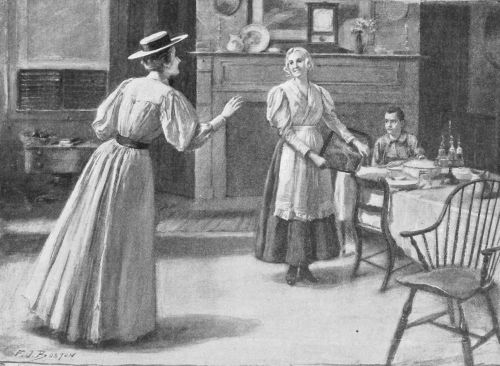
Lizette came home from her work with a radiant face on the third day. "Amasa, how came you to let Cosy Pringle go into the workshop?" she exclaimed. "But I can't scold you, it has turned out so beautifully! I have been trying a little invention—oh, for a long time! I never thought it could really succeed!" Lizette looked as fresh and bright as if all the work and care had been a dream. "Cosy saw it and told Thad Norcross. It seems he and Thad had been trying to do the same sort of thing—mere boys' play, of course—and Thad told his father. Mr. Norcross will help me to get a patent! Viola! Amasa! He says it may be worth a great deal of money!"
Lizette and Viola were crying for joy; but Amasa could think only of the horror of Viola's disgrace, for now, of course, Cosy Pringle would tell.
"You won't think anything now of my little triumph," said Viola, when they had calmed down a little and sat down to supper. "'School-girl Friendships' is to be published in full in the Bilberry Beacon next Saturday, with my own name signed it—not Lilla Carryl, as I signed it two years ago, when I sent it to the Gilead Gleaner. Oh, what a flutter I was in then! and I never dared to let a soul know it! The editor of the Beacon made me write a foot-note, telling all about it."
"I'm an awful jackass," said Amasa, his voice gruff with joy and shame.
"You're the dearest boy in the world," said Lizette. "But I don't want you to associate with Cosy Pringle."