WHAT MARJORIE COULD DO.
Reading edition
BY H. G. PAINE.
I.
"Fire! Fire!"
Marjorie Mason woke up with a start.
"Clang! clang!" went the fire-engine from around the corner.
"Whoa!" shouted the driver.
"Dear me!" thought Marjorie; "it must be very near here," and she jumped out of bed and ran to the window. The engine was already connected with the hydrant across the street, and the firemen were attaching the hose and bringing it—what? yes; right up the front steps of the Masons' house! One fireman was ringing violently at the front-door bell; and Marjorie wondered why her father did not go down to open the door. Perhaps the house next door was on fire, and they wanted to take the hose up on the roof. Still the bell rang, and now Marjorie could hear the firemen from the hook-and-ladder truck that had just come up breaking in the parlor windows with their axes.
"Why doesn't somebody go to the door?" she said to herself. "It will never do to have that dirty hose dragged through the parlor and over the new carpet!" and she jumped to the door of her room to run down and let the firemen in; but, as she opened it, a rush of hot air and stifling smoke blew into her face, choking and gagging her, and filling her eyes with tears. Then she realized for the first time that the fire was in her own house. She shut the door with a bang, and ran to the window, opened it, and looked out. As she did so a tongue of flame shot up in front of her from the window of the library, just underneath her own room. Her father's and mother's room was in the back part of the house on the same floor as the library. "Was it on fire, too?" Marjorie shuddered as she thought of it.
"And Jack!" Her brother Jack slept in the back room on the same floor as Marjorie, but the rooms did not connect. "Perhaps the fire is only in the front part of the house," she thought, "and the others don't know anything about it." She determined to arouse them.
Marjorie opened the door again. The smoke and heat were stifling, but there was no flame that she could see. Then she shut her eyes, closed the door behind her, and rushed down the hall to Jack's room. She had been to it so often that she could not miss the door-knob, even in her excitement. Fortunately the door was unlocked. She opened it quickly, and shut it behind her, gasping for breath. Oblivious alike of the danger and the noise Jack was still fast asleep, but she soon woke him up, and together they rushed to the back window. Looking down they saw their father helping their mother out upon the sloping roof of the back piazza.
At the sight of her poor mother, who was very ill, in so perilous a plight, Marjorie forgot all about her own danger, and shouting, "Hold on tight—I'll tell the firemen!" before her brother could stop her she had run back fearlessly to her own room despite the fact that the stairway was now all in a blaze. As she opened her eyes she saw the glazed helmet of a fireman at the window.
"GO BACK AND LOOK AFTER FATHER AND MOTHER!"
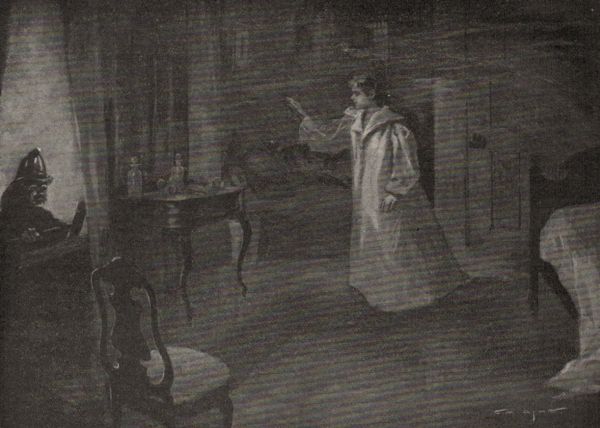
"Go back!" she cried; "go back quick and look after father and mother; they are on the roof of the back piazza!"
Then a strange feeling of dizziness came over her. She felt a strong arm around her waist. She dimly saw a kind face near to hers, and was conscious of being carried down, down, down, so far, so far, and of hearing people cheering a great way off.
II.
It was a very different house, the one that Marjorie went to live in after the fire, not nearly so nice as the dear old home where she and Jack had been born. In the first place, it was in a distant and different part of the city. The rooms were all differently arranged, and the furniture and everything in them were different. It seemed to Marjorie as if nothing had been saved from the old house. Even the clothes they all wore were different—very different, indeed; for they were black.
That was a sign of the greatest and saddest difference. Though the firemen had quickly gone through the basement and rescued Marjorie's father and mother and Jack and the servants, the dear mother had not long survived the shock and the exposure: and Hetty, the waitress, who now attended to the housekeeping and looked after Marjorie, did things very differently from her.
All these circumstances combined to make great changes in Marjorie's life. She went to another school now, near by; but she did not make friends easily with the pupils there, and so she spent most of her afternoons at home with Hetty instead of associating with girls of her own age. And very lonely she was much of the time.
Hetty was a good waitress, who had been with the family for several years, and she knew just what Mr. Mason liked, and how he liked to have things done about the house; but she was an ignorant silly girl, and not at all a good companion for Marjorie.
Jack was two years older than his sister. He was sixteen, and preparing for college, and his father thought best that he should not change schools. So he had to make an early start every day, and very rarely came back until dinner-time, and then had to study hard all the evening.
Now and then, when he did come home early on a rainy day, Marjorie and he would have great fun, like the old times; so at last she came to wish for bad weather with as much eagerness as she had used to look for sunshine.
Since her mother's death her father had seemed very much preoccupied and indifferent to what she and Jack did. And, as time went on, he was more and more away from home. He changed the dinner hour from six until seven, and was often late at that. Then right afterward he would generally go out, and not come back until after Jack and Marjorie were in bed.
Marjorie especially missed her father's presence and companionship; and one "dull, sunshiny afternoon," as Marjorie called it, in default of any other sympathizer, she confided her grief to Hetty, who seemed in a pleasanter mood than usual.
"I wonder what it is that takes so much of father's time?" she said.
"Oh, it's coortin' he is, av coorse, ye may belave," replied Hetty.
"Oh no, you don't mean—that, do you?" exclaimed Marjorie.
"Sure 'n' why not?" said Hetty, with a smirk. "Widowers generally does. But I can tell you that I for wan will not shtay wan minute, no, nor wan sicond, av he brings a new mistress into this house!"
III.
Marjorie was very much worried at what Hetty had said. It hardly seemed possible to her that the girl could be right, and that her father could be contemplating such a step as she suggested. Yet there was no doubt that he seemed very much changed since his wife's death, and Marjorie sought in vain for any satisfactory explanation of his frequent absences from home.
She lay awake a long time that night—thinking. And the less able she was to find a reason that would account for the difference in her father's manner and habits, the more readily she brought herself to believe that Hetty was right in her supposition.
"It's my fault, it's my fault," she sobbed to herself, as she buried her head in the pillow. "I haven't tried to take dear mother's place, and to look after the house, and to do the things she used to do for father's comfort. I've just acted like a silly, helpless little girl, and shirked my responsibilities, and left everything to Hetty, and I think she's—she's just hateful."
Then, when Marjorie realized how short a time had passed since the fire, and the funeral, and the moving, it seemed to her that perhaps it was not too late now for her to begin to take the place in the household that she had mapped out for herself. This thought gave her new comfort, and with an earnest prayer that she might be given strength to carry out her plans she fell asleep.
Next morning, when Hetty brought in the breakfast, she found that Marjorie had changed her seat at the table to the place opposite her father, that had been vacant ever since they moved into the new house, and was pouring out the coffee for him and Jack, as her mother used to do.
Marjorie watched her father closely to see if he noticed the change. At first he appeared oblivious to any difference in the usual arrangement, and, turning to Hetty, after tasting his coffee, he said,
"Hetty, haven't you forgotten the sugar?"
Marjorie's face grew crimson with mortification, and, as she caught Jack's wink, and marked the appreciating smack of his lips, she realized that in her excitement she had put her father's sugar in Jack's cup.
"Sure 'n' Miss Marjorie's pouring the coffee this morning; I dunno," replied Hetty.
Mr. Mason looked up, with a smile, and said, "Well, take this cup to her, and see if she isn't putting sugar in, too."
Hetty did his bidding with a self-satisfied air, and Marjorie meekly dropped in the missing lumps.
"Very nice indeed," was Mr. Mason's comment, as he tasted his coffee again, "even if it was prepared on the instalment plan."
And Marjorie felt that her first effort had not been altogether a failure after all.
That evening when he came home and went to his room he found his frock-coat neatly brushed and laid on the bed. In an absent-minded manner he hung it up in the closet, and went down to dinner in his business suit. Marjorie sat opposite him and served the soup. Presently Mr. Mason took an evening paper out of his pocket and began reading.
Marjorie addressed one or two questions to her father; but though he looked up brightly for a moment and answered her, he soon turned again to his paper, and appeared to be absorbed in its contents.
"What are you reading about, father?" she finally ventured to ask.
But his reply was not conducive to further conversation, "Silver."
"Silence is golden," said Jack to his sister, in an undertone.
Next evening when Mr. Mason came home Marjorie asked him if he would let her see the evening paper. Her father seemed a little surprised, and handed it to her. Then he went up stairs before dinner and saw his coat laid out again, and smiled, and put it on. They had scarcely sat down when Jack produced a newspaper and began to read it.
"Jack," said Marjorie, "don't read the paper at the table; it isn't polite."
Jack put the paper away, and Marjorie began to ask her father questions about what sort of a day he had had downtown, and told him how Jack had been selected to play on the school football team, and asked him to explain some points in her history lesson that were not quite clear in her mind. Marjorie was pleased to see that her father took a great deal more interest in what she and Jack were doing, and after that the dinner hour was the brightest and happiest in the day for Marjorie.
But Mr. Mason, though he recognized Marjorie's efforts to make this hour what it had been in the old house, and had begun to take a renewed interest in what interested Jack and Marjorie, still spent the most of his evenings away from home, and seemed often so preoccupied that with difficulty he aroused himself in response to Marjorie's efforts at polite conversation.
Those were anxious and sad days for Marjorie—Hetty's silly, thoughtless words had made a deep impression on her mind, and she knew that if they were true it must be because he missed the presence and companionship of her dear mother, and the home atmosphere with which she had surrounded their lives.
It seemed to her that the task she had undertaken would not have been so hopeless amid the familiar surroundings of their old home. But in this strange and unaccustomed place it seemed as though her efforts must be in vain. She studied to see if by some rearrangement of the furniture she could not give a more attractive and homelike air to the stiff and formal drawing-room.
Hetty laughed at her suggestions, and would not help her. So she set to work to do it herself. At first she resolved to banish a hideous vase on the top of a tall cabinet, but when, standing on the top of the little step-ladder, she tried to move it, it proved heavier than she supposed and slipped from her grasp. In her attempt to save it she lost her balance and fell with it to the floor, striking her head on a corner of the cabinet.
The next thing that Marjorie knew she was lying in bed, feeling very weak and queer. She opened her eyes, and then shut them again suddenly very tight, and lay still for a long while, trying to remember what had happened; because she thought she had seen in that brief glance that she was back in her old room at home, and the impression was so pleasant and restful, and made her feel so happy, that she did not want to open her eyes and dispel the illusion. Then she thought she heard a clock strike—one, two three, four—her clock! she would have known that sound anywhere. She could not resist the temptation to look, and slowly unclosed one eye.
Yes, that was her very own clock that Jack had given her on the mantel-piece, there could be no mistake about that, nor about the mantel-piece either, for that matter, nor about the pictures over it, nor about the paper on the wall—both eyes were wide open now—nor about the rugs on the floor, nor the sofa, nor the chairs, nor the pretty, white bedstead. It was all a beautiful mystery, and she did not try to solve it. She simply gave a happy little sigh and fell into a deep and quiet sleep.
When she awoke again she felt better and stronger, and lay for several minutes feasting her eyes upon the familiar features of her old room at home.
Then the door opened quietly, and a sweet-faced woman in a wash-dress and white cap and apron entered.
"Oh, tell me," asked Marjorie, eagerly, "am I dreaming, or have I been dreaming? Is this really my room, and if it is, wasn't there any fire, and if there was, how—"
"There, there, my dear," answered a soft pleasant voice, "you are very wide-awake again, I am glad to see, and this is your own home, and there was a fire; and if you will lie very quiet, and not ask any more questions, you can see your brother Jack in a little while, and a little later your father, when he comes home."
"And—and are you—are you—" faltered Marjorie.
"Oh, I am Miss Farley, the hospital nurse. Now lie still, dear, and don't bother your head about anything."
"I won't," responded Marjorie, with a contented smile. "I thought maybe you were a step-mother."
In the afternoon Marjorie was so much better that Miss Farley let Jack spend quite a while by her bedside, while he told everything that had happened.
"My eye!" said he, "you must have given your head a terrible crack when you fell from the steps. I can tell you father and I and Hetty were scared. That was three weeks ago. Just think of that. You've had brain-fever, and all sorts of things. But Dr. Scott and Miss Farley pulled you through in great shape. The best thing was that father could have you put right into an ambulance and brought here. Say, what do you suppose he has been up to all these months? Why, he's been having this dear old house rebuilt just exactly as it was before the fire; and there was a lot more furniture and things saved than you and I thought, and he has had it all put back in the old places, and he has bought everything he could get exactly like what was burned, and what he couldn't buy he has had made so that you'd think it was the same identical thing. He used to come here afternoons and boss the workmen about, and in the evening he'd come here alone and arrange things in the old places. Say, isn't it just fine! and he never said a word about it, so that he could have it for a surprise for you on your birthday. It was all ready the day you got hurt, so he had you brought right here, and yesterday was your birthday, so that it came out just as he had hoped, after all."
"Where's Hetty?" asked Marjorie, after a short pause.
"Hetty? Oh, she married the milkman, and left without warning the day we moved in here," said Jack.
"Papa," said Marjorie, as she lay holding his hand as he sat beside her that afternoon, after she had thanked him for his beautiful birthday present, "papa, you're not going to bring anybody here to take mamma's place, are you?"
"No, my pet," replied Mr. Mason, as he bent and kissed her cheek. "Nobody in the world can ever do that; but nobody in the world can come so near it as her dear little daughter."