THE IMP OF THE TELEPHONE.
Reading edition
BY JOHN KENDRICK BANGS.
I.—JIMMIEBOY MAKES HIS ACQUAINTANCE.
The telephone was ringing, of that there was no doubt, and yet no one went to see what was wanted, which was rather strange. The cook had a great way of rushing up from the kitchen to where the 'phone stood in the back hall whenever she heard its sounding bells, because a great many of her friends were in the habit of communicating with her over the wire, and she didn't like to lose the opportunity to hear all that was going on in the neighborhood. And then, too, Jimmieboy's papa was at work in the library not twenty feet away, and surely one would hardly suppose that he would let it ring as often as Jimmieboy had heard it this time—I think there were as many as six distinct rings—without going to ask the person at the other end what on earth he was making all that noise about. So it was altogether queer that after sounding six times the bell should fail to summon any one to see what was wanted. Finally it rang loud and strong for a seventh time, and, although he wasn't exactly sure about it, Jimmieboy thought he heard a whisper repeated over and over again, which said, "Hullo, Jimmieboy! Jimmieboy, Hullo! Come to the telephone a moment, for I want to speak to you."
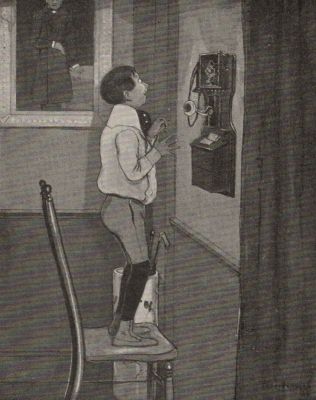
Whether there really was any such whisper as that or not, Jimmieboy did not delay an instant in rushing out into the back hall and climbing upon a chair that stood there to answer whoever it was that was so anxious to speak to somebody.
"Hullo, you!" he said, as he got his little mouth over the receiver.
"Hullo!" came the whisper he thought he had heard before. "Is that you, Jimmieboy?"
"Yes. It's me," returned Jimmieboy. "Who are you?"
"I'm me, too," answered the whisper with a chuckle. "Some people call me Hello Hithere Whoareyou, but my real name is Impy. I am the Imp of the Telephone, and I live up here in this little box right over where your mouth is."
"Dear me!" ejaculated Jimmieboy in pleased surprise. "I didn't know anybody ever lived in that funny little closet, though I had noticed it had a door with a key-hole in it."
"Yes, I can see you now through the key-hole, but you can't see me," said the Imp, "and I'm real sorry you can't, for I am ever so pretty. I have beautiful mauve-colored eyes with eyelashes of pink, long and fine as silk. My eyebrows are sort of green like the lawn gets after a sun shower in the late spring. My hair, which is hardly thicker than the fuzzy down or the downy fuzz—as you prefer it—of a peach, is colored like the lilac, and my clothes are a bright red, and I have a pair of gossamer wings to fly with."
"Isn't there any chance of my ever seeing you?" asked Jimmieboy.
"Why, of course," said the Imp. "Just the best chance in all the world. Do you remember the little key your papa uses to lock his new cigar box with?"
"The little silver key he carries on the end of his watch chain?" queried Jimmieboy, eagerly.
"The very same," said the Imp, "That key is the only key in this house that will fit this lock. If you can get it and will open the door you can see me, and if you will eat a small apple I give you when we do meet, you will smallen up until you are big enough to get into my room here and see what a wonderful place it is. Do you think you can get the key?"
"I don't know," Jimmieboy answered. "I asked papa to let me have it several times already, but he has always said no."
"It looks hopeless, doesn't it?" returned the Imp. "But I'll tell you how I used to do with my dear old father when he wouldn't let me have things I wanted. I'd just ask him the same old question over and over again in thirteen different ways, and if I didn't get a yes in answer to one of 'em, why, I'd know it was useless; but the thirteenth generally brought me the answer I wanted."
"I suppose that would be a good way," said Jimmieboy, "but I really don't see how I could ask for the key in thirteen different ways."
"You don't, eh?" said the Imp, in a tone of disappointment. "Well, I am surprised. You are the first little boy I have had anything to do with who couldn't ask for a thing, no matter what it was, in thirteen different ways. Why, it's as easy as falling up stairs."
"Tell me a few ways," suggested Jimmieboy.
"Well, first there is the direct way," returned the Imp, "You say just as plainly as can be, 'Daddy, I want the key to your cigar box.' He will reply, 'No, you are too young to smoke,' and that will make your mamma laugh, which will be a good thing in case your papa is feeling a little cross when you ask him. There is nothing that puts a man in a good humor so quickly as laughing at his jokes. That's way number one," continued the Imp. "You wait five minutes before you try the second way, which is, briefly, to climb upon your father's knee and say, 'There are two ends to your watch chain, aren't there, papa?' He'll say, 'Yes; everything has two ends except circles, which haven't any'; then you laugh, because he may think that's funny, and then you say, 'You have a watch at one end, haven't you?' His answer will be, 'Yes; it has been there fifteen years, and although it has been going all that time it hasn't gone yet.' You must roar with laughter at that, and then ask him what he has at the other end, and he'll say, 'The key to my cigar box,' to which you must immediately reply, 'Give it to me, won't you?' And so you go on, leading up to that key in everything you do or say for the whole day, if it takes that long to ask for it thirteen times. If he doesn't give it to you then, you might as well give up, for you'll never get it. It always worked when I was little, but it may have been because I put the thirteenth question in rhyme every time. If I wanted a cream cake, I'd ask for it and ask for it, and if at the twelfth time of asking I hadn't got it, I'd put it to him finally this way—
"'I used to think that you could do Most everything; but now I see You can't, for it appears that you Can't give a creamy cake to me.'"
"But I can't write poetry," said Jimmieboy.
"Oh, yes you can!" laughed the Imp. "Anybody can. I've written lots of it. I wrote a poem to my papa once which pleased him very much, though he said he was sorry I had discovered what he called his secret."
"Have you got it with you?" asked Jimmieboy, very much interested in what the Imp was saying, because he had often thought, as he reflected about the world, that of all the men in it his papa seemed to him to be the very finest, and it was his great wish to grow up to be as like him as possible; and surely if any little boy could, as the Imp had said, write some kind of poetry, he might, after all, follow in the footsteps of his father, whose every production, Jimmieboy's mamma said, was just as nice as it could be.
"Yes. I have it here, where I keep everything, in my head. Just glue your ear as tightly as you can to the 'phone and I'll recite it for you. This is it:
"I've watched you, papa, many a day. And think I know you pretty well; You've been my chum—at work, at play— You've taught me how to romp and spell. "You've taught me how to sing sweet songs; You've taught me how to listen, too; You've taught me rights; you've shown me wrongs; You've made me love the good and true. "Sometimes you've punished me, and I Sometimes have wept most grievously That yours should lie the hand whereby The things I wished were kept from me. "Sometimes I've thought that you were stern; Sometimes I could not understand Why you should make my poor heart burn By scoldings and by reprimand. "Yet as it all comes back, I see My sorrows, though indeed most sore In those dear days they seemed to me, Grieved you at heart by far the more. "The frowns that wrinkled up your brow, That grieved your little son erstwhile, As I reflect upon them now, Were always softened by a smile. "That shone, dear father, in your eyes; A smile that was but ill concealed, By which the love that in you lies For me, your boy, was e'er revealed."
Here the Imp stopped.
"Go on," said Jimmieboy, softly. "Tell me some more."
"There isn't any more," replied the Imp. "When I got that far I couldn't write any more, because I kind of got running over. I didn't seem to fit myself exactly. Myself was too big for myself, and so I had to stop and sort of settle down again."
"Your papa must have been very much pleased," suggested Jimmieboy.
"Yes, he was," said the Imp; "although I noticed a big tear in his eye when I read it to him; but he gave me a great big hug for the poem, and I was glad I'd written it. But you must run along and get that key, for my time is very short, and if we are to see Magnetville and all the wire country we must be off."
"Perhaps if the rhyme always brings about the answer you want, it would be better for me to ask the question that way first, and not bother him with the other twelve ways," suggested Jimmieboy.
"That's very thoughtful of you," said the Imp. "I think very likely it would be better to do it that way. Just you tiptoe softly up to him and say,
"If you loved me as I love you, And I were you and you were me, What you asked me I'd surely do, And let you have that silver key."
"I think that's just the way," said Jimmieboy, repeating the verse over and over again so as not to forget it. "I'll go to him at once."
And he did go. He tiptoed into the library, at one end of which his papa was sitting writing; he kissed him on his cheek, and whispered the verse softly in his ear.
"Why certainly," said his papa, when he had finished. "Here it is," taking the key from the end of his chain. "Don't lose it, Jimmieboy."
"No, I'll not lose it. I've got too much use for it to lose it," replied Jimmieboy, gleefully, and then, sliding down from his papa's lap, he ran headlong into the back hall to where the telephone stood, inserted the key in the key-hole of the little door over the receiver and turned it. The door flew open, and before him stood the Imp.
[to be continued.]
BEFORE HIM STOOD THE IMP.
Two weeks ago, in commenting upon the Spirit displayed by a certain class of scholastic athletes—they cannot properly be called sportsmen—I remarked that should ribbons be offered as prizes at future interscholastic track-athletic games, I feared five-eighths of those who enter under existing conditions would take no further interest in the sports. I feared at the time this might be a slight exaggeration, and I hope it is: but that my assumption was well grounded there is no doubt. I heard of one young man, who proudly canters about the cinder track in the spring-time, and claims to be a sportsman, who upon reading the paragraph in question exclaimed: "Ribbons? Well, I guess not. You can bet that if they had ribbons for prizes, I would be one of the five-eighths that would drop out!"
If the awarding of ribbons as prizes could purge the ranks of school athletics of such cup-hunting, medal-seeking mercenaries as that young man frankly admits he is, I devoutly hope and pray the expedient may be adopted. In chemistry there is a way of testing fluids for impurities by applying certain acids. If some good genie would only come up out of the earth and apply the ribbon test to interscholastic sport as conducted in New York city, I can assure him he would get a response that would startle him. But I don't suppose there is any use of advocating the ribbon scheme. I know, as well as the next man, that it would be impracticable. The custom of awarding prizes of value has become too general for us to be able to do away with it, even in behalf of such a holy cause as the purification of sport. Such a step, too, would injure the clean as well as the unclean, and although there is no doubt the former would be quite willing to suffer temporarily for the sake of redeeming or of getting rid of the latter, the suggestion is too radical, I am well aware, to be put into execution. We shall have to look for some other method of routing these Tammanyites of interscholastic sport.
A great many of these mercenary medal-hunters, like the young man I have quoted, will probably sneer at what I am now saying, and will perhaps consider me a crank. But a few years from now, if they still remain in the field of athletics (if they have not been chased out of it by ribbons or some other purifying element), they will see that I am right, and that this Department is none too severe in its arraignment of this class of sports. For they are "sports." They are not "sportsmen." There is a big difference between a "sport" and a "sportsman." A true "sportsman" is always a gentleman by instinct, if not by birth and education, and he engages in sport for sport's sake only. He does by others as he would be done by. A "sport" enters contests for mercenary motives, and as a rule prefers to do others.
Young men who are just entering athletics, who are going into contests with other amateurs, and hope to continue to engage in sports through their school days and college days, and even after that time during hours not devoted to the serious work of life, cannot too soon become convinced of the fact and imbued with the idea that true sportsmanship lies in playing for the sake of the game, and not for the sake of the victory or for the prize that victory may bring. "Sport for sport's sake" should be the motto of every scholastic athletic association in the country, and of every boy who takes part in any game—from marbles up.
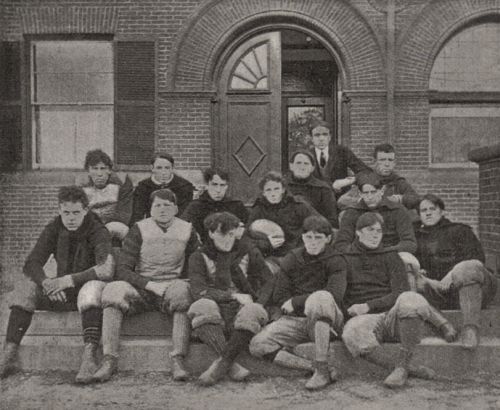
Argensinger, m'g'r. Edwards, r. g. Kafer, f.-b. Righter, l. e. Noble, sub. Powell, q.-b. Dibble, l. h.-b. and Capt. Arrott, sub. Emerson, r. t. Cadwalader, l. t. Richards, l. g. Davis r. h.-b Eddy, r. e. Simons, c. THE LAWRENCEVILLE FOOTBALL TEAM.
In all justice, however, to these young men whom I am addressing as they probably never have been addressed before, let me say that their "sporting" spirit (and I use this word here in the sense of a bad mercenary spirit in matters of sport) is largely due to the attitude adopted by some of the principals of the New York schools. I do not hesitate a moment to put a large part of the blame on these principals, because they deserve it, and are directly responsible for a great deal of the unsportsmanlike conduct of the boys who attend their schools. If they chose, they could easily prevent a great deal of the evil that is done to the true spirit of sportsmanship. But they do not look at it in that way. Their idea is to encourage sport for the sake of the medals to be won, and they look upon a championship as one of the best of advertisements for their school. Medals, medals, and more medals; and let sport take care of itself! There was a rumor last spring that one of the New York principals made one of his pupils sign an agreement to the effect that he would only enter in certain events at the interscholastic games. The young man was after medals, and wanted to grab for several; but the older "sport" was wiser, and he knew there was a better chance for gold or silver disks if the energy was concentrated on certain ones. All this may be idle talk and without the slightest foundation. I hope it is; but it was a good healthy rumor, at any rate, last spring.
The managers of the New York Football Association are having considerable difficulty in securing the services of college graduates to act as umpires and referees at interscholastic championship games. It is easy to see that this might very well be a hard task, for the games are played at Williamsbridge, and it means a whole afternoon devoted to the purpose for a college graduate—in all probability in business—to accept an invitation to act as an official on these occasions. Nevertheless, in this great city of New York there ought to be a sufficient number of graduates of the local schools, likewise graduates of colleges, familiar enough with the game to be efficient, and willing to devote at least one or two afternoons of the season to the good work of advancing the interests of football in the schools.
It is not right to expect the players to do everything. They deserve some encouragement from their elders; and it certainly is discouraging for two teams to appear on the field, and find that there are no officials to conduct the play. It is not advisable to have officers of the N.Y.I.S.F.B.A., or other students or tutors of the schools, act as officials, because disputes are more liable to occur under these circumstances. And yet if there is no one else at hand or available, it is better to take such men for officials than to call the game off. But I believe that by using forethought and energy enough college men can be found to act as umpires and referees for the remaining games this season. Students of the schools are perfectly competent to serve as linesmen.
An example of the undesirability of student officials was the recent game between Cheshire and the Hopkins Grammar School. The reports of that contest as given by the newspapers are something appalling to contemplate. If we could believe them we should almost feel like giving up our faith in the sportsmanship of that region. Aside from other misdeeds, which have nothing to do with sport, credited to them, the Hopkins Grammar lads are accused of having played one or more Yale medical students on their team. On the other hand, the New Haven players accuse their opponents of playing several teachers. (If this be true I commend last week's Interscholastic Sport columns to the Cheshire scholars.) But whatever the rights and the wrongs of the case may be, it is a disgraceful state of affairs, and one that we can well afford to pass over in silence as far as the details are concerned.
The point I was leading up to is that the disabled Captain of the Hopkins team is reported to have acted as umpire, his place on the field being taken by a player named Jewett. The report of the game as printed in a New Haven paper goes on to say: "Neither side scored until just before the whistle was blown for the end of the first half, when Acting Captain Jewett of Hopkins secured the ball and rushed over the line. Cheshire claimed time was up, and, according to their version, they were supported by the Hopkins Captain as umpire. Acting Captain Jewett, however, decided to quit, and the game stopped. Then followed trouble." There it is in a nutshell. Jewett decided to quit, because he was not satisfied with the umpire's decision. And the umpire was the actual Captain of the team which Jewett had charge of and which proved a "quitter." If there is anything a sportsman justly despises it is a "quitter."
But the Hopkins Grammar players are not the only ones subject to the edifying affection commonly called sulks. Last week the French-American College and the High-School teams of Springfield, Massachusetts, met in a "friendly contest." They were going to play for "sport," of course. (Sport for sport's sake, you remember.) Well, it seems that two instructors, Mr. Turner and Mr. McGregor, officiated as referee and umpire. There was an off-side play, and both officials so agreed and decided. Then the College team refused to play any further, and became quitters. What I cannot understand in all this is why any team of presumably sensible young men, after having agreed to abide by the decisions of gentlemen in whom at the time they must have had confidence, should refuse to abide by a decision as soon as one is made against them. I have said so many times in the few lines that I have written this week that this or that was unsportsmanlike, that I think we had better drop this painful subject now and turn to something more cheerful.
It would seem from the score of the recent game between Hartford High and Hillhouse High, that the former had had a hard time of it. In reality, the victory was an easy one. Hartford caught the ball at the kick-off, and by a series of carefully planned plays forced it down the field and over Hillhouse's line for a touch-down. These were the only points scored, although the ball was in Hillhouse's territory during most of the game. Play was carried on in a pouring rain, which made runs around the end almost impossible. Most of the gains on both sides were obtained by sending the runners between guard and centre or guard and tackle. New Haven's team was as good as could be gotten out of the school, but it was considerably inferior in ability and weight to Hartford's. Smith and Erickson were weak at the end positions, but not much worse than their opponents; but the tackles, Collet and Russell, were strong.
The Hartford centre was superior to that of the New Haven team, and had little trouble in making holes for the backs to plunge through. McQuade at full-back did fully as well as Hartford's man Luce, who is looked upon as the crack player in his position in the league, and he was responsible for a number of the advances made by his side. On the whole, the weather conditions were such as to make a just criticism of the work of either team impossible, because no doubt most of the fumbling and poor tackling was due to the slippery condition of things in general. There was a good deal of ragged playing, however, that cannot be excused even on the ground of rain and mud, and Hillhouse especially needs to brace up and give attention to interference, and to the breaking up of interference.
Hartford put up a good game a few days later against the Yale Freshmen, who defeated the school team 20 to 0. There was no scoring done in the first half except a safety by Hartford. In the second the Yale men sent eight fresh players into the field, and from then on Hartford had little show of winning. I think if the same teams had played from start to finish, there would have been a different story to tell at the end of the game.
Parental interference in boys' sports is always to be regretted, especially if the sport is being carried on under rules and conditions which experience has shown to be good ones, and under the supervision of older persons, who are, as trainers and coaches, just as anxious for the young player's health and condition as the most nervous mother could be. If a boy is sent to a private school it is fair to presume that his parents have confidence in the judgment and integrity of the principal and instructors, regardless of their intellectual and scholarly attainments or of their pedagogical talents. Therefore, if these professors, in whom the parents have expressed their confidence by confiding their sons to their care, approve of athletic sports in general, and of football at this season in particular, the parents, being less able to judge of the merits of the question, should allow their boys to take part in these sports until they have good reason to discredit the instructor's judgment. Parents, as I have frequently said before, are too often influenced by exaggerated reports of football accidents occurring to untrained players taking part in unscientific contests.
There is no danger to a healthy boy who plays football under the supervision of a competent coach. For this reason it is my opinion—and I am sure the opinion of all lovers of football—that the parents of the Barnard School boys who forbade their sons to take part in the game, have made a mistake which they will doubtless recognize when they become more familiar with the sport. The action of these parents has resulted in the disbanding of the first team at Barnard. This eleven had already won several victories, and the players were looking forward to earning a creditable position in the league, but now all this has been given up.
But the true spirit of sportsmanship has not by any means been extinguished in the school. The players with the objecting parents have retired, and the first team has fallen to pieces, but the fragments have been collected by an energetic captain, and new men have been found who practise on the gridiron daily; not with the view of getting into shape for this season, but to train players for next year. This is true sportsmanship. These boys are going into sport for sport's sake, and should be encouraged. They are of the stuff that winning teams are made of.
W. L. Dubois, Urbana, Ohio.—You might lighten your racket by scraping it with glass or sand-paper, or by hollowing out the handle. Don't soak it. You will find it more satisfactory in the end to buy another, or to trade your own off for a lighter one.
K. M. Towner, Asbury Park, New Jersey.—A correct diagram of Defender is not to be had. Some of the yachting papers published approximately correct diagrams at the time of the recent races. There will be an article on the construction of model yachts in the volume of Harper's Round Table, which begins with this issue.
The Graduate.
Any questions in regard to photograph matters will be willingly answered by the Editor of this column, and we should be glad to hear from any of our club who can make helpful suggestions.
OUR PRIZE OFFER.
Our prize offer has brought many queries in regard to the rules of the competition, the printing, mounting, and marking of the pictures, the style of picture required, etc. Though the rules and requirements were made as plain and concise as possible, we are quite willing to go more into detail and to answer any question which will aid our Camera Club to make this competition the best we have yet conducted.
The competition "open to all amateurs" seems to call forth the most queries. "Can any one under eighteen take part in it?" "Can an amateur under eighteen send pictures to both contests?" "Must an adult amateur be a member of the Order?" "May an amateur under eighteen who wishes to take part in both competitions send the same picture to each?" are some of the questions asked.
The prize offer "open to all amateurs" is, as stated in the circular, open to all amateurs who desire to take part in it, without regard to age limit. This, of course, admits any member of the club under eighteen, and any member under eighteen may take part in both competitions. Any adult amateur who wishes to enter the competition may become a "Patron" of the Order by simply sending name and address on a postal to Harper's Round Table. While there is no condition which would prevent an amateur sending the same picture to both competitions, it is expected that he or she will not do so, as it would be hardly fair to allow a picture to win a prize in both competitions, provided it was the best of its class, for both are, of course, under the same rules, and have the same classes.
One correspondent wishes to know if he may send bromide prints. Referring to Rule V, he will see that any printing process may be used, with the exception of the blue-print. This is no reflection on the blue-print process, which is sometimes preferable for some pictures; but blue prints are usually excluded from photographic competitions, as it is harder to judge the real merits of a picture from a blue print, and they do not reproduce as well as those in black and white.
The date for receiving marine pictures has already closed, but landscape pictures will be received until November 18th. It is not too late in the season to make landscape pictures, and photographs taken when the trees are partly stripped of leaves are sometimes finer than those taken when the foliage is in its prime. "Wood interiors" can only be made either in the autumn or early spring.
In making landscape do not try to include too much in the picture. Landscape artists seldom make a picture which includes extended view. They select some picturesque spot, with a clump of bushes and bit of stream, perhaps, and make a picture which is a thing of beauty, which could not be done if they climbed some lofty hill, and made a picture of the wide stretch of landscape before them. A picture answering this latter description is entirely out of proportion to the small 4 x 5 plate into which it is compressed, and can only be used with success in a lantern-slide.
Take special pains with the finishing and mounting of the pictures. Do not use a 4 x 5 card-mount for a 4 x 5 picture. Use at least a card 6 x 8 in size. See recent numbers for hints on mounting pictures.