LAURIE VANE, BRAKEMAN.
Reading edition
BY MOLLY ELLIOT SEAWELL.
Mudhole Junction was a desolate place enough, especially on winter nights, when the wind roared through the mountain gorges, and an occasional fierce, despairing shriek from a passing locomotive waked the wild echoes among the granite peaks. But Blundon, the station-master, and Laurie Vane, the bright-eyed young fellow from the East, who lived in the little shanty a quarter of a mile off had a soft spot in their hearts for Mudhole Junction, and with reason. Both of them had found health and strength in the high, pure altitude, and each had also found a friend in the other. Blundon often wondered why a young fellow of nineteen should be living up there, apparently as much cut off from the human species, other than the Mudhole Junctionites, as though he belonged to another planet. But seeing the boy was perfectly correct in every way, and Blundon himself having the soul of a gentleman, and above asking questions, Laurie Vane was not bothered to give explanations.
One autumn night, about a year after Laurie's advent, he and the station-master were spending quite a hilarious evening together in the little station-house. A fire roared on the hearth, and some malodorous cheese, a plate of crackers, and a pitcher of eider were on the table. On one side of the fire sat Blundon, grizzled and round-shouldered, but with a world of good sense in his well-marked face; on the other side sat Laurie, a red fez set sideways on his curly head, and his guitar across his knees.
"Talk about your spectacular shows," said Laurie, softly thrumming "In Old Madrid," on the guitar, "I don't know anything quite up to that ten-o'clock express on a wild night like this. When she rushes out of the black mouth of the tunnel for that straight stretch of three miles down here, and flies past, hissing and screaming, with one great glaring eye blazing in the darkness, she looks more like one of the dragons of hell than anything I can imagine. It's worth more than many a show I've paid two dollars and a half to see."
Blundon smiled at this as he answered:
"And I can see it every night in the year for nothing. People call it lonesome up here, but I guess mighty few folks know how much company an old railroad man like me can get out of passing ingines and slow freights, and even out of the rails and ties. Anybody would think I was a paid section-boss the way I watch the road-bed about here."
"How long were you a railroad man?" asked Laurie, stopping in his thrumming.
"About twenty years," said Blundon. "But it was in the East, where railroading ain't the same as it is out here. I was in the caboose of a train that made two hundred and twenty miles, year in and year out, in four hours and forty minutes, including three stops. It was a solid train of Pullmans, and the road-bed was as smooth as a ballroom floor. I had an eighteen-thousand-dollar ingine—the Lively Sally—and when I pulled the throttle out she was just like a race-horse when he hears the starter shout 'Go!' I don't believe I ever could have quit the railroad business if the Lively Sally hadn't come to grief. But it wasn't when I was a-drivin' her. I was laid off sick, and they gave her to another man—a good enough fellow, but you can't learn the ways of an ingine in a day nor a week, any more than you can learn the ways of a woman in a day or a week. Sally used to get balky, once a year reg'lar. For about a week she'd have the jim-jams—seemed like she got tired of working, and wanted a spell of rest in the round-house. Well, the new man didn't know this, and instead of letting her have her own way, he tried to drive her, and Sally just blew her cylinder-head out for spite. And when she was helpless on the siding a long freight came along, and the switchman lost his wits, and set the switch wrong, and that eighteen-thousand-dollar beauty was crippled so she never was worth much afterward. And about that time my lungs gave out, and I had to come up here. I never cared much about an ingine after Sally. I dare say I might get a place again to run a passenger train, but I think about poor Sally, and I don't feel like going back on the old girl; so here I am, side-tracked for life at Mudhole Junction."
"It was all on account of a patent air-brake that I'm here," remarked Laurie.
"It's coming," thought Blundon.
"I am an only child," said Laurie, after a little pause, "and I had the best daddy in the world, except that he was so obstinate."
"You weren't obstinate, young feller," Blundon gravely interjected. "You were just firm. It's the other feller that's pig-headed always. Go on."
Laurie glanced up quickly, and grinned at Blundon for a moment.
"Well, perhaps I was a little obstinate too—a chip of the old block. As long as my mother lived, God bless her!"—here Laurie raised his cap reverently—"she could always make peace between us. But when she went to heaven there was nobody to do this. The first serious falling out we had was when I went to college. I took the scientific course, and apparently I didn't do much at it. But I was working like a beaver at an air-brake, and when I wasn't in the class-rooms I was down at the railroad shops studying brakes. I found out a lot about them, and I also found out that my wonderful invention wasn't any invention at all. It had been tried and discarded. My father, though, thought I was idling, and wrote me a riproaring letter. One word brought on another, until at last I walked myself out of the house after our last interview, and told my father I would never take another cent from him as long as I lived. I had a little money that my mother left me. My father said I'd come back as soon as I'd run through with what I had, and that made me mad. I knew my lungs weren't in good shape, and the doctors told me to come up here and try living in a shanty for a year. I've done it, and I'm cured, and my feelings have softened toward my father—he was a kind old dad when he had his own way—but I can't—I can't make the first advance to him."
Blundon's usual address to Laurie was, "Young feller," but on serious occasions he called him "Mr. Vane, sir."
"Mr. Vane, sir," he said, "do you know the meaning of the word courage?"
"Yes," answered Laurie, promptly.
"And sense—good, hard, barnyard sense, Mr. Vane, sir?"
"Yes," again replied Laurie.
"And, Mr. Vane, sir, do you think you're treatin' your father right?"
"N-n-no," said Laurie, not at all promptly.
"Well, Mr. Vane, sir," continued Blundon, rising, and getting his lantern, "I don't think you can lay any extravagant claims to either sense or courage as long as you don't know how to make the first advance toward your own father, when you know you ain't treatin' him right. There's the express going in the tunnel."
Laurie rose too with a grave face. Blundon's words were few, but Laurie had learned to know the man, and to respect him deeply; and Laurie knew that Blundon's words were a strong condemnation.
The two went out upon the little platform to see the express pass. The night was very dark, without moon or stars. In a minute or two the train, a blaze of light from end to end, dashed out of the tunnel, and with one wild scream took the three-mile straight stretch down-grade like a streak of lightning. Not half the distance had been covered, when Blundon, almost dropping the lantern in his surprise, shouted, "She's slowing up to stop!"
Almost by the time the words were out of his mouth the locomotive was within fifty yards of them, and with a clang, a bang, and a snort it came to a full stop. The conductor had jumped off while the train was still moving, and he ran up to Blundon and Laurie.
"What's the matter?" asked Blundon, holding up the lantern in the conductor's face.
"Matter enough," answered the conductor. "The engineer slipped on the floor of the cab, about ten miles back, and wrenched his arm, so he is perfectly helpless, and almost wild with pain; the negro fireman brought us the last ten miles, but he couldn't take us over the mountain."
"I reckon I can," said Blundon, coolly. "You know my record."
"Yes; and that's why I stopped," answered the conductor. "But look here."
He handed out a piece of paper, on which was written clearly:
"Pay no attention to a red light on the trestle. It means a hold up at the end of the trestle. The men know what is in the express car, and they have dynamite.
"A Friend."
"Maybe it's a hoax," said Blundon.
"And maybe it ain't a hoax," said the conductor.
Blundon, the conductor, and Laurie had been standing close together during this short and half-whispered colloquy, but the negro fireman had slipped up behind them, and had seen the note by the lantern's glimmer.
"Good Lawd A'mighty!" he yelled. "De train robbers is arter dis heah train! Well, dey ain' gwi git no chance fur to blow dis nigger up wid dynamite." And without another word he took to his heels, and immediately was lost in the darkness.
"Here's a pretty kettle of fish!" exclaimed the conductor.
"Never you mind," said Blundon, with a grim smile; "this young feller will be my fireman, and I'll agree to take the train across the mountain, hold up or no hold up. I'm off duty now until six o'clock to-morrow morning, and I can get back by that time."
"All right," answered the conductor, going toward the cab, where they found the engineer groaning with pain.
"Just groan through the telephone, old man," said Blundon, as they helped him out, "and you'll get a doctor from the house over yonder, and he'll set your arm in a jiffy."
"Wouldn't it be a good idea," said Laurie, diffidently, "if the engineer telephoned to Stoneville that if the train is delayed to send a posse to the Stoneville end of the trestle! This is the night the Stoneville Light Infantry meet to drill, and they'd be handy in case of a hold up."
The conductor hesitated a moment, then went over to the express car, and came back.
"The express messenger says to telephone to the soldier boys, and if it is a hoax, he can stand the racket, and if it ain't—well, he has got near ninety thousand dollars in the safe, and he ain't a-going to give it away."
In another moment the injured engineer was ringing the telephone bell. Two or three passengers then appeared on the platform of the smoker.
"Hello!" cried one of them, in a voice singularly like Laurie's. "What's up?"
"Stopping for a new fireman, sir," answered the conductor, airily. "All aboard!"
As Laurie took his seat, in the cab beside Blundon, he said, with a pale face, "That was my father who spoke."
"Glad of it," bawled Blundon, over the roar of the train. "I hope he's got a gun."
Laurie had often heard that one never could judge of a man until he had been seen engaged in his own especial vocation, and he found it true as regarded Blundon. The old engineer was usually round-shouldered, and had a leisurely, not to say lazy, way of moving about. But the instant his hand touched the throttle of the engine he became alert and keen-eyed, his figure straightened, and the power he possessed intrinsically became visible.
The train sped on for an hour before entering a deep cut, at the end of which they would have to cross a great ravine over a long trestle. A mile or two beyond the trestle was the little manufacturing town of Stoneville. As they entered the cut darkness became blackness, and the train began to slow up a little before going on the trestle.
Laurie shouted in Blundon's ear, "This is a mighty good place for a train robbery!"
Blundon nodded, and Laurie, turning to the window, strained his eyes toward the ravine that showed like a huge black shadow before them. And in the middle of the trestle a red danger signal burned steadily.
"It's there," cried Laurie to Blundon.
By the time the words were out of his mouth a fusillade of shots rattled against the side of the cab.
"Lie down! lie down!" cried Blundon, throwing himself flat on the floor, and Laurie promptly followed suit. Then three ghostly figures leaped on the train, and two of them catching Blundon and Laurie, held them fast, while the third brought the train to a stop.
"Get up," said the first robber to Blundon, who scrambled to a sitting posture with a pistol at his ear. The second robber had likewise established close connections between Laurie's ear and another pistol, but allowed him also to sit up on the floor. The third robber jumped off, and presently the crash of dynamite showed that the express car was broken into. Then there was a wait of ten minutes, while the robbers, of whom there were several, rifled the safe.
During this time Blundon showed such perfect coolness that it calmed Laurie's natural excitement, and won the admiration of the highwaymen.
"Euchred, Mr. Vane, sir!" was Blundon's only exclamation, as he sat cross-legged, looking at Laurie.
To this Laurie replied, "I told you it was a good place for a train robbery."
"Young man," remarked the gentleman who covered Laurie with his pistol, "I am afraid you haven't had the advantages of good society, like me and my pal there. You hadn't oughter call names, especially on a social occasion like this."
"Perhaps I oughtn't," meekly answered Laurie.
"We are gentlemen, we are," continued this facetious bandit. "We don't go in for robbin' ladies of their handbags—we don't want your little silver watch, sonny. We are opposed to the bloated corporations that rule this country, and we are doing our best to maintain the rights of individuals against them by cleaning out their safes."
Laurie, without arguing this important question, remarked, "If you have so much regard for the rights of individuals, I wish you'd let me scratch my eye."
"I will do it for you with pleasure," amiably remarked the bandit, and with the cold muzzle of the loaded pistol he gently scratched Laurie's eye, to that young gentleman's intense discomfort.
In a few minutes more several of the gang who had gone through with the safe came to the cab.
"Bring one of those gents out here," said the man who seemed to be the leader. "We have got the express car and the engine disconnected from the rest of the train, but we don't exactly understand the brakes, and we want them set."
A gleam of intelligence passed between Blundon and Laurie which served the purpose of words.
"That young feller," said Blundon, indicating Laurie, "is a famous brakeman. He invented an air-brake once, only it wouldn't work."
BEFORE A WORD WAS SPOKEN, MR. VANE RECOGNIZED LAURIE.
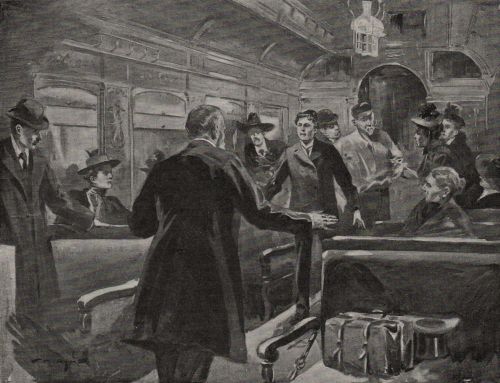
Laurie, still covered by the pistol in the hands of his friends, got out of the cab, and soon the sound of hammering and knocking reverberated, showing he was working with the brakes. In a little while he was brought back, and Blundon and himself were then marched to the passenger car, hustled in, and the door locked on them. The first person Laurie's eyes rested on was his father. The excited passengers gathered around the two, but before a word was spoken Mr. Vane recognized Laurie. In another minute the two were in each other's arms. Laurie's first words were: "Daddy, I was wrong. I beg you will forgive me—"
But his father could only say, brokenly, "My boy—my boy!"
Blundon, after a few moments, raised his hand for silence, and then, in a low voice, but perfectly distinct to the earnest listeners, he said:
"Ladies and gentlemen, them train-robbers have bitten off more than they can chew. We had warning of this at Mudhole Junction, and the reg'lar engineer—I'm only a substitute—telephoned an hour ago to the Stoneville Light Infantry to be here if the train wasn't on time, and no doubt the soldiers ain't half a mile away. I've got a young amatoor fireman here—Mr. Laurie Vane—who invented an air-brake—"
"That wouldn't work," added Laurie, sotto voce.
"—And the robbers took him to set the brakes so they could run away with the ingine and express car. But this smart young gentleman disconnected the coil of the brakes, and everything about this train is just the same as if it was nailed to the tracks. The ingine can spit sparks, but she can't turn a wheel, and I'm thinkin' they'll be monkeyin' with her until the Stoneville Light Infantry comes along and bags 'em every one!"
A silent hand-clapping greeted this; then all the passengers, keeping perfectly still, waited for their rescuers to arrive. Meanwhile a great noise and whacking went on outside, as the robbers vainly struggled to make the engine move. Laurie sat, his arm about his father's neck, and although he said but little, every glance was an appeal for forgiveness. Blundon had made him out something of a hero in resource, and his father's proud recognition of it was plain to all. After fifteen minutes' waiting, under high tension, Blundon, peering closely into the surrounding darkness, uttered a suppressed chuckle.
"They're comin'," he said. "The robbers don't see 'em; they are too busy with the ingine."
A pause followed, unbroken by a word; then a yell, as the robbers realized they were surrounded. The passengers locked up in the drawing-room car could see little of the scuffle, but they heard it, and in a few minutes the door was wrenched open, and an officer in uniform announced that the robbers were captured, and called for the engineer to come and take charge of the engine.
Laurie and Blundon both wear watches with inscriptions on them—gifts from the railway company. Laurie is living in his father's house, and has altogether given up his dream of inventing a new brake, and is reading law very hard, much to his father's delight; and people say, "Did you ever see a father and son so fond of one another as Mr. Vane and that boy of his?"
And Laurie has several times asked his father, dryly, if he was really sorry that his only son had studied up the subject of air-brakes when he ought to have been in the class-room. Laurie has promised Blundon that once in two years at least he will go to Mudhole Junction. They have had but one meeting as yet, since Laurie left, when Blundon sagely remarked:
"Mr. Vane, sir, I think you did a sight better in holding that train down to the track with them ordinary brakes than you ever will with any of your own. But the best thing you did, after all, was to ask your father's pardon, and you ought to have done it a year before, Mr. Vane, sir."