THE NORMAL EYE.
Reading edition
BY JNO. GILMER SPEED.
If six persons casually thrown together look at the moon when it is high in the heavens, and each be asked how large the moon seems to be, it is more than likely that the questioner will receive six different answers. This probably would not be the case if the moon were near the horizon and just rising or just setting.
The differences in the answers to the first query will be due to the perfect or imperfect action of the various eyes. The comparative uniformity of the answers in the second instance would be due to the nicer adjustment of the eyes by seeing at the same time with the moon familiar objects on the earth, such as houses and trees, which would afford a standard of measurement.
Many persons old and young have remarked what I have just noted. I have often observed such differences of vision, but never gave any particular thought to the matter until the beautiful gilded statue of Diana on top of the lofty tower of the Madison Square Garden was erected as a weather-vane. The arrow of the chaste huntress points in the direction of the prevailing wind.
To me the statue, when it was first erected, seemed at least ten feet tall. To another of my friends it seemed a trifle smaller, and so did the appearance vary, until the sixth of my companions said that to him the statue seemed no larger than a good-sized doll—that is, about two feet in height.
Then we turned to the moon, and here again were six opinions. They varied from between attributing to the moon the size of a barrel-head, eighteen inches in diameter, and the size of a breakfast plate, about seven and a half inches. I was puzzled and interested, and as I saw larger than any of my friends, I was afraid that my eyes were in some way out of focus.
Next day I went to an optician to ascertain whether or not I had normal vision. I was put through the usual tests of reading, without the aid of glasses, sentences in different-sized letters. Then the optician declared that I saw with most unusual accuracy. I was puzzled at this, for I regarded Mr. Augustus St. Gaudens, who had made the weather-vane statue of Diana, as the most gifted sculptor in America, and Mr. Stanford White, the designer of the tower upon which the statue stands, as one of our most accomplished architects. These gentlemen could not have made a mistake, I thought, for surely they did not mean that Diana should have to one standing on the ground the appearance of a giantess.
It happened that the shop of the optician I consulted was in the neighborhood of Madison Square. Looking from the windows, one could see Diana changing her front as the spring winds shifted. Still she seemed at least ten feet in height. I turned to the optician.
"Have you normal vision?" I asked.
"I am not so fortunate," he replied.
"Is there any one here whose vision has been frequently tested, and about which there can be no doubt?"
A young man was sent for, and I was told that his eyesight was as perfect as human eyesight ever gets to be. I took him to the window and pointed out Diana, who now seemed in the act of shooting her arrow directly over our heads, and was therefore facing us.
"How large does she look?" I asked.
"Oh, she is too large," he responded, with a laugh; "she seems fully ten feet high to me." Here was confirmation of my own opinion.
I then went to Mr. St. Gaudens. He told me frankly that the statue was too large, and that it was to be replaced by a smaller one—five feet shorter, a diminished replica. With the modelling he was entirely satisfied, as are all other competent art critics, I believe, but he was convinced that the statue was too tall.
I asked him what the custom was in determining how much a figure that was to be placed at an elevation should be exaggerated. He told me that in modelling ordinary statues a platform could be made of the same size as the base upon which the finished work was to rest, and that then the sculptor's sense of proportion would guide him. In this case, however, where a statue was to be placed at an elevation of 325 feet, such a test was impracticable.
Hence the proportions had to be determined by a scale-drawing which showed all the various parts of the building and tower in relation to each other and to the whole. This drawing was modified until it completely satisfied the sense of proportion of both architect and sculptor. Such a method, however, appears not to have been exact enough to have prevented two of our ablest men from falling into a costly error of judgment.
By marking off a base-line for one side of a right-angled triangle, and letting another side of the triangle be the height of the tower, the length of the hypothenuse, or third side of the triangle, which would also have been the line of vision, could have been easily calculated. Then if another right-angled triangle be constructed, the hypothenuse of which is just as long as the normal human vision can see without diminishing an object of the size that it is desirable that the elevated object should appear when fixed in place, then the height of this given object would be to the hypothenuse of the second or subsidiary triangle as the hypothenuse of the larger triangle is to the height of the desired object. That is, if the normal vision will reach accurately 200 feet, that would be the hypothenuse of the second triangle. Suppose, then, that the hypothenuse of the first triangle be 500 feet, and it was desired that the elevated object should appear six feet high; then the architect would have to make it fifteen feet high for the proper result to be attained.
By applying such a plain mathematical rule as this the costly mistakes made in New York might have been obviated, and by its aid it can be determined at any time just how much an elevated object should be exaggerated so that it will look of a natural size. Such a rule as this can be applied by any school-boy who has mastered his trigonometry; but there are few, if any, architects who resort to calculations to determine a mere matter of size when it does not relate to the strength of the structure. The strength of walls and floors is of course calculated with mathematical nicety, but those matters of construction and ornamentation which only affect the appearance of buildings are determined by the taste and the sense of proportion of the designer.
And it may be that it is scarcely worth while for architects and designers to take any greater pains than they do to arrive at mathematical accuracy in those things which, after all, have only an æsthetic value. The first Diana on the tower was too large; but if a thousand had been randomly gathered in Madison Square Garden, and a census of their opinions taken, it would probably have been found that the vote stood something like this: 50 would have thought the statue 15 feet high; 100, 10 feet; 200, 8 feet; 200, 6 feet; 200, 5 feet; 100, 4 feet; 100, 3 feet; 50, 2 feet.
The statue, which was at an elevation of 325 feet from the ground, was really 18 feet in height. The present statue, which has replaced the one of which I have been speaking, is 13 feet high.
The percentage of persons having normal vision is very small, and those who by the use of glasses or spectacles correct such defects are also comparatively small, if we except those who realize the impairment of their vision as they realize, after the meridian of life has been passed, the impairment of other faculties. Children, as a rule, have normal vision; but I am assured by numerous practical opticians that not more than ten per cent. of the men and women who have passed their twenty-first birthday still have normal vision; and when a person has got beyond forty-five and can still see with the accuracy of youth, then that person affords so exceptional a case as to be worthy to be placed among the living curiosities. A small percentage of persons with abnormal vision see large, but, as a rule, eyes that are not as they should be see objects in a diminished form.
This being the case, an architect who has a normal vision, or corrects his vision by the aid of properly adjusted spectacles, and whose sense of proportion is also of a high order, will very likely continually be designing things that only a small percentage of those who are to look at them will be capable of appreciating. Out of a thousand grown persons who see his accurately proportioned work, one hundred will see it with normal eyes, and two hundred more, perhaps, will see it with eyes corrected by spectacles. Three hundred will therefore view his work as he does himself, and seven hundred, not knowing that their vision is defective, will judge that his work has been badly done. Therefore, build he ever so well, he is building only for a small minority. The children, with eyes ordinarily in a normal condition, should be the best friends an architect could cultivate, for they, in one sense, at least, usually have the capacity to look upon his work and say whether it be well done or not. But, unfortunately, about the time that young people reach an age when they begin to think seriously about art and architecture, the great majority of them also begin to lose that normal sight, without which distant objects can no longer be seen in accurate proportions. Or perhaps the architects might impress upon all those who criticise their work that a consultation with an oculist and a call upon a spectacle-maker would enable a critic to reform his adverse judgment. Such a course would be a good thing both for the eye specialist and the optician. But if an architect himself have defective vision, he can either design his structure by mathematical rules, or do for himself what has just been suggested for his critics. At any rate, the statistics available, and these are to a large extent only approximated, show that the eyesight of Americans is getting all the time more defective, and lead to the conclusion that in the course of a few more years the exceptional person will be the one who does not wear eye-glasses or spectacles or squint impertinently through the "monocle," that distinguishing mark of English and Continental dandyism.
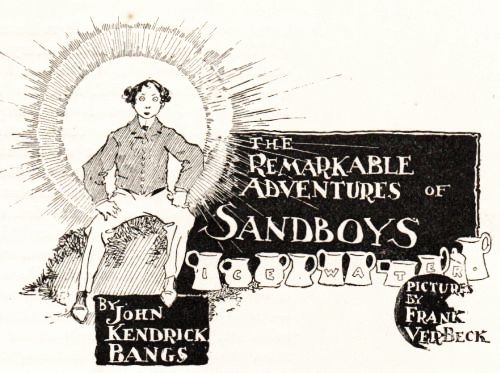
THE LAST BEAR OF THE SEASON.
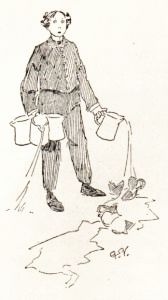
When the boys, after a long and tedious railway journey from the hot city to the cool wooded mountain country, arrived at the much-beloved hotel where they had spent several very happy summers, the first person to greet them was Sandboys, the curly-headed hall-boy with the twinkling eyes and rapid-running feet. Sandboys, as they entered the great, comfortable hotel office, was in the act of carrying a half-dozen pitchers of iced water up stairs to supply thirsty guests with the one thing needful and best to quench that thirst, and in his excitement at catching sight once again of his two little friends, managed to drop two of them with a loud crash upon the office floor.
"It's Sandboys," said Jack, gleefully. "I was afraid we wouldn't see him this year. He's been studying theelygy."
"He'll never be any kind of a preacher," returned Bob, with a laugh at the idea. "He can't hardly open his mouth without tellin' a fish story or a bear story, and I don't think his kind of stories would do for sermons."
At any rate, whatever the cause might have been, there Sandboys was, plying his old vocation, and apparently no further along in the study of theology than he had been when, a year before, he had bade the boys "good-by forever," with the statement that as he was going to be a missionary, the chances were they'd never see him again.
"I don't see why the proprietor of this hotel keeps a careless hall-boy like that," said a cross old lady, upon whose dress Sandboys had managed to spill some of the water.
"Well, you will see in a few days," returned an old maid who was sitting at her side, sharply. "Those two boys as has just come in is fearful noisy and lively, and that Sandboys last summer was the only person around here as could keep 'em quiet. When he wasn't around they was a-climbin' all over the men and a-settin' in the laps of all the ladies."
"They look movey an' noisy," said the cross old lady, eying Jack and Bob narrowly. "Whose boys be they?"
"They're cousins—their fathers is brothers. Their last name's Drake," replied the old maid.
"Humph!" sneered the cross old lady. "Seems to me, if they behaves as you say they do, they'd oughter been named Gander. Gander's a good name for all boys, 'pears to me, anyhow, a-squawkin' an' a-sissin' around all the time."
But Bob and Jack and Sandboys were blissfully unconscious of the severity of the old lady's criticism, and had eyes for the moment for none but each other.
"Hull-lo!" cried Sandboys, joyfully. "You back again?"
"Looks so, don't it?" said Jack.
"Didn't expect to see you, though, Sandboys," said Bob. "Thought you'd be off preachin'. Given up theelygy?"
"Sorter," said Sandboys. "Didn't like the prospect o' bein' et by Samoans and Feejees, so I thought I'd stick to bell-boyin' another season, anyhow; but I'll see you later, boys. I've got to hurry along with this ice-watter. It's overdue now, an' we've got the kickin'est lot o' folks here this year you ever see. One man here the other night got mad as hooky because it took forty minutes to soft bile an egg. Said two minutes was all was necessary to bile an egg softer'n mush, not understandin' anything about the science of eggs, where hens feeds on pebbles."
"Pebbles?" cried Jack, astounded at the idea.
"Certainly. Pebbles," reiterated Sandboys. "Nothin' extryordinary about that. Chickens has got to eat somethin', and up in these here States o' New Hampshire an' Vermount there ain't much left for 'em after we human bein's has been fed except pebbles, in which the soil is partickerlarly fertile. Well, when a hen fed on pebbles comes to lay eggs, cobblestones ain't in it with 'em for hardness, so's when you come to bile 'em it takes most a week to git 'em soft—an' this feller kicked at forty minutes. Most likely he's swearin' around upstairs now because o' the delay in gettin' his ice-watter; and 'tain't more'n two hours since he sent for it, neither."
With this, Sandboys, gathering up the remaining pitchers of water, bounded up the first flight of stairs like an antelope and disappeared, while Bob and Jack went with their parents in to supper, to which they did full justice, for their luncheon on the train that day had been very scrappy and meagre.
They did not see Sandboys again that night, for they were pretty well tired out with their day's exertions, and most reluctantly obeyed their parents' commands to tumble into bed at an early hour. But the next morning they were down bright and early, and there in the office, humming softly to himself, sat Sandboys, patiently awaiting such summonses as might come to him from the awakening guests above.
"It's nice to see you again, boys," he said, as they greeted him. "Somehow the hotel 'ain't seemed natural without you. It's been too sorter peaceful an' quiet like; but now that you're back, I reckon the band'll begin to play a few tunes. All been well?"
"First rate," said Jack. "How about you?"
"Pretty good," said Sandboys. "'Ain't had much to complain about. Had the measles in December, and the mumps in February; an' along about the middle o' May the whoopin'-cough got a holt of me; but as it saved my life, I can't kick about that."
Here Sandboys looked gratefully at an invisible something—doubtless the recollection in the thin air of his departed case of whooping-cough, for having rescued him from the grave.
"That's queer," put in Bob, looking curiously at his old friend. "I don't see how whoopin'-cough could save anybody's life. Do you, Jack?"
"I guess I don't," replied Jack; "but it isn't queer if it saved Sandboys's life, because somehow or other queer things happen so often to him that they've stopped being queer to me."
"Well, I must say," said Sandboys, with a pleased laugh at Jack's tribute to the wondrous quality of his experiences, "if I was a-goin' to start out to save people's lives generally I wouldn't have thought a case o' whoopin'-cough would be of much use; but as long as I'm the feller that has to come up here every June an' shoo the bears out o' the hotel, I ain't never goin' to be without a spell o' whoopin'-cough along about that time if I can help it."
"What do you mean by shooing out the bears?" asked Jack.
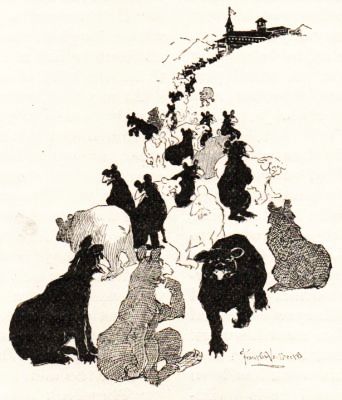
"It's part o' my business," said Sandboys. "I told you once before about how the bears come down from the mountains in winter and sleep here in the hotel rooms, an' lead a reg'lar hotel life among 'emselves, until the snow melts, when we have to drive 'em out. They climb in the windows of the cupola generally, burrowin' down to it through the snow, an' divide up the best rooms in the house, an' enjoy life out o' the wind an' storm, snug 's bugs in rugs. Last June there must ha' been a hundred of 'em here when I got here, an' one by one I got rid of 'em. Some I smoked out; some I deceived, gettin' 'em to chase me out through the winders, an' then doublin' back on my tracks an lockin' 'em out. Others I gets rid of in other ways; but it's pretty hard work, an' when night comes I'm generally pretty well tired out.
"By actual tally this June I shood a hundred an' three bears off into the mountains. When the hundred an' third was gone I searched the house from top to bottom to see if there was any more to be got rid of; every blessed one of the five hundred rooms I went through, and not a bear was left that I could see. I tell you, I was glad, because there was a partickerlarly ugly run of 'em this year, an' they gave me a pile o' trouble. They hadn't found much to eat in the hotel, an' they was disapp'inted an' cross. As a matter of fact, the only things they found in the place they could eat was three sofy cushions an' the hotel register, which don't make a very hearty meal for a hundred an' three bears.
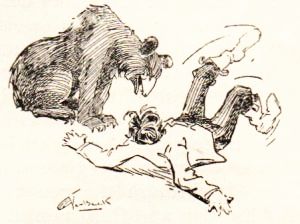
"All this time I was sufferin' like hooky with bad spasms of whoopin'-cough, an' that made my work all the harder. So, as you can guess, when I found there warn't another bear left in the house, I just threw myself down anywhere and slept. My! how I slept! I don't suppose anything ever slept the way I did. And then what do you suppose happened? As I was a-lyin' there unconscious, a great big black hungry bruin that had been hidin' in the bread-oven in the bake-kitchen, where I didn't think of lookin' for him, came saunterin' up, lickin' his chops with delight at the idee of havin' me raw for his dinner. I lay on, unconscious of my danger, until he got right up close, an' then I waked up, an' openin' my eyes, saw this great black savage thing gloatin' over me. He was sniffin' my bang when I caught sight of him."
"Mercy!" cried Bob.
"There was no use o' askin' for mercy from him," retorted Sandboys, with a convincing shake of his head. "He was too hungry to think o' bein' merciful."
"'Oh lor!' says I, as I gave myself up for lost. 'This here's the end o' me;' at which the bear looked me straight in the eye, licked his chops again, an' was just about to take a nibble, when, 'whoop'! I had a spasm of whoopin'. Well, I guess you boys knows what that means. There ain't nothin' more uncanny, more terrifyin', in the whole run o' human noises than the whoop o' the whoopin'-cough. At the first whoop the bear jumped back ten feet. At the second he put for the door; but stopped and looked around, hopin' he was mistaken, when I whooped a third time; and the third did the business. That third whoop would ha' scared Indians. It was awful. It was like a tornady runnin' through a fog-horn; an' when he heard that, Mr. Bear started on a scoot up those hills that must have taken him ten miles before I quit coughin'.
"An' that's why I says that when you've got to shoo bears for a livin', an attack o' whoopin'-cough ain't the worst thing in the world to have when you can use it. Anyhow, it saved my life from the last bear of the season, an' I'm thankful to it."
Which Bob and Jack thought it was no less than proper that Sandboys should be; but they didn't tell him so, for at that moment he was summoned to find number 433's left boot, which the bootblack had left at number 334's door, by some odd mistake.
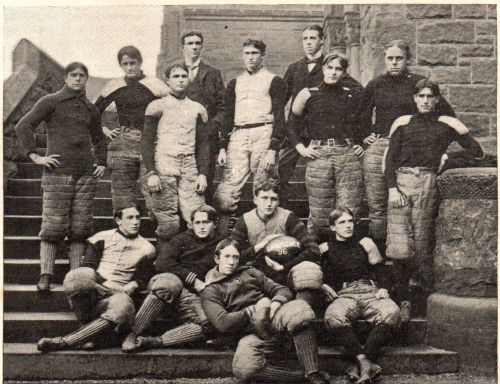
Lawrenceville has never started the year with so few old football men back again in school. Nine of last year's players have not returned. Among those who are on hand are Cadwalader and Richards, the guards. Richards has been out for practice only about two weeks, but he is rapidly getting into his old form. Mattis, who was disabled at full-back last year, came out early, and was appointed temporary captain; but he has now been forced to give up playing, owing to an injury to his knee, and Richards has been appointed permanent captain. Righter, who was elected to the office at the close of the season last fall, did not return to school, and is now at Amherst College.
THE LAWRENCEVILLE FOOTBALL TEAM.
Compared with those of former years, the rush-line will be light, averaging, perhaps, between 157 and 160 pounds. Cadwalader is the heaviest man on the team. Ross, Pinkerton, and Dana have been tried at centre, and the last-named appears at present to be capable of the best work in that position, although he lacks experience. Cadwalader and Richards will of course be worth more than they were last year, both men being extremely valuable as ground-gainers. For tackles, S. Dodds and James are the leading candidates. Dodds played on the second team last fall, and should become a strong player under coaching this year. James may be looked upon as fairly sure of making his position.
As to the rest of the team, there is considerable uncertainty. At present Little and Dudley are playing at the ends, and are as good as four other candidates for those positions. C. Dodds, who was substitute full-back last year, might be developed into a good end rusher, but he is now being played at full-back and right half-back. At quarter Arrott, who pitched for the nine last year, has been doing fairly good work, but it seems probable that he will be superseded by De Saulles, a brother of the '94 quarter-back now at Yale. De Saulles is quick, a sure tackler, and, with experience and maturity, will doubtless become the equal of his brother.
There is a large number of candidates for the half-back positions—Willing, Wells, Kafer, Adams, and McCord. The latter two may eventually get the positions, while Kafer, a brother of last year's full-back, and C. Dodds may be held for the full-back positions.
Much good material will doubtless be developed, however, by the various house teams, which are practising daily, and some men may be taken from them for the first eleven. The games of importance played so far have been against the Princeton scrub twice, Lawrenceville losing, 18-6 and 18-0. It should be remembered, however, that this scrub team scores almost daily on the Princeton 'varsity. Lawrenceville has defeated the New Jersey A.C., 8-4, and St. Paul's, Garden City, 28-0. The St. Paul's team is considerably heavier than that of Lawrenceville, but they have not so far developed the team-work which is such a strong feature of the Jersey-men's game. Their men start very quickly, and their half-backs are real sprinters, but they are not sufficiently shielded by interference, and when they came in contact with the Lawrenceville men they were unable to make such gains as they did against Berkeley, whom they defeated 50-0.
A few weeks ago this Department had occasion to comment upon certain unsportsmanlike features of athletics in Wisconsin, and called particular attention to the fact that the Madison High-School had at one time allowed certain members of the University of Wisconsin to play upon its football team. It was also said at that time that the Madison High-School was "a great boaster of championships." The latter phrase seems to have given greater offence to the athletes at Madison H.-S. than anything else, for the Department is in receipt of a letter from the captain of the M.H.-S. football team, in which he admits that "we had on our last year's team two players who were taking studies at the U. of W.," but, he adds, "we never boast."
It is to be regretted that the Madisonians should have misunderstood the sense in which the word "boast" was used in this Department. We never had any intention of citing them as vainglorious. Those students at Madison who have read, or are now reading, Homer will find the expression "to boast" very frequently used by the old Greeks, and always in a good and proper sense. If they will look in the Century Dictionary they will find, among a number of definitions, the following: "Boast (II., 2.): to glory or exult in possessing; have as a source of pride." It was in the sense that Madison H.-S. had many championships as a source of pride that they were spoken of in this Department as boasters of championships. In the same sense we may very justly call Andover a boaster of championships. Lawrenceville School is a boaster of championships; the Oakland High-School, in California, is a boaster of a great many championships; the Berkeley School in this city is a boaster of championships; so, likewise, is the English High-School in Boston. There is nothing in these statements for any schools to take offence at.
Concerning the two players of the Madison High-School team last year who were members of the University of Wisconsin while they played as school-boys on the school team, the captain of the Madison High-School gives a frank and detailed statement of their connection both with the school and with the University. He adds: "True it is they were members of the U. of W., but they were only there on condition, and, on the other hand, were full-fledged members of our school until their graduation day. They were the only ones in the history of our teams that were members of both schools at the same time. You can judge for yourself whether or not we were justified in playing both of these men."
Any one with the slightest conception of the ethics of sport will be able to judge of this question at once, and will unfailingly decide that the Madison High-School was certainly not justified in any way whatever in playing these two men. Just as soon as these students were enrolled as members of the University, no matter if they only took fifteen minutes' instruction a year at the University, they were disqualified from having any connection whatsoever with High-School athletics.
In an affair of this kind there can be no half-way conditions. If you allow such men as these on school football teams, what is to prevent University students from taking one hour a week at the High-School in order that they may play football on the High-School team? The latter would be just as much a student of the High-School as the two men who have caused Madison's athletics to suffer charges of unsportsmanship.
I feel sure that a little thought on this subject will convince the captain of the Madison High-School football team, and all the members of his school, that what I say is perfectly just. He has asked me to correct the statement made in the same issue that "the Madison High-School football team has never been defeated." I do so at once. It has been defeated. I ought to have known at the time, from experience, better than to write any such sentence as that.
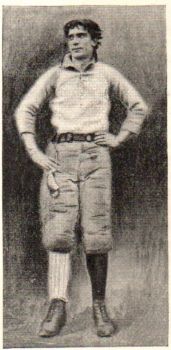
J. S. BUSH, HARTFORD HIGH-SCHOOL. Half-back.
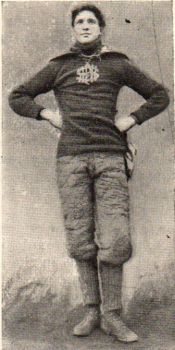
K. A. STRONG, HARTFORD HIGH-SCHOOL. Half-back.
The New Britain High-School football team, which has made such a good record so far this year, is going to make a strong bid for the championship of the Connecticut League. I am writing this just before the important game with Hartford, which will have been played by the time this week's Round Table is published; but even if New Britain suffers defeat at the hands of Hartford, I feel sure that it will not be without putting up a strong fight.
Towers, at centre, is aggressive on the attack, but weak in defensive work, and does not get into the interference. Corbin, right guard, on the other hand, gets into the interference well, but is a weak tackler. Alling, on the other side of centre, is a sharp, aggressive player. Flannery and McDonough are both old players, and are the best two men in the line, invariably making their distance when the ball is given to them. Porter, at end, is one of the best players in that position in the Connecticut High-School League. He is very fast in getting down the field, and breaks through the interference cleverly. Griswold, at the other end, is a good tackler, but in other respects his playing is only fair.
Captain Meehan, quarter-back, runs his men with good judgment, is a good tackler, passes well as a rule, but occasionally makes costly fumbles. Brinley, at half-back, is a green player, but a fast runner, and will do very much better as soon as he learns to follow his interference. Fitch, the other half-back, has this same fault, and is not much of a tackler, but he seems to have the knack of making gains around the end. O'Donnell, at full-back, is a fair punter, a good line-backer, and a good tackler. He is beyond doubt the best player on the team, and plays as well as many a college man in the same position. Take it all in all, the New Britain team has a strong heavy line, but the half-backs run too high, and do not pay enough attention to following their interference, and the whole aggregation is too careless at tackling.
The star player among the Chicago High-Schools is beyond any doubt Teetzel, of the Englewood High-School, whose portrait we published in this Department last week. It is deeply to be deplored that any charges of professionalism should have been brought against him, and it seems that these should either be proved at once or entirely withdrawn and hushed. In the recent game between Englewood and Lake View, Teetzel proved himself a giant. At the outset it looked for a time as if Lake View were going to have the best of the argument; they forced the ball rapidly down the field and scored. But Englewood took a sharp brace at this point, and had everything their own way for the rest of the afternoon, winning, 28-6.
There have been a number of squabbles among the High-School teams of Chicago, and most of the disputes seem from this distance to be of a most childish nature. The true reason for all the trouble appears to be a fear of defeat, which evidences, on the other hand, an unhealthy desire for victory that bodes no good to the welfare of sport in that section. I am glad to learn that the Board of Managers at the recent League meeting decided that English High and North Division must play out their game which was scheduled for two weeks ago but was not played.
All of the Games played in the Cook County League on October 22 were won by large scores. North Division defeated Northwest Division, 48-0, but the latter team was so poor that the game was devoid of interest. Johnson made several splendid runs, one for 100 yards and another for 90 yards, both resulting in touch-downs. Friedlander showed himself as expert, as ever as an end, although he did not have many chances. Manual lost to Hyde Park, 42-0. Hyde Park's team-work was excellent, and the best individual play was done by Ford, a new man at end. The other games, of the day, at least those that were not forfeited, developed no good men, and displayed little of interest to football enthusiasts.
Contrary to expectations, Shady Side Academy and Kiskiminetas, of the Pittsburg Interscholastic League played their first game on October 24, and the latter won by the large score of 20-0. To be sure, Shady Side was handicapped by the loss of Beeman, who was unable to play, and who is usually one of the strongest ground-gainers of the eleven; and Arundell, their full-back, ought never to have gone on the field, while Dravo was in about as equally poor condition.
From the start the play was mostly in S.S.A.'s territory, and a very few moments after the ball was started Kiskiminetas had scored a touch-down and kicked a goal. Shady Side made a desperate effort to stop the game of their opponents, but the Saltsburgh men were a heavier lot, and sent their interference around Humbird's end for continual gains. Their system of interference was excellent, and Shady Side found it almost impossible to break into it. Thus before the end of the first half the home team had scored two touch-downs, kicking both goals.
In the second half, although S.S.A. worked hard, Kiskiminetas gained gradually and pushed the ball slowly down the field, until McColl scored another touch-down. The Pittsburg half-backs, even when they had the ball, were apparently unable to advance it very far, Geer not being hardened to the game yet, and Dravo, as already mentioned, being in poor condition. The line also did not hold together as it should, and Kelso, the Kiskiminetas right tackle, went through it frequently for good gains. Toward the end of the second half, however, Shady Side made a desperate stand and held their opponents well.
The Kiskiminetas eleven is unusually strong this year, averaging over 150 pounds. Montgomery is a wonderfully good end rusher, and prevented any runs being made through his territory by breaking up the interference every time and downing the runner. Kelso is a splendid ground-gainer, and dashed seemingly at will through the Shady Side line. McConnell did good work for the Pittsburg team, and by his fine tackling prevented Kiskiminetas from scoring on more than one occasion. The playing of Kirke, S.S.A., was one of the features of the game; he repeatedly broke up the magnificent interference of the opposing eleven, and worked hard from start to finish.
In the second half G. McConnell was put in at full-back, and it is to be regretted that he is not heavier, for he has the making of a good player. When he has put on a few more pounds he will make a good running full-back or a plunging half. He is especially good at starting quickly. The next game between these two elevens will be played on the Shady Side Academy grounds, November 16, and should be very interesting, for between now and then the Shady Side team ought to be able to develop some team-work, in which at present they are slightly deficient.
Harry Logan, Pine Grove, Pa.—Yes.
Albert Currier, Iowa City.—Rule 9 of the Football Rules of 1896 states that "A goal consists in kicking the ball in any way, except by a punt, from the field of play over the cross-bar of the opponents' goal." For greater detail see Lewis's Primer of College Football (Harper and Brothers, 75 cents).
"TRACK ATHLETICS IN DETAIL."—Illustrated.—8vo, Cloth, Ornamental, $1.25.
The Graduate.
A School of Squid.
I spent seven weeks of my vacation in Searsport, Maine. One day my father proposed to go fishing in the bay. We got a boat and rowed to a spot noted for cunners. Soon my father began to pull in his line. I followed his example. When the supposed fish reached the surface we found they were not fish, but squid. They threw water upon us, and threw out a poisonous inklike substance, which luckily did not hit us.
We did not take the squid into the boat, but let them drag over the stern as we rowed ashore. We looked over the side of the boat, and away down in the water we could see a large school of them. They rose to about four feet from the surface. One of them grasped the largest of the prisoners and endeavored to pull him away. The line proved too strong, and he gave up the task.
It is very interesting to watch squid swim. When swimming forward, the ten arms are laid in such a position as to form a point. The caudal fin is now its propeller. When swimming backwards the caudal fin is carefully folded over the body. Water is then forced through the siphon, which sends the body backward. The squid's head is so joined to the body that it appears like a pivot. The body is covered with black specks, which are little sacs of pigment that expand and contract. The general color is white.
William J. Putnam, R.T.K. Dorchester, Mass.
LAUGHING BABIES
are loved by everybody. Those raised on the Gail Borden Eagle Brand Condensed Milk are comparatively free from sickness. Infant Health is a valuable pamphlet for mothers. Send your address for a copy to the New York Condensed Milk Co., N. Y.—[Adv.]