BUILDING A STATUE.
Reading edition
Modelling the clay for a statue is one of the most fascinating, interesting, and, at the same time, instructive sights. From the moment the preliminary frame-work is constructed to the final delicate finishing-touches of the sculptor, the work progresses through many stages. It is seldom that we think of the time and labor spent on such works of art.
The sculptor who undertakes a commission to model, let us say, an equestrian statue of colossal size, to be erected in commemoration of some great General, finds a long task before him. In the first place, he reads up the General's life, obtains all the information possible of his characteristics, habits, etc. Then he procures all the photographs of him that he can, and after careful study of them he works up a number of pencil sketches, until he strikes a typical pose that he hopes will be satisfactory. Then comes the production of the miniature model. This he deftly works into shape with clay or wax. Oftentimes these small models are carried to a nearly perfected stage, and it is in these that the genius of the sculptor asserts itself.
From the lump of clay which his fingers have flattened, trimmed, rounded off, the little model issues forth as a nucleus, from which its gigantic brother is to come. With the proportions laid out in the small one, the sculptor sketches his iron frame-work for the full-size model. On a platform of heavy beams he constructs this frame-work, which, when complete, has an anatomical look about it; but it would be a difficult matter to find in the seemingly crazy arrangement of twisted iron and the wire ropes, with blocks of wood tied on them, anything resembling anatomy.
The skeleton frame has to be exceedingly strong; for should any part give way later with the weight of the damp clay, it would doubtless involve the beginning of the work all over again. With the frame complete and tested as to its strength, the clay is built up around it, careful attention being given to each minute detail, especially to the anatomical ones. From the beginning, in the use of the clay, it is essential to keep it damp, and all through the construction water is applied through a hose-pipe with a sprinkler attached. This wetting-down is extremely important, for should the clay get dry, it would crumble like dirt, or crack, thus ruining the work.
The figure of the General is modelled nude, and brought to a high finish. A live model is employed for the purpose, and he poses astride a dummy horse in the position the sketch and miniature model call for. After the figure is finished, even to the curve of each muscle, equipments are put on the dummy horse, and the model dresses himself in the General's costume and again takes the pose. The sculptor then proceeds to dress the General and his horse. With his many different tools he slowly shapes the clothing in the new clay that he has ruthlessly slapped on the exquisite modelling underneath. Bit by bit the various garments assume form and develop under the ready hand of the master, every little fold or crease being carefully worked up. The likeness is the most important part, however, and great attention is paid to the face. In this it is necessary to combine so many things besides likeness that the task is at times almost discouraging.
Months have been required to accomplish the work, and all through it the sculptor has been studying the history of his subject, reviewing his results, altering them to suit his tastes, until finally he lays down his tools and calls his work finished. Plaster casts are then taken of the model, and from these the bronze casting is made.
If a marble statue is ordered, the sculptor sometimes prefers to model on a small scale and then to put his model in the hands of skilful cutters in marble, who carry the work as far as they can judiciously, when it is again taken up by the sculptor, who finishes it, putting in the lines that proclaim his genius and commend it to the world as a work of art. When this is done, the small original model must be finished up to the highest point of the sculptor's ability. Usually, the first modelling is done in the clay, life size, as this allows of alterations that may suggest themselves during the advancement of the work.
Hubert Earl.
Any questions in regard to photograph matters will be willingly answered by the Editor of this column, and we should be glad to hear from any of our club who can make helpful suggestions.
HOW TO MAKE "DOUBLES."
A photographic operation which gives a great deal of amusement is the making of "doubles." A double photograph is one in which the same person is represented twice, both portraits being taken on the same plate. Doubles are made in the ordinary camera, the only apparatus needed being some device by which either part of the lens or part of the plate-holder is covered. This being done, the person to be photographed takes his position before the camera, half the plate is exposed, and the shutter closed. The subject then changes his position to the opposite side, and the other half of the plate is exposed. When the picture is developed it will look as if made by one exposure.
One way of making doubles is to have a box which will fit the front of the camera so that it will project about three inches beyond the front of the lens. A double door opening exactly in the middle of the box should be fitted to the front of the box. The doors should meet in a close straight line, so that when closed there will not be any danger of light getting into the camera before the plate is exposed. Care must be taken that the doors meet on a line exactly in the middle of the lens, so that when either door is opened only half the lens will be in operation.
Another and simpler way is to cut a plate-holder slide exactly in half, arrange the camera, close the shutter, put in the plate-holder, take out the slide, and slip the half-slide in its place. Make the exposure, take out the half-slide and put in the plate slide, pose the subject for the other half of the picture, and take out the slide and put the half-slide in the holder over the part which has already been exposed.
In arranging for the picture it is more convenient to fix on some line or small object which shall come in the centre of the plate when the exposure is made. The subject to be photographed should stand at least nine or ten inches one side of this central point, for if the drapery of the dress overlaps, the picture will show a blur.
In making the exposure great care must be taken not to move the camera, as if it is moved even the very least bit, a blurred line will appear in the picture showing just where the two exposures join. The focus must not be changed unless a plain background is used. In making the exposures for the two pictures the time of both must be equal. This is more necessary for an exposure made out-of-doors than for one made in the house. If the exposures are unequal in time the negative will be unequal in development, and, as a consequence, half of it will be lighter than the other.
Many interesting and amusing pictures may be made by the means of double photographing. A person may be taken playing checkers or chess with himself, reading to himself, taking his own picture, offering himself something to eat, etc. An amusing picture might be made of a person begging of himself, the first picture being taken in his ordinary walking dress, and the second dressed in ragged clothes and holding out his hat for alms.
AT WAR WITH HIMSELF.
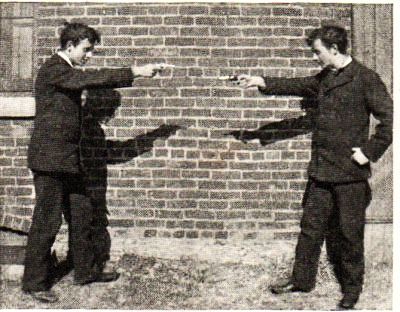
In the accompanying picture the subject is fighting a duel with himself.
Sir Knight Frederick Clapp sends a print, and asks the reason of the spots on the negative from which it is made, and when the next photographic competition is to be conducted. The spots on the negatives which make the print imperfect are caused either by bits of film or dirt in the developer settling on the film, or by air-bubbles forming on the surface of the plate when it is covered with the developer. In either case the developer is prevented from acting on the film, and causes spots which have the effect of halation. Small round holes in the negatives are caused by dust on the plate. The time of the photographic contest has not yet been decided. It will be announced in this column as soon as arrangements are completed.
Sir Knight Calvin Farrar sends a print of the interior of the log cabin built for the recent celebration in Cleveland. Please accept thanks for same.
Sir Knight Richard C. Lord asks for a formula for developer for snap-shots and for time exposures. See answer to Sir Charles Lusenkamp for formula in No. 886. The J. C. tabloids make a fine developer for instantaneous exposures.
"Quad," Pittsburg, Pa., sends a print from a film, and asks what gives it its mottled appearance. As far as one can judge from the blue print, the mottling is due to imperfect fixing, or the film was left too long in the developer without rocking. There is no remedy for the film.
Sir Knight E. D. Ball, Spartansburg, S. C., sends a print, and wishes to know what is the reason of the yellowish-brown color. The trouble is in the toning-bath. Test it with blue litmus-paper. If it turns the litmus-paper red, add enough bicarbonate of soda, a little at a time, until it turns the red color back to blue. Use the bicarbonate of soda in solution.
Edward Bragton, 87 West Thirty-second Street, Bayonne, N. J.; Rachel Kelsey, Baraboo, Wis.; William T. Kelsey, Baraboo, Wis.; J. L. Goodman, 807 Broderick Street, San Francisco, Cal.; H. T. Cooper, 2416 Harriet Avenue, Minneapolis, Minn.; E. Lester Crocker, Tarrytown-on-Hudson, N. Y.; John H. Chamberlain, 6 Franklin Avenue, Dayton, O.; Arthur P. Lazarus, 756 South Hope Street, Los Angeles, Cal.; Fred. W. Long, 416 West Adams Street, Muncie, Ind.; Fred. D. Rose, 405 South High Street, Muncie, Ind.; Harry R. Patty, 2533 Michigan Avenue, Los Angeles, Cal.; Wm. H. White, Jun., Pembroke Avenue, Norfolk, Va.; George E. Holt, Moline, Ill., wish to become members of the Camera Club.
Lady Lesley Ashburner, Media, Pa., would like to correspond with members of the Camera Club. Lady Lesley asks for directions for making enlargements, as she did not find it in No. 801, as directed; also how to make ferro-prussiate paper. Look again at No. 801. The article is entitled "Bromide Enlargements." Directions for making ferro-prussiate paper may be found in Nos. 797, 823, and 828.