HAROLD WHITE'S PERIL.
Reading edition
BY G. T. FERRIS.
"I tell you, Captain Heald, this is an awful responsibility you're shouldering. Not one, but two hundred lives hang on it. General Hull could never have meant his orders to be absolute. At such times something must be left to the commanding officer. He must know better than a superior two hundred miles away."
The swarthy brows of Kinzie, the Indian trader, who knew redskin nature better than any other man at Fort Dearborn, were puckered with anger and contempt. It was the hour for a quick-witted and resolute soldier, not for a timid martinet, the slave of the letter and not of the spirit of his orders. The commander of that little garrison of fifty, many of whom were non-effectives, was "a round peg in a square hole"—and a hole, too, that yawned big and deep for human life.
"You're not a military man," was the peevish answer. "My business is to obey orders and not reason on them. The General has determined to withdraw all garrisons from outlying posts, and I must do my duty at any risk."
"At risk to yourself, yes! but not to helpless women and children and a lot of sick soldiers not able to pull a trigger or stagger five miles in a broiling sun," John Kinzie retorted, quickly. And pointing through the gate of the palisade, he continued: "Look at those savages on the beach watching like vultures. A thousand lie within call of a war-whoop. How many scalps would remain at the end of an hour if you put yourself in their hands? D'ye think Black Partridge would have said those words last night if there had been a ray of hope?[1] You have ample stores and ammunition, and can hold out for a month or more behind these timber walls. Anything else is madness. As for me," said the trader, with an air of noble pride, "the danger is less. So I don't speak for myself or mine. I have dealt with every tribe for two hundred miles about. I have never tricked a savage in trade. They have eaten of my dish and drunk of my cup, and found shelter under my roof. My wife has been a guardian angel to their sick and needy. But be sure of one thing: friendship for the Kinzies will never save the life of any other pale-face at the hands of a redskin."
"Mr. Kinzie must decide for himself whether he will accompany the troops or not if he is so sure of his Indian friends," said the Captain, stung by the words of the other. "We march at nine to-morrow morning," and he turned on his heel into the parade-ground. As he passed through the groups of settlers who had sought shelter in the fort, and noticed the look of foreboding stamped on every face, he was almost inclined to change his purpose, though the soldiers were even then dismantling the arsenal and knocking in the heads of the spirit-barrels.
John Kinzie walked rapidly to the head of a sand knoll which gave him a wide view of the scene. Groups of dark figures were scattered over the shining beach as if they were statues of copper, or they waded in the ripples of the beautiful blue lake, throwing water at one another with loud laughter. One could scarcely have fancied that close to the edge of this sportive mood the spirit of murder hid in ambush with cocked rifle and sharp hatchet. A mile away lay the Indian camp, which had grown five times bigger within as many days, like an assemblage of huge ant-hills, with the ants thickly swarming about. But it must be time for Harold White to return, and he passed to the rear of the palisades, where the men, rolling the casks through the underground sally-port, were emptying the powder and whiskey into the river. Just across the stream opposite the fort, set in the midst of green trees and fields, were his home and warehouses. He had sent his young clerk, a lad of fifteen, with a message to Mrs. Kinzie, for he had preferred to have his family stay in their own house till the last moment.
"Did ye ever hear tell of such a 'fool' business as this, Bill?" he heard one soldier say to another, shaking his fist in the direction of the fort. "I guess mighty few of us will hev as much hair on our heads this time to-morrer."
"I don't keer for myself," said the other, gloomily; "a soldier's got to buck agin the wuss thing as comes without sayin' a word. But I'm a-thinkin' of the old 'oman and the little gals."
Mr. Kinzie saw the canoe shoot from under a clump of bushes and skim swiftly across the narrow river, to-day a black and unattractive body of muddy water, but at that time a pellucid stream where fish leaped to the angler's bait.
"To-pee-nee-be's messenger has come," said Harold, "and brings word that the two big canoes will cross to-night from St. Joseph to take off the family at sunrise."
"Thank God!" cried the trader, fervently, for sure as he felt for himself of the comparatively friendly feeling of the savage horde gathered there, he knew Indian nature too well to trust it when mad with the thirst for blood-shed. The chief of the St. Joseph band had a few days before warned him of treachery, and offered to convey his wife and children across the lake to his own village. "Harold, you must stay with Mrs. Kinzie in the canoes," said he. "I shall march with the troops, and do what I can. Perhaps I may have some influence till if comes to the worst. I depend on you. I know what your wish is, but you must forego it now. You've had your taste of Indians already. Remember, you only escaped by the skin of your teeth last spring."
"Yes," was Harold's reply; "and I shall never be happy till I've—" He bit the words off short, but the boy's smooth face was a man's in its stamp of passion and resolve, for the frontier lads often got old in will and courage before their chins grew beards. Some of the legends of boys' doings in the annals of Indian warfare are as stirring as the stories of Homer's heroes. Harold had had righteous cause for his feelings. Four mouths before, on a bright spring day, a score of Pottawattomies had entered the house of his uncle, about two miles up the river from the fort, and asked for food. Their tongues were friendly, but their eyes sullen.
"Harold," said his uncle Lee, "go over the river with Beaubien and feed the horses," but his look said, "Paddle as fast as you can to the fort for help." The Frenchman and he had scarcely gotten well into the stream before there came the spit of bullets, and then came a continuous crackle, with the shrieking of women and children, and then silence. Harold, left friendless, found a protector in Mr. Kinzie; but his heart flamed always hot with that memory. The Kinzie family would be as safe without him, and he was swept by his rash fancies as if his will were a soap-bubble.
The sun hung in the sky, on the fatal August morning, a burnished copper ball. Scarcely a breath heaved the dark surface of the lake, and no laughter of light danced in the sparkle of a crest. A pallor lay on the sandy levels and ridges of the beach similar to the upturned face of some one dead. Nature had set the stage for the tragedy of man. The little column left the fort at nine o'clock, a small company of friendly Indians in the van, then the caravan of transport wagons, loaded with rations and with women, children, and sick soldiers, then a few armed settlers, then a meagre uniformed platoon of less than two-score fighting-men. A double column of Pottawattomies formed on either side. As they began to move, the soldiers presented arms to the flag fluttering down from its staff. They might have spoken the words of the gladiators when they trooped into the arena in olden time, "Ave, Cæsar! morituri te salutamus" (Hail, Cæsar! we, the death-doomed, salute you). It is even a historical fact that the band played the Dead March when that funeral procession tramped out on the road of destiny between walls of living bronze.
Harold, armed with a double-barrelled rifle, had hidden behind a big sand knoll near the gate. When John Kinzie helped his family into their frail barks of safety he had marked the absence of the lad, but there was no time to think further or search, for there was much business afoot. Harold saw his guardian now expostulating with Indian chiefs, now urging some special course on Captain Heald, who marched with his detachment, now encouraging the trembling women in the wagons. And so the column wended its slow course over the burning sand away from the fort.
Suddenly came other sounds than the distant drone of trumpet and tuba. Surely that was gun-firing. There could be no mistake, indeed, for punctuating the muffled roar was heard the long-drawn "wow-wow-wow" of the whooping savages. The hour had come. A mile and a half from the fort, where now stands a memorial tablet under an old cottonwood-tree in the thick of the princeliest residences of a great city, the cloud had burst. From behind the sand ridge which divided the prairie from the beach five hundred warriors had sprung suddenly to their feet, like arrows drawn to the head, and poured in a hail-storm of bullets, to which the treacherous escort added their quota. Harold had stood for some time spellbound by his own thoughts and fears, but the trance was now broken. He ran hot-foot toward the scene of the struggle. Each step brought the sights and sounds of the massacre clearer. Shrieks, yells, the rumble of the firing, dark forms leaping like madmen with uplifted arms, or bending like wild-beasts over objects on the sand. It was a tumult of horror beyond words. After a little the confusion lessened, and there was a pause, followed by the howl of triumph which is the Indian's pæan of victory. Harold, primped out by his wild run, had hidden behind a sand hill for breath, within a stone's-throw of the scene, for the savages, absorbed in their work of death, had not noticed his advancing figure. One wagon, from which now came the wail of a sick child, had escaped their fierce handiwork, and three warriors with bare tomahawks bounded toward it. The boy, taking steady aim, discharged both barrels of his rifle, and one of the red men fell. Every nerve tense with excitement, Harold sprang forward with his clubbed gun, and, catching a tomahawk cut on the barrel, dashed the butt into the head of the nearest savage. As the latter fell with closing eyes, it was with a thrill of satisfaction, strangely blended with awe, as if some higher power had struck by his hand, that the boy recognized the face of the leader of the savages who had slain his uncle and his family. The next moment he was half throttled by a clutch about his throat.
"Boy my prisoner; make no noise," he heard as the iron grip loosened. It was the voice of Black Partridge, who, an unwilling actor in the tragedy, had by his craft, as afterwards turned out, saved several lives on this occasion. Mr. Kinzie, Captain Heald, and another officer, with their wives and a few others, had escaped the slaughter, and were captives. As for the rest, their mutilated bodies lay dead on the sands down to the very water's brink, where their road had been.
"Perhaps not able to save Harold, for boy kill warriors," continued the friendly chief. "Better crawl through grass like Indian back to fort, and hide in cellar till dark; then swim cross to Kinzie's." So he led his charge to the edge of the rank prairie-grass with, "See Black Partridge bym-by."
Bending in his covert, Harold retreated stealthily as a coyote to the empty fort. As he passed through the gate into the dismal solitude, with all its suggestions of recent life and cheer, his heart quivered afresh with the sense of what it all meant. He knew the subterranean secrets of the fort well; and knew, too, that some of the Indians were likely to stray back at any time. Both block-houses of the post had deep stoned cellars, from which were exits into the underground sally-port opening on the river bank. He could easily hide himself here among the rubbish and lumber, and perhaps find something to eat. He did indeed discover some scraps of bread and bacon, and, better yet, a retreat to elude the keenest eye down in that dusky cavern. As the day waxed the heat grew stifling, but there was a well in the cellar which relieved his thirst. In fumbling about the place for the pump-handle, he found several barrels apparently undisturbed. He marvelled what they could be, and by some blind instinct did not make his hiding-place here, but selected a spot protected by a mound of empty boxes close to a little timber gate which opened into the sally-port.
He heard the yells and shouts of the Indians outside and above as they roamed about everywhere, searching for the "fire-water," which they loved so well. They had indeed been doubly infuriated because the commandant had ordered the destruction of the whiskey and the powder. They fancied that some might have escaped, and were hunting for it like hounds on the scent. Harold could now and then construe an Indian word, and he thought of the barrels so near at hand. He had felt a broken candle in one of the boxes where he hid, and this he now lit from his flint and steel. As he groped his way, peering at the cellar bottom, he perceived several black trails converging toward the heap of casks. He blew out his light with a gasp, and a breath of ice stirred the roots of his hair and chilled his marrow as the truth flashed on him. Some of the soldiers had left full powder-barrels and a train to destroy the careless savages, if possible, should they go down with lighted candle or torch. Harold crawled back to his ambush, and tugged with all his might at the little timber gate; but the bolts were rusty with damp and disuse.
While he struggled he heard the outcries of the Indians nearer and nearer, and their thick tongues showed they had already found whiskey, a beginning which promised the ransacking of every rat-hole in the fort for more. With the strength of despair he struggled with the obstinate bolts, and, just as they began to creak a little in their rusty sockets, a dozen savages, doubly intoxicated with liquor and with the slaughter of the inhabitants of the fort, tumbled down the stone stairs at the other end of the cellar. With candles flaming in their hands, with faces and bodies hideously painted, and with eyes glowing in the flare of the lights like live coals, they looked like nothing less than the demons which Harold remembered to have seen in some of the Bible picture-books of that period.
HAROLD'S ESCAPE INTO THE TUNNEL.
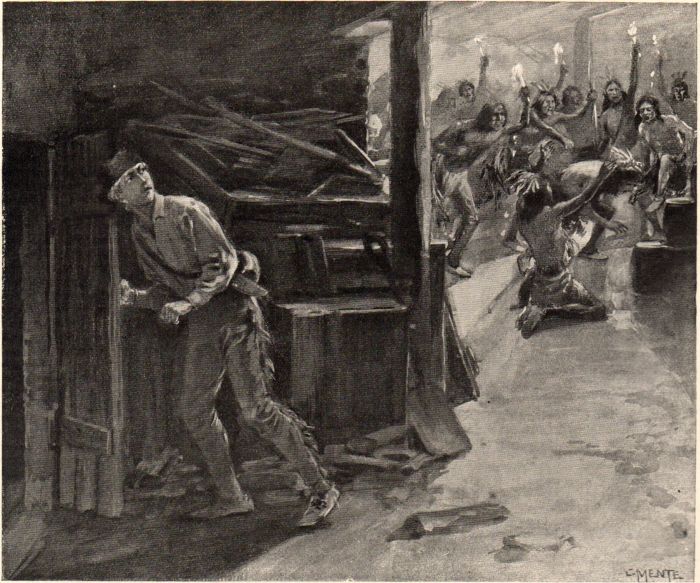
The boy's only thought now was to force the gate, escape into the tunnel, and close the mouth again behind him. That was his one chance of escape. The maddened red-skins, their eyes glittering in the weird light, waving their glittering candles from which smoulders of burnt wick were dropping, chanting some sort of exultant song, ran about the cellar as if they were the figures of a monstrous nightmare. Their eyes at last fell on the pyramid of barrels, and they darted at the expected treasure-trove. Harold had never ceased tugging frantically at the gate, and when the bolts jangled back and he slid the barrier, it seemed his dangerous companions must have heard. Luckily the blissful thought of "fire-water" made them blind and deaf to all else. He passed the portal, softly closed it again, and sped with whirling senses up the dark passage. But the strain had been too great, and he collapsed in a dead faint, with a crash in his ears as if the earth had been shattered to its core.
When Harold recovered his senses a disk of light in front marked the outlet to sunshine, but in the rear the tunnel was choked, and his legs were tangled fast in a mass of earth and débris. He extricated himself and made his way to the entrance, sore but sound of bone. One of the block-houses had been blown to fragments, and the other partly tumbled into ruins, while about fifty of the savages had been slain or terribly maimed. Groups of Indians stood in the distance sobered and awe-stricken. When he crossed to the Kinzie mansion after dark, he found the captives there under guard, but the captors altered into a merciful mood. Black Partridge had improved the occasion to impress on their minds that the awful catastrophe was a divine punishment for their treachery.