THE IMP OF THE TELEPHONE.
Reading edition
BY JOHN KENDRICK BANGS.
II.—IN THE IMP'S ROOM.
"Dear me!" ejaculated Jimmieboy, as his eye first rested upon the Imp. "That's you, eh?"
"I believe so," replied the Imp, standing on his left leg, and twirling around and around until Jimmieboy got dizzy looking at him. "I was me when I got up this morning, and I haven't heard of any change since. Do I look like what I told you I looked like?"
"Not exactly," said Jimmieboy. "You said you had lilac-colored hair, and it's more like a green than a lilac."
"You are just like everybody else naming your colors. People are very queer about things of that sort, I think. For instance," said the Imp, to illustrate his point, "you go walking in the garden with one of your friends, and you come to a rose-bush, and your friend says, 'Isn't that a pretty rose-bush?' 'Yes,' say you; 'very.' Then he says, 'And what a lovely lilac-bush that is over there.' 'Extremely lovely,' say you. 'Let's sit down under this raspberry-bush,' says he. Well, now you think lilac is a delicate lavender, rose a pink, and raspberry a red—eh?"
"Yes," said Jimmieboy. "That's the way they are."
"Well, maybe so; but that lilac-bush and rose-bush and raspberry-bush are all the same color, and that color is green, just like my hair; you must have thought I looked like a rainbow or a paint shop when I told you about myself?"
"No," said Jimmieboy. "I didn't think that, exactly. I thought, perhaps, you were like the pictures in my Mother Goose book. They have lots of colors to 'em, and they are not bad looking, either."
"Well, if they are not bad looking," said the Imp, with a pleased smile, "they must be very much like me. But don't you want to come in?"
"I'm not small enough," said Jimmieboy; "but I'll eat that apple you spoke about, and maybe it'll make me shrink, though I don't see how it can."
"Easy enough. Haven't you seen a boy doubled up after eating an apple? Of course you have; perhaps you were the boy. At any rate there is no reason why, if an apple can work that way, it can't work the other. It's a poor rule that won't work both ways, and an apple is pretty good, as a rule, and so you have it proved without trying that what I say is true. Here's the apple; eat it as quickly as you can and give me the core."
Jimmieboy took the dainty piece of fruit in his hand and ate it with much relish, for it was a very sweet apple, and he was fond of that sort of thing. Unfortunately, he liked it so well that he forgot to give the core to the Imp, and, when in a moment he felt himself shrinking up, and the Imp asked for the core, he was forced blushingly to confess that he had been very piggish about it, and had swallowed the whole thing.
"I've half a mind not to let you in at all!" cried the Imp, stamping his foot angrily upon the floor, so angrily that the bells rang out softly as if in remonstrance. "In fact, I don't see how I can let you in, because you have disobeyed me about that core."
"I'm surprised at you," returned Jimmieboy, slightly injured in feeling by the Imp's behavior. "I wouldn't make such a fuss about an old apple-core. If you feel as badly about it as all that, I'll run down into the kitchen and get you a whole apple—one as big as you are."
"That isn't the point at all," said the Imp. "I didn't want the core for myself at all. I wanted it for you."
"Well, I've got it," said Jimmieboy, who had now shrunk until he was no taller than the Imp himself, not more than two inches high.
"Of course you have, and if you will notice it is making you grow right back again to the size you were before. That's where the trouble comes in with those trick apples. The outside makes you shrink, and the core makes you grow. When I said I wanted the core I meant that I wanted it to keep until we had had our trip together, so that when we got back you could eat it, and return to your papa and mamma just as you were in the beginning. Just run to the parlor mirror now and watch yourself."
Jimmieboy hastened into the parlor, and climbing upon the mantel-piece gazed into the mirror, and, much to his surprise, noticed that he was growing fast. He was four inches high when he got there, and then as the minutes passed he lengthened inch by inch, until finally he found himself just as he had been before he ate the apple.
"Well, what are you going to do about it?" he asked, when he returned to the telephone.
"I don't know," said the Imp. "It's really too bad, for that's the last apple of that sort I had. The trick-apple trees only bear one apple a year, and I have been saving that one for you ever since last summer, and here, just because you were greedy, it has all gone for nothing."
"I'm very sorry, and very much ashamed," said Jimmieboy, ruefully. "It was really so awfully good, I didn't think."
"Well, it's very thoughtless of you not to think," said the Imp. "I should think you'd feel very small."
"I do!" sobbed Jimmieboy.
"Do you, really?" cried the Imp, gleefully, "Real weeny, teeny small."
"Yes," said Jimmieboy, a tear trickling down his cheek.
"Then it's all right," sang the Imp, dancing a lovely jig to show how glad he felt. "Because we are always the way we feel. If you feel sick, you are sick. If you feel good, you are good, and if you feel sorry, you are sorry, and so, don't you see, if you feel small you are small. The only point is, now, do you feel small enough to get into this room?"
"I think I do," returned Jimmieboy, brightening up considerably, because his one great desire now was not to be a big grown-up man, like his papa, who could sharpen lead-pencils, and go out of doors in snow-storms, but to visit the Imp in his own quarters. "Yes," he repeated, "I think I do feel small enough to get in there."
"You've got to know," returned the Imp. "The trouble with you, I believe, is that you think in the wrong places. This isn't a matter of thinking; it's a matter of knowing."
"Well, then, I know I'm small enough," said Jimmieboy. "The only thing is, how am I to get up there?"
"I'll fix that," replied the Imp, with a happy smile. "I'll let down the wires, and you can come up on them."
Here he began to unwind two thin green silk-covered wires that Jimmieboy had not before noticed, and which were coiled about two small spools fastened on the back of the door.
"I can't climb," said Jimmieboy, watching the operation with interest.
"Nobody asked you to," returned the Imp. "When these have reached the floor I want you to fasten them to the newel-post of the stairs."
"All right," said Jimmieboy, grasping the wires, and fastening them as he was told. "What now?"
"Now I'll send down the elevator," said the Imp, as he loosened a huge magnet from the wall, and fastening it securely upon the two wires, sent it sliding down to where Jimmieboy stood. "There," he added, as it reached the end of the wire. "Step on that; I'll turn on the electricity, and up you'll come."
"I won't fall, will I?" asked Jimmieboy, timidly.
"That depends on the way you feel," the Imp answered. "If you feel safe, you are safe. Do you feel safe?"
"Not very," said Jimmieboy, as he stepped aboard the magnetic elevator.
"AT LAST," EJACULATED THE IMP.
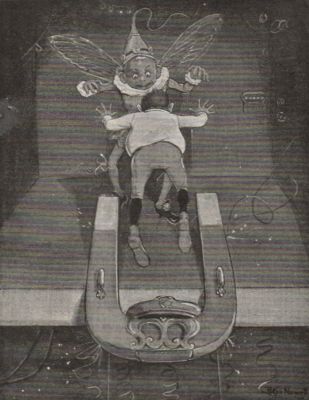
"Then we'll have to wait until you do," returned the Imp, impatiently. "It seems to me that a boy who has spent weeks and weeks and weeks jumping off plush sofas onto waxed hard-wood floors ought to be less timid than you are."
"That's true," said Jimmieboy. "I guess I feel safe."
"All aboard, then," said the Imp, pressing a small button at the back of the room.
There was a rattle and a buzz, and then the magnet began to move upward, slowly at first, and then with all the rapidity of the lightning, so that before Jimmieboy had an opportunity to change his mind about his safety he was in the Imp's room, and, much to his delight, discovered that he was small enough to walk about therein without having to stoop, and in every way comfortable.
"At last!" ejaculated the Imp, grasping his hand and giving it an affectionate squeeze. "At last you are here. And now we'll close the door, and I'll show you my treasures."
With this the door was closed, and for a moment all was dark as pitch: but only for a moment, for hardly had Jimmieboy turned around when a flood of soft light burst forth from every corner of the room, and the little visitor saw upon every side of him the most wonderful books, toys, and musical instruments he had ever seen, each and all worked by electricity, and apparently subject to the will of the Imp, who was the genius of the place.
[to be continued.]

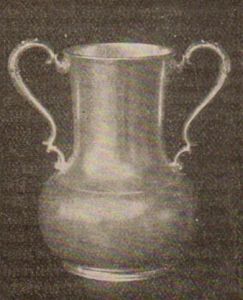
HOUSE FOOTBALL CHAMPIONSHIP CUP, LAWRENCEVILLE SCHOOL.
The game between Lawrenceville and Andover day after to-morrow will be an interesting one to watch, for both teams are in the best of condition, and have been doing remarkably good work all season. Phillips Academy will have the advantage of home grounds, but even so they will have to put up a pretty stiff game to overcome those lively players from New Jersey. Last year the first contest in football between these two schools was held at Lawrenceville on the same date that will see this season's play, and the home team was victorious to the tune of 20 to 6. The score will probably not be so large day after to-morrow, for the two elevens seem to be more evenly matched.
There was at first some trouble in getting the proper men fitted into the several open positions at Lawrenceville, but the team has been pretty well settled upon now, and the men who lined up against the Princeton Freshmen last week will in all probability represent the school in the Andover game. Eddy and Righter have improved greatly, and will remain at the ends. The former is doing a good deal of running with the bull, and ought to give Andover some trouble. Cadwalader, who played guard last year, is now at tackle. He is somewhat slow to wake up, but when once started it takes two men to hold him. Emerson is the other tackle, and he is no doubt the best man in that position of any school team this year. Church of the Princeton 'Varsity had all he could take care of when he faced Emerson in the recent game that the Tigers played against Lawrenceville. He can be counted on for making frequent holes in Andover's line, and I should not be surprised if he got through often enough to stop some of Douglass's kicks.
The heaviest man on the team is Edwards at right guard, and he is playing about the best all-around game of any man on the team. He breaks through quickly, and is also a valuable man in advancing the ball. Richards is at left guard, and, although a new man for the team this year, is learning the game rapidly, and knows his position thoroughly. He has another claim to athletic distinction in being Lawrenceville's best tennis-player. The new man at centre, Simons, has been somewhat of an experiment all along, and may prove a weak spot in an otherwise solid line. He is amenable to coaching, however, and unless something pretty serious crops up in his play, will not be displaced for the Andover game.
Quarter-back will not be so well taken care of as it was last year, for there are few players so clever as was De Saulles, who is now at Yale. Powell, now holding the position, has had some experience, however, having played quarter for two years on the Cook County Normal School Team, of Chicago. Captain Dibble has entrusted him with the important duty of giving the signals, which is properly a part of the quarter-back's duty, although it is the Captain's privilege and prerogative. Where it is possible to have the man at quarter do the signalling, it is always best for the general welfare of the team, and Powell has proved himself fairly capable of shouldering the responsibility. He is a little prone to the "rattles" at the start. This nervousness, of course, affects the play of the backs, and some minutes are lost before the team can get steadied down.
This feature of Powell's play may prove embarrassing at Andover, for there will be a cyclone of yelling as the game starts on the hill, and the P.A. forwards will do all they can to make things unpleasant for him. If this nervousness is something the man is unable to overcome at first, although he can, a few minutes later, play football with the coolest of any on the team, I should advise Captain Dibble (if he will pardon me for offering a hint not in any way intended as a suggestion as to how he should handle his team) to give the signals himself until Powell has got steadied down to work. As to Powell's good points: his passing is fair, and his tackling qualities are much above the average.
At the halves, Captain Dibble and Davis hold their places where they have now played together for three seasons. Dibble's injury to his ankle a few weeks ago will probably not affect his work at Andover, although he has been forced to keep out of practice for some weeks. He is a sprinter of great promise and considerable achievement, and his running qualities make him an invaluable man. He gets up to his place in the interference quickly, dodges excellently, and when once clear of his interference usually runs around the opposing full-back, making a sensational dash. Dibble is probably the hardest man to tackle and bring to a full stop that has ever been on a Lawrenceville eleven, and frequently, when about to be tackled low, jumps clean over the man. This is a dangerous trick, but has frequently proved successful when performed by Dibble.
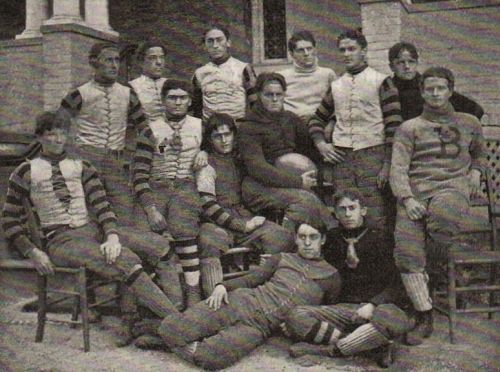
THE BERKELEY SCHOOL FOOTBALL TEAM. Photograph by Pach Brothers
The other half-back, Davis, is a strong line backer, and is one of the most reliable men on the team. Captain Kafer, of the baseball team, is now at full-back, and fills the position very creditably. His line backing is fair, and he can outpunt must of his fellows at the school. He has made several goals from the field this year.
As for the team-play in general, there is room for improvement at the present writing, but I feel sure good work along that line will be done during the last few days previous to the 14th. In the recent game with Pennington Seminary, one of Lawrenceville's oldest and greatest rivals, Lawrenceville won by 40-0, but only four points were made in the first half. During this time the school team was kept continually on the defensive. Pennington's players, of course, are much older men, and at the start-off showed superior strength. In the second half, however, the Lawrenceville players put up an exceedingly fast game, virtually using up their opponents. Pennington had the ball but once during the half. This kind of work is the best kind of proof of the excellent system of training which prevails at this New Jersey school, and which this Department has on more than one occasion commented upon.
At Andover the team-play of the eleven has been perhaps more fully developed than at Lawrenceville, and the P.A. eleven has had the advantage of playing against a set of stronger teams, as an average, than the Jersey men. The scores up to the first of the month show Andover's record, in nine games played, to be 86 points to her opponents 74, whereas last year at the same date the scores were, Andover, 184; opponents, 113, in eleven games played.
One of the best games Andover has played this season was that against her old Worcester rival, the Academy, in which P.A. came out on top by the small margin of 4-0. Throughout the match both sides played a straight, old-fashioned game, and attempted few trick plays. It was football all the way through, and upon it Andover won. The visitors found early in the game that it was practically useless to attempt to buck the Academy centre for any substantial gains, and so devoted most of their attention to close end plays, going generally just outside the tackle. The Academy ends did practically nothing in the way of tackling, and each time a gain was made it was on an end play, aided by good interference. The Academy players, on the other hand, found they could make good holes in the centre of the line, and through them made a number of gains. Occasionally they would get around the ends, but it was through brilliant individual work rather than by good interference.
The touch-down was made in the second half. Worcester had forced the ball down to Andover's 25-yard line, and there lost it on a fumble. P.A. then took a big brace, and put snap into their play. They worked the ends almost entirely, and always for at least a four-yard gain, and thus finally scored, Barker placing the ball behind the Academy goal-line, but in a bad position. A kick-out was attempted, and the ball fairly caught, but the angle was a difficult one, and Barker failed, by a narrow margin, to kick a goal. No further scoring was done by either side.
It is unfortunate that the opening of the Connecticut High-School F.B.A.'s season should have been characterized by anything but good football and a spirit of fair play, and it is still more unfortunate that sensational reports of the slight misunderstanding which occurred should have been printed broadcast in the newspapers. Both elevens played a strong game, and everything would undoubtedly have passed off to the satisfaction of all concerned if Referee Hall had been more capable than he showed himself on the field. The score was 22-12 in favor of Hartford, but a general opinion prevails in both camps that Hartford's actual winning score was 24-18.
The decision by the referee which caused the greatest dissatisfaction was one which gave Hartford twenty-five yards for alleged foul tackling by a New Britain player. This put the ball right under New Britain's goal, with only three yards for Hartford to gain—and they gained it. There is considerable doubt as to whether under even the strictest interpretation of the rules there was any foul tackling; and so the decision created a feeling of dissatisfaction and uncertainty which did not improve the manners of the players on either side. Hartford played good football, however, and deserved the victory. Their work was snappy from the beginning, and the visiting players took advantage of their superior weight to rip holes in their opponent's line. The backs seemed to tower above the New Britainites, but Luce was depended upon for most of the runs around the end. Occasionally New Britain braced and outplayed her rivals, at one time especially when Hartford had the ball within six inches of the New Britain line, and was forced to surrender it on four downs.
The National Interscholastic Athletic Association question will come up for discussion again before the New York I.S.A.A. at its meeting this afternoon, and I hope next week to be able to announce to the readers of this Department in distant cities that definite steps have at last been taken toward the formation of such an organization. I learn from various sources that the lack of enterprise in the matter thus far displayed has been due to a feeling that the scheme might prove too great for schoolboys to handle. I can't see this myself, and I feel confident the objection will not hold water when it comes to be tested. Schoolboys of to-day are just as capable of running an organization similar to the Intercollegiate Association as college men are, and the best way for them to insure success is to have confidence in themselves and go ahead. Don't proceed without first looking where you are to step; but the step having once been decided upon, go ahead, and don't be afraid of your legs!
The provision in the constitution of the Inter-Academic League of Philadelphia which restricts membership in the organization to schools located within a radius of ten miles from the city shuts out a good many institutions that take a prominent position in scholastic sport. The Hill School of Pottstown is one of these, and the Swarthmore Grammar-School is another. The latter is only about a mile beyond the prohibitory limit, and seeks most of its rivals among the schools of the League. The school is a new one, and has only been in athletics for three or four years, but the showing made in that time has been excellent. I hope the school will join other institutions in the State, and form another league that will be bound to rival the I.A.L. in importance.
The Swarthmore Grammar-School eleven this year, although light, is the best the school has ever put into the field, and in October the team earned three victories in four contests. They first defeated the Moorestown Friend's School, 30-0, and in the next game they succumbed to Penn Charter, 30-6. The Penn Charter team is the strongest of any in the I.A.L., and will no doubt secure the championship this year. The players are heavier and more experienced in the science of the game, and the showing of the Grammar-School players against them may therefore be considered creditable. Brownfield, S.G.-S. played a good game at full-back, and saved several touch-downs by his hard tackling. Smith, at half, is a new man, but is learning fast; and Waring, at left end, showed up well for a player of his weight.
The third game was played against the Haverford College Grammar-School, also a member of the I.A.L., and it proved a hot contest on the latter's field. The Haverford team was considerably heavier, but Swarthmore played hard. In the second half the ball was in Haverford territory most of the time. Once, when the ball was within four yards of their line, Brownfield tried twice for goals, but failed both times by narrow margins. The score was 6-4 in favor of the visitors, both sides scoring in the first half. Brownfield again showed himself by far the best player on the team, and he will be an acquisition to the Swarthmore College eleven when he enters next year. The fourth game was the defeat of the Abingdon Friend's School at Jenkintown by 22-0. The S.G.-S. full-back in this match kicked two goals from the field, one of them from the 35-yard line. Trainer, the left tackle, scored the first touch-down, after a run of 80 yards. There are still a number of games on the S.G.-S. schedule, and the end of the season ought to show the school as holding an enviable position in athletics.
The schools of the Long Island League are playing bettor all-around football than the New-Yorkers, and the teams seem to be more evenly matched. The championship is by no means a foregone conclusion, but will probably rest between St. Paul's and Pratt Institute. St. Paul's played a sharp game with the New York Military Academy recently. The latter was defeated by a score of 34-4. In the first half of the game it looked as though the visitors would have things all their own way until they lost the ball on a fumble. Hall, of St. Paul's, picked it up and made a long run, scoring a touch-down and goal. After that the visitors seemed to lose heart, and the Garden City players worked with a snap that soon set the score climbing. The best work of the home team was done by Gardiner, Hall, and Linn.
The Pratt Institute team opened the Long Island interscholastic season with a victory over Adelphi, and by a score that surprised even those who knew what a strong eleven the Institute had. The score was 66-0. Some of the best work was done by Higgins, Gribbon, and Kelley, Gribbon, especially, making a number of long runs and two touch-downs. He also kicked a difficult goal, as well as several easier ones. Brissel and Pratt put up a star game as end rushers. Pratt scored a touch-down inside of two minutes from the time play was called. In the second half Gribbon caught the ball at the kick-off, and ran almost the entire length of the field, scoring a touch-down. The backs were helped wonderfully by the excellent interference given by the line-men. Cranford was about the only Adelphian who did any good work, and the fumbling of the entire team was unpardonable.
C. S. M., Portland, Oregon.—There is no reason why, in playing intercollegiate football, the runner with the ball should not pass it before he is down, as they do in the Rugby game, unless he passes it ahead. See Rule 28 of the 1895 intercollegiate rules. The reason why the ball is not more frequently passed while a player is running with it is because the American game has become so scientific as to make such a play risky for the side in possession of the ball.
G. E. W., Bayonne, N. J.—You will find the answers to your questions in the book entitled How to Get Strong, by William Blaikie, published by Harper & Brothers, New York.
Clarence E. Abbott, Franklin, Massachusetts.—The sail you describe ought to be sufficient for the purposes you mention. The matter can best be decided by experience. A first-rate article on sail skating may be found in The Boys Book of Sports, published by the Century Co., New York.
The Graduate.