STORIES OF PRESENCE OF MIND.
Reading edition
BY DAVID GRAHAM PHILLIPS.
IN THE TOWER OF BERKELEY MANOR.
Catharine Burton was waiting in the hall, when Dr. Langsdale came from her father's room.
"Why don't you obey my orders?" he demanded. "I thought you were in bed an hour ago."
"I wanted to hear the latest news," she said, smiling apologetically. "How is he now, doctor?"
"Just as before—sleeping. He will come around all right, always provided he has absolute quiet. I am more alarmed about you. You have not slept for two nights, and your nerves are like the strings of a tuned violin. You must go straightaway to bed. And don't neglect taking that sleeping draught I gave you. Now, good-night."
And Dr. Langsdale turned into his own room, near Mr. Burton's, so that the nurse could have him at the sick man's bedside in an instant. Catharine went slowly toward her apartments in the tower. Her whole body ached with weariness. Three days before her father was stricken suddenly, and Dr. Langsdale was called by telegram from New York city. She had not slept because, until that afternoon, it was uncertain whether her father would live or die. And he was all she had in the world.
Her bedroom was low-ceilinged and quaintly furnished, with three deep windows looking out over the Hudson. Berkeley Manor stood on the very edge of the Palisades, and its tower rose two hundred feet above the rocky shore of the river. She threw herself into one of the huge curving window divans, and, with her eyes upon the village that straggled over the opposite hill, watched its lights vanish one by one. She sat there nearly an hour, and then, remembering the doctor and his medicine, went to her dressing-table. She sat in the chair in front of its low mirror and wondered how she could be so wakeful, how her mind could be so active, when she had been sleepless so long. As she thought, she stared vaguely into the mirror, without seeing anything. It was so turned that there was a reflection of the floor half-way under the big bed. She presently became conscious that two small, bright circles were shining from the darkness under there.
"The cat," she thought, looking more closely.
She was about to call it, when she saw, a little further down, a streak of brightness. The image in the glass was gradually getting clearer as her eyes grew accustomed. Slowly, but with awful distinctness, she traced the outlines of a man lying under the bed. From the shine of his eyes, she thought he was looking straight at her. She fell back in the chair so that he no longer could see the reflection of her face. She felt as if the blood were leaving the surface of her body and freezing solid around her heart.
"I must not faint," she thought, hurriedly. "I must do something. He does not know I have seen him. He thought he was hidden by the darkness. What shall I do? What shall I do?"
She went back to the window and leaned far out. There was some comfort even in getting her head out of that room. Her thoughts were running in circles like a flock of bewildered chickens. She could not think of anything definite. Disconnected bits of stories she had read about people in this position raced through her brain, but she could bring back nothing helpful.
"I'll ring the bell," she said to herself at last, and half started away from the window. Then she remembered that the bell had been so muffled that its sound would not reach the ears of the sleeping servants. Again her thoughts whirled round and round, getting nowhere. And again a definite idea flashed. "I'll go and lock the door on the outside. He will be locked in. Before he can get the door broken down, I will have them all here."
This pleased her so much that she was stronger, more courageous. "Yes," she thought, glancing at the key which was on the inside. "I can change it to the outside easily. Where he is lying he cannot see what I am about."
She went to the closet and pretended to be searching for something.
"Pshaw!" she exclaimed, in a vexed tone, and went on toward the door. Her hand was on the key, when she stopped and shivered. "I forgot father," she thought. "If I lock this man in and go for help there will be a terrible uproar. It will surely awaken father and alarm him. And Dr. Langsdale said that would be fatal. The man will fight, the revolver will go off, and perhaps some one will be killed."
Her thoughts were flying straight along and to a purpose as she stood there with the door closed and her hand upon the key. They reached the end in an instant, and she almost smiled, it was so simple. Instead of opening the door she locked it, and tried the handle to make sure. She took the key out and almost ran to the window. She sent the key whirling out over the Hudson. She was shut in with the burglar, behind a door which she could not unlock and he could not easily break down. She fell into the window-seat and lost consciousness.
A ROUGH-LOOKING MAN WAS SHAKING HER.
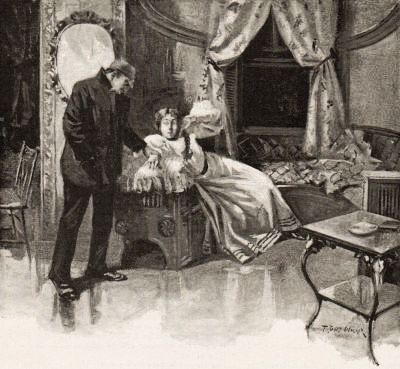
When she opened her eyes a rough-looking man was shaking her.
"Where's the key to that door, miss," he said, gruffly.
"I threw it out of the window," she answered, her voice trembling. She was looking straight at the man, and his eyes shifted.
"What did you do that for?" he asked at last, as if dazed.
"I did it on purpose." Her courage was coming back, now that the man was actually before her, the danger actually on. "I saw you under the bed when I was sitting at the table there. My father is sick down stairs. The slightest excitement would kill him. I thought of several things. The only thing to do was to lock you and myself in so that neither could get out. If I had locked you in there would have been a great noise when I brought the others to attack you. If I had locked you in and gone away and left you for the night you would have tried to break the door down some time before morning, and that would have made a noise."
The burglar was listening with rage, wonder, admiration following one another in his expression. She was glad to see that wonder and admiration were winning over rage. The idea of what she had done seemed to please him.
"Well, I—" He did not finish, which she took as another good sign. He threw himself into a chair, crossed his legs, and put something away in his inside coat pocket.
"Thank you," she said, smiling faintly. "I feel much better now."
The burglar fidgeted, as he invariably did when she fixed her eyes squarely upon him. "But I don't see, miss," he began—"I don't see how you've helped yourself much, after all. What's to prevent me from breaking that door down?"
"Well, I'll explain it to you," she said. She was making desperate efforts to get on friendly terms with him. "You cannot possibly break that door without rousing everybody. There are three men-servants, and there is Dr. Langsdale. They will come up here armed. You cannot kill all of them. One of them will be sure to kill or wound you. And if you are wounded, you will be captured. And if you are captured after killing somebody, why, you'll—I don't know just what the law is."
"Why, I'll hang, miss," said the burglar, laughing at his own grim humor.
"Well, you don't want to get killed or to hang, do you?" went on Miss Burton. She was now feeling almost at ease. "So this is my offer: If you will stay quietly here until five o'clock, the servants will be astir. I'll ring the bell, and when my maid comes I'll ask her to go and get the extra key and unlock the door. I'll send her away, and take you downstairs and let you out myself. And so that you won't have your night for nothing, I'll give you the hundred dollars I have in my purse in the drawer over there—that, or anything else you want."
She was waiting eagerly for his answer, smiling persuasively at him. He kept his eyes down, shifted in the chair, crossed and recrossed his legs. He rose, went to the window, and leaning out, looked down. He came back and stood before her.
"How do I know that you will not play a sharp trick on me, and then get me into trouble?" he said, trying to make his voice rough.
"I promise that I will deal fairly, if you will. I don't break promises. But if that is not enough, remember, if there were to be any noise, it would kill father."
"I'll go you," he said, after he had looked out of the window again and had examined the heavy door. "And here's my hand on it."
Miss Burton, of Berkeley Manor, without hesitating, took the hand of Mr. Burglar.
An embarrassing wait of five hours was before them. Under the new excitement she was wide-awake. She realized that she must keep him in good humor. She drew him out, made him tell her about himself, his struggles, his plans, his hopes. And, under the flag of truce, this enemy of society sat at his ease, talking freely, trying to win the approval of the beautiful brave young woman. As the hands of the little clock on the mantel neared five he reminded her, roughly apologizing for keeping her up. She pulled the bell-cord and went on talking to him. At the first quarter past five he got up himself and pulled the cord again. Soon there was a knock. The footman's voice answered the query.
"Oh, it's you, John," said the young woman, "Will you get the extra key and unlock the door? I am locked in."
When John was heard putting in the extra key Miss Burton motioned the burglar toward the closet. When the door was unlocked she opened it, thanked the footman, and closed it again. Through the half-open closet door she saw that the burglar had his hand in the pocket of his coat. She called him out, pointed toward the pocket and the hidden hand, and smilingly shook her head. The burglar flushed at being caught doubting her, and took his hand out quickly and awkwardly. She got the money from her purse and held it toward him. He hung his head and made no motion to take it.
"Take it," she said, gently; "it may help you on to—to some other kind of a life. I give it to you freely. I think you have earned it, in a way."
She pressed the money into his hand. She led the way down the stairs, through the deserted hall and the conservatory, and so to the door into the gardens. He hesitated in the doorway, and glanced at her quickly. She held out her hand.
"Good-by," she said, smiling frankly and kindly. "And—and—please do the best you can—for my sake."
He looked humble and miserable as he just touched her fingers and hurried away. Miss Burton went back to her tower-room. She was tired in mind as well as in body, and she knew that she would sleep soundly without the medicine. Her heart was light. She was thinking that she had saved her father, and, perhaps, another.