THE BRIDGE OF AN OCEAN LINER.
Reading edition
BY FRANKLIN MATTHEWS.
If you should go down into the engine-rooms of one of the ocean fliers, when the ship is going at full speed in mid-ocean, and should feel the heat and see the tremendous activity there, you might think you knew exactly how these modern monsters of the sea were propelled. The engines are the heart of the craft, but there has to be a brain, and you find that on the bridge. The bridge is a platform, walled in by canvas about five feet high, and stretching clear across the ship, usually above the wheel-house. You see the hardest kind of work in the engine-rooms, but on the bridge no one seems to do anything, when you look up there from the deck, but stand around and be dignified. If, however, you can get the Captain to take you on the bridge, and tell you of the amount of work done there, you will soon see that the real work in running a ship is on the bridge. The difference between the work in the engine-rooms and that on the bridge is exactly the difference between manual and mental labor.
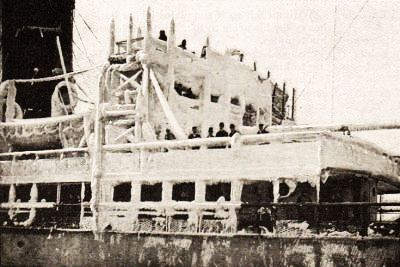
THE BRIDGE AFTER A WINTER VOYAGE.
Of course you know in a general way that the steering of the ship is done on the bridge, and that the Captain must have some way of communicating with the engine-rooms. In small ships there are speaking-tubes and jingle-bells, but in the ocean fliers the distance between the bridge and the engine-rooms is too great for these devices. It would be a most difficult task to use a speaking-tube in a howling gale, and make a man nearly three hundred feet away, in a compartment where the roar is like that of a Niagara, hear what you are trying to say. Jingle-bells might get out of order at a critical time. Another agent must be used, and this agent is electricity. When the Captain wants to give orders to the engineer in all large vessels nowadays he telegraphs to him. He practically controls his ship from stem to stern by the use of electricity. Were it not for that, big ships could not be operated. The day of calling out orders is passed, and perhaps this is why the bridge seems to be such a quiet place.
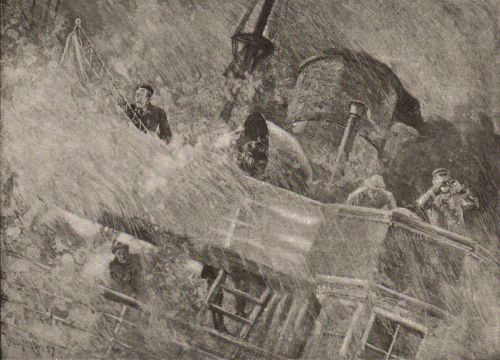
WORKING UP INTO THE WIND ON A RAINY NIGHT.
Let us spend an hour with Captain Randle, of the American liner St. Louis, on the bridge in mid-ocean. He first takes us into the wheel-house. It is a room about ten feet long and ten feet wide, with a curved front. A wheel about three feet in diameter is placed in the centre of the room, and you are surprised to see that the quartermaster keeps turning it almost constantly. You have always thought that he had simply to keep his eye on the floating compass in the box directly in front of him and hold the ship steady on her course. As you look at the compass you see the ship veering now this way and now that as she rolls and plunges, or as one screw turns faster than the other, and thus pulls the ship around. It is hard to make two independent screws go at exactly the same speed, and so this man at the wheel is busy all the time turning the ship straight. He has to fight the waves and the screws and the winds at the same time, and he is a busy man.
This steering-wheel controls the ship by means of a small column of oil in a little tube. By turning the wheel this way or that the oil in the tube is forced up or down, and that opens or closes certain valves in the steam steering-gear four hundred feet away, and the rudder is turned as easily as if a child had done it. In most steamships the steam steering-gear is controlled by hydraulic power—that is, by water—but the use of a column of oil is an improvement.
As you look about, you see fastened to the cornice directly in front of the wheel-man a little scale in black with white lines marked off on it. There is a dial on it, and as the ship rolls you see that this is a device to mark the degree of the roll. You may notice that it takes about a second for every degree of a roll. On each side of the room is another long black gauge, and the dials point to certain figures, generally between ninety and ninety-five. These dials are little electrical devices, showing exactly how many revolutions the screws are making. The Captain at a glance knows what is going on in the engine-rooms.
Over in the corner of the room is another curious electrical device. It is a little box with a clock in it. The Captain tells you it is the machine that controls the whistle in time of fog. The law requires a long blast of the whistle at such times every two minutes. By pressing in a button on this little clock apparatus, and by setting the clock in a certain manner, the whistle is blown automatically for seven seconds every minute. There can be no error of man in that work. Just as sure as every minute comes around that whistle will blow seven seconds. Under the old way, when a man pulled the whistle cord there was no exactness in the work. When the fog is over the button is released, and the whistle stops.
Over on the other side of the room is a little switchboard. It has two sets of three switches. These switches control the side and mast-head lights of the ship. In the old days oil was used for these lights. The coming of electricity changed that. In each of the lanterns now used as a side or mast-head light there are two large electric lamps. Now, as you know, the film often burns out or breaks in these lamps, and suddenly you are in darkness. It would never do to have this happen on shipboard. The light might be out for a long time, and it would not be noticed, and in that time dreadful things might happen. This is obviated by having two lamps in each lantern and an instrument called a "buzzer," which makes a fuss right behind the steersman if one of the lights in a lantern goes out. When the buzzer sounds, the man in charge simply turns on the spare light, and probably not five seconds are lost.
Step out now on the bridge. You will notice that it has three kinds of telegraphs. They consist of circular disks on standards about as high as the hand. Above the disks are handles on frames to which a dial is attached. Inside the disks lights may be placed. The glass surface is divided off into regular spaces on which different words are printed. By moving the handle back and forth the dial points to certain words, and a bell is rung. If the telegraph in use, for example, is that to the starboard engine-room, and the Captain has rung for "half-speed," he knows that his order is being recorded on a similar disk in that room, and that as soon as the engineer down there receives it, he will repeat the order to the bridge, so that the Captain may know instantly that the orders have been received and obeyed.
In addition to two of these telegraphs to the engine-rooms, there is one called the docking telegraph, and one called the steering telegraph. The docking telegraph is used in making fast to or leaving a pier, and the steering telegraph is for use in case the steering apparatus in the wheel-house should break down, and it should become necessary to steer the ship by hand, from the after part of the vessel. On the engine-room telegraph you read these marks: "stop," "stand by," "slow," "half-speed." On the docking telegraph you read: "hold on," "heave away," "not clear," "slow astern," "slow ahead," "all clear," "slack away," "let go." On the steering telegraph you read: "hard-a-port," "port," "steady," "course," "steady," "starboard," "hard-a-starboard." It is through the use of this docking telegraph that you understand why a big ship can come up to her pier in the most deliberate way, occupying sometimes an hour, without any apparent confusion, and, so far as the average person can see, without any one giving orders. The Captain stands on the bridge, and the first officer on the forward deck. The Captain can give orders to the first officer by a simple wave of the hand. He must talk to the officer in charge at the stern by the telegraph. This he is doing constantly, but no one hears him, and few realize what is going on. It is a hard task to bring 11,000 or 12,000 tons of iron up to a given spot, and stop it with its tremendous momentum within a few inches of a certain place. The docking telegraph helps to do this.
In looking about further you see two or three little spigotlike affairs turned under the rail. When you ask about them the Captain will tell you that they are electric arrangements to stop the whistle-blowing device, and to turn on the whistle direct from the bridge. In case of fog, and the whistle of another ship is heard, it is necessary to make certain signals. Turning one of these little spigots cuts off the regular whistle and turns on the sound as long and as often as the Captain desires. After the danger is passed the spigots are turned back under the rail, and the electrical device in the wheel-house continues its regular seven seconds blast. You see on each side also sockets in which to place the lights that are burned, or the bombs that are exploded at sea. When passing ships at night, the St. Louis, for example, burns one red and two blue lights. That tells the other ship the name of the St. Louis. There is a standard on the bridge from which an explosive rocket can be sent up. The noise from such a rocket can be heard six miles, and the rocket is set off by a lanyard, like a cannon.
THE DAILY OBSERVATION.
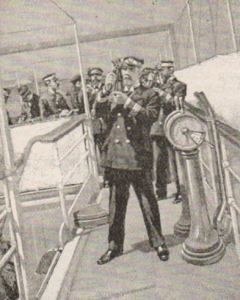
These are the appliances that you see on the bridge. There is constant work there. The log is being kept all the time; the floating compass in the wheel-house is compared with the standard compass outside every half-hour. When a change in course is made, all the compasses on the ship are compared. Every morning at daylight the whip's position is worked out by the north star, and every day at 11.30 o'clock the dead reckoning of the position of the ship is handed to the Captain by the junior officers. All the officers are required to be on the bridge ten minutes later when the daily observation is made. Day and night there is constant activity there.
"How do you know in a fog," I asked of Captain Randle, "which way the sound of another vessel comes from?"
"I stand square in the centre of the bridge with my face exactly to the front," he replied; "and I have trained my sense of hearing so accurately that I can tell which ear the wave sound strikes first as it rolls by. It is rare that we mistake the direction from which a sound comes."
This shows how delicate and at the same time how responsible the task of running a big steamship is.