THE EDUCATED GOOSE.
Reading edition
hat do you think, mamma," said Johnny, the other day. "I have just read a real funny story in the paper, and it is all about a goose."
"Well, what did the goose do?" asked Johnny's mother, with a smile of expectation.
"Why, this goose didn't do anything, but she is being taught her letters with big red blocks, and after awhile I suppose she'll be able to read Mother Goose. Won't she be surprised to find out that there was ever a poet in the family?" As Johnny's mother made no reply, he continued, pleasantly:
"I hope the poor goose won't ruin her eyes when she does know how to read, because it would be awful if she had to wear eye-glasses like grandmamma. I suppose she is now studying hard and going to school just like a little girl."
"There isn't any school for geese, is there, Johnny?"
"No; I forgot when I said she was going to a regular school. She is being taught at home by her owner. Don't you think it very kind of this good man to teach the poor goose to read?"
"It is, Johnny; but I can't see the use in it."
"There may be no use in it," replied Johnny, who was not a little surprised at his mother's view; "but I think it will be very nice for the goose to be able to enjoy picture-books and read fairy tales, especially when the pond's frozen and she cannot go swimming, and when the snow is so deep that she can't go rooting around. Besides, when the lawn is nice and green she can read the sign 'Keep off the Grass,' and, of course, she will do it, because when she is educated she will be more polite and refined. And then when the goslings crawl under her at night she can put them to sleep by singing to them little songs, and she can also tell them pretty stories about giants and fairy princesses when they are swimming around the mill-pond, and then she will teach the goslings to read. But there's one thing they will never do."
"What's that, Johnny?"
"Why, if they ever learn to write they won't do it with goose-quills. But I suppose they will wander into the house, and sit on the sofa in the library, and read books. Now suppose you were a goose, mamma, wouldn't you like to be able to read?"
"I don't know, Johnny."
"Well, I would; but I would never like to read anything about the goose having his head chopped off and being stuffed with potatoes and onions. But I suppose when the goose can read she will be worth too much to eat, because she can be used as a nurse, and read stories to little boys on rainy days. And she may be able to teach little boys to read by using blocks, and I can tell you that would be just fine, and a great deal better than going to school, because the goose couldn't keep us in. Do you know what I'd do if I were an educated goose?"
"No. What would you do, Johnny?"
"I'd start a swimming-school, and I could teach every kind of swimming except swimming on the back. I think I know why the chicken can't swim."
"Why, Johnny?"
"Why, because she is afraid to try. Now, mamma, which would you rather be, a wild goose or a tame goose?"
"Johnny, why do you ask so many questions?"
"Because, mamma, I have to answer questions all day at school, and the only chance I have to ask them is at home."
"Then I wish you would hurry off to school now."
Johnny took his books and started; but when he was on the street he looked back inquiringly at his mother. She opened the window and asked him what he wanted, and he replied:
"Say, mamma, if the goose ever does have to go to school, and it is too far to walk, how do you suppose she'll ever be able to fly with her blocks and books under her wings?"
BY GASTON V. DRAKE.
XVI.—FROM BOB TO JACK.
Paris.
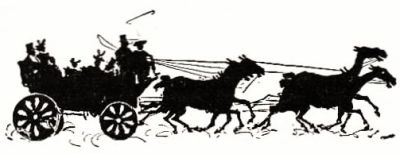
DEAR JACK,—Had a fine time yesterday. We hired a great big open wagon that used to belong to Napoleon the Third and drove out to Versailles. If it wasn't wrong to bet I'd bet you a quarter you can't pronounce that word. Two to one you'd call it Ver-sales, which it isn't at all, but Vare-sigh. That's a queer thing about French. It isn't spelt the way it's pronounced, which I can't see the good of, and people who don't know it get lost. Take the word Luxemburg for instance. We'd pronounce it Luks-um-berg, but these people here wouldn't recognize it if we did it in their hearing, but if we said Loo-ksaun-boor they'd understand right away. And all the streets are Roos or Boolyvars. Boolyvars is French for Boulevards, and it's all right to call them that if they want to because that's what they are, but what's the sense of changing an easy word like streets into a silly little word like roos I can't even guess, and I'm generally a good guesser.
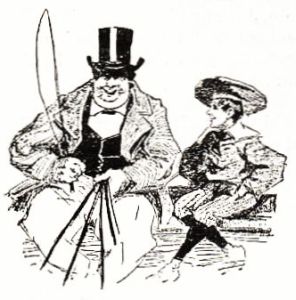
I sat next to the driver going out and it was very interesting. He couldn't speak English and I couldn't speak French, so we spent most of our time laughing. He'd say something to me and laugh and then I'd get one of my jokes at him and laugh, and I must say it was just about as good as if we understood what we were saying to each other—anyhow, it was more successful than Pop's attempts to talk to him. Pop said something to him in his patent French, as Aunt Sarah calls it; he asked him what a certain building was and as far as we could make out his answer, he replied that he thought it might before night, though it was clear enough when we started.
Speaking of Pop's patent French, it sounds quite as good to me as real French. He just takes an English word and Frenchifies it. For instance if you don't know French for building, you say bildang. Kesserkersay cet bildang la, in Pop's patent French means what building is that there. In some cases it works without your knowing it, like Pudding. If you take pudding and Frenchify it into Pooh-dang it's near enough for a Frenchman to understand, and if there is any, and there generally is, he'll bring you some.
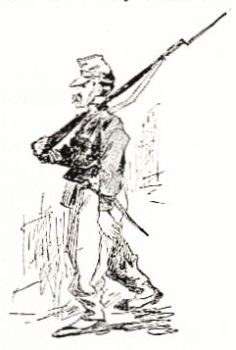
It's a beautiful drive from Paris out to Versailles and you see lots all the way. The first thing we passed was the obelisk. It's kept cleaner than the one in Central Park and I don't like it as well. It doesn't seem so old, because it is so clean. Ours always looks as if it was on its last legs as it has a right to be, while this Paris one is as spick and span as it would be if it had been polished up with tooth-powder that very morning. The next thing to be seen on the drive was the Arc de Triomphe. That means Arch of Triumph and was put up when the French people used to triumph. It's got a fence around it now so that nobody can wear it out by walking under it. That's sarcasm as Aunt Sarah calls it, which is saying what you don't think with your nose turned up. The real reason why it's fenced in I guess is that the French people aren't triumphing as much as they were when they had a man like Napoleon at the hellum. France isn't any Yale College nowadays and hasn't won anything for a long time, and I don't see how she can expect to with the funny looking soldiers she has. Pop says they're all fuss and red pants, but Aunt Sarah thinks they're fine because there isn't any pomp about them, they're content to be plain soldiers of the Republic and wear what the government thinks is good for 'em. Pop says they make up in vanity what they lack in pomp, and when it comes to a question between Pop and Aunt Sarah I always side with Pop because he's a man and knows more. Anyhow I don't think much of the French soldiers. They haven't got great big chests like the English soldiers have and somehow their uniforms make me think of hand-organs. I wish we had a few arches like that Arc de Triomphe about New York or even America.
You can see this particular one from all over the city and there's no use of talking about it it makes you think more of the people and you learn more of their history looking at arches than when you don't see anything but elevated railroads and big sky-scraping office buildings. That's one thing Paris hasn't got and I guess it's one reason she's such a bright sunshiny looking city. All your light and air and sunbeams aren't shut out by life-insurance companies and newspapers. Elevated railroads, and life-insurance companies and newspapers don't teach you much but arches of Triumph do and I sort of think if we Americans would put up a few arches like that even if they cost a lot of money and took ten years to build there'd be more patriotism around about. I know this: I've learned more history over here in a week from what I've seen, than I could learn home in forty years from books, which is all we Americans can learn from except the newspapers which don't even agree and leave us worse off after we've read 'em than we were before.
Then we went through the Bois de Bologne which as I told you before is French for Central Park and it was great. They have woods and lakes and avenues all through it and best of all you don't have to keep off the grass either. What good grass is if you can't enjoy it is a thing I never understood. Pop says he can't understand it either except that people who can't make anything else like to make rules which accounts for all the signs in Central Park forbidding you to do everything you want to do, like "Don't tease the monkies," and "keep off the grass" and so on. In our American parks all you can do is walk where you're let, but here you can do anything you please in the parks and no one's any the worse off. What's more the folks that enjoy parks go to 'em and get all the fun out of 'em there is to be had, here. You see Frenchmen pushing two baby-carriages at once and smiling all over even if it isn't easy work, and you can't ride a mile without seeing a half a dozen picnics going on right square on the grass, any day of the week; only a French picnic isn't a bit like an American one. It lacks lots of things that makes an American picnic pleasant, particularly lemon pie. It's queer these people over here don't seem to know how good real pie is—but anyhow they all come out and sit on the grass and sing together and have a good time. That's what I like. Pop says I like it because it's something I never saw before, but he's only half right. I like it because I like to see people having a good time and that's what they have in the Bois de Bologne. Then there are caffys where you can get ice-cream and cake all through it with bands and fountains playing all day.
(This letter will be continued next week.)
T. M. EDWARDS, Winner N. E. I. S. Tennis Tournament.
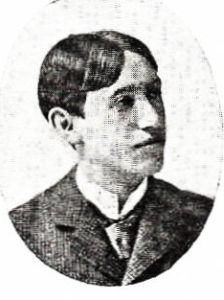
Although there was a larger number of entries for the New England Interscholastic Tennis Tournament this year than last, the standard of play was considerably lower. But it is hardly to be expected that every season will develop such men as Ware and Whitman. The winner of this year's tourney, T. M. Edwards, shows more promise than ability just now, but he is made of good material, and is bound to develop. To win the National Interscholastics, however, he will have to work hard between now and Newport, for Fincke, I think, could defeat him to-day.
The matches were very uneven in the early part of this Cambridge tournament, the winners, as a rule, taking two straight sets. In the preliminaries only eleven three-set matches were played. The four men left for the semi-finals were Edwards of English High to play Howe of Cambridge Latin, and Seaver of Brookline High to play Cummings of Newton High. Both matches were won in two straight sets, Edwards defeating Howe, 8-6, 6-4, and Seaver getting the better of Cummings easily, 6-1, 6-3. The final match between Edwards and Seaver created considerable interest and developed some good tennis. Seaver took the first set, 6-3. After that Edwards drew himself together, and showed some good up-hill work. His winning score was, 3-6, 6-1, 8-6, 7-5.
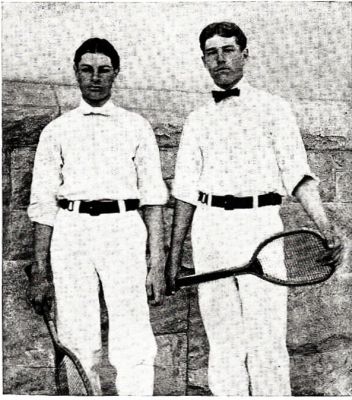
REGINALD FINCKE, SHERMAN L. COY, Winners of the Yale Interscholastic Tennis Tournament.
The standards of performance which must be attained by the athletes who are to represent the New England I.S.A.A. at the National Games were fixed by the Executive Committee at a recent meeting. They are as follows: For the 100, 10-2/5 sec.; for the 220, 23 sec.; for the quarter, 53-2/5 sec.; for the half, 2 min. 6 sec.; for the mile, 4 min. 40 sec.; for the walk, 7 min. 40 sec.; for the 1-mile bicycle, 2 min. 40 sec.; for the high hurdles, 18 sec.; for the low hurdles, 28 sec.; for the shot, 37 feet; for the hammer, 115 feet; for the pole vault, 10 feet; for the high jump, 5 ft. 7 in.; and for the broad jump, 21 feet. These are very high standards indeed, and a team composed of two men in each event with records represented by these figures will be a hard crowd to beat.
At this same meeting the Executive Committee passed a very good rule, to the effect that contestants at the association's games shall pay the regular admission of fifty cents, like spectators. This course was adopted because in the past complimentary tickets have frequently failed to reach contestants; sometimes they have not even been printed, and the result has been that men have come to the games, and have had to pay a fifty-cent admission anyway. This money is supposed to be returned after the games, but seldom is. Under the new rule contestants will be sure of not having to pay more than fifty cents.
J. K. Robinson, c.f. Johnson, 2d b. Hill, l.f. Sheffer, sub. G. Robinson, 3rd b. Goldsborough, r.f. O. E. Robinson, sub. A. Robinson, s.s. S. Starr (Capt.), c. Hall, p. E. Starr, 1st b. ST. PAUL'S BASEBALL TEAM.
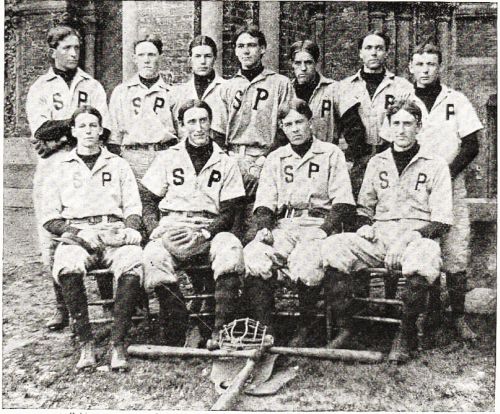
The St. Paul's, Garden City, baseball nine promises to be a strong team this year, although, with the exception of four men, it is made up of inexperienced players. Hard training, however, begun in February, has developed strong team play and excellent base-running. Sidney Starr, captain and catcher, is a first-class back-stop and a speedy and accurate thrower. Hall, who did such good work last year, has made great improvement in form and effectiveness. He has been troubled with a lame arm, but will soon be in good condition. Everett Starr at first base is playing a much better game than he did last year. Second base is covered satisfactorily by Johnson, while Arthur Robinson, the young sprinter, is proving himself a clever short-stop, good batter, and excellent base-runner. George Robinson at third is new at the position, but fills it acceptably. Hill, left field, and J. K. Robinson, centre field, will, before the season is over, be in a class by themselves. Goldsborough, right field, is slower, but makes up for this by his stick-work. The substitutes are Sheffer and O. E. Robinson. (This nine seems to be largely a Robinson family affair.)
The important games thus far have been with Berkeley and Brooklyn High. The former resulted in a victory for St. Paul's by 7 to 4. The St. Paul's vs. Brooklyn High-school game was a fine exhibition of scholastic baseball. Although the teams were very evenly matched and the game was close from start to finish, St. Paul's, by steadier play at critical points and superior base-running, won by the score of 3-2. The probability is that this victory secures the L.I.I.S. championship to St. Paul's, as Brooklyn High is certainly the strongest school team in Brooklyn.
Hastie, r.f. Watson, 1st b. Eddy, sub. Righter, 2d b. Cheyney, c.f. Martin, l.f. Arrott, p. Kafer (Capt.), c. Cadwalader, 3d b., and p. Jones, s.s. LAWRENCEVILLE BASEBALL TEAM.
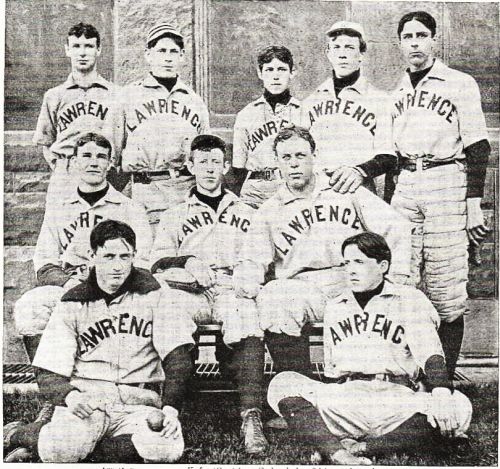
The Lawrenceville nine is slowly getting into trim for its important games. So far the team is not noteworthy in any special particular, although the general work is of a high order. The coaches have been trying new men at first and third bases, short-stop, and centre field; and yet with many of the old players back the team has been slow in getting into form. Cadwalader, who played third last year, is alternating with Arrott in pitching, and is doing fairly well. Arrott is stronger than he was last year. Kafer, the Captain and catcher, is a valuable man, and does the back-stop work satisfactorily, though his throwing to bases is not yet sure or reliable. Watson, a new man at first, is only fair. Jones, at short-stop, is a short, lively fellow, who develops slowly, but surely and steadily. When not pitching, Cadwalader fills third base well. In the out-field all the men are quite sure on the high flies, though not at all reliable on the running catches, and are slow in fielding in line drives.
As a whole the men may realize that success in a game is due to hard work and determination and everlasting perseverance, but they surely do not show it by their actions. They show little judgment in batting, being puzzled continually by the pitchers; and many of them simply wait, hoping to get a base on called balls. When on the bases the men have thus far not shown their ability to seize every opportunity offered to advance the bases. The coaches keep hammering away, however, and hope for good results against the Hill School and Andover later on.
Lawrenceville has had some valuable practice games with the Princeton consolidated team, which is the next to the 'Varsity, and beat them twice in four games. The school team also did better in the second game with the Princeton 'Varsity, 15-1, in nine innings; the first game resulting 16-1, in five innings. Princeton has a strong batting team this year. Eight of the fifteen runs in the second Lawrenceville game were made in the first inning, but after that the school team steadied down, and shut the 'Varsity men out for several innings.
Andover and Worcester will again this year have a dual track-athletic meet. The probable date is May 23, at Andover. Both schools are getting their men in condition, and much new material is being developed. Andover has only a few of last year's men to count on. Senn, Dunton, and Jones are doing good work in the sprints, and Lindenberg, although a new man at the quarter, promises well for that distance. Gaskell in the half, and Richardson and Palmer in the mile, are expected to score points for Andover. Crouse is showing excellent form in the walk, and will give the Worcester man a hard push for first place. Tyler will not run in the half, which will be a severe loss to the team. Stone ought to take a place in the bicycle-race, and Perry seems good for at least second in both the pole vault and the high jump. An unusually large number of men at P. A. are working at the broad jump, and some good material ought to be developed for that event. Andover's principal weakness is in the weights, the hammer and shot men all being new to the work. Cady, who came up from Hartford this year, is a fast man over the high hurdles, and Newcombe may be counted on for points in the low hurdles.
The date for the National Interscholastic Games, which has been under discussion for some time, has finally been set for June 20. Unless something unforeseen occurs to prevent, the events will be run off on the Berkeley Oval.
The Interscholastic League which was recently formed by Lawrenceville, St. Paul's, the Hill School, Hotchkiss Academy, and Westminster has fallen to pieces. For one reason or another, more or less valid—mostly less—the three last-named schools withdrew, leaving only Lawrenceville and St. Paul's. These two schools decided to continue in the League, and will hold their games at Lawrenceville on May 23, extending to the other three schools the privilege of joining at any time they may desire.
At the Pacific Coast championships, held on an improvised track at Central Park, San Francisco, Saturday, May 2, the Academic Athletic League's team took second place with 26 points, first honors going to the University of California with 35, and the next highest score, 18, being made by Stanford University. The A.A.L. captured all the sprints—the 100, the 220, the 440, and also the 100-yard novice.
Drum took the 100-yard dash in 10-3/5 seconds, after winning two trial heats in 10-4/5 and 10-3/5 respectively. The track was very slow, being practically a course of soft sand. If the races had been run on a hard track all the figures would undoubtedly have been much lower. Drum also won the 220, which was run in one heat in 25 seconds. The 100-yard novice went to Lippman of Hoitt's in 10-4/5 seconds, and the quarter was taken by Woolsey, B.H.-S., in 57 seconds. Woolsey had a big crowd about him, and seemed to be lost at the beginning of the last hundred yards; but he made a great finish, and won. His time is excellent, considering the track, which, besides being heavy, is seven laps to the mile, with three turns in the 440.
The star scholastic performer of the day, however, was Cheek, O.H.-S. He won the shot with a put of 41 feet 8½ inches, which breaks the Pacific coast record of 40 feet 5 inches. This winning put was his third, the first being over 38 feet, and the second nearly 42 feet; but he stepped out, unfortunately, and this was not measured. Edgren, the U. of C. crack, was second in the event, and nine inches behind Cheek. Cheek also went into the pole vault, and cleared 10 feet 5 inches, although he weighs over 190 pounds, and has been in training only three weeks. He competed in the broad jump too, doing 19 feet 8 inches, and in the high jump he cleared 5 feet 4 inches, dropping out before he was disqualified, in order to save himself for the vault.
Hoffman, O.H.-S., did good work too. He vaulted 10 feet 5 inches, and jumped 5 feet 6 inches, securing second in the former event. Warnick took his heat in the low hurdles in 29-4/5 seconds, and got third in the finals. The walk was an exciting contest between Walsh of Lowell H.-S. and Merwin, U. of C. The college man took the lead for two laps, when Walsh forged ahead and led until the last hundred yards, when Merwin spurted and crossed the line only a few yards to the good. The California school athletes may well feel proud of the records made by their representatives.
The Graduate.
It was in the car of one of those narrow-gauge railroads that penetrate the wilds of the Maine woods. The yelps of the dogs in the baggage part of the smoker brought the conversation of the hunting party around to pointers. Many wonderful tales of these excellent animals had been told, when an old veteran with grizzled whiskers who had remained silent remarked:
"That last story of yourn, neighbor, puts me in mind of my dog. We were up near the border, precious nigh onto civilization, and I had played in pretty good luck, bagging a couple of brace before noon. All of a sudden I missed the dog, and I whistled and stamped round, but I couldn't raise him nohow. Finally I gave it up. I knew he must be pointing somewhere about, and thought he'd show up when I went into camp. Well, he didn't, and I finally left the region.
"I happened to get up there again 'bout three weeks later, and striking in near the same place, what did I stumble over but the dog, rigid as stone, and pointing up a tree. Yes, gentlemen, he had a bird there, and kept it till I came. When I shot it, the dog keeled over, couldn't stand it any longer. Well, three weeks is a pretty good stretch for a dog, but he was a wonder."
And the old veteran quietly puffed his pipe and silence reigned.