THE AMERICAN NIGHTS' ENTERTAINMENTS.
Reading edition
THE M. S. D'S.
BY EMMA J. GRAY.
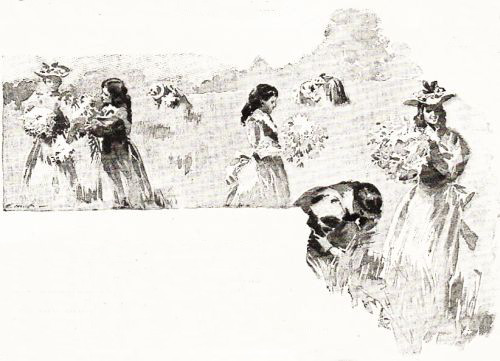
"It fell upon a day in the balmy month of May" that the M. S. D's went for an out-of-door frolic.
Who were the M. S. D's? Merry Sons and Daughters. The society had been incorporated the year before; there were no dues, no president, secretary, treasurer, or by-laws; there was but one qualification—being merry. No long faces among the members of that society; no boys or girls who always want things done their way. No, that style of person was not eligible, nor selfish folks, or any other kind of disagreeable people.
The M. S. D's were stanch, true-hearted, and sunny, their greatest joy being forgetfulness of self. They were always merry because they were always happy; and they were always happy because they trod evil underfoot, and thought out great thoughts white and godlike, thoughts that shone with the clear and steady light that reflected good-will on all.
Therefore, when the society went for a day's fun it was the gayest of roving, a complete El Dorado of enjoyment; and an outing in the blithesome month of May to them meant a full and happy one.
For some reason the usual parties had been omitted this year, and therefore none of the girls had been crowned Queen, and none of the boys had paid their respects to the Court.
So when they reached the "happy independence grounds," as the boys dubbed them, because everybody was to do as they pleased when they got there, it was most amusing that each one seemed to have the same desire to gather handfuls of blossoms, weave crowns, hunt for four-leaved clover, and listen to bird calls. And thus it was that soon were gathered blue violets from the meadow, and dandelions, buttercups, and daisies from among the long waving grass that covered field after field through which these Merry Sons and Daughters laughingly ran.
And then followed the butterfly hunt; just to see if anybody could really catch one of these "ne'er-do-weel" fellows. But their fragile painted wings carried them so safe and rapid that when a hand was almost over the petal tip that held the happy fellow, he would up and away in the breezy blue, and ride on graciously out of sight, or sometimes, as through a desire to tempt his pursuer, skim over the clover blossoms, and finally light again on a bunch of daffadown-dillies, or possibly make a round of all the sweet May blossoms.
"What the Dandelions said" was then played, which is the old game so familiar to all from babyhood—that of blowing the soft down of the ripened dandelion to learn "How old am I?" Blow once, one year old; blow twice, two years, and so on, until all the downy stuff has gone. The number of times the blows have been given before the down has altogether disappeared indicates the age.
And then the players ran at utmost speed to the babbling brook, which was a short distance off; and having first torn the dandelion stems into quarters by splitting the tubular stem from tip to flower, they laid them in the cool flowing water, and watched them curl until all were tightly rounded; then shaking off the gathered drops, they firmly fastened these curls to their hats, together with the bunches of clover, buttercups, violets, strawberry blossoms, or whatever else fanciful taste dictated.
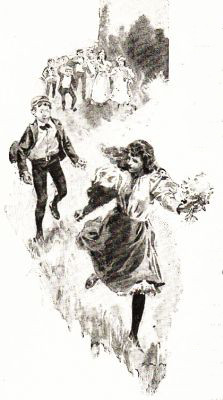
This pastime was soon followed by the "Daisy Catch." Both girls and boys stood in a group, with the exception of one girl, and to her was given a bunch of daisies. There was also a tree selected as a place of safety, after which the other girls then counted ten, allowing ten seconds for the count. During the counting the girl ran wherever she pleased, but the moment ten was spoken the boys raced after her. The idea was to "tag" her while the flowers were in her hand. If she was "tagged," the girl must then throw the daisies, as if they were a ball, to the boy tagging her. If he caught them, the game would proceed as before, by reversing the players; but if he did not catch them, the girl could try over again. The girl could also demand another chance if, when fearing she would be tagged, she threw her daisies away and caught them again before any of the boys did. Whenever the game was repeated it commenced regularly from the beginning, the players taking the same position as at the start. On the way back from the brook everybody's attention was drawn to a pair of yellow-birds that had braved the yet unsettled atmosphere, and were building a very pretty home for themselves near the top of a blackberry bush, when all of a sudden a cat-bird's song was heard, and knowing that he was very shy, all breathlessly kept quiet. And then how uneasy the little yellow-birds became! The young people wondered what it all meant; but afterwards they saw both the yellow-birds fly off for fern down or other soft stuff with which to line their nest, and this disappearance was evidently what the cat-bird desired, for no sooner had the birds gone than, quietly and cautiously, and yet rapidly, as if seizing opportunity much after the manner of other thieves, he approached and stole all the building materials he could possibly carry from their pretty home.
This sight reminded the boys of a game called "Keep It." It was nothing more nor less than an echo, and those who knew lightly closed each hand so that the first two fingers touched the thumb. Then putting one hand on top of the other, and calling through the column thus made, trumpet fashion, the noise was greatly accelerated, and, "Keep it, keep it," were the words over and over again repeated in the uncanny peculiar way that echo repeats sound. The children then ran in various directions, laughingly trying to get ahead of each other, and discover who could make the clearest and loudest echo.
But the great feature of the day was the boat-race, and this was an impromptu amusement, for the boys had planned the girls should botanize, tell stories, or anything that they liked, while they went fishing; and with fishing in mind the boys had many a secret conclave beforehand, as each one was trying to get all the fishing points possible, and many and various were the ones received, everybody agreeing, however, that all the fishermen must understand both shoving and sculling a boat before attempting to fish in that particular water, as it was winding, narrow, and full of all sorts of rushes, meadow grasses, and snags in variety, and if rowing was attempted, fishing would be impracticable. Then, too, there should be a slight wind blowing from the southwest, and a cloudy sky. So as fishing was the uppermost thought, the boys were sure the weather would be right when they got there, and therefore came laden with bait, tackle, and fishing-baskets in abundance, for they had assured their mothers they would bring home a lot of shining fat fellows for supper. A few, too, of the more skilled had refused to bring bait, saying, with an important toss of the head, they only fished with flies; and no sooner had the M. S. D's gotten to their destination than these fishermen ran to the water to watch the sort and color of flies the fish were mostly jumping for.
So it was a genuine disappointment when, at ten o'clock in the morning, the sun shone unusually hot and the water was as smooth as a mirror, for not even a perceptible zephyr was stirring.
Therefore it was that the girls begged the boys not to attempt fishing, that it would be only a great waste of time, and to further quote their words, "when it gets cooler, as it's bound to after a while, let's have a boat-race"—for there was a clear space of water where such could be held.
This was a happy suggestion, and immediately the race was arranged. The girls who did not care to row were to act as umpires; and a grand stand was selected, which was nothing more nor less than a massive irregular rock over which a tangle of vines ran luxuriously, and for canopy there was a wide-branched locust-tree.
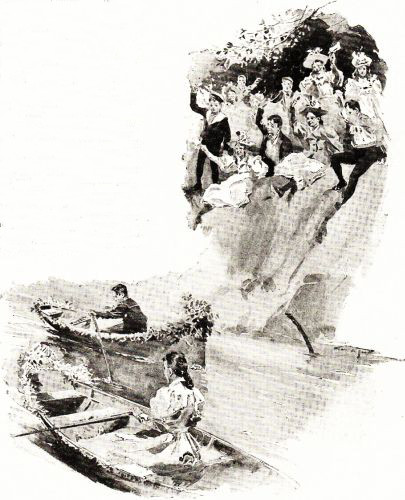
There would be three races—one between the girls, another between the boys, and the third between the girls and boys together, and they were to be given in the order indicated. Two willow-trees which conspicuously over-hung the water, and so could not be mistaken, were selected as the points that would start and end the race, the prow of the boat being even with the centre of the tree-trunk at starting, and the stern of the boat being even with the centre of the tree-trunk on closing. Only one person would be in a boat at a time, and no person could have a second chance. As the water was too narrow to allow for all the boys or all the girls to try at once, it was decided that two boats only should row, and then two more, and so on. After the race was over, the victors would be obliged to row again, two and two, as at the first, and so determine the winners. When the winning girl and the winning boy were known, they would race together, and thus the champion rower would be discovered. Whoever was champion was to be rewarded with a wreath of laurel, after the fashion of the great Roman victors; laurel was not very plentiful in this section, but the boys were confident that by a run of a mile or so they could find some, and if they couldn't they would use oak leaves, and tell the hero they were meant for laurel. In any case, the wreath must be made and at the grand stand before the race opened; at this stand, also, the coronation would take place.
Providing for the race led to the gathering of numberless flowers, with which the boats were decorated, and later, as they sped over the water, they seemed a part of a great picture—over and around them air and clouds, exquisite colorings of matchless reds, yellows, violets, pinks, and greens, soft reflections of the same in the water and the distance, and, added to all, the ambition of the rowers and the contending emotions of those who watched the pretty play. One boat was very simply trimmed. It was carpeted with mosses and wreathed around with fern leaves; another was so daintily decorated it seemed as if it was a fairy boat; and yet another style was richly and gayly covered, as though it was at the disposal of a grandly beautiful queen, and almost, unconsciously we turned to look if Cleopatra was near. This boat was canopied with apple blossoms; the branches were held in place between the narrow strip of wood that forms the border of the lining and the boat herself. But this boat was not among the winners; it was top-heavy, and therefore too difficult to steer and row. The shades of night were indeed fast falling when the M. S. D's reached home again. The sunburnt faces, joyous laughter, and light-hearted confusion of voices told their own story.