KIRK MUNROE'S POPULAR BOOKS
Reading edition
SNOW-SHOES AND SLEDGES
A Sequel to "The Fur-Seal's Tooth."
Brimful of adventures admirably recorded. The young folks will take delight in it.... We confess to having read every word of the journal with as much interest as we once read "Robinson Crusoe" or the "Swiss Family Robinson."—Christian Intelligencer, N. Y.
A book that will hold the interest of its readers from beginning to end.—N. Y. Evening-Post.
THE FUR-SEAL'S TOOTH
There is plenty of moving incident in the tale, and the atmosphere, redolent of seals and the life of that stormy clime, will delight all boys.—Spectator, London.
CANOEMATES
An entertaining story for boys, and will usefully enlarge their knowledge of our great Atlantic peninsula.—N. Y. Evening Post.
RAFTMATES
The story has a strong, wholesome tone, and will hold the interest of boy readers from first to last page.—Churchman, N. Y.
CAMPMATES
Capitally written and admirably illustrated.... An excellent record of the early development of certain Western cities and of certain Indian tribes now fast disappearing.—Critic, N. Y.
DORYMATES
A wholesomely exciting tale of adventure which any bright boy might consider a valuable addition to his library.—Christian Intelligencer, N. Y.
Each one volume. Illustrated. Post 8vo, Cloth, $1.25.
The "Mates" Series, Four Volumes in a Box, $5.00.
HARPER & BROTHERS, Publishers, New York.
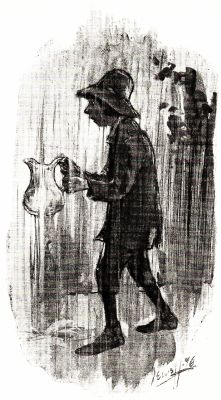
NOT STRANGE.
"I git good measure," said Mrs. Jones, "but, I declare, the milk Henry brought me yesterday mornin' was more'n half water."
The art of painting pictures so near to life as to deceive the naked eye is very old. Pliny relates that Zeuxis once painted some grapes so naturally that birds used to come and peck at them, and that Parrhasius once painted a curtain so artfully that Zeuxis desired it drawn aside that he could see the picture it hid. Discovering his error, he confessed himself outdone, as he had only imposed on birds, whereas Parrhasius had deceived the human intellect. Another time Zeuxis painted a boy with some grapes, and when the birds again flew at the grapes he was very angry, saying that he was certainly at fault with the picture. He reasoned that had it been perfect the birds would have been frightened away by the boy.
Caius Valerius Flaccus says that Zeuxis's death was occasioned by an immoderate fit of laughter on looking at the comic picture he had drawn of an old woman.
"The reason why the British want to swallow up half of Venezuela," asserted Pat, "is because of the gold there is down there."
"Sure," replied Mike, "they're always after gold, the English. If they were landed on an uninhabited island, they would not be there an hour before they'd have their hands in the pockets of the naked savages!"
Baron Rothschild was once caught in a predicament that many people experience daily, and that is getting into a conveyance of some kind, and then not having the money to pay the fare.
The driver of the omnibus into which Rothschild entered demanded his fare, and the Baron, feeling in his pockets, discovered that he had no change. The driver was very angry. "What did you get in for, if you had no money?"
"I am Baron Rothschild," explained the great capitalist, "and there is my card."
The driver scornfully tossed the card away. "Never heard of you before," said he, "and don't want to hear of you again. What I want is your fare."
The banker was in great haste. "Look here. I've an order for a million," he said; "give me the change." And he proffered a coupon for that amount.
The driver stared and the passengers laughed. Fortunately a friend of the Baron entered the omnibus at the moment, and taking in the situation, immediately paid the fare. The driver, realizing his mistake, and feeling remorseful, said to the Baron,
"If you want ten francs, sir, I don't mind lending them to you on my own account."
TO GO A-FISHING.
It's time to put the lessons by, The fields are full of daisies; When summer blue is in the sky, Who cares for sums and phrases? Deep in his heart, his highest joy, The boy I know is wishing To leave the school-room's strict employ, And just to go a-fishing. He'll find a grand old willow-tree, Above brown waters dipping, Where catfish glide and pickerels be, And dainty birds are sipping. There, waiting long, with earnest pluck, At last his line will quiver, And you and I will wish him luck Beside that bonny river.
EXPLAINED.
Willie. "I think I know why Ponto wags that stump of a tail so very hard."
Aunt Jane. "Why does he do it, Willie?"
Willie. "Because it is only half a tail, and he wants to enjoy a sense of wagging a whole one."
A RAPIDLY MADE COAT.
Manufacturers are always pleased to turn out the product of their establishments in less than the average time, and many have made records to which they point with pride. In the issue of the Round Table for December 10, a short article was published on making a coat in thirteen and a half hours, from shearing the sheep to putting the finished garment on a man's back. This was done at Greenham Mills, in England, in 1811. Mrs. James Lyon, of Bath, New York, writes that a similar feat took place in that town in 1816, and was accomplished in less than nine hours by one George McClure, who asserted that it could be done in ten hours. The record of each step of the work still exists, with the exception of the shearing. The wool was colored in thirty-five minutes; carded, spun, and woven in two hours and twenty-five minutes; fulled, warped, and dyed in one hour and fifty-one minutes; carried to the tailor in four minutes, and was turned into the finished coat by him and his journeyman in three hours and forty-nine minutes. The shears used in the work are still preserved, and can be seen at the Steuben Agricultural Society's Fair Grounds, at Bath.
This feat, at the time, doubtless attracted as much attention as a record-breaking railroad train or steamship does to-day. It is probable that many of our present manufacturers make such trials for their own edification, which, if described, would prove interesting.