TWO LEADERS OF THE GREEK REVOLUTION.
Reading edition
BY V. GRIBAYEDOFF.
reece's active championship of the cause of the Cretan revolutionists, in the face of the opposition of the combined powers of Europe, recalls that plucky little nation's fierce struggle for her own independence from Turkish rule during the early portion of the present century. Indeed, as Prince George started for Cretan waters the other day with his flotilla of torpedo-boats, almost the last words Prime-Minister Delyannis said to him were:
"May the spirit of the great Canaris hover over your Highness and your brave men, inspiring you to maintain nobly the traditions of the Hellenic navy!"
Here is probably what Delyannis had in mind: The Greece of to-day lacks the larger vessels of war fully as much as did the Greece of 1820, but at that earlier period she possessed a formidable weapon in the dreaded fire-ship, and under Canaris's lead the enemy's naval power was almost destroyed by this primitive method of attack. The fire-ship of the past has been supplanted by the torpedo-boat of the present, an engine of war calling into play almost the same qualities as its predecessor—pluck, skill, dash, and rapidity in handling. And Delyannis was therefore anticipating that the deeds of the early part of the century would be repeated at its close in a mode of warfare for which his countrymen are both by nature and temperament eminently fitted.
The story of Greece's struggle for independence both by land and by sea has formed the subject of many volumes of prose and verse. But among all the heroes of those stirring times there are two whose names will live on the roll of fame—Constantine Canaris, the fearless and enterprising sailor, and Marco Botzaris, the guerilla chieftain.
Let us begin with Canaris, whose achievements were the greater by reason of his surviving all the manifold dangers of this most cruel of wars; Botzaris, on the other hand, succumbed to a Turkish bullet long before Greece was liberated. Let the reader glance at a map of the Grecian Archipelago, and among its numerous islands he will find one named Ipsara, about midway between the mainland of Greece and the coast of Asia Minor. It was on this barren and desolate stretch of rock that Constantine Canaris was born at the close of the last century. Until the war of independence broke out in 1821 he pursued the humble calling of fisherman, but at the outbreak of the revolution he abandoned everything to espouse the cause of his country. His wife, an ardent patriot herself, and the mother of three children, whom she had proudly named Nicolas, Lycurgus, and Miltiades, in honor of the past glories of Greece, urged her husband on in his resolve.
And so Canaris went to the front. He was destined soon to be heard from. The fighting at the commencement of the war was confined to the Greek mainland, especially the Morea, or ancient Peloponnesus; but the bad condition of the roads throughout Rumelia obliged the Sultan to send his re-enforcements by water through the historic Dardanelles. The fishermen fighters of the archipelago felt that here was their opportunity. The inhabitants of the three islands of Samos, Ipsara, and Hydra equipped a flotilla, and started out to intercept the oppressor. Now inasmuch as the Turks possessed double-deckers and frigates carrying an untold weight of metal as against the light and poorly armed craft of the Greeks, it was not to be supposed that the latter would venture on a struggle at close quarters. The lessons of the past were there to teach them that their sole hope of salvation lay in the skilful use of the fire-ship, and they adopted this system of warfare with one accord. It required a high order of seamanship to carry it on with success and a thorough knowledge of the actions of the tide and wind, for a slight miscalculation not only involved a failure of the enterprise, but the almost certain destruction of the aggressor.
There were various modes of attack. As a usual thing, an ordinary fishing sloop or schooner, filled with combustible material—tar, pitch, oil, sulphur, etc.—and navigated by half a dozen fearless patriots, would be directed at dusk against the enemy's ships lying at anchor. When the messenger of destruction arrived within a few hundred yards of the intended victim, the temporary crew applied the torch to tapers placed at intervals among the combustibles in the hold, and then lowered themselves into a small boat to row off to a safe distance. Carried by the wind and current, the fire-ship stole on in the darkness, the fire having in the mean while taken hold in good earnest. On, on it went into the midst of the Mussulman's ships of war, the flames now darting from its sides in huge tongues, sparing naught upon its path. Panic-stricken and forgetful of all discipline, the Turk became a ready victim to the avenger. His first thought was to cut his cables, but this measure made matters worse, inasmuch as the big ships, once loose from their moorings, usually collided with one another, and rendered their own destruction only the more certain.
The scenes that followed the incursion of the flaming avenger beggared all description. It became a choice between a fiery and a watery death, for the unfortunates who had survived the explosions of the powder-magazines, and even those who hoped to reach shore by swimming, were doomed to destruction at the hands of the vindictive patriots hovering near in small boats. For it must be remembered that this was a war to the knife on both sides, in which quarter was neither asked nor given.
But to return to Canaris. His first naval success was obtained under the orders of a man whose name is venerated as one of the greatest heroes of the war of independence, Admiral Andrea Miaulis, after whom one of the Greek war-ships now on service in Cretan waters is named—the Navarchos Miaulis.
The Sultan was sending an army to besiege Missolonghi on the Gulf of Corinth, and his mighty fleet had covered about half the journey between Constantinople and that stronghold when it sighted a Greek squadron off the island of Lesbos. Miaulis had a comparatively strong force at his command and was tempted to try conclusions with the foe at close quarters, but Canaris, with greater long-sightedness, realized that his countrymen could ill afford to assume so great a risk, and although a mere subordinate, entreated the Admiral, on his bended knees, to be allowed to first attack the Turks with a few fire-ships. Miaulis had given the signal to clear the decks for action, and at first resented the interference.
"Your Excellency has but one fleet, and the Sultan has a dozen," persisted Canaris. "Our deaths will not atone to our country for the consequences of our defeat and destruction!"
The veteran fighter soon caught the drift of the younger man's argument.
"So let it be," he exclaimed. "Zito Hellas!" (Long live Greece!) And muttering an invocation to his patron saint, he ordered Canaris to proceed with his plan.
Within one hour after this interview the hardy Ipsara fisherman succeeded in setting fire to the Turkish Admiral's flag-ship, three frigates, and five sloops, and forced the rest of the enemy's fleet to seek shelter under the guns of the Dardanelles forts. The loss of the Turks in men exceeded 1000; that of the Greeks was but fifteen killed and wounded.
Victorious at sea, the Greeks were at this period almost uniformly defeated on land. Fifteen thousand patriots were massacred at Patras in Morea, and many more at Salonica. The second year of the revolution witnessed the most terrible events. In order to punish the inhabitants of Scio, off the coast of Asia Minor, for sundry acts of rebellion, the Sultan sent a powerful armament to that devoted island, and in the course of a few days it was entirely depopulated. Of its 85,000 inhabitants only 15,000 escaped to the mainland; the rest were either put to the sword or carried away into captivity. But vengeance for this savage act was close at hand. Miaulis, Canaris, and another hero, George Pepinis, overtook the Sultan's vessels as they were heading for the Dardanelles. Miaulis, who had usually prohibited his men from indulging in excesses, issued the watchword "Remember Scio!" which meant no quarter under any circumstances. In the battle that followed, every known method and weapon of naval warfare was brought into play—fire-ships, grappling-irons, carronades, chain-shot, boarding assaults, and so forth—and when finally the smoke cleared at dusk, the Greeks found that they had destroyed six Turkish ships of the line, ten frigates, and twelve brigs, out of a total of fifty sail.
CANARIS DESTROYING THE TURKISH FLEET.
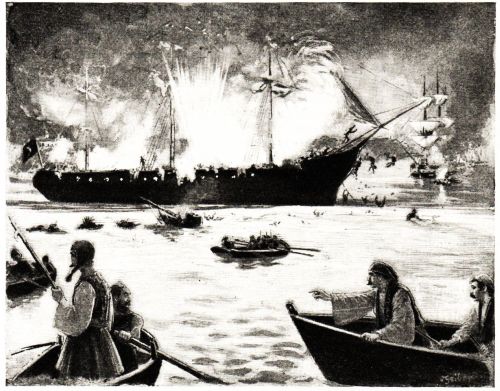
Canaris himself was wounded, and, indeed, owed his life to a miracle. He had selected the Turkish flag-ship as his especial prey, and steered a large brigantine filled with pine shavings and sulphur in her direction. When within a few hundred yards of the foe he started the conflagration below, and then made his way to the stern, intending to jump into a small boat behind. But in some way the boat had become detached, and was nowhere visible; the sulphurous flames were beginning to shoot up from the hold, and the bullets from the Turkish small-arms were whizzing in uncomfortable proximity. There was danger indeed, and increasing every moment at that, as the wind and current drove the vessel wildly on. There was nothing for it but to jump overboard and swim for dear life. But, though expert swimmers, Canaris and his five subordinates were not proof against leaden balls, and one after the other the poor fellows sank, until only the leader remained. Even he was struck after a while, and began to lose blood rapidly. Just as he was about abandoning hope, none of the Greek ships being near, a terrific explosion rent the air and convulsed the waters, and when the sinking man's head arose to the surface for the last time, as he thought, there, within arm's-reach, was floating the large figure-head of the Turkish Admiral's vessel. The fire-ship had done its work. It had blown up 500 Mussulmans, and by this very act had saved the life of Greece's naval hero.
Canaris's exploits now became the subject of general attention, and his name also grew to be a by-word among the Turks. The very suspicion of his being near caused the Turkish Admiral, who had been sent to relieve the fortress of Napoli di Romania, besieged by General Kolokotronis, to sail away without accomplishing his purpose. Still this act of prudence did not save him in the end, for Canaris followed the Turkish fleet to the bay of Tenedos, and there made sad havoc among the large double-deckers, blowing them one after the other out of the water. The Turks on this occasion added to the disaster by cutting their cables and running foul of one another.
The following year, 1823, Canaris drove back into the Dardanelles another Turkish fleet that had been sent from Constantinople to re-enforce the beleaguering army of Missolonghi, a proceeding that exasperated the Sultan to the point of vowing vengeance against the irrepressible Giaour. The Sultan kept his word. The year 1824 saw the accession to Turkey's fighting forces of the entire military and naval resources of the vassal state of Egypt. The Khedive placed a large army and navy, commanded by his adopted son, Ibrahim Pasha, at the Sultan's disposal. The campaign therefore began with an expedition against the Greeks, numbering 100,000 men and a fleet of 80 war-vessels. This mighty armament was first directed against the islands of Spezzia and Ispara, the latter, as stated, being Canaris's home. At the approach of the Turks a council of war was summoned at Ispara by the local dignitaries.
"Give me five fire-ships," exclaimed Canaris, "and I will stand for your safety, and that of your wives and children!"
But, as in all communities, there were here some politicians and wise-acres to be reckoned with who had never fought themselves, but who would have been perfectly willing to give Napoleon himself points on strategy. Canaris's plan was overruled by these men, and it was decided to await the enemy on shore. The result of this decision was the capture and devastation of the island, including a massacre of all the males above tender age. Canaris escaped by swimming to a boat. He had already gotten his family safely out of the way on hearing the announcement of the council's absurd plan of campaign.
It is unnecessary to say that the brave Ipsariot fully avenged the cruel wrong done to his native isle. A few months later he fell upon an Egyptian fleet of forty sail, laden with provisions and munitions of war, and destroyed almost half their number. What remained of the Turco-Egyptian men-of-war after all these reverses was burned or sent to the bottom in February, 1827, by the allied fleets of England, France, and Russia at the memorable battle of Navarino. Canaris not only experienced the satisfaction of witnessing this event, but he also lived to see his country free and independent.
MARCO BOTZARIS AND HIS GAUDY WARRIORS.
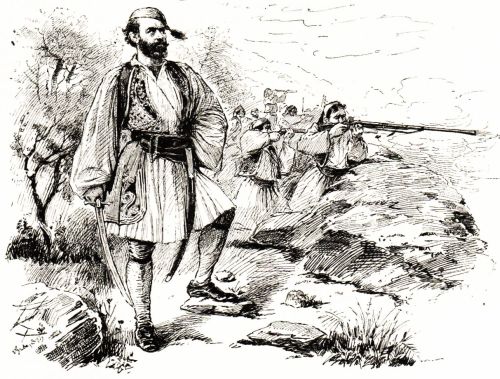
Marco Botzaris, the most picturesque military hero of the Greek war of independence, was a native of Souli, a famous mountain stronghold in Epirus, which for centuries has produced a race of fighting-men. The Souliotes indeed were justly considered the flower of the Greek revolutionary army. Attired in a costume resplendent with gold lace, gilt buttons, snow-white linen of superior quality, and other finery, they made an imposing array on dress parade or on the march. An American traveller named Emerson, who visited the theatre of the war in 1821, says of them, "I have seen the noble grenadiers of Napoleon, and I have known the superb English guards, but the Souliotes appear to me to surpass both." He describes their method of fighting to be somewhat theatrical, and to resemble that of the Scotch Highlander. Every man chooses his post, and like the ancients who covered themselves with shields, they seek cover behind a rock or stone, and from there shoot down the foe. In order to deceive the latter, the Souliote sometimes places his red cap on a pole at some distance away. He seldom makes more than three discharges, preferring to finish the fight with the cold steel. His weapon is a curved sword, called a yataghan, and he wields it with terrible effect.
One can imagine that with such material at his command Botzaris was able to lead the Mussulman a lively dance, as the saying is. His wild dashes on convoys, his surprises by day and night, and his ability to check the advance of large bodies of the enemy under all conditions of time and place, soon made his name a terror among the followers of the prophet. Neither Maurocordatos nor Kolokotronis, with all their science and their military training, was able to inspire the same fear in the enemy's ranks. Botzaris's name will ever be linked with the story of Missolonghi, its vicissitudes and its victories. With 400 men Botzaris defended this stronghold against an army of many thousands under Omar Vrione, and in repelling six assaults killed 12,000 of the enemy. This was but one of many triumphs. It was near this same stronghold of Missolonghi that the great hero met his death on August 20, 1823. He had received information that a large column of Turks was on its way to that place, and he decided to intercept it with his small force of 1200 Souliotes. It was late at night when the patriots came across the enemy, and by superhuman efforts succeeded in crushing him. For the time being Missolonghi was saved, but the brave Botzaris received his death-wound in the very moment of victory. He died with the words. "Zito Hellas!" on his lips.

The eighth annual interscholastic in-door athletic meeting of the New England I.S.A.A., a week ago Saturday, was a remarkable one for several reasons. First of all was the surprise at the outcome, which was entirely unlooked for; not that the winning school was not thought well of and was not a candidate for the honors it reaped, but that the victory was so very one-sided.
POINTS SCORED BY THE SCHOOLS.
P
u
Rt
ut
4ni
5nn
318-ig
40608yn
00000ag1
--00-r6P
yy--ydH-o
aayyaill
rraarHgbe
ddrrduh.T
ddrVo
DDWdJSat
aaRRaluhua
ssuulemoll
Schools.hhnnksptts
English High8851½224½
Worcester High5510
Hopkinson's351½9½
Noble's and Greenough's257
Worcester Academy21½11½6
Chauncy Hall55
Cushing Academy55
Boston Latin22
Newton High11
Phillips Exeter11
Cambridge High and Latin11
It was predicted before the games that the contest for points would devolve upon certain schools, but it happened in several instances that calculations were rudely upset by representatives who failed to come up to expectations. This was noticeable especially in the case of Worcester Academy, a school that was feared by all, but which turned out a disappointment.
English High from the outset began to gather the points, and 16 in the 40-yard dash and half-mile walk added materially in swelling the total of 24½. Worcester High was satisfied to beat out its rivals the Academy. Hopkinson's gave a better exhibition than it has for several years, and came third in the competition for points. The customary record-breaking performances were forthcoming, and the 40-yard dash, 1000-yard run, and the running high jump were affected, while the hurdles were done in the same time as last year.
The list of entries was considerably smaller than last year, because of the requirements of the new registration law, which prevents many from competing. A rumor spread around before the games began that some of those entered had not registered with the Secretary of the A.A.U., which was confirmed by Manager John Graham of the meet. A conference of the Athletic Committee of the B.A.A., under whose auspices the games were given, was held to decide what should be done. They decided that if a sanction could be obtained from the president of the I.S.A.A. for such schools not registered but members of the I.S.A.A., the men should be allowed to compete and assume all of the responsibility. This was also done to act as a test case for the A.A.U's decision.
H. C. KENNINGTON.
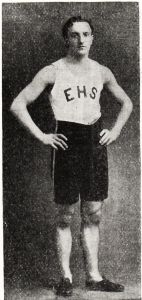
An unparalleled surprise was developed in the first event on the programme, when the existing record in the 40-yard dash was broken, three runners doing the trick, and equalling the world's mark for the distance. It was an unusually speedy lot that was entered in this event, and when the trial heats began to be caught in the old record the final figure was awaited with suspense. In the trial heats the first and second place winners were eligible for the semi-finals. In the first line-up was Butler of Worcester High, the best runner that school has, and Kennington of English High, who eventually became the winner.
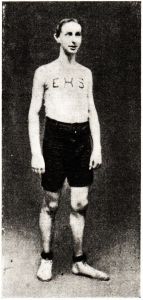
W. J. DUFFY.
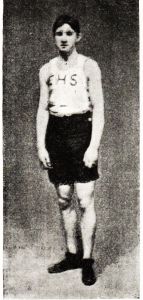
The next two heats were captured by English High-School sprinters, Kane getting the first and Duffy the second, in 4-3/5 sec. Eight heats were run off in all before the list of entries had been exhausted. Butler, Kane, and Duffy were called in the first semi-final, and speculation was intense as to whether the Worcester lad would survive the ordeal. Kane and Duffy realized that they had a worthy foe to deal with, and knew that they would have to strain every bit of energy to shut the Worcester man out and make the final round, but they were equal to the occasion.
Kennington, the third English High runner, did not have much trouble in claiming the second semi-final heat, and Wight of Brown and Nichols, ran second to him. In the third, Archibald of Hyde Park won the heat in a canter, though the time was 4-3/5 sec.; Sever of Brown and Nichols was able to catch a second. A peculiar thing happened in the final heat. At the crack of the pistol five of the six runners were off on a line; the sixth, Archibald, was set back a yard, which practically put him out. As the tape was reached there was scarcely a wavering of the line, but in the last few strides the sprinters shifted somewhat, though a blanket would have covered them as the post was passed. The judges deliberated long, and finally came to the conclusion that no decision could be reached, and the only way to settle the matter was to have four of the runners try it over; so Kane, Kennington, Duffy, all of English High, and Sever of Brown and Nichols, toed the scratch again. It was almost a repetition of the former heat, but Kennington was proclaimed the winner by the narrowest of margins, with Duffy second, and Kane third.
W. F. MOHAN.
Each school was allowed to make one entry in the 1000-yard run, the reason being that the narrowness of the track made it necessary to reduce numbers so as not to clog up the path. Mills of Chauncy Hall was a prime favorite, and nobody disputed his right to be called the winner, and most attention turned to his ability to make a new record, which he had been heard to say he would attempt. The New York schools had a chance last winter to see what kind of stuff Mills is made of when he won the mile at the Madison Square Garden, and on March 27 they will be given another opportunity. Mills rarely sets the pace, and in this instance held back to give the others this work to do. Kinsley of Worcester Academy started out at a 440 clip, with the evident intention of running some of the athletes off their feet in the first part of the race. Sullivan of Worcester High, the national interscholastic miler, was not to be lost in such a manner, and sailed after Kinsley as if he had wings. On the third lap Sullivan in some unaccountable way missed his footing and tumbled, and he was left behind. Meanwhile Mills was keeping his eyes open, and seeing his field lagging, made a dash for the lead and began to leave a gap between him and his nearest opponent. For two laps he ran round the track with a wonderful burst of speed, the spectators wildly cheering his efforts to shatter the record. There were no exclamations of surprise when it was announced that he had replaced 2 min. 33 sec. by 2 min. 30-1/5 sec. Kinsley was a quarter of a lap in the rear of Mills, and Falls of Phillips Exeter, an unknown runner, close upon the former.
The 300-yard run brought out some good running, but the time of last year was never in danger of being disturbed. In the very first heat Butler of Worcester High and George Hersey, of Worcester Academy, met, and the issue was breathlessly awaited. The former had the pole, and with this advantage—a big one, too, on the track conditions—swung round the corners in the lead. Hersey unfortunately was hedged in closely on all sides, and he just saved himself at the last moment by breaking his way through and coming in second.
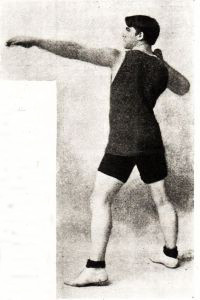
W. W. COE.
Kennington and Kane of English High counted in the next heat, but the latter was disqualified, as on one of the corners he came in contact with Baker of Noble's School, and the latter was thrown. Baker was permitted to go into the final. Garrett and Winslow, two of Cambridge High and Latin's best, won heats, and the latter got a point for his school. Butler was the choice in the final heat, but it was expected that Kennington and Hersey would make him hustle. Kennington bowed to fate by going off his mark and losing a yard at the start. He was making up this distance in fine shape when he went down in a heap on a corner. Butler was not pushed to do his utmost, as Baker, who was coming after him in the stretch, was some yards away.
Worcester High had strong hopes of winning the 600-yard run, basing its faith on the presence of Dadmund, Mills, and Moran. Each one qualified in his heat to run in the final, and the High-School stock was going higher. When the test came Dadmund was found wanting, as his strength failed him. Lincoln, captain of the Boston Latin, was conspicuous in this event, as he held the lead till the last corner, fifteen yards from the worsted. Here Mills caught him, and together they ran shoulder to shoulder the remainder of the distance, Mills falling across the line in the van. It was a most thrilling finish and a victory richly earned, the audience appreciating the struggle.
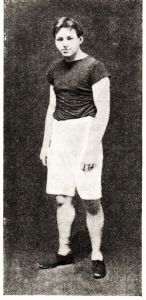
J. H. Converse, of English High, the national interscholastic hurdler, appeared to defend his title, and kept it from being marred, although he had a narrow escape, Hallowell and Cole of Hopkinson's pressing closely to the last foot.
W. D. EATON.
The half-mile walk was another English High event, as all three places went to that school. Mohan, who was credited with a point at the out-door games, set the stride, with Riley and Foley, his schoolmates, in close proximity. On the last lap Griffin of Worcester High challenged Mohan for the lead of the procession, and gained his end, but with disastrous results to his aspirations, for in spite of his coming home first by five yards, the judge of walking had given him his final caution, and Mohan got the prize, with Riley and Foley filling the other places.
The field events had a small following, and in only one case was a record shattered. Rotch of Hopkinson's cleared 5 feet 8½ inches in the high jump, bettering the old figures of 5 feet 8 inches. Converse of English High and Howe of Worcester Academy were tied at 5 feet 7¾ inches, the latter getting the second prize on the toss of a coin, but the points being divided. A similar distribution of points was necessary in the pole vault. C. A. Shorey, the one entry from Cushing Academy, got this event with a vault of 9 feet 6 inches. Keene of Hopkinson's and Kendall of Worcester Academy tied for second at 9 feet.
W. W. Coe, of Noble's School, was prophesied to win the shot, and he pushed the 16-lb. weight 35 feet 7 inches; Eaton of English High was over a foot behind him, with 34 feet 1½ inches; and D. F. Spear, of Worcester Academy, came third, his put being 31 feet 9½ inches.
The six relay races aided in increasing the enthusiasm, and school feeling reached a high pitch of excitement. Dedham High defeated Hyde Park High; Worcester High defeated Noble's and Greenoughs; Newton High defeated Boston Latin; Cambridge High and Latin defeated Hopkinson's; Chauncy Hall defeated Exeter. The climax came when E.H.-S. ended a splendid afternoon by beating Worcester Academy in a race that will be remembered for many days.