SOME REMINISCENCES OF CHARLES DICKENS.
Reading edition
BY HENRY AUGUSTUS ABRAHAM.
he recent death of Mr. Charles Dickens, the eldest son of the great author, reminds a schoolfellow of the former, who enjoyed for many years the friendship of the family, of a few circumstances connected with the author of the Pickwick Papers that, never having found their way to paper, may not be without interest at this moment.
It was due probably to Dickens's great regard for the actor Macready that he selected Dr. King's preparatory school for his son. Macready, who lived not far from King's, and who had heard of his great success as a teacher of the classics, informed Dickens of his intention to send his two boys to the school, and Dickens at once decided to place Charlie, as his son was always called, at the same institution.
King's was situated near the famous Lords cricket-ground on Maida Hill. When Douglas Jerrold heard of this he was anxious to know what made her ill, and trusted that Charlie would be all right.
What Dickens replied "deponent saith not," but at a later date he remarked that his boy was in pretty royal company.
It was here that the schoolfellow and his fortunate companions first set eyes on Charles Dickens. Charlie, quite unconscious of the flutter that he would create in the breasts of his schoolmates, quietly informed them that his father would visit the school on a certain day. Until that auspicious time the Pickwick Papers became more bethumbed than ever. The writer was on the tiptoe of expectation and not a little nervous. What liberties are taken with the names of the great! "Dickens is coming!" If Jones the lawyer were expected, or Pills the apothecary, it would have been: "Mr. Jones is coming; Mr. Pills will visit his son."
When Dickens did come it was with a rush. He lovingly embraced his boy, shook the hands of the fortunate lads who were introduced as Charlie's particular chums, slipped some money into his son's hand, and was off, without the almost inevitable allusion to the pons asinorum or the hic, haec, hoc, those bêtes noire of a schoolboy's existence.
But it was while he was talking to Dr. King that an opportunity was given to study Dickens from a boy's point of view. He was then considerably under forty, but looked—to the boy, remember—a comparatively old man. What was young in him were his hair and eyes. There were not many wrinkles visible, but lines of thought and care marked features that in repose were deceiving in their sternness. As to his dress, the writer has since thought that, while it might have been quite untidy and loud for a butterman's best, it suited Dickens's rapid motions and easy gait. It would be hard to imagine Dickens in prim attire. Such apparel would have been out of place.
It was while summering at Broadstairs, a quiet watering-place on the Kentish coast, that the writer had perhaps the best opportunity to study Dickens's characteristics—the most notable of which most certainly was his love for children. Apparently adoring his own, he still had room in his great heart for other people's darlings. Had it been more generally known that for several seasons Dickens made Broadstairs his abiding-place, that pretty little sea-side resort would have been crowded with visitors. As it was, several of his intimate friends, among them the artists Stone and Egg, made Broadstairs their summer home.
Those twenty-mile rambles, so frequently alluded to, would alone have made Dickens interesting to younger people, who were continually arranging to meet the author and his frequent companion, Miss Hogarth, on the cliffs or sands between Pegwalt Bay and Margate.
Once Dickens came to the rescue of some children who had been overtaken by the tide. Miss Hogarth and the writer were of the party. Dickens summoned donkey-boys from Margate and sent the youngsters home at a gallop. They arrived just as the tide was washing the white cliffs.
Only once in several years did the writer hear Charles Dickens's voice in angry tones. This was the occasion, and it was indelibly impressed on his memory:
"Mamie" (Miss Mary Dickens) and "Katie" (Catharine, named after her mother, whom Dickens always addressed as Kate) were very pretty and interesting girls; indeed, they were the little belles of Broadstairs. They frequently had juvenile tea parties at "Bleak House," as Dickens's Broadstairs home was called. It was situated on a high bluff, and stood alone—a very picturesque but mournful and deserted-looking building, as peculiar in its style as the author's house in Devonshire Terrace, London. Dickens's library had a seaward and an inland view. He was then writing Dombey and Son, and he had told Miss Hogarth that he must not be disturbed. But notwithstanding this injunction, the tea party, rather formidable in numbers, tired of cake and bread and butter, scoured the house and turned it into a Bedlam, gentle Mamie, however, protesting.
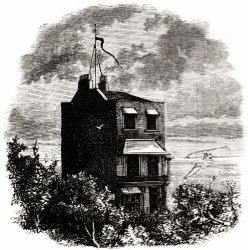
BLEAK HOUSE, BROADSTAIRS. (From an old print.)
At a moment when Dickens was evidently very much engrossed, the children, with a wild rush, broke in on his quietude. The writer, wittingly, or perhaps impelled by force of numbers, found himself within a few feet of the desk where Dickens was writing, and was very much alarmed as Dickens looked angrily on the crowd. But he loved children too well to be angry with them long. Rising from his seat, the frown melting into the smile that always endeared him to young people, he spread his arms and simply shooed us from the room, like the geese that we were, and bade us seek Miss Hogarth, who never seemed to tire of entertaining her niece's guests. But on this occasion the abashed marauders, deeming "discretion" to be "the better part of valor," crept into the garden, where Charlie was engaged in the innocent though perhaps dangerous pastime of gathering some very dubious-looking plums from a tree that had seen better days. Miss Hogarth, having doubtless been interviewed by Dickens, led the young people to understand, later in the day, that strangers would not be admitted to Bleak House until further notice, thus practically breaking up the tea parties. We subsequently learned that Dickens had frequently been disturbed, and it was necessary that silence should reign for a season.
Very little has been written, if indeed anything, of this interesting summer home of the noted author—Bleak House. It was surrounded by high and gloomy brick walls that gave the old place a dreary and forbidding appearance. Its very quaintness moved Dickens to make it his temporary abiding-place. It may have been interesting, but it seemed to the good people of Broadstairs, as they looked on the most exposed spot in all the little place, that only courageous hearts could live at Bleak House. And during a frightful storm, that sunk fishing-smacks and damaged the coast, devastating the esplanade and destroying not a few farm-houses, the frightened residents at morning's dawn looked with pale faces in the direction of Bleak House, almost expecting to find it in ruins. But in spite of its exposed position, the house bravely withstood the gale, although chimney-pots and trees were blown down. The family was naturally alarmed, and betook themselves to apartments adjoining the library on the esplanade. The library and assembly-rooms were the public resort of Broadstairs's quality. But Dickens was rarely if ever seen at the gatherings.
Dickens remarked a few days later to the writer's father that the gale had been an alarming and thrilling experience.
DICKENS'S HOUSE IN DEVONSHIRE TERRACE, LONDON. (From an old print.)
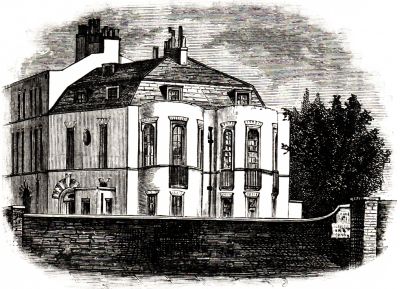
Soon after the meeting at Dr. King's school Charlie's schoolfellow visited the family in Devonshire Terrace, just off the New Road. David Copperfield was then the book of the hour, and because it had been suggested that the author had his own boyhood in mind while writing the novel, Dickens was more of a lion than ever to the juvenile mind. Charlie devoured the pages of the book with avidity. Indeed, all the novelist's children were charmingly appreciative of their father's writings—a flattering incentive to Dickens, no doubt.
At the moment of this visit, his own little darlings, as well as some others, were crawling all over him, reminding one of Gulliver in the toils. But he at once turned to the somewhat bashful visitor, and, in renewing the acquaintance, with delightful tact made the schoolboy feel that he was not de trop.
It was at the juvenile birthday parties that Dickens seemed in all his glory. At the supper table, in helping some little miss to "trifle," he would assure her with all possible gravity that it was no trifle at all. When the writer, urged to make a little speech on the occasion of Charlie's birthday, came to a full stop at the words "I am sure," Dickens at once came to his assistance, and enabled him to retire from the platform, however ungracefully, with the remark, among others, "Always be sure, my dear boy, and you'll get along all right."
At the little theatrical entertainments Dickens was the alpha and the omega of the proceedings. He was sometimes author, adapter, condenser, musical director, manager, prompter, and even stage carpenter. He overflowed with energy.
Dickens, doubtless remembering his own acute sensitiveness as a child, could not wittingly wound a child's feelings. He made fun with, not of us. No party ever came off at Dickens's without "Sir Roger de Coverley" being introduced. Dickens shouted with laughter as some novice got badly mixed up in "all hands down the middle." Off he darted after the lost sheep—generally an awkward boy—and turned his blushes to smiles by saying, "What a dancer this boy will make when he's tackled a little more roast beef!" or, "Isn't Tommy a nice young man for a small party?"
There was nothing of the pedagogue about him. No vulgar attempt to pose as the brilliant "Boz." He was simply a big boy, and he came down the ladder of his fame to meet his fellows on their ordinary platform—to be one of them in their own simple way for a time.