Chapter VIII
Reading edition
CLIFF CASTLE AND ITS OCCUPANTS.
"Oh, sir," cried Todd, "I am indeed grateful to you for all your kindness to me!"
"And I," replied the old gentleman, "am more than pleased to see thee so evidently restored to health. At the same time I sincerely welcome thee to the Valley of Peace, which, with all it contains, is at thy service. May I introduce myself as Rufus Plant, at one time professor of ethnology in Calvert College, but now and for many years resident of this valley?"
"Calvert College, did you say, sir? Why, that is the college where my brother Mortimer Chalmers is professor of geology, and the one that I am to enter next fall. It seems to me, too, that I have heard your name before. Wasn't there something strange about your dis— I mean, I thought you were killed by Indians."
"Doubtless that was the report, and it might well be credited," replied the Professor. "But tell me, lad, is thy name Chalmers?"
"Yes, sir—Todd Chalmers, of Baltimore."
"Can it be that thee is a relative of my old friend Carey Chalmers?"
"He was my father."
"The Lord be praised for all His mercies!" exclaimed the other. "Why, lad, if thee was a messenger from Heaven thy presence could not be more welcome to an old man cut off these many years from intercourse with his fellows. But thee must be sorely in need of refreshment, and it would be wrong to keep thee longer from her who waits anxiously to welcome thee. Therefore let us hasten to the castle, if indeed thee is strong enough for so arduous a climb."
Todd quickly proved that he was now fully equal to the task that he had so nearly accomplished the evening before, and a few minutes later, filled with an eager curiosity, he stood with his new friends on a broad shelf of rock a hundred feet above the valley. It was bordered along its outer edge by a low parapet, and was partially overhung by the cliff that still rose above it. At its inner end was a veritable house of stone, having a door and windows, just outside of which stood one of the dearest of old ladies, clad in Quaker costume.
The boy knew at a glance that she who welcomed him must be the one whom his new acquaintances spoke of so lovingly as "mother"; but more than ever did he wonder at the strangeness of her surroundings, and long for an explanation of the many things that were puzzling him. A thousand questions were at his tongue's end; but he could not ask them then, for the dear old lady at once led the way into the house, saying:
"Not another moment shall thee be kept from thy breakfast, Todd Chalmers; for starvation is one of the things not permitted in Cliff Castle, and hunger is written on thy face."
Never had Todd entered so queer an abode, nor one so filled with curious objects, as when he passed the doorway of that little dwelling. Its low roof was not more than two feet above his head, and its interior walls of white clay were covered with rude drawings in color that strongly suggested the work of ancient Egyptians. The stone floor was covered with rugs of goat and deer skins; several articles of rude furniture, besides blocks of jasper and agate used as seats, were conveniently placed, while great earthen-ware jars, quaint in shape and beautifully decorated in colors, stood on all sides. In one corner was a rude fireplace, which was evidently used only to furnish warmth, as Todd had already noticed another, provided with appliances for cooking, on the outer platform.
Best of all, in our hungry lad's estimation, was a table covered with a snowy cloth and laden with food. Nearly all its furnishing—including bowls, platters, jugs, and small dishes—was of earthen-ware quaintly devised and ornamented. There were also several steel knives and forks, half a dozen silver spoons, three white china cups, and as many saucers.
Served on these queer dishes was a breakfast of broiled chicken, oatmeal, corn-bread, and another bread made from grass-seeds, eggs, and stewed peaches, besides small white cheeses, and a jug of goat's milk, all of which combined to make a meal that seemed to Todd better than any he had ever before tasted. It made him pity himself to recall how, only the day before, he had been very nearly starved actually within sight and reach of all this abundance.
When his hunger was at length satisfied, the boy related his adventures of the past few days, describing his wanderings on the desert, his efforts to reach the blue peaks that ever beckoned him forward, his finding of the valley, his perplexity at discerning signs of human occupancy but no inhabitants, his joy at seeing the smoke from Cliff Castle, his fruitless attempt to reach the place from which it ascended, and his doubts as to the kind of reception he might meet from its occupants.
To all this the lad's hearers listened with deepest interest, frequently interrupting him with questions and exclamations. When he had finished he turned to the Professor, saying:
"Now, sir, that you have learned how I happen to be in this place, will you not tell me of your own experience in reaching it, and your reason for remaining here all these years?"
"Gladly will I gratify thy most natural curiosity," replied the old man, "but I must ask thee to wait until evening; for the narrative is of such length that it cannot be told until our affairs are ordered for the day. Therefore, let us first return thanks to our Heavenly Father for His abounding mercies, and then attend to the duties awaiting us."
With this the old man led the way to the outer platform, to which Nanahe fetched a small Bible, that was the only book the Indian lad had ever seen, and from which he read aloud, without hesitation, the exquisite Twenty-third Psalm. While he read, Todd gazed over the underlying valley, and wondered that its every feature should appear so familiar to him. Suddenly he recalled the mirage that three days before had first turned his steps in this direction, and knew that the picture then presented was an image of the one upon which he now looked.
After the simple service was ended the Professor and Nanahe descended into the valley, carrying with them the fowls that had been brought to the castle for safety during their two days' absence. The old lady busied herself with domestic duties, and Todd found himself at liberty to explore the quaint little house, which, his hostess informed him, was only one of many, long since abandoned by their builders, that were to be found among the cliffs enclosing the valley.
"Thee must have read of the ancient cliff-dwellers of this region," she said, "and so will understand when I tell thee that this place of abode and most of its contents were made by their hands, and that we are to-day leading the very life of that long-vanished people."
"But what became of them?" asked Todd.
"That is a mystery that many persons have tried in vain to solve. My husband is of the opinion that they were forced to migrate, either by flood or drouth, but expected to return, since they left their most valued possessions behind them, and carefully concealed the only entrance to the valley. Had they been destroyed by an enemy, their possessions would also have been destroyed or removed, whereas nothing had been touched from the day they left, probably hundreds of years ago, until that on which we were led to this place, and it was given to us for a house."
"It was very wonderful," said Todd; "but the strangest part of all is to find you and your husband and a young Indian living here so contentedly and comfortably. I can't understand it all, and wish you would tell me how it came about."
"Have a little patience and it shall be made clear to thee," replied the old lady, with a smile. "It is a tale of strange experiences, and I would gladly relate it, but I know the Professor has set his heart on telling it himself."
So Todd was forced to wait, and passed the morning in an examination of the dwelling and its contents. Later in the day he descended to the valley, where at the hut he found Nanahe cutting into thin strips, for drying, the meat of a deer that he had just brought in.
"How did you kill it?" asked Todd. "I didn't know you had a rifle."
"I have not, nor did I ever see one," replied the Indian lad. "I killed it with my throw-stick."
"Throw-stick?" repeated Todd, with a puzzled air. "What is a throw-stick?"
NANAHE EXHIBITS HIS THROW-STICK.
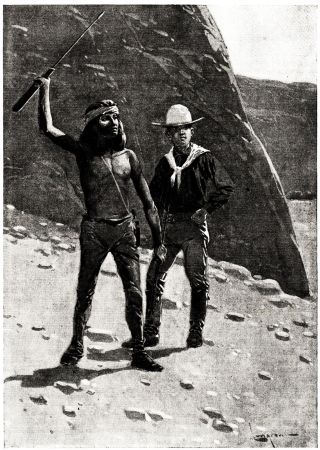
For answer Nanahe handed him a stick of tough wood two feet long, about as many inches in diameter, and fitted at one end with a handle in which were two finger-holes. The weapon was completed by a slender lance having a barbed head formed from a splinter of obsidian, keen-edged as a razor. Nanahe laid this lance on a flattened side of the throw-stick, with its butt resting against a bit of bone that was embedded in the wood near the upper end of the weapon. The lance was held in position by the thumb and one free finger of the thrower's right hand until the act of throwing was begun. Then it was released and sent whizzing through the air with such force that it fell to the ground more than one hundred yards away.
"Now I understand," cried Todd, "for I have often thrown apples from the end of a stick in just that way. But surely you can't throw the lance with any degree of accuracy."
Without replying, Nanahe smilingly selected half a dozen of the stone-headed shafts, and hurling one after another with inconceivable quickness at a tree some thirty yards from him, set them quivering in its bark so close together that a ring two inches in diameter would have encircled them all.
"Good enough!" cried Todd, enthusiastically. "I give in, and acknowledge that your throw-stick is a wonderfully effective weapon. But where did you pick up the idea?"
"The Professor found some of them in the cliff houses," answered Nanahe. "He says that in very ancient times all hunters used them, and that even now they are common among people called Eskimos who live in a far-away land of ice and snow. He taught me how to use them, and this one I made myself."
"Well," said Todd, "I begin to see how people get along and manage to live comfortably in a place like this; but it certainly takes genius to do it. As for myself, I know I should have starved long before I learned to kill a deer or even a rabbit with any such primitive weapon as a throw-stick. Now let's get back to the castle, for it must be supper-time, and after that I am to hear the Professor's strange story."
[to be continued.]
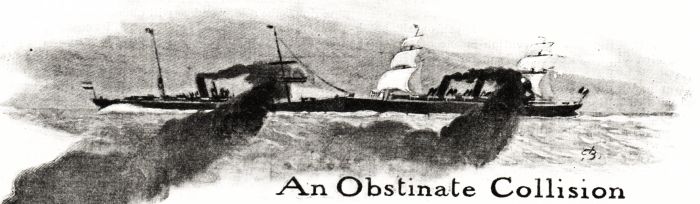
ONE OF THE OLD SAILOR'S YARNS.
BY W. J. HENDERSON.
t was a crisp morning in late October. All the land was sere and yellow, darkening away into brown shadows. The trees kept their garments of leaves, but these were ragged and sombre, as if the heat of summer had worn and burned them. The grass at the foot of the trees was brown and gray, and the bare branches of the field bushes made naked perches for belated birds. The sky was wan and faint near the rigid horizon, but deeply blue in the zenith; and the sun, far down the southern vault of the heavens, rolled westward in a glory of silver. The sea was of a gorgeous ultramarine color, with a dash of royal purple in its shadows, and a glitter of cold emerald in its transparent crests. A light nor'west wind barely ruffled its surface, yet sufficed to fill the sails of a score of schooners which were ploughing a snowy road to the southward.
Henry and George felt that it was a good day for yarns, and so they hurried out of the house immediately after breakfast and bent their steps toward the pier. There they saw their old friend in his familiar attitude, with his eyes fixed on two steamers which were rapidly approaching each other from opposite directions. He did not turn his head as the boys approached him, but said, in a meditative manner,
"It are not no sort o' kind o' use fur to try to git past without shiftin' yer helm."
Then he relapsed into silence, while the two boys stood wondering what was coming next. Presently the Old Sailor broke out again,
"Do ye see them two steamers?"
"Yes," answered both boys.
"Waal, they are agoin' fur to pass putty close."
At that instant a gush of white steam rose from one of them, and the hoarse cry of her whistle rumbled across the water. The other vessel answered with a single blast.
"An' wot do that mean?" asked the Old Sailor.
"That means," answered Henry, "that they are going to port their helms and keep off to starboard."
"Werry good, too," declared the Old Sailor. "An' ef they didn't, wot'd happen?"
"They would bump into each other," answered George, soberly.
"W'ich the same it'd be a colligion," said the Old Sailor, "an' mebbe it would be like the colligion o' the Lord Kindlin'wood an' the Orange Mary, an' mebbe it wouldn't, 'cos w'y, I don't reckon there ever were no sich colligion afore, an' I don't reckon as how there ever will be agin."
"Will you please tell us about it?" asked Henry.
"In course I will, my son. W'enever I recomembers one o' them picooliar misfortins wot has happened to me at sea, I allus tells ye about it, don't I?"
The Old Sailor fixed his eyes on the two steamers, which were now passing each other very closely, and shook his head.
"It are all werry putty in clear an' calm weather," he said; "but it ain't no good wotever in weather wot are dirty. Waal may I never live to see a ship's cook at the fore-sheet ag'in ef it weren't jess like I'm agoin' fur to tell ye. I were in Liverpool an' didn't have no berth at all, so I were more'n half tickled to death w'en I met old Jonas Pettigrew, the shippin' agent, an' he sez to me, sez he, 'They 'ain't got no mate on the Lord Kindlin'wood yet.' I'd heerd about her. She were bound fur Calcutta an' Hong-kong by way o' the Suez Canal, an' her Cap'n were a Frenchman, 'cos she'd jess been bought by a French company in Canton. So I went down to the dock where she were a-takin' in her cargo, an' I sez to the Cap'n, sez I, 'Here are a mate fur ye.' His name were Zhan Four—anyhow, that's as near as I can come to wot he called hisself. 'Ala bonner,' sez he to me, sez he, w'ich the same it are French fur 'Bully fur you.' We soon come to tarms, an' I turned to.
"Waal, we didn't have no incidents or accidents o' no kind at all on the run down to Alexandry. Then the wind come in from the south'ard an' east'ard an' blowed putty nigh straight up the sea. I don't remember any nastier sea than it kicked up. The Lord Kindlin'wood would stand straight up on her starn-post, an' then take a pitch forrad and go clean into it up to her foremast. We had double lookouts up in the crow-nest, an' they was under water so much o' the time that they hollered fur divin'-suits.
"Waal, it blowed an' it blowed an' it blowed. It blowed so hard on the second day that it cut the tops right off'n the seas, an' sent 'em flyin' along like buckets o' rain, an' blow me fur pickled oysters ef ye could stand with your face up to wind'ard.
"Howsumever, we got used to it arter a while, an' the cook took to singin', so we knowed we was all right. But along about the middle o' the fust dog-watch one o' the lookouts yelled, 'Steamer ho!' I jumped into the fore-riggin' an' seed the wessel dead ahead o' us. She were a steamer about our own size, bound to the north'ard. She were runnin' at full speed ahead o' the gale, an' were drivin' along like the werry tops o' them seas wot I told ye about. Only she were actin' a little different from the Lord Kindlin'wood, 'cos w'y, she were a runnin' with the seas. So w'en one o' them would roll in under her starn she would h'ist her taffrail up into the air, an' plough forrad with her head down for all the world like a mad bull. Then the sea would underrun her an' git under her bow, an' she'd sit up on her starn-post with her bow p'inted away up in the air, an' like the werry tops o' them seas wot I told ye about. That were all right, but wot discomforted me w'en I saw her were that she were a-headin' right dead on end at us. Now we didn't dare fur to shift the Lord Kindlin'wood's helm an inch. We had to keep her head to the seas, 'cos w'y, it were the only way she'd lay to an' behave herself. The other wessel I sort o' reckoned, bein' about our size, would be in danger o' broachin' to ef she shifted her helm. So I were somewhat anxious 'bout how the two on 'em was agoin' fur to git past each other. I sent a man aft to call the Cap'n, an' he came on the bridge an' danced a reg'lar jig. 'Ef she turn not away she will make to the bow a bump!'
"'Wot is the orders, Cap'n?' sez I to he, sez I.
"'Blow the wheestle! Blow the wheestle!' sez he to me, sez he. An' accordin'ly I blowed it once, signifying accordin' to the rules o' the road at sea, that we were puffickly agreeable that both parties should keep to the right. The other ship she blowed hers back at us. O' course we couldn't hear nothin', but we could see the steam, an' we knowed she were agreeable. But she didn't change her course a little bit.
"'Dogs an' cats an' little kittens!' sez Cap'n Zhan Four, in French. 'Ef he change not the course, we are collided.'
"'Shall I order the helm to be shifted, Cap'n?' sez I to he, sez I.
"'Non! non! All the time non!' sez he to me, sez he. 'I turn not out of my path for such rubbeesh! I hit him in the meeddle, the miserable shadow of a dead horse!'
"'Werry good, sir,' sez I to he, sez I.
"An' I sez to the man at the wheel, 'keep 'er steady.' The other wessel, seein' we didn't change our course, blowed her whistle several times, but o' course that didn't 'nay pa riang,' as the Cap'n sez. Waal, to make the story short, this are edzackly wot happened. The Lord Kindlin'wood riz up over one o' them flat-topped seas, an' plunged head fust down the other side. At the werry same instant the stranger were sittin' up on her taffrail gittin' ready to dive down; an' consequentially we 'n the two ships come together precisely an' direckly head on, the stranger's bow overrun ours, an' she came down with her forefoot right on top o' our fo'c's'le deck. There were one grand crash, an' fur half a minute ye couldn't see nothin' 'cept flyin' timbers, iron, egg-shells, an' ham bones. In the middle of it all ye could hear the Cap'n screechin' in French, an' the two whistles a-blowin', an' the mates yellin' to clear away the boat-falls, 'cos w'y, it were not to be expected that both wessels would do anything 'ceptin' go to Davy Jones's locker in about five minutes. But they didn't, an' that are the picooliar part o' this 'ere yarn wot I'm a-tellin' ye, an' also the werry partikler reason w'y I are not a-feedin' Red Sea fish like Pharaoh's army.
"It warn't no sort o' proper behavior fur wessels wot, accordin' to the laws o' colligions, ort to gone to the bottom; but sich as it were, this were the bloomin' ridiklous way on't. The stranger's bow comin' down right on top o' ourn cut through the decks jess like a axe, straight down to the k'elson. An' there it stopped, bein' wedged in jess like the axe in a log, an' a dozen tugs couldn't 'a' pulled her out. An' wot we found out arter a few minutes, w'en we'd all got through bein' crazy, were that she were wedged in so tight that there weren't a leak anywhere at all, an' them two ships was actooally made into one, 'ceptin' that it were a new kind o' wessel with two starns, an' no more bow than a bass-drum. The Cap'n o' the stranger he comes forrad on a run an' a jump, and w'en he got to the place w'ere our cat-heads was alongside o' his he stopped, an' sez he, bawlin' like Feejee Injun in a fit o' cholery:
"'Donner unt blitzen! vot kind o' peezness vas dot? Vere ist der Gept'n?'
HE JUMPED CLEAN OFF THE BRIDGE AND DANCED ON ONE FOOT.
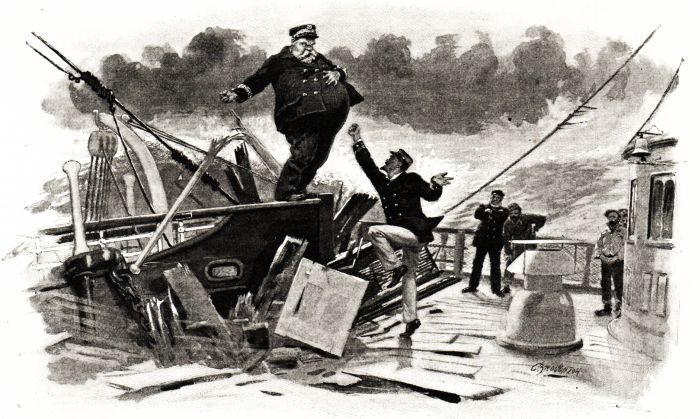
"Ye see, we l'arned by his way o' talkin' that he were a bloomin' Garman, an' I looked to see some fun w'en Cap'n Zhan Four an' him got laid yard-arm to yard-arm. But they couldn't edzackly do that, 'cos w'y, 'cos they was laid bow to bow, like a couple o' buckin' billy-goats in a fight. As soon as ever Cap'n Zhan Four heard the Garman Cap'n talk he jumped clean down off'n the bridge to the fo'c's'le deck an' danced on one foot, while he yelled:
"'Singe cornay of a Allemand!'—w'ich means dog-eared monkey of a Garman, an' are not no perlite way fur one gen'leman to address another at sea—'why do you make to knock a hole in my sheep?'
"'Ach, du dummer aysel!' sez the Garman, sez he; 'wot for you ton't ged your sheep out der vay?'
"'My sheep makes not to be in the way,' sez Cap'n Zhan Four, sez he; 'it is your sheep that comes straight at mine an' runs upon her, unessy pa?'
"'Donnerwetter!' sez the Garman, 'how could I dot help? I vas before der seas, unt you vas behint. Das macht nichts aus!'
"'Silonce!' screeched Cap'n Zhan Four. 'Speak not the accursed tongue of Garmany at me!'
"'Sprechen sie nicht dot frog talk at me!' howls the Garman. 'I speak der lankwitch von my vaterland alvays!'
"'Hoist the French flag!' sez Cap'n Four.
"'Up mit der Garman flag!" sez the Garman.
"An' as soon as the flags was run up them two crazy critters commenced fur to dance up an' down their two forrad decks right in each other's faces, one on 'em singin' the 'Marseillaise,' an' the other 'Die Wacht am Rhein,' like they was fit to bu'st theirselves. An' in the mean time, o' course, the two bloomin' ships, jammed together, slewed around broadside on to the sea, an' a big wall o' green water broke aboard an' putty nigh swept the two on 'em overboard. Anyhow, it put a stop to their singin', an' sot 'em a-thinkin' about their 'sheeps,' as they called 'em.
"'Back out you!' yelled Cap'n Zhan Four.
"'Nicht!' shouted the Garman. 'Ich back for no Frenchman alretty yet! Back you!'
"'Jammy! Jammy!' screeched Cap'n Four, an' 'jammy' it were, only that are French fur 'not on yer life!'
"'I go aheat full speet!' sez the Garman.
"'Ay maw,' sez Cap'n Four, w'ich the same that are French fur 'me too.' An' then them two wild men o' the sea orders their engines ahead full speed, an' the two ships commenced a grand pushin' match, fur all the world like one o' them there feet-ball games wot the long-haired collidge fellers plays in the mud every autumn. Now this 'ere shovin' game were a putty even match atwixt them there two ships, 'ceptin' fur one thing, an' that were that the Garman had the wind an' sea with him. So he commenced fur to push the Lord Kindlin'wood back'ards up north'ard toward the canal agin. Waal, boys, I reckon ye've seed a good many mad men, but ye 'ain't never seed none half or quarter as mad as that there French Cap'n Zhan Four. He said more funny things in French than ever I kin recomember, an' he got so red in the face that he putty near busted hisself. Howsumever, it didn't do no good, 'cos w'y, the Garman had the best on't in the matter o' the elements, an' he were steadily a-shovin' of us back to w'ere we come from, w'en the gale broke, an' the sea beginned fur to go down. The barometer riz, an' I looked fur a smart shift o' wind, w'ich the same it come along all right about three bells in the arternoon watch o' the second day. It dropped right around to nor'west, an' in ten minutes were blowin' a brisk breeze.
"'Sacred name of St. Michael!' sez Cap'n Zhan Four, sez he, 'now I push the Garman to the south pole!'
"'I hope ye ain't agoin' az fur as that,' sez I, ''cos I shipped fur Calcutta an' Hong-kong, an' I 'ain't got my seal-skin overcoat along with me,' sez I, jess like that, him bein' a crazy French Cap'n and me a werry partiklarly sane American mate.
"'I push him anywhere I want to!' sez Cap'n Zhan Four.
"An' he orders more fire an' more steam. An' putty soon we found that we'd stopped goin' back'ard an' was a-holdin' the Garman in his place. But we couldn't make him go back'ard fast enough fur to suit Cap'n Zhan Four. So seein' the wind were putty fresh, I sez to the Cap'n, sez I,
"'Wot's the reason we don't set all our canvas?'
"'Excellentment!' sez he, w'ich are French fur 'bully,' an' I jumps out an' gives the orders.
"Waal, boys, jess as soon as we got the canvas on her we commenced fur to push the Garman back'ard, an' he commenced fur to do the dancin' an' howlin'; but it didn't do him no good. He heaped coal onto his fires an' he burnt oil an' ham fat, but he couldn't hold us. We shoved him all the way down the Red Sea an' out into the Indian Ocean. Then he got his men forrad an' tried to cut his ship out o' ours, but Cap'n Zhan Four ordered the hose turned on 'em with hot water, an' that stopped that job. Finally, the Garman Cap'n, he come forrad with a flag o' truce, an' sez he'd like to make a treaty o' peace atwixt Garmany an' France on the high seas. So him an' Cap'n Zhan Four had a long talk, an' finally they agreed that they'd make fur the nearest port, each one agreein' to be pushed back'ards half-way an' to keep his engines agoin' reversed to help things along. An' so we finally reached the island o' Socotra, w'ere we contrived to get the ships apart an' patch ours up fur the run to Bombay."