STORIES OF AMERICAN LITERATURE.
Reading edition
BY HENRIETTA CHRISTIAN WRIGHT.
JAMES FENIMORE COOPER.
HE DISTINGUISHED THE CALL OF ANIMALS.
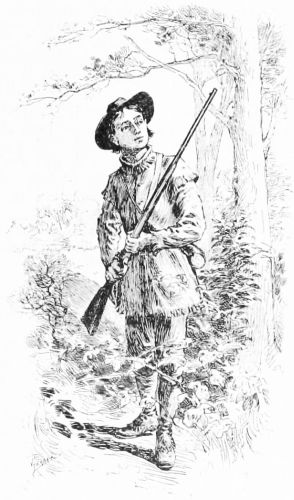
Late in the eighteenth century the village of Cooperstown lay almost in the midst of the primeval forest, which extended for miles around. Here the future novelist James Fenimore Cooper had been brought while yet an infant by his father, who had built the family mansion, Otsego Hall, in this secluded spot, far from the highways of travel, designing to make it the centre of a settlement of some note, if possible. Here, as the boy grew older, he learned wood-lore as the young Indians learned it, face to face with the divinity of the forest. He knew the language of the wild animals, and could distinguish their calls far across the gloomy spaces of the wood; he could follow the deer and bear to their retreats in dim secluded recesses; he could trace the path of the retreating wolf by the broken cobwebs glistening in the early sunlight; and the cry of the panther to its mate high overhead in the interlacing boughs of the pines and hemlocks was of a speech as familiar as his own tongue. When he was thirsty he made a hunter's cup of glossy leaves and drank in true Indian fashion; when fatigued, he could lie down and rest with that feeling of security that only comes to the forest-bred; when thoughtful, he could learn from the lap of the waves against the shore, the murmur of leaves, and the rustle of wings those lessons which Nature teaches in her quiet moods.
These experiences and impressions sank into Cooper's heart, and were relived again long after in the pages of his romances with such vividness that they are plainly seen to be real memories.
Leaving his home while still a young boy, Cooper went to Albany to study under a private tutor, and in 1803 entered Yale College, which, owing to some trouble with the authorities, he left in the third year of his course. It was now decided that he should enter the navy, and he left New York in the autumn of 1806, being then in his fifteenth year, on a vessel of the merchant marine. There was then no Naval Academy in America, and a boy could only fit himself for entering the navy before the mast; his ship, the Sterling, visiting Portugal and Spain, carrying cargoes from port to port, and taking life in a leisurely manner that belonged to the merchant sailing-vessels of that day. It was a time of interest to all seamen, and Cooper's mind was keenly alive to the new life around him. The English were expecting a French invasion, and the channel was full of ships of war, while every port on the southern coast was arming for defence. The Mediterranean was yet subject to incursions of the Barbary pirates, who would descend under cover of night upon any unprotected merchant-vessel, steal the cargo, scuttle the ship, and carry away the crew to be sold as slaves to the Tripolitan and Algerian husbandmen, whose orchards of dates were cultivated by many a white person from across the Atlantic, held there in cruel slavery.
The waters of the Mediterranean were full of merchant-men of all nations. Here, side by side, could be seen the Italian, French, and English sailor, while the flags of Russia, Turkey, Egypt, and Greece dotted the farther horizon.
HIS PLACE WAS ON THE DECK AMONG THE SAILORS.
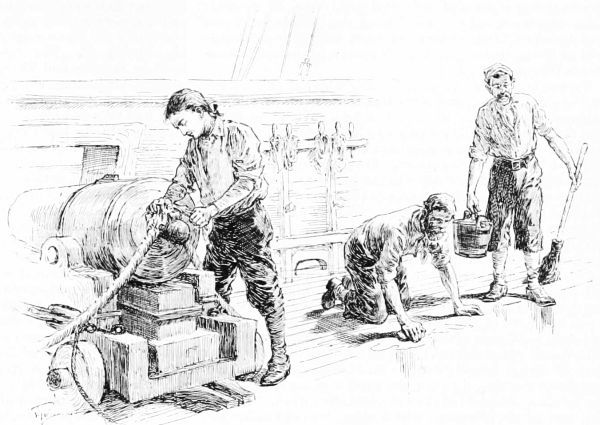
Cooper passed through all these stirring scenes, known to those around him only as a boy before the mast, but in reality the clever student and observer of men and events. His work was hard and dangerous; he was never admitted to the cabin, though an equal, socially, to the officers of the ship; in storm or wind or other danger his place was on the deck among the rough sailors, who were his only companions during the voyage. But this training developed the good material that was in him, and when, in 1808, he received his commission as midshipman, he entered the service better equipped for his duties perhaps than many a graduate of Annapolis to-day.
Cooper remained in the navy three years and a half, seeing no active service. He finally resigned his commission, and passed several succeeding years of his life partly in Westchester County, New York, and partly in Cooperstown, and having no ambition beyond living the quiet life of a country gentleman.
It was not until 1820, when he was in his thirty-first year, that he produced his first book or novel of English life, which showed no talent, and which even his most ardent admirers in after-years could not read through. It was not until the next year, 1821, that a novel appeared from the hand of Cooper which foreshadowed the greatness of his fame, and struck a new note in American literature. American society was at that time alive with the stirring memories of the Revolution. Men and women were still active who could recall the victories of Bunker Hill and Trenton, and who had shared in the disasters of Monmouth and Long Island. It is natural that in choosing a subject for fiction he should turn to the recent struggle for his inspiration, and American literature owes a large debt to him who thus threw into literary form the spirit of those thrilling times.
His first important novel, The Spy, was founded upon a story which Cooper had heard many years before, and which had made a profound impression upon him. It was the story of a veritable spy, who had been in the service of one of the Revolutionary leaders, and whose daring and heroic adventures were related to Cooper by the man who had employed him.
Cooper took this old spy for his hero, kept the scene in Westchester, where the man had really performed his wonderful feats, and from these facts wove the most thrilling and vital piece of fiction that had appeared in America.
The novel appeared in December, 1821, and in a few months it was apparent that a new star had risen in the literary skies. The book made Cooper famous both in America and Europe. It was published in England by the same publisher who had brought out Irving's Sketch-Book, and it met with a success that spoke highly for its merit, since the story was one telling of English defeat and American triumph. It was put into French by the translator of the Waverley novels, and before long versions appeared in every tongue in Europe. It was regarded not merely as a tale of adventure in a new department of story-telling, but it was generally conceded to be a fine piece of fiction in itself, and its hero, Harvey Birch, won, and has kept for himself, a place hardly second to any creation of literature.
Cooper had now found his sphere, and his best work henceforth was that in which he delineated the features of American history during the struggle for independence. His greatest contributions to literature are found in the short series of novels called "The Leatherstocking Tales," and in his novels of the sea. "The Leatherstocking Tales" consist of five stories, in which the same hero figures from first to last. The series began with the publication of Cooper's second novel, The Pioneers, but the story of the hero really begins in the fascinating pages of The Deerslayer, where he is represented in the first stage of his career.
The series grew much as Tennyson's Idylls of the King grew, the same man being introduced in different parts of his career, though each separate book did not follow in exact order from the author's hand. The success of The Pioneers was remarkable. Thirty-five hundred copies were sold before noon on the day of publication, and although, perhaps, the least powerful of the "Tales," it was read with the same interest that had been given to The Spy.
In the new novel Leatherstocking was first introduced as the philosopher of nature, ignorant of books, but wise in the lore that is taught by the voices of Nature. It is a story of the primitive life of the frontiersmen of that day, and their occupations, interests, and ambitions form the background to the picture of the hero, Leatherstocking, who embodies the author's idea of chivalrous manhood, and whose creation is one of the noblest achievements of fiction.
The scene of The Pioneers was laid in the vicinity of Cooper's boyhood home, and all the exquisite pictures wrought into the setting are vivid and lifelike illustrations of the little frontier village, where man received his sustenance first hand from Nature, and where all his surroundings partook almost of the simplicity of the first ages of the world. It was an appropriate theatre for the actions of that rustic philosopher Leatherstocking, and there is a vein of tender reminiscence through the book that must always give it a charm apart from the rest, though in itself it is the least perfect story of the series.
The story of Leatherstocking begins in The Deerslayer, though it was not written until twenty years after the publication of The Pioneers. The scene was laid on Otsego Lake, and the character of Leatherstocking was drawn as that of a young scout just entering upon manhood. The next year, 1841, came The Pathfinder, having for its background the shores of Lake Ontario, with which Cooper had become familiar during the winter there in the service of the navy.
In these two books Cooper reached the highest point of his art. Leatherstocking appears in The Deerslayer as a young man full of the promise of a noble manhood. And this ideal character is developed through a succession of stirring adventures, the like of which are to be found only in the pages of Scott. Side by side with Leatherstocking stand those pictures of Indian character, which became so famous that the Indian of that day has passed into history as represented by Cooper.
The Pathfinder carries Leatherstocking through some of the most exciting episodes of his adventurous career, and belongs to the same part of his life as The Last of the Mohicans, published sixteen years before, the scene of which is laid near Lake Champlain. The Last of the Mohicans takes rank with The Deerslayer and The Pathfinder in representing Cooper at his best. In these three novels we see Leatherstocking as a man in the prime of life battling with the stirring events that were making the history of the country. All the story of the war of the white man with nature, with circumstances, and with his red brother in civilizing the frontier, is told in these books. It is the romance of real history, and Leatherstocking had his prototype in many a brave frontiersman whose deeds were unrecorded, and whose name was never known beyond his own little circle of friends.
In The Pioneers Leatherstocking has become an old man who has sought a home in the forest to avoid the noise and strife of civilized life, and he closes his career in The Prairie, a novel of the plains of the great West, whither the old man has gone to spend his last days. It is the story of a lonely life of the prairie-hunter of those days, whose love for solitude has led him far from even the borders of the frontier, and whose dignified death is a fitting ending to his noble and courageous life. It is supposed that this end to Leatherstocking's career was suggested to Cooper by the ever-famous Daniel Boone, and some of the incidents of the story read like real life. One of Cooper's most famous descriptions—that of the prairie on fire—occurs in this book—a scene excelled only by the description of the panther-fight in The Pioneers, or the combat between Deerslayer and his foe.
Cooper began his series of sea novels by the publication of The Pilot in 1824, and stands as the creator of this department of fiction. He was the first novelist to bring into fiction the ordinary, every-day life of the sailor afloat, whether employed on a merchant vessel or fighting hand to hand in a naval encounter. Scott's novel, The Pirate, had been criticised by Cooper as the evident work of a man who had never been at sea, and to prove how much better an effect could be produced by one familiar with ocean life he began his story, The Pilot.
COOPER READING TO AN OLD SHIPMATE.
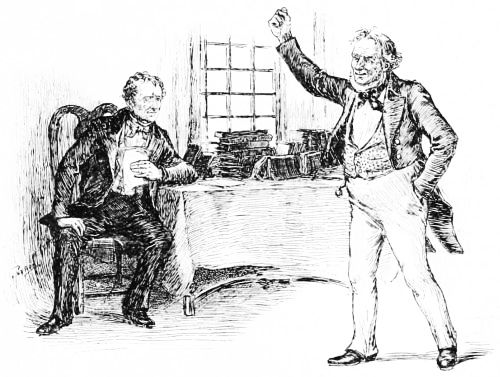
The period of the story is the American Revolution, and the hero was that famous adventurer John Paul Jones, introduced under another name. It was such a new thing to put into fiction the technicalities of ship life, to describe the details of an evolution in a naval battle, and to throw in as background the vast and varying panorama of sea and sky, that Cooper, familiar as he was with ocean life, felt some doubt of his success. In order to test his powers, he read one day to an old shipmate that famous account of the passage of the ship through the narrow channel in one of the thrilling chapters of the yet unfinished work. The effect was all that Cooper could desire. The old sailor got into such a fury of excitement that he could not keep his seat, but paced up and down the room while Cooper was reading; in his excitement he was for a moment living over again a stormy scene from his own life; and the novelist laid down the manuscript, well pleased with the result of his experiment. The Pilot met with an instant success both in America and Europe. As it was his first, so it is perhaps his best sea story. In it he put all the freshness of reminiscence, all the haunting memories of ocean life that had followed him since his boyhood days. It was biographical in the same sense as The Pioneers, a part of the romance of childhood drafted into the reality of after-life.
Red Rover, the next sea story, came out in 1828. Other novelists had begun to write tales of the sea, but they were mere imitations of The Pilot. In the Red Rover the genuine adventures of the sailor class were again embodied in the thrilling narrative that Cooper alone knew how to write, and from its first appearance it has always been one of the most popular of the author's works. In these pages occurs that dramatic description of the last sea fight of Red Rover, one of Cooper's finest achievements.
Cooper's popularity abroad was equalled only by that of Scott. His works as soon as published were translated into almost every tongue of Europe, and were sold in Turkey, Prussia, Egypt, and Jerusalem in the language of those countries. It was said by a traveller that the middle classes of Europe had gathered all their knowledge of American history from Cooper's works, and that they had never understood the character of American independence until revealed by this novelist.