KING ARTHUR AND HIS KNIGHTS.
Reading edition
IV.—THE FINAL TRIAL.
"Ten Knights, as before, were put by the stone to guard it until the new trial," continued the Story-teller. "The Archbishop was not going, through lack of care, to have it said that anything had been done to the stone meanwhile to make it harder for the contestants to pull forth the sword, or easier for Arthur to perform that feat."
"I'll bet those Knights practised on it, though," said Jack. "I would have."
"It wouldn't have done any good, I imagine," said his father. "There was something mysterious about it all, and whatever that was it worked in favor of Arthur and against all the others."
"I don't believe all ten of 'em together could have pulled it out," Mollie put in. "It was one of those trick swords, like men swallow at circuses, I guess, and I'm certain that Mr. Merlin put it there, and showed Arthur how the trick worked. It had a spring in it, which he could touch with his thumb to make it come out, maybe."
"Maybe so," said her father, "although I doubt it. There were lots of queer things happening in those days that we of to-day would hardly believe if we saw them with our own eyes—things that sound in the telling of them quite like fairy stories."
"Like Merlin being able to tell what was going to happen next week?" suggested Jack.
"Exactly," said the Story-teller. "If anybody claimed to be able to do that now, we'd laugh at him."
"He'd be a great man for a newspaper," said Jack. "If a newspaper had a man like that on it, it could tell the people in advance that such and such an accident was going to happen at such and such a time on such and such a railroad, and then the people wouldn't go on that road at that time, and their lives would be saved."
"That's so," said Mollie. "And if the accident was going to happen because a switchman was asleep, somebody could be sent ahead to wake him up, so that the accident wouldn't happen at all."
"There is no doubt about it," said the Story-teller. "A man like Merlin would be very useful in these days, but his kind is very much like the leviathans and mastodons that lived before the flood. The race has died out, and true prophets are as scarce now as huckleberries in December. But to come back to the story, whether there was a spring in the sword or not, Merlin was undoubtedly responsible for it, and whatever he did, he did it in Arthur's behalf, for when Candlemas day came about again the same thing happened that had happened before. The sword would not budge for any one but Arthur, and a great many people began to be convinced that he was the rightful King. There were enough dissatisfied persons, however, to make one more trial necessary, and the Archbishop, yielding to these, set one more date, that of Easter, for the final contest."
"He had to earn it, didn't he," said Mollie.
"You bet he did," said Jack. "It must have been like our medals at school. You've got to win it six times in succession, once every month, before it's yours for keeps."
"But you know about that rule before you begin," said Mollie. "It's fair enough in school, but it seems to me Arthur won it at the start, and ought to have had it."
"He certainly did win it at the start, under the terms of the contest," said her father. "Still it was just as well, under the circumstances, that there should be no dissatisfaction among those who lost, and as it wasn't at all hard for Arthur to pull the sword out, he couldn't complain. The others had to work a great deal harder than he did, and, in the end, got nothing for their pains."
"I guess the Archbishop kind of liked to see all those people pulling and hauling at it," suggested Jack, with a grin. "It must have been something like a circus for him, anyhow, with all those knights in their fine spangles, and their horses with splendid harness, and all that."
THEY ALL KNELT BEFORE HIM, AND HE WAS CROWNED.
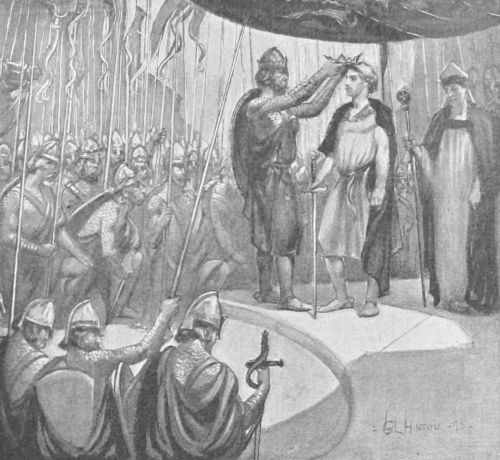
"Very likely," said the Story-teller. "That view of it never occurred to me before. It has always been a matter of wonder to me that the Archbishop made poor Arthur go through the ordeal so many times, but now I begin to understand it. He wanted to be entertained as much as anybody else, and very possibly he ordered so many repetitions of the performances to that end, knowing, of course, that by so doing he could not injure Arthur's chances. Arthur had to be very careful of himself, however, between times. The other Knights were too anxious for the prize to stop at playing tricks on him, and Sir Ector saw to it that wherever he went he had a strong guard about him to keep him from harm. These guards, made up of the most faithful men in his father's service, kept watch over him night and day until Easter, when the final trial came off with no change in the result. Arthur pulled the sword lightly out of the stone, but despite their struggles the others could do nothing with it. Then the people themselves were satisfied. The Knights may not have liked it any better than before, but the people did, and they cheered him to the echo, and said that the question was now settled for once and for all, and offered to slay any man who now dared to say that Arthur was not entitled to the throne. They all knelt before him, and he was knighted by one of the bravest men of the day, and shortly after he was crowned. It was a long trial for him, but he was patient and worthy, and withstood every test, and in the end he got his reward."
"Well, I'm glad of it," said Jack. "The way they made him work for it seems to me to have entitled him to it."
"Papa," said Mollie, after a little thought on the matter, "was this King Arthur any relation to the man Jack-the-Giant-Killer was always sending giant's heads to."
"He was the very same man," replied her father. "Why?"
"I was only thinking," said Mollie, "that if it was the same man, Jack couldn't have tried to pull that sword out, because I'm pretty certain he could have done it."
"Perhaps," said her father, "but that could only have left the question as to the rightful King unsettled."
"I don't think so," cried Jack. "Because then they'd have had to have a match between Arthur and Jack. That would have settled it."
"And who do you think would have won in that event?" asked the Story-teller.
"Well," said Mollie, dubiously, "of course, I don't know, but I'd have stood for Jack."
"I'm with you, then," said the modern Jack. "A boy who could handle giants the way he did wouldn't have had much trouble with a fellow like Arthur."

The rivalry between Worcester and Phillips Andover academies, which has existed ever since the two big schools first met on track and field in the New England Interscholastics, was made even greater by the dual games held at Worcester on the 8th. Andover had felt confident of winning, but a combination of hard luck and a poor and unfamiliar track tended to cause her defeat. As at Hartford, for the Connecticut H.-S.A.A. games on the same day, there was a bad wind blowing up the track which interfered with good time for the sprints, the 100 being done to the exceedingly slow time of 11-1/5 secs. The score of 62 to 50, however, does not by any means show how close the contest was, for first one side was ahead and then the other; so that it was not until the last event of the day had been decided that the Worcester contingent felt certain of their victory. To-day the Andover men are doubtless somewhat consoled by the way their athletes turned the tables on their Worcester rivals at the Interscholastics on the 15th, and the regrets for defeat must be considerably lessened by the conviction that should the Worcester contest be held again, the result would certainly be different. Andover made 25 points at Cambridge, while Worcester Academy scored but 9-2/5.
Holt, P.A. Hine, P.A. Chase, W.A. 120-YARD HURDLE RACE, ANDOVER-WORCESTER GAMES
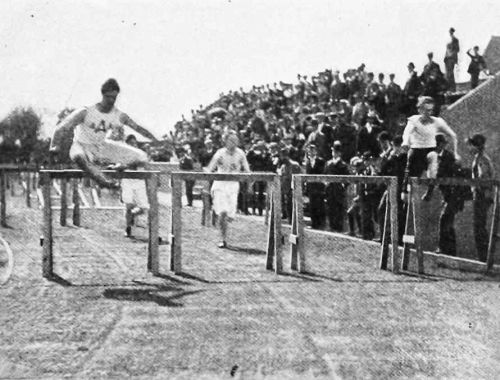
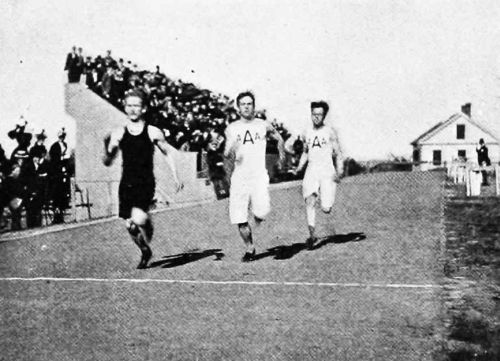
Where Andover suffered most at Worcester was in the bicycle race and in the 100-yard dash. Manning was fully ten yards ahead of the field in the former event, and it looked as if the dark blue were here sure of six points at least, for Palmer was coming along rapidly behind him, when the leader lost control of his wheel and fell. Palmer rushed up and tumbled almost at the same spot, leaving Forsyth the only Andover man in the race. The latter forged ahead, and by a powerful spurt passed Campbell of Worcester, who was leading. He thought he had won as he shot past the winning post, but he had gone only seven laps, and as he slowed up the three Worcester riders went by him to take all the points at the finish. In the 100 the judges made a bad decision. Every one on the field—excepting those whose province it was to do so—saw Senn of Andover win the race by about a foot. Sargent was announced the victor, however, and for some odd reason Andover made no protest. Perhaps they were too confident of victory. But even if Senn had been awarded the first place (all the other events resulting as they did), the score would still have been in Worcester's favor—59 to 53, so the mistake of the judges was of little consequence, except to Senn as an individual.
Barker, W.A. Gaskell, P.A. Munn, P.A. THE 220-YARD RUN, WORCESTER-ANDOVER GAMES.
Holt of Andover did the best work for the visiting team. He captured the high hurdles in 18-3/5 secs., put the 16-lb. shot 33 ft. 6 in., and threw the 12-lb. hammer 104 ft. 6 in. In the weight events he did not equal his own best records. Laing ran a good race in the half-mile and the mile, leading all the way in both events, and in the latter he was followed home by two of his schoolmates. It is noteworthy that in almost all sports where Andover men enter they are particularly strong in the long-distance runs. The field events were the most exciting for the spectators, because the score was such that all depended on the result of these. Here the Andover men excelled, but on the track, as will readily be seen from the table of results printed in this Department last week, the Worcester athletes were superior. On the whole, the meeting between the two teams was most successful, and Worcester Academy deserves great praise for her victory. She won it by hard work, and deserved every point scored. At the present moment the Worcester schools may justly claim first place in the ranks of track athletic sports; for after the High-School's performance on Holmes Field, on the 15th, it is plain that few scholastic associations could hope to worst them.
On the following Wednesday Andover did better. The nine met the Lawrenceville baseball team on their own grounds and it was theirs. Everybody was surprised; even Andover. Not so much at the victory, perhaps, for P.A. men are always sanguine, but no one anticipated a whitewash. Andover put up the best game of the year, and I have not seen Lawrenceville play worse. Men who had scarcely made any errors during the entire season muffed and fumbled like a lot of novices; and in betweentimes the Andover men pounded the ball, and the crowd helped things along generally by plenty of shouting. Perhaps the crowd and the unfamiliar field had something to do with Lawrenceville's defeat, but it is hard to understand why the Jersey players, who have been batting well all the spring, could not find the ball when they had men on second and third. Possibly Sedgwick can explain this. Sedgwick was a host in himself, and he received such support as has not been given by the Andover players to any pitcher this season. He struck out nine of his opponents and gave only two bases on balls, whereas he was hit safely only six times. Drew, who caught him, played an errorless game; in fact, every man on the team did, with the exception of Harker, who made in the first inning the only misplay for the side.
The hard hitting of the home team would have won the game even if Lawrenceville had shown better field-work. P.A. made twelve hits, including a two-bagger, two three-base hits, and a home run. Greenway led with two singles and a three-bagger, while Barton made a two-bagger and a home run. As for the error-making, Lawrenceville took the lead in that in the fourth inning. Sedgwick got his base on balls, and was thrown out at second; Greenway took first on an error and second on an error; Elliott got to first on balls; Dayton followed him on an error, which let Greenway home; Waddell went to first after being struck by a ball, and after Davis had struck out both Dayton and Elliott scored on an error. Fortunately for Lawrenceville, the inning was closed by Waddell's being thrown out at third.
This is the third consecutive defeat that Lawrenceville has suffered at the hands of Andover in baseball, and never before has the victory of the Massachusetts team been so decided. The only way to account for the Jerseymen's weakness is that they were affected by the long journey, and were probably "rattled" by the Andover crowd. This Lawrenceville nine can do better. A team that can play the University of Pennsylvania 6-8 and Princeton 2-5 ought not to succumb to Andover by 11-0. The following day Lawrenceville met Exeter, but only seven innings were played, as the visitors had to catch a train for home. When play was stopped the score stood 3-3, and there was considerable dissatisfaction on Exeter's part because the last two innings could not be finished. Lawrenceville showed better form than was exhibited at Andover, making only two errors; but Exeter was playing good ball too, and it is an open question now as to which is the better team. Next year more careful arrangements should be made, for the memory of this season's game will always be unsatisfactory.
NEW ENGLAND I.S.A.A. GAMES, HOLMES FIELD, CAMBRIDGE, JUNE 15, 1895.
N.E.I.S.A.A.
Record.
Event.Made by
100-yard dash10-1/5sec.F. H. Bigelow, W.H.-S., 1894
220-yard run22-2/5"F. H. Bigelow, W.H.-S., 1894
440-yard run50-3/5"T. E. Burke, E.H.-S., 1894
Half-mile run2m.6"S. Wesson, W.A., 1894
Mile run4"34-2/5"W. T. Laing, P.A., 1894
Mile walk7"36"P. J. McLaughlin, W.H.-S., '93
120-yard hurdle17-2/5"W. W. Hoyt, R.L.S., 1893
220-yard hurdle27"A. H. Hine, P.A., 1894
Mile bicycle2"41-3/5"A. A. Densmore, Hopkinson, '93
Running high jump5ft.7-3/4in.C. J. Paine, Hopkinson, 1893
Running broad jump21"6"C. Brewer, Hopkinson, 1890
Pole vault10"6-3/4"W. W. Hoyt, R.L.S., 1894
Throwing 12-lb. ham'r125"R. F. Johnson, B.H.-S., 1894
Putting 16-lb. shot39"3"M. O'Brien, E.H.-S., 1894
Event.Winner June 15, 1895.
100-yard dashJ. T. Roche, W.H.-S.10-3/5sec.
220-yard runJ. T. Roche, W.H.-S.23-2/5"
440-yard runR. S. Hull, W.H.-S.53-3/5"
Half-mile runA. Albertson, W.H.-S.2m.5"
Mile runD. T. Sullivan, W.H.-S.4"42-4/5"
Mile walkC. V. Moore, N.H.-S.7"18-3/5"
120-yard hurdleA. H. Hine, P.A.18-1/5"
220-yard hurdleA. H. Hine, P.A.27-4/5"
Mile bicycleH. Freyberg, W.H.-S.2"40-3/5"
Running high jumpF. Holt, R.L.S. }5"7-1/2"
R. Ferguson, E.H.-S. }
Running broad jumpE. L. Mills, S.H.-S.20"3"
Pole vaultB. Johnson, W.A.10"7"
Throwing 12-lb. ham'rM. Sargent, Hopkinson119"4"
Putting 16-lb. shotE. Holt, P.A.36"11-1/2"
Points made by Schools.
Worcester H.-S.33
Andover25
English H.-S.12-1/2
Worcester Academy9-2/5
Hopkinson6
Newton H.-S.5-1/5
Somerville H.-S.5
Noble's4-1/5
Roxbury Latin3-1/2
Cambridge H. and L.3
Lynn H.-S.2-1/5
Chelsea H.-S.2
Chauncey Hall1
—-
Total112
Firsts count 5. Seconds 2. Thirds 1.
The championship pennant of the New England I.S.A.A. remains at Worcester. It was carried down there by the High-School athletes last March, and they made their title to it secure on Holmes Field a week ago Saturday by rolling up a score twenty points greater than any Boston school—greater, in fact, than the scores of all the Boston schools put together. Andover had the satisfaction of finishing second, with her old rival, the Worcester Academy, who defeated her the week before, in fourth place. The games were well managed, and, considering the fact that there were 335 entries, the events were run off with commendable promptness. Four records were broken, and a good many others that are up pretty high already were closely approached, as the accompanying table will show. The marks that went were the half-mile, the walk, the bicycle, and the pole vault. Albertson, W.H.-S., has held the record for the 1000-yard run for two years, and his practice at that distance has made him a capable runner for the half. He kept well back in the bunch when the race started, and waited until the very last corner was behind him before he attempted to pull away from his companions. Then he spurted, and passed the three men ahead of him, winning easily a full second under record time.
The biggest alteration of figures, however, was made after Moore of Newton H.-S. had won the mile walk. He was looked upon as a winner at the start, but no one anticipated such an excellent performance as 7 min. 18-3/5 sec. He is as graceful in his work as any man can be in this acrobatic event, and will surely be heard from in years to come if the walk is not abolished from the amateur and collegiate programmes. The probabilities are, however, that in a very few years the walk, like the tug-of-war, will be a back number; but Moore is a good athlete, and he will surely be able to be just as prominent in some other branch of sport. The spectators were almost as deeply interested in Rudischhauser and Williams's contest for last place, as they were in Moore's struggle for first.
A pleasing feature of the bicycle races was the absence of accidents. There was not a single spill, and every man rode for all he was worth. New men took the points; and that is a good thing. Both Freyberg and Druett broke the tape ahead of record time in the second heat, but in the finals they ran four seconds behind. The final heat, although not the fastest, was the most interesting. Six men started, and for the first quarter Freyberg held the lead. Then he was passed by Boardman and Cunningham, who set the pace for a lap, after which the W.H.-S. rider pushed ahead, and left every one behind. The finish spurt was good, but it was evident that every rider was tired from the effects of the trial heats. It would be well next year to follow the plan adopted by the Inter-collegiate Association of having the preliminary heats on the previous day.
A. H. HINE.
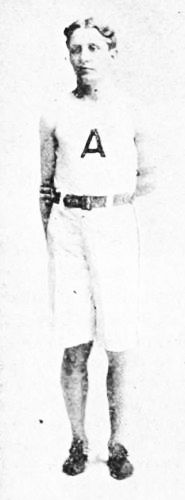
E. G. HOLT.
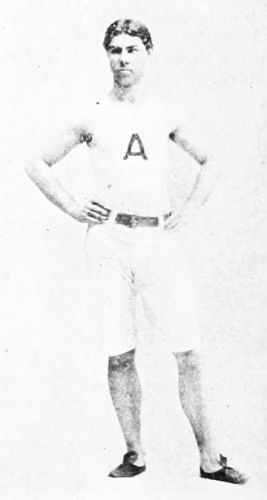
None of the field events were particularly interesting, except the pole vault, in which Johnson of Worcester Academy broke Hoyt's record by a quarter of an inch. The high jumpers only reached 5 ft. 7-1/2 in., where Holt, R.L.S., and Ferguson, E.H.-S., tied for first place. Mills of Somerville High came in as an unknown quantity, and took the broad jump with a leap of 20 ft. 3 in. Andover's strong men were Holt and Hine. At the dual games at Worcester, Holt did giant's work, but at the Interscholastics he only took one first, in the shot, defeating O'Brien, whom many had looked upon as a sure winner, and a place with the hammer. Hine's hurdling was most graceful, and both races were exciting. In the high finals the racers kept well abreast for thirty yards; then Hine forged slowly ahead, but was overtaken by Ferguson, whom he beat home by a few feet only. The low hurdles were even more thrilling. Fuller led at the start, but was caught by Hine at the fourth hurdle. Then it was jump and jump for twenty-five or thirty yards; but Hine had better form, and came in several feet ahead. The day was most satisfactory from the point of view of sport, and every performance of the New-Englanders made me wish they might meet the New York school athletes on an open track and a level field. What a contest that would be! No effort should be spared to bring it about, and the only way to do it is to form one large all-embracing Interscholastic Association.
One correspondent urges Hartford as the most suitable place for the meeting. He believes it would be preferable to New Haven for many reasons, one of which is that the Yale field track is only a quarter of a mile around, whereas the track at the Charter Oak Park is a mile in circumference and sixty feet wide. It is a question whether, for the purposes of an Interscholastic meet of this kind, a mile track would be as good as a lesser one. The time made might be faster if the road-bed were in good condition, but the spectators would not enjoy the races so much as if the runners passed the grand stand a number of times; and the men themselves would find greater difficulty in gauging their speed, most of them being accustomed to four or five lap tracks. A better argument in favor of Hartford is that three railroads centre there.
Of the school athletes who took part in the New York A.C. games at Travers Island, several secured places. Baltazzi won first in the high jump, clearing 5 ft. 10-1/4 in. Fisher went into the 100 and the 220, but was distanced, and Powell got a tumble in the bicycle race. Whether it was his own fault, I cannot say; but there are very few races he has ridden in this year where he has been able to keep in his saddle all the way around the course. He retained his seat in the Interscholastics and won. W. T. Laing came down from Andover, and entered the mile with Conneff and Orton. He had 40 yards handicap, and came in second, with Orton behind him. Orton, however, was pretty well fagged out from the effects of his half-mile race with Walsh. F. W. Phillips, of Bryant and Stratton's, had a handicap of 6 inches in the pole vault, and by making an actual leap of 10 ft. 3 in., secured first, over Baxter at scratch, who cleared 10 ft. 6 in.
Some creditable performances were made at the field meeting of the Pittsburg Interscholastic A.A., which was held at the Pittsburg Athletic Club Park last week. Only four schools were represented, but the crowd was enthusiastic and the events well managed. Graff, of Shadyside Academy, did the best all-round work. He won the 100 in 10-2/5 sec., and the 220 in 24 sec., besides taking first in the hop, step, and jump (another of those acrobatic events which have been handed down from the Dark Ages), and third in the shot. If the Pittsburg H.-S. athletes had been better trained they would have made a more creditable showing, for there is good material there. As it was, they managed to score 21 points out of a possible 135. Shadyside Academy, the winner, got 51, and was followed by the Park Institute with 44. Allegheny, the tail-ender, scored 19 points.
The championship of the Southern Connecticut Baseball League went to the Black Hall School again this year. The final game was played on June 1st, against the Norwich Free Academy. The Black Hall team suffered only one defeat out of the six games of the series—a very creditable performance, considering the numerical size and athletic strength of the other schools in the League. Their success was due to the steady work of the battery, their strong batting, and careful base-running.
The Graduate.