HARPERS NEW CATALOGUE.
Reading edition
Thoroughly revised, classified, and indexed, will be sent by mail to any address on receipt of ten cents.

This Department is conducted in the interest of Bicyclers, and the Editor will be pleased to answer any question on the subject. Our maps and tours contain much valuable data kindly supplied from the official maps and road-books of the League of American Wheelmen. Recognizing the value of the work being done by the L. A. W., the Editor will be pleased to furnish subscribers with membership blanks and information so far as possible.
Copyright, 1895, by Harper & Brothers.
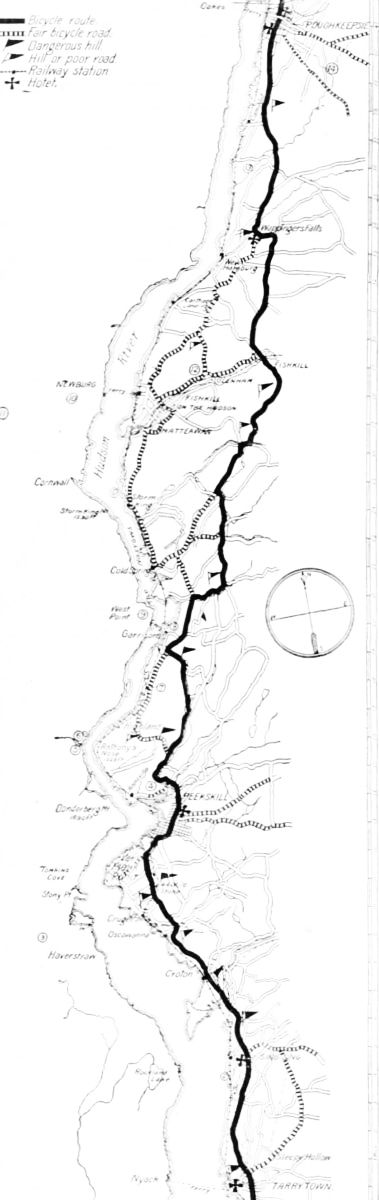
The map this week continues from the point, Tarrytown, reached on map published in No. 810 of the Round Table, to Poughkeepsie, a ride of over forty miles, which would be another and second stage on the route from New York to Albany. All routes of this nature must, of course, be divided by wheelmen reading this Department into sections of a length which is most suitable for their own special purposes. It is perfectly simple, for example, for a good rider to go from New York to Poughkeepsie in one day. On the other hand, for one who is unaccustomed to long distances the route shown on this map, from Tarrytown to Poughkeepsie, is a very good ride. When the series, therefore, covering a distance from New York to Albany is published, by putting the maps together each wheelman may choose how far he will go each day.
Running out of Tarrytown, the rider takes the Albany Post Road and passes the André Monument (1), which he should pause to examine. After leaving this monument he will come to St. Paul's Methodist Episcopal Church. Here he should turn to the left and go down a long hill, thence following the turnpike, which is unmistakable, until he reaches Sing Sing, a distance of seven miles. If the wheelman takes time for it, he may turn down to the river, about a mile before reaching Sing Sing, and stop a moment to take a look at the State-prison. From Sing Sing the road to Peekskill is direct; but it is a difficult twelve-mile ride, with hills all along the way, especially just before crossing to Croton Point, again on the Point, and then all the way up to Peekskill. The road itself is sandy, and occasionally covered with loam. The riding is not very good, and the wheelman is wise if he dismounts frequently. After leaving Croton, and when approaching Verplank Point, he can look across the river to Haverstraw, and see Treason Hill, where the meeting between Arnold and André took place, and the terms of the surrender of West Point were made. From Peekskill the rider runs out about half a mile to the north, then turns to the left and follows the telegraph poles to Garrison's. Immediately after crossing the bridges, on going out of Peekskill, he will notice on the left the State Camp (4). The road is sandy, and there are some bad hills over these eight miles.
If the rider has time to stop for a look at historic places, he should turn to the left after leaving the Peekskill encampment-grounds and run down to Highland Station, from whence he can see across the river the site of old Forts Clinton and Montgomery (5 and 6). Keeping on this road and running up to Garrison's along the shore, he will pass Beverly House, Arnold's old headquarters (7). At Garrison's is the old Phillipse Manor, and directly across the river is the United States Military Academy of West Point. The best road from this point to Wappinger's Falls is to follow the black route on the map, keeping to the right beyond Garrison's, and running on through Fishkill to Wappinger's Falls, a distance of eighteen miles.
It is possible, however, to keep to the left just beyond Garrison's, and following the fair bicycle route, keep to the shore of the Hudson. The road, however, is much more hilly through these highlands. By taking this route the wheelman may cross the ferry at Fishkill village to Newburg, where he may see the Washington headquarters (10), and Knox's headquarters and winter camp (11) just outside Newburg. On the road from Fishkill-on-the-Hudson to Fishkill itself he will pass the State Hospital for the Insane (12). The road from Wappinger's Falls into Poughkeepsie, a distance of eight and a quarter miles, is moderately good. The roads are easy riding, and the grades are not bad. The rider should turn to the right on leaving Wappinger's Falls, cross Wappinger's Creek, and take South Avenue direct into Poughkeepsie. On the way he passes at the right of the Gallaudet Home for Deaf-Mutes (13), and if he cares to, after reaching Poughkeepsie, he may struggle up the Poughkeepsie Hills to take a look at Vassar College (14).
Note.—Map of New York city asphalted streets in No. 809. Map of route from New York to Tarrytown in No. 810. New York to Stamford, Connecticut, in No. 811. New York to Staten Island in No. 812. New Jersey from Hoboken to Pine Brook in No. 813. Brooklyn in No. 814. Brooklyn to Babylon in No. 815. Brooklyn to Northport in No. 816.
A CITY BOY'S CONCLUSION.
The cricket 'neath the old rail fence His song forever toots. And sounds as if he's breaking in A brand-new pair of boots.
This Department is conducted in the interest of Girls and Young Women, and the Editor will be pleased to answer any question on the subject so far as possible. Correspondents should address Editor.
Among the accomplishments which girls may cultivate to advantage none surpasses that of reading aloud to the satisfaction of others. It is singular that more of us do not acquire this delightful art. I do not mean that we should become elocutionists, or study to be proficient in dramatic effects; I simply advise girls who wish to give pleasure to their families and friends to practise the art of reading intelligently, in a clear and distinct voice, pronouncing their words plainly, giving each sentence its full meaning, and being careful not to drop the voice too suddenly at the end of a paragraph. It is so natural to let the voice fall too much and too far at the close of a paragraph, that those who wish to be heard make a point of learning how to use the rising inflection—not to the degree which implies interrogation, but, so to speak, leaving off with tones on the level, so that the voice carries well across the room.
During vacation you will have opportunities to exercise this gift if you possess it. Half a dozen girls may enjoy the same story if one reads aloud while the rest work. The dear auntie whose sight is failing, and who is bidden by the doctor to rest her eyes, will be very much obliged to you if you will read to her an hour or more a day at intervals, as she and you may find convenient.
I have found in my own experience that when I am reading with a view to remembering a poem or essay or chapter of history, it is fixed upon my mind more readily than otherwise if I read the passage aloud to myself. Hearing as well as seeing the words, two senses aid in carrying the message to the brain. I like to read poetry aloud when I am alone, thus doubly enjoying its music and its feeling.
As every bright young woman should be informed about current events, my girl friends hardly need the reminder to read the daily papers. In doing this, read according to system. You will be able to secure better results if you have a plan than if you scan the journal taken in your home in a slip-shod, heedless way.
Every newspaper has its summary of contents, in which the news of that day and paper are condensed and presented in a compact form. Read this first. Select from this what you most wish to read—the foreign letters, the society gossip, the political leaders, the description of a prominent personage. Whatever you read, read with your whole attention, and learn how to skip a great many things which, while coming under the head of news, are not important to you. Reports of crime, for example, must be published, but you and I can very well omit reading them.
Somebody in the house, and it may as well be you, dear daughter Jane or Charlotte, should take upon herself to see that the daily papers are not spirited off to line closet-shelves or kindle the kitchen fire before they are a week old. Father often wishes to refer to last Thursday's Sun or Tribune, Brother Tom wants another look at yesterday's Herald or the Weekly Record or Register, whatever the favorite paper may be. Nothing is more annoying than to search the house over—mother's room, the library, the back parlor, the halls—and discover no trace of the longed-for sheet, which probably has been dissolved into ashes, fluff, and smoke, to save Bridget a little trouble. You might charge yourself with seeing that no paper is ever destroyed until it is a whole week old. Also when a paper contains an item or a story which will probably interest grandmother or Uncle Roger in another town, it is very sweet in you to slip a wrapper around the paper, first marking the column in question, and mail it to the person to whom it will give pleasure. Do not forget the marking. Nobody likes to spend a morning hunting for the reason why a paper has been sent to him.
DON'T WORRY YOURSELF
and don't worry the baby: avoid both unpleasant conditions by giving the child pure, digestible food. Don't use solid preparations. Infant Health is a valuable pamphlet for mothers. Send your address to the New York Condensed Milk Company, N. Y.—[Adv.]