RIGS AND MAKESHIFTS OF THE SMALL BOAT.
Reading edition
BY DUDLEY D. F. PARKER.
While a boy may not have occasion or the good fortune to handle or own a large boat, he is almost certain, if he lives near water, to have something to do with a bateau, skiff, or small boat of some character. Or perchance he may own a row-boat of the St. Lawrence skiff variety, and may wish to put a sail on it. Now there is nothing more clumsy and dangerous than a badly rigged small boat. By badly rigged is not meant only the boat whose spars are imperfect, or other things connected with her rig radically wrong, but also the boat that carries a rig that may be perfectly suitable for another class, but is entirely out of place in one of this size. A thing to be avoided in all small boats is unnecessary rigging; too many halyards and sheet ropes are in the way, and, where the rigging is on a very small scale, are very apt to get tangled or out of order when most wanted. So it may readily be seen that, for instance, the jib-and-mainsail rig of a twenty-five-foot boat, with its accompanying number of sheets, stays, and halyards would be totally out of place in a fourteen-foot bateau. The whole attention of the natives or "shell-backs" in or near our fishing villages has been devoted to the originating of makeshifts for the avoidance of everything that makes the construction and handling of a boat more difficult. Their idea seems to have been that anything that could be accomplished without the aid of mechanical means, simply by the use of a little extra muscle, had better be done that way.
PLATE 1.
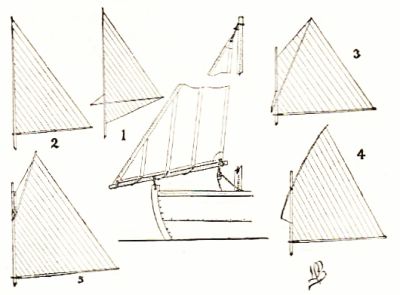
PLATE 2.
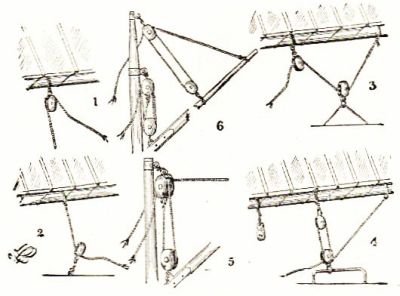
PLATE 3.
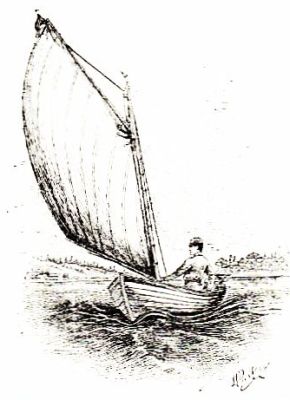
It might be said that in the small boat are seen the various rigs, in their simplicity, whose principles have been elaborated and altered to meet the different conditions required. Taking them in order of simplicity, we first come to the "leg-o'-mutton" rig. Here only two spars are used, and no halyards. In No. 1 (Plate I) the boom has no jaws, and is held in place at the mast by catching the projecting end in a sling, and by poking the other end through a cringle in the leech. The only lacing required is to fasten the sail to the mast, the sail only being fastened to the boom (more properly sprit) at the points mentioned. If it is found to bag, the remedy is to shorten the sling until the sail sets flatly. This can never be entirely accomplished, as the sail, being supported by the boom only at the extreme outer end and the mast at the other, is very apt to stretch in a stiff breeze.
Advancing a step, we come to the remedy of this trouble (Fig. 2, Plate I). It is the introduction of jaws at the mast, instead of the rope sling. The tendency to bag is removed, as the sail is fastened at frequent intervals by lacing to the boom, along which it may be kept stretched tightly. Also the tendency of the boom to slide forward is effaced as it butts up against the mast. In this method a much lighter spar can be used, as the strain is made to come more or less throughout its whole length, whilst in the first-mentioned it comes wholly at the ends. The principal objection against the "leg-o'-mutton" rig in general is the great length of mast required. This is one of its most serious drawbacks, and the other is the inability to reef the sail. Of course modifications of this rig have been made, introducing halyards and supplying reef points, but a discussion of that is beyond the scope of this paper, such modifications being rarely seen on a small boat.
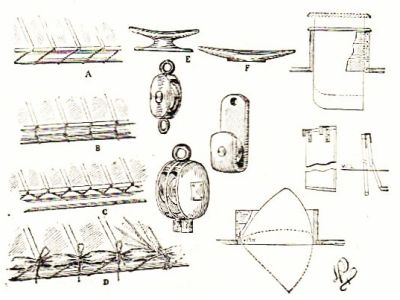
As mention has been made of lacing a sail to spars, perhaps it would be just as well to digress a little here, and speak of three well-known methods of lacing. The first, A, (Plate III), is the simplest and about as effective as any. The sail is fastened to the boom by an "over-and-over" lacing. In B, the sail is held by a series of "half-hitches," and in the third, or C, the lacing runs through eyes screwed into the boom.
The next step in rendering the rig more compact is to shorten the mast. This can only be done at the cost of an increase in the complexity of the rigging. A new spar is introduced, and the sail is cut down from a triangle to an area having four sides. Some means had to be found to support the upper edge, and a study of the last three sail plans will show some of the methods in use. Figs. 3 and 4 are nearly equal, as far as simplicity goes, though Fig. 3 is simpler on account of the absence of lacings on the upper edge. This is commonly known as the "sprit-sail," and, taking all things into consideration, it seems to be the most efficient and handiest of all the rigs. Of course it is not as efficient in some respects as the sail in Fig. 5, the same trouble being experienced on the top edge as in the "leg-o'-mutton"—bagging—but it possesses the advantage of greater simplicity. If we examine this rig we will readily see that it is any large fore-and-aft sail reduced to its simplest form. We find, instead of the gaff and the two halyards to hold the sail up, all this is replaced by the simple device of the pole (sprit), one end of which is stuck in a cringle in the upper corner of the sail, and the other caught in a sling. The sail does not move on the mast, and is laced to it. The boom has jaws at the mast, and the sail is laced on, or sometimes the device shown in No. 1 is resorted to, though the former method will be found to make this sail set better. There are no reef points, and the only way to reef is to drop the peak by removing the sprit. Of course it must be understood that this rig is not at all practicable in a boat of any size, but in any of about the size of a row-boat it will be found to be most convenient.
In the next device (No. 4) we approach nearer to the regular "fore-and-aft" sail. There can be seen the introduction of a yard to which the upper edge of the sail is laced, as to the ordinary gaff. No halyards are used, and the yard is lashed to the mast, and held at the proper angle to keep the sail flat by a rope fastening its lower extremity to the mast. The only objection to this rig is that the yard has a tendency to give and to permit the sail to bag. This rig is frequently seen on duck-boats. There is no method of reefing except dropping the yard, unless reef points are introduced.
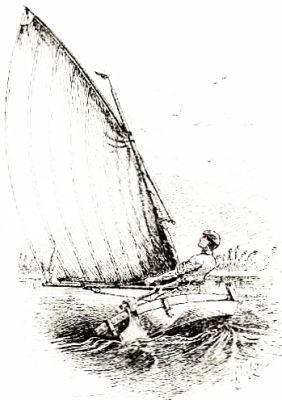
A DUCK-BOAT TYPE.
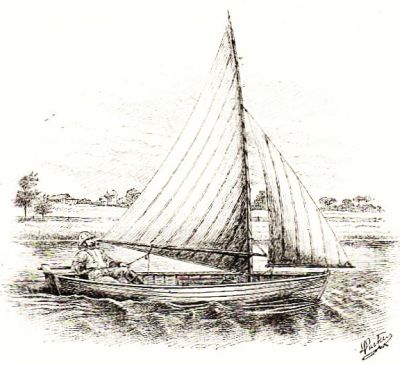
Taking a step further we come to the "fore-and-aft" sail proper. Here we find the introduction of a gaff, which might be looked upon as the shortening of the yard in the preceding rig. There are jaws on both boom and gaff, and the sail is movable on the mast, being usually held on by loops, the gaff moving up and down. To take the place of the lashings in the preceding rigs, ropes (halyards) fastened to this spar and passing through blocks at the mast-head and so down have been introduced. Because of the ability to hoist and lower the sail, reefing is accomplished by a row, or rows, of little ropes (reef points), by which it is tied down, thus reducing it to almost any size desired according to the number of reefs tied in. Most small sails of this character have at least one row, and some two; though the small cat-boat usually has three. In a previous article (Harper's Round Table, No. 827) a description of how to tie a reef in the sail of a larger boat was given. The principle is the same in all sized sails, and perhaps it will only be necessary to add here that the reef points are not tied around the boom but around the part of the sail taken in by the reef (D, Plate III). The stop at the outer cringle, however, is tied around the boom. A simple means of reefing, which may be used in all the rigs except the first, is by rows of holes of the same character as the leech cringle; and after pulling the sail down to the proper distance (most sails laced to the mast can, with a little care, be moved), hold the reef in by a single lacing through them, in the same manner as the sail is laced on in A. A stop at the leech is required, as in the preceding method.
ST. LAWRENCE SKIFF WITH FORE-AND-AFT SAIL.
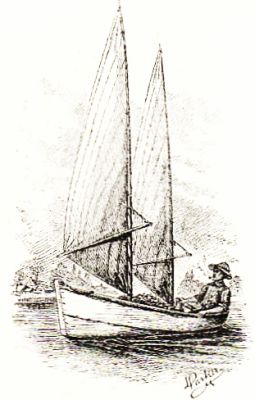
Many combinations are made with the jib. There seems to be about only one common way of rigging a jib for a small boat. A pretty clear idea may be gained from the sketch (Plate I). As may be seen, no stay is used, the sail usually being bound with a rope, which gives it sufficient strength; no halyard is used, either the jib being lashed to the mast, and lowered and hoisted when it is stepped or unstepped. The lower edge is laced to a boom, which is secured to the bow with a lashing about four inches long, a third of its length projecting. The sheet rope is fastened to the inner extremity. The most common combination is the jib and sprit-sail, generally known as the "skiff rig" (see sketch). It is quite often used with one of the "leg-o'-mutton" sails. The most general use of the "leg-o'-mutton" types, however, is either two together, as in the sharpie rig, or separately as the only sail in the boat.
A SHARPIE-RIGGED OYSTER-BOAT.
Perhaps a few words on the spars would be in place here. First, taking the stick itself; it should always be a straight-grained piece of wood, as free from knots as possible, and well seasoned. The several spars require different degrees of tapering. The aim of the taper is to reduce weight, by concentrating the greatest amount of material at the point most strained, and removing the surplus. The mast should leave little taper, except in the "leg-o'-mutton"—where it is tapered very much towards the head—and ought to be nearly the same size throughout its whole length, the thickest part, if any, from a short distance above the deck or brace to a few inches below. It should have a slight taper at the head and a pretty good sized one at the heel where it enters the step. The boom should have a slight gradual taper, the thickest part being between a quarter and a third of the distance from the mast to the end of the spar, and the mast end much heavier than the other. The making of the jaws has been described in a previous article (Harper's Round Table, No. 818). The thickest part of the gaff should be about a third of the distance from the mast. The sprit should be about the same thickness throughout its entire length. In the yard rig the thickest part of the yard should be in about the same relative position to the mast as it is in the gaff.
A DOUBLE-END CLAM-BOAT.
Turning now to the rigging of the boat; the only one of the rigs requiring halyards is the fore-and-aft sail (No. 5). The method of threading can readily be understood from a study of the sketch. No. 5 (Plate II) is only practicable for a small boat, but No. 6 is more suitable for a larger one. About the only other thing requiring mention in the rigging are the different methods of reeving the sheet rope. No. 1 and No. 2 are the simplest, the only difference between them being the positions of the fastened ends. In the first the end is secured to the boat, and in the second it is fastened to the boom. The device shown in the third sketch is a trifle more complicated. The fourth one is the most intricate of all, but has the least drag on the sheet, as every time the rope passes over a wheel in a block by so much is the pull diminished. This rig requires the introduction of a double block on the traveller, and perhaps a snatch block to ease the pull when close hauled.
As blocks have been mentioned, perhaps it would be as well to say that small galvanized iron blocks can be procured at very little cost, and will accomplish all that is required of them. Of course, if the boat's owner is inclined to spend more money, wooden blocks will make the rigging neater and run easier. Travellers are used to fasten sheet ropes to the boat, and may be made in two ways, either out of iron or rope. The iron traveller in this case is an iron rod carrying a ring to which the block is attached, bent down at the ends, which are threaded and fastened with nuts through the stern. The rope traveller is a strong cotton rope, the ends fastened on each side of the boat, and the rope passing through a ring on the lower side of the block. In the rigging may be also included the cleats for belaying the halyards and sheets. For the halyards, and for purposes where it is desirable to fasten the rope securely and for some time, a cleat shaped like E is best; but if it is desired to fasten the rope temporarily, or to use it as a means of breaking the pull on the rope, the jam-cleat F is the most efficient, a turn or two causing the rope to jam. Leaving the rigging, we will turn to the boat proper.
SKIFF-RIGGED BATEAU.
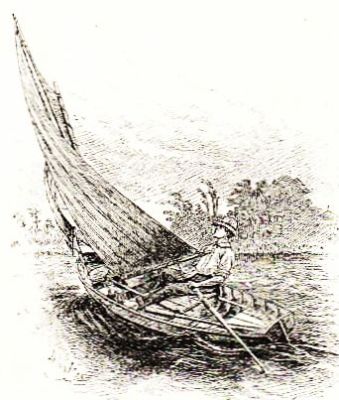
There are three methods of keeping a boat from making leeway (going side-ways)—by a centre-board, leeboard, or keel. The last is impracticable for a small boat, and will not be considered. There are two varieties of centreboards in use—the ordinary drop pattern, as used in the larger boats, and the dagger. The drop is generally triangular in shape, held in place by a pin at the lower corner of the trunk passing through the apex. The dagger is only a board or board shaving a projecting cap on the top, so that it will not fall through the trunk, and is lifted entirely clear when not wanted. The drop pattern is a little more convenient, but somewhat difficult to make. The drop is just as efficient, and can never get out of order, whilst easily replaced if broken. It is the one most used by the "natives." The only danger of this board, and one that must be always borne in mind when sailing in waters where bars abound, is that it cannot raise up when it strikes an obstruction as the drop will, and, if you are not watchful, may upset your boat. The leeboard seems only a miserable apology at the best, and is only pardonable when you do not desire to cut a hole in your boat's bottom to build a trunk. The only practicable method is to make a movable board with clamps that fit over the gunwale, and move it to the lee side as the boat's course changes. In a previous article (Harper's Round Table No. 818) there has been described how to make a rudder with tiller and yoke-line attachments, and it will be unnecessary to go into details here. The yoke lines are sometimes the only way of steering in some types of boats, as, for example, the St. Lawrence skiffs. In the sea skiffs and river bateaux there is an extremely simple means of steering by an oar. It is held in two places, either in a lock or groove cut in the stern-board or under the lee counter. The stern oar is used in much the same manner as a rudder, but the lee oar is kept out of the water most of the time, only being immersed when the boat begins to fetch up, and taken out as soon as this tendency is corrected. The reason of this is that the oar, being rested against the gunwale, projects over the side at quite an angle from the fore and aft, and hence, if kept in all the time, it would throw the boat's head off.
There is quite an extensive use of the jib in this class of boats. The jib can be made to exert quite an influence on the boat's speed, and if the sails are nearly balanced the boat can be held on a straight course by proper trimming. It is only by experience that the trim of the jib can be learned, as it depends on the balancing of the sails, on how close you are sailing, and on the strength of the wind. When going about let slack the jib-sheet just before the boat begins to round up, trimming it again when on the other tack. If the jib is out too far it has a tendency to flap, and if too flat, there is a tendency of the boat's head to fall off the wind.