GYPSY'S FURY.
Reading edition
BY WILLIAM HEMMINGWAY.
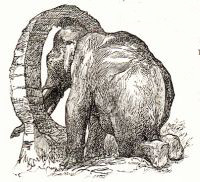
f all the wild animals tamed by man, the elephant is in many respects the most dangerous and treacherous. All old animal-trainers know that. In spite of the many tales that are told about the good nature and honesty of these gigantic brutes, no experienced man will trust them. You will notice, for example, at the circus, that the man who puts the herd of elephants through a lot of tricks always faces them, or, if he turns his back, he does so only for an instant. And while the crowd is applauding the evolutions and capers of the big fellows, you will notice half a dozen helpers armed with elephant hooks ready to jump into the ring and help the trainer at a moment's notice. No one can tell at what moment an elephant may become sulky and obstinate. When that happens the brute must be led away as soon as possible. It is useless to try to force him to go on with his tricks.
Living for years in confinement, having little exercise or none, the poor elephants become sickly, worried, and irritable. They suffer physical changes. If you look closely at an elephant that has been kept long in captivity, you will see that the knees of his hind legs are bent inward, and that the legs look weak and wobbly. That is the result of swaying from side to side, which the elephant does partly from nervousness and partly from want of exercise. The beasts deteriorate mentally in as great a degree, and you will find it the rule that old elephants are bad-tempered.
In Chicago, not long ago, Gypsy, a gigantic elephant, killed a man, and kept a whole neighborhood in terror for three hours. The man had been warned to keep away from her, and his overconfidence in his ability to subdue the savage beast cost him his life.
Gypsy is forty-five years old, and weighs five tons. She spent the winter in Chicago with a circus, and was kept in a stable at No. 232 South Robny Street. Her name used to be Empress years ago, but she killed a man, and her owners gave her a new name and hoped she would never become vicious again. But an elephant that goes wild is like a horse that runs away. She may not misbehave for a long time, but she is almost certain to do great harm sooner or later. Gypsy had been irritated for several days before her outbreak. Her regular trainer and handler, Bernard Shea, was called away to Omaha, and Gypsy did not like to be left in the care of a stranger. She was not fond of Frank Scott, who took charge of her. She allowed him to bring her food and water, but she grew angry whenever he took her out for exercise. On Tuesday night she saw a mouse running along a ledge in the barn, and this frightened her into a panic. She trumpeted and tugged at her chain, and could hardly be quieted. Scott did all he could to soothe her, but she was restless all night long.
Frank Scott took Gypsy out for exercise early on Wednesday afternoon. W. H. Harris, who owns the elephant, says he often warned Scott not to do this, but the man persisted. There is an alley between Jackson and Van Buren streets, and here the keeper made the big beast trot up and down for ten minutes, while he sat astride of her neck close behind the back of her huge head. Twice she balked and shook her great ears, but Scott jabbed her with a sharp prod and forced her to go on. This prod or hook is a bit of steel shaped like a rooster's spur, fastened to the end of a short thick wooden handle. It has been the instrument used for ages in controlling elephants. When Gypsy came to the door of the barn again she stopped, and tried to turn in. There was a malicious gleam in her little eyes, and she had swung her ears forward—a sure sign of anger in an elephant.
"Go on, Gyp!" Scott commanded, sharply. But the elephant shook her head and advanced toward the barn door. The man drove the steel hook deep into her ear. She screamed with pain, and with a wild toss of her head threw Scott to the ground. She wrapped her trunk around him, and picked him up as easily as you would lift a little doll. She held him high above her head and roared. Mr. Harris, her owner, and three other men who had been attracted by the noise came running up the alley. Mr. Harris shouted to the elephant to be still, but she seemed not to hear him. She walked across the alley, and threw Scott against a building. An ambulance and a squad of twelve policemen had been called now, but they could do nothing for a time. Gypsy was infuriated, and she charged wildly up and down the alley. As she ran away again, two men quickly jumped out of the barn and carried Scott in. The ambulance took him to the hospital, but he never recovered consciousness.
More than five hundred persons had gathered by this time to see the furious elephant. The police had all they could do to keep many of them out of the alley. Two policemen, leaving the box from which they had sent a call for the patrol wagon, had to run to avoid Gypsy. A blow from her trunk swept past them with a rush that doubled their speed. Thirty-six more policemen came up and helped to drive back the crowd. The streets for blocks around were cleared of people, because if the mad beast should choose to leave the alley she could not be stopped, and she would certainly kill everybody she could reach. It would be too late to try to escape after she came out, for a mad elephant runs like the wind. The speed of a horse is child's play compared with the mighty rush of this clumsy giant when enraged. All the fire-arms in the neighborhood were brought out, but the circus men prevailed on the police not to let them be used, as ordinary rifle-bullets would only have made Gypsy more angry without hurting her at all.
After running up and down the alley until she was tired, Gypsy at last sauntered into the barn. The circus men quickly closed the doors behind her. These doors were made of great oak planks four inches thick, firmly riveted together, yet they were no more of a barrier to the elephant than a paper hoop is to a circus rider. The moment Gypsy heard the doors swing into place she wheeled around and ran out of the barn. She left the doors in splinters. She did not slacken her pace, nor did she seem to know that she had met an obstruction as she was passing through the massive oaken structure. Once more she galloped blindly up and down the alley. An old elephant man said that bread would quiet the animal, so some one hurried to a bakery and soon returned with ten newly baked loaves. These were thrown over a fence into the alley, and Gypsy ate them greedily. Ten more were brought up and fed to her, and more after that, until she had consumed fifty loaves. As she ate, her rage seemed to pass away. When the fiftieth loaf had disappeared she wandered into the barn once more. Claude Orton, a trainer, tried to fasten a chain around Gypsy's leg, but she pushed him away; yet she showed no signs of rage against him. A big piece of canvas was hung over the broken door. Gypsy walked over and felt it carefully with her trunk, but she made no attempt to break through. At the end of an hour she allowed Orton to chain her leg, and she quietly remained after that in her accustomed place.