HOW MAGIC IS MADE.
Reading edition
BY HENRY HATTON.
IV.
FIG. 1.
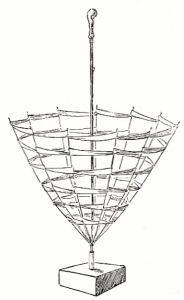
One of the best tricks of De Kolta is called, "The Miraculous Production of Flowers." It may be exhibited on the stage or in the drawing-room, and is equally effective in either place. The performer shows an umbrella from which the covering has been removed and its place supplied by multicolored ribbons, which go from rib to rib, leaving a space between. He then opens this umbrella, and stands it upside down on the stage, resting the ferrule end in a piece of metal tubing, which, in turn, is supported by a stand. He also shows two or three empty shallow wicker baskets, and a sheet of heavy brown paper. His arms being bared to prevent the possibility of anything being concealed in his sleeves, he folds, or rather twists, a sheet of paper into a cone or cornucopia. Every one knows this cone is empty, as they have seen it made, and yet the performer shakes from it enough flowers to fill not only the baskets, but also the inverted umbrella. Every once in a while, when the supply of flowers is apparently exhausted, the paper is opened and shown to be empty, and yet, when again rolled up, the flowers pour from it in as great volume as at first.
The flowers in this case are emphatically spring flowers, though it may be truthfully said that "the flowers that bloom in the spring have nothing to do with the case." They are made in a variety of shapes, but the most simple form is, to my thinking, the best, and any one can make them by following these instructions:
FIG 2.
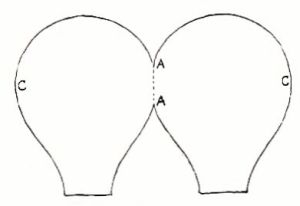
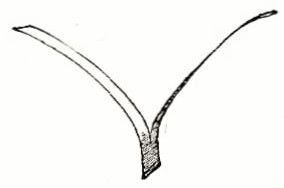
Cut a number of pieces of red, blue, yellow, or pink tissue-paper of the shape shown in Fig. 2, and an equal number of that in Fig. 3. Fold them at the lines A A and B B, shown by the dotted lines, so that C and C and D and D come together. Then cut some flat thin spring steel, not highly tempered, into strips about one-eighth of an inch in width and from an inch and three-quarters to two inches and a quarter in length, according to the size of the "flower." The latter, for the drawing-room, should be about two and a half inches long and two inches at the widest part, while for the stage they are best when three and a quarter long and proportionately wide. The strips of steel must next be cut in two the longer way, until within about a quarter of an inch of one end, and these halves must be bent outward in opposite directions, so that they assume the position shown in Fig. 4.
FIG 3.
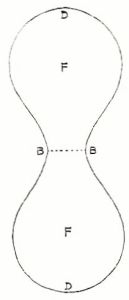
Place the spring between the folds of Fig. 3, so that the arms will lie on F F, and then paste them firmly down by placing over a strip of paper of the same color as the "flower." Next put Fig. 2 between Fig. 3; paste the points C C to E E and G G to B B, and let them dry thoroughly. The flower has now assumed the shape shown in Fig. 5. All that it needs to complete it are two green leaves of paper, silk, or muslin, which are to be pasted one on each side at the smaller end. To make much display, about five hundred of these flowers ought to be used.
FIG. 4.
Having made the flowers, the next thing to learn is how to get them into the paper horn without being seen. Some performers load the cone—to load being the technical name for filling—by simply holding a bundle of flowers in the right hand, and deliberately placing the hand inside the cone, under pretence of taking out a flower, but that is anything but artistic.
Do up three bundles of, say, seventy-five flowers each. To do these up place them between two oblong pieces of thin green card-board, putting an elastic over the longer way; and that this may not slip, have nicks in the ends. Pressing these ends will cause the card-boards to bulge out in the centre, and allow the flowers to escape. Two of these bundles must have loops of rather stiff wire run through the elastics, so that when the bundles lie on the table the loops stand up. These bundles are laid at the back of the table, behind a basket, at the performer's left. The third bundle, also on the table, is a little to the right of the others.
PAPER LEAF.
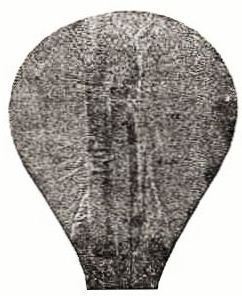
The performer first bares his arms, then rolls up his cone and throws it on the floor, mouth toward the audience, or lays it on a table. Now picking up the third bundle with his left hand, and putting it, almost in the same movement, under the bottom of a basket which he picks up, he advances to his audience to show that the basket is empty. Returning to the stage, he lays the basket on his table, retaining the bundle of flowers in his left hand. Then picking up the cone by the smaller end, he remarks, "The hands are empty." As he says this he passes the cone to the left hand, which he places inside the mouth, thus dropping the bundle in, shows the right hand empty, and taking the cone in that hand again, shows the left also empty. Putting both hands around the lower part of the cone, he squeezes it and the card-boards, and the flowers being released, he begins to pour them into the basket.
As the flowers fall out, he pretends to guide them with his left hand, and this gives him an opportunity to catch the wire loop of one of the bundles on the table between his fingers.
When the cone is emptied, the performer unrolls it and straightens out the paper, prior to working in the second bundle. This bundle, understand, is back of the left-hand fingers. Taking the sheet of paper at one edge by the tips of the fingers of that hand, and letting the paper fall in front, he smoothes it with the right hand, and presently seizing the lower edge by that hand, he brings the sheet back over his left hand, thus leaving the second bundle inside the cone thus formed. This is a remarkably neat and clever move, almost impossible to detect, and is well worth the little practice needed to acquire it.
The cone is now emptied, and the third bundle picked up in the same way as the second, and the cone again formed over the back of the hand. The flowers for the umbrella are loaded into the cone in an altogether different way, but one quite as difficult to detect if well done.
FIG 5.
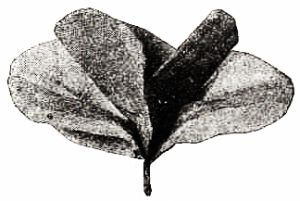
About three hundred flowers are placed between two sheets of stiff card-board, and these are tied together in a single bow-knot with silk floss, the end which unties the knot being allowed to hang down, and having a tiny shoe-button fastened to it, so that it may be found easily. Hanging from one of the pieces of card-board is a loop of strong black thread. This bundle is placed in the inside right breast pocket of the performer's coat, and the loose end of the loop is passed over a button or small hook sewn on the vest.
To load the bundle into the cone, the performer holds the open flat sheet of paper in his right hand, which hangs at his side. Turning it front and back, he says, "Absolutely empty, as you all can see." And while his audience have their eyes fixed on it, his left thumb finds the loop, and passing through it, lifts it off the button. "I shall hold it away from my body," he continues, and as he says this he raises the sheet in front of him so that it nearly covers his breast. As he does this, almost simultaneously, his left hand grasps the upper edge of the sheet about the centre, and thus pulls the bundle out and holds it dangling behind the sheet. The left hand, still holding bundle and paper, is pushed well out, so that the sheet is not near the body. The right hand now seizes the upper right corner of the paper, and drawing it towards him, the performer twists it into a cone. His hand is thus left inside, and as he withdraws it, what more natural than to catch hold of the shoe-button, give a steady pull, and release the flowers? Walking round and round the umbrella, the performer continues to shake flowers from the cone until the novel receptacle is filled.
The professional conjurer has large deep pockets inside the breast of his coat, the mouth towards the front; but as many of my readers will not care to have specially prepared coats, they may substitute a large oblong black bag, which can be fastened to the coat by small black safety-pins. The mouth should come within about two inches of the front. Similar but smaller pockets can be pinned to the back of the trousers leg, when they will be covered by the coat tails, but will prove handy for small articles.
Some conjurers allow themselves to be firmly tied with ropes, and yet while in this condition perform feats that apparently require the free use of both hands. These, however, are always done behind a curtain or other screen. Just how this is done I may explain later, but for the present here is a very good substitute. The performer locks his hands, and his crossed thumbs are tied tightly together with a long strong cord, the ends of which are held by two of the audience. A soft hat or handkerchief is thrown over the hands, and almost instantly one is waved in the air. It is as quickly thrust back, and on removing the covering the knots are found as firmly tied as at first.
There are two ways of doing this, both of which I shall explain.
FIG. 6.
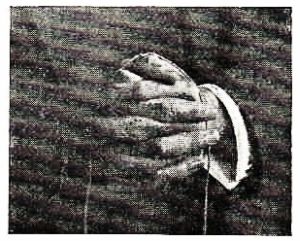
In the one method, when the hands are brought together the forefinger of the left hand is on top; then follow the right forefinger, the left second finger, the right third finger, the left third finger, the right little finger, and last the left little finger, as shown in Fig. 6, the right second finger being inside the hands. When the cord is placed under the crossed thumbs, preparatory to tying them, this right second finger, which will not be missed from the clasped hands, grasps the cord and holds it down, thus gaining slack which is at the bottom of every tie exhibited from the time of the Davenport brothers to the present day. Of course with so much slack it is a very easy matter to release the thumbs, and the next moment to present them apparently tightly tied. At the conclusion of the trick the cord must be gathered up and put out of the way, lest some of the audience should get hold of it, and thus discover the secret.
In the second method the palms of the hands are placed together and the thumbs held up. Then a rope, about the size of an ordinary sash cord, is laid just above the fork of the thumbs. The ends are given to two committee-men chosen from the audience, who are asked to pull, so as to convince themselves that the rope is sound; then the thumbs are crossed and pressed down on the rope, which is tied in a double knot.
As in the first method, a handkerchief is thrown across the hands, and again as in the first method the hands are rapidly freed, and just as rapidly tied again.
In doing the trick this way the slack is gained just after the committee-men are asked to pull on the rope. At that moment the hands are held about two inches apart, and just then the thumbs squeeze hold of the rope, and bringing the hands closely together, the slack is caught between the palms, the crossed thumbs hiding all signs of it.
I once saw a man who claimed to do certain wonders "by the help of unseen powers," but as two of these can be produced by the most ordinary human power, I give them here, so that any of my readers who is so disposed can set up in the "seer" business for himself.
The performer hands out some half-sheets of note-paper, measuring, say, 4½ by 7 inches. These he requests the audience to fold, as nearly as possible, into four equal strips, each of which will then measure 1¾ by 4½ inches. These strips he distributes among the company, who are asked to write a name of man or woman on each strip, which is then to be folded once or twice, and thrown into a hat, when all the strips are to be thoroughly mixed. The performer then places his hand in the hat, and selecting one strip, announces that the name in it is that of a man or of a woman, as the case may be. So he continues until each slip has been taken out.
FIG. 7.
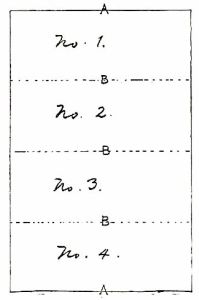
Although the performer has nothing to do with cutting the paper, yet the trick depends altogether on the way in which it is cut. Reference to Fig. 7 will explain this at a glance. It will be seen that if the paper is cut into four strips, two of these, No. 1 and No. 4, will each have a sharp edge, A, and a rough edge, B, while Nos. 2 and 3 will have two rough edges. In handing out the papers the performer always gives a sharp-edged strip with the request, "Please write the name of a man on this," while the rough-edged ones are given for the names of women. When he puts his hand into the hat he has merely to run a finger over the edges of a strip, and he can at once determine whether the name on it is that of a man or of a woman, even without the aid of "unseen powers."
For his next phenomenon—by which name he attempted to dignify his tricks—he required the assistance of his wife. She was conducted to a room on another floor of the house, and while she was thus out of sight and out of hearing the Professor introduced a pack of cards. One of the company drew a card, and showed it to the rest of those present, the Professor included. Then the gentleman who drew the card wrote on a piece of thick paper the question. "What is the name of the card drawn?" This was placed in an opaque envelope, so that the writing could not possibly be read; the envelope was sealed, and the Professor addressed it to his wife. She placed it for a moment against her forehead, and then seizing a blank card, wrote on it, "The card chosen was the eight of hearts," which was correct.
The secret is in the way the address is written. By previous arrangement it is understood that the suits of the cards are to run as follows: spades, hearts, clubs, and diamonds. Should a spade be drawn, a period is placed after the first word of the address; if a heart, after the second; if a club, after the third; if a diamond, no period appears in the first line of the address. For the number of the suit the cards run in their regular order, ace, deuce, etc., the Jack counting 11, the Queen 12, the King 13. To designate the suit, an initial letter is introduced in the address, the one used being the one in numerical order coming after the number of the suit. Thus, in the first case, the card being the eight of hearts, the address was written
Mrs Sarah. I Smith
—the period after Sarah designated the suit, while I, the ninth letter of the alphabet, showed the number of spots on the card.