KING ARTHUR AND HIS KNIGHTS.
Reading edition
II.—THE SWORD.
"Now while the lords and their followers were gathered in the great church," the Story-teller said, as Jack and Mollie began to show some curiosity as to what this miracle for which Merlin hoped might be, "there was discovered in the church-yard near the altar a great black stone, about four feet square, on the middle of which stood a steel anvil a foot in height. Thrust into this, with its shining point visible, was a beautiful sword, and about it, written in letters of gold, were these words:
"'WHOSO PULLETH OUT THIS SWORD OF THIS STONE AND ANVIL IS RIGHTWISE KING BORN OF ENGLAND.'"
"Who put it there?" asked Jack.
"I don't know," said the Story-teller. "It was there, and that is all I know about it, and the people when they saw it were full of wonder, and marvelled greatly to read the words written about it. I imagine, however, that Merlin and the Archbishop had something to do with it, for when the people went into the church, and told the Archbishop what they had seen, he did not appear to be at all surprised, but commanded all to remain within the church and not to touch the sword until the service was over. The people and the gathered knights and all their followers obeyed the Archbishop's command, for they did not dare do otherwise; but, when the service was over, they all rushed out into the church-yard to see the stone and the anvil, with the wonderful sword stuck into it. And then, when the lords had read the golden inscription upon the stone, each made an effort to pull the sword out of its anvil-sheath, but not one of them could do it. They pulled and tugged and pulled and tugged, but it was all in vain. They neither broke nor budged it, and the Archbishop of Canterbury said it was evident that none of those present could claim to be the rightful King. He added that he believed that the right one would yet be discovered, and suggested that ten of the best knights of the land should be made a guard of honor to watch over the sword until New-Year's day, when any one who wished might come and in the presence of all make the effort to pull it from the anvil. This was agreed to, and it was decided to have a great tournament upon the coming New-Year's day, after which the trial should be made. This kept the knights and their followers in London, for it was important that all should be present at the trial, success in which meant so much, not only to the successful man, but to the whole kingdom as well."
"Didn't Merlin try to pull it out?" asked Mollie. "If he put it in, I should think he could have pulled it out, and then he could have been King himself."
"Possibly; but I imagine he didn't want to be King, for one thing, and, for another, he had been too good a friend to Arthur, and to Uther, his father, to wish to betray them. The Chronicles do not say whether he tried it or not, but if he did, he failed; and so the week between Christmas and New-Year's went by without any one's having moved the sword; and the lords made their preparations for the tournament, and many of them, I have no doubt, spent a great deal of their time getting their muscle up in the hope of winning the crown.
"On the New-Year's day all again assembled in the church, and, after the service, proceeded to the field where the tournament was to take place. Sir Ector, followed by his son, Sir Kaye, who had himself been made a knight, and Arthur, rode with them, when it was discovered that Sir Kaye had left his sword behind him at his father's lodging. Summoning Arthur, he requested him to return to the house and get it for him. This Arthur readily consented to do, for he was fond of Kaye, whom, as we have already seen, he supposed to be his own brother. Turning his horse about, he rode full speed back to the lodgings; but when he arrived there he found every one had gone to the tournament, and he could not find his foster-brother's sword. For a moment he was perplexed. He knew it would never do for Sir Kaye to be found at a tournament without his sword, for the sword was the sign of his knighthood, and a knight who had lost it would have been considered unworthy of the honor which had been bestowed upon him. Suddenly Arthur bethought him of the sword in the anvil, and without much hope that he should succeed where so many others had failed, he resolved to make the effort to loosen it anyhow, and in case of success to carry it to Sir Kaye.
"So he rode to the church-yard, and found it as deserted as Sir Ector's lodgings had been. The ten knights who had been left to guard the sword, like every one else in London, had gone to the tournament. Dismounting from his horse, Arthur strode into the yard, and grasping the handle of the sword as firmly as he could, pulled at it fiercely, when, to his surprise and delight, it came out of the anvil. Without stopping to think of all that this meant for him, he remounted his steed, and rode hastily back to Sir Kaye, to whom he handed the weapon.
"The instant Sir Kaye looked at it he knew it to be the sword of the stone, and putting his spurs to his horse, he dashed to where his father stood, and, showing him the glittering blade, told him that it was the sword of the stone, and said,
"'I must be King of this land!'
"But Sir Ector was cautious, so he questioned Kaye closely as to how he had come by the weapon, and he made him go with him and Arthur back to the church and swear to what he said; and Sir Kaye told him the whole story—how he had left his own sword at home and had sent Arthur back for it; how Arthur had gone there, and not finding any one, had bethought him of the sword in the anvil, and had taken it, though no one had witnessed the act."
THE RIGHTFUL KING OF ENGLAND.
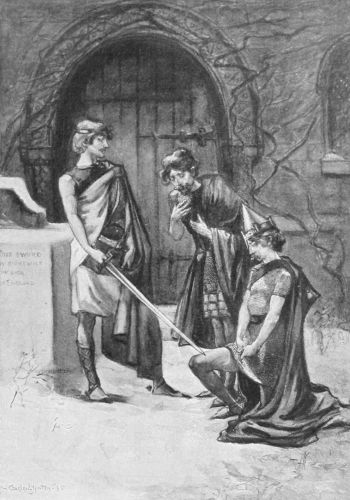
"Whereupon Sir Ector made Arthur return the sword to the anvil, and himself tried to pull it out, but it would not come; and then he made Sir Kaye try it, and still it would not come; and then bidding Arthur make an effort, the boy did so, and it came out easily, at which both Sir Kaye and his father knelt before Arthur, and hailed him as the man who should be rightful King of England."

With the New England Interscholastic games next Saturday the season of track and field athletics—as far as school leagues are concerned—will practically come to a close. The season has been a most successful one. Records have been broken on every hand, even in events where it was supposed that many a year must go by before that performance could be bettered. This excellent showing is the natural result of the hard training and constant energy of the hundreds of runners and jumpers in the schools; and the ever-increasing number of contestants all over the country proves that track and field sports have secured a firm foothold, and now deserve to be recognized as equal in importance to both football and baseball. In the vicinity of New York, at least, there are fully twice as many who indulge in track athletics as there are baseball and football players. In other regions I think the proportions are more nearly equal. The growth of these sports has been very rapid. In almost every centre there is an Interscholastic Association or League, and the daily newspapers, not only of the East but of the West, have been printing reports of scholastic meets for the past two months. The work of the school athletes has decidedly become a factor in amateur sport. In some of the school leagues there are better men than the colleges can boast of.
The annual meeting of the Inter-collegiate Athletic Association at the Berkeley Oval, usually characterized as the "Mott Haven games," because they were first held at Mott Haven, brings together the best college athletic talent from all parts of this broad country. This year a team from the University of California travelled three thousand miles overland to contest for the championship on that day. Besides them, an unknown runner with a rapid gait and a queer cap came out of the West, and left the crack sprinters of the East straining and striving behind him, while he, with a broad smile, pocketed two gold medals, and carried them back to Iowa. I don't believe there was ever any better sport at Olympia, and if the colleges can be so successful in these things, and can draw men to compete at these games from every point of the compass, why should not the schools follow their example, and form one great Interscholastic Association, and have a big meeting once a year? There is no reason why they should not. I can think of hardly a single obstacle in the way of the formation of such a league. All that is needed is that some energetic individual or individuals, or some enthusiastic and sporting spirited Athletic Association take the matter in hand and put it through. Once started, the routine of organization would roll along as if on wheels.
It is not necessary that every school in the country should be asked to join at the outset. On the contrary, I would suggest that the greater Association under discussion be made up of the various I.S.A.A.'s now existing, and that the big annual games be a contest among the winners of the annual games of the individual associations. This scheme commends itself, because only the best men from every locality could compete at the meeting, and the number of entries could in that manner be limited. We have all had experience with a superfluity of contestants, and we know what interminable trial heats mean. If the movement to form a general Interscholastic Association should be started in New York, there would be no lack of leagues already in good standing to call upon for membership. There are the New York and the Long Island I.S.A.A.'s right here. Near by we have the New England I.S.A.A., the Western Massachusetts I.S.A.A., the Maine I.S.A.A., the Connecticut I.S.A.A., the Pennsylvania Inter-academic A.A., the Dartmouth I.S.A.A., and the New York State I.S.A.A. of Syracuse. In addition to these there are many others that I need not mention here. A large and influential league in the West is the Academic Athletic League of the Pacific Coast, of whose prowess on track and field I have had occasion to speak of many times in this Department.
Of course, one of the first questions that would arise upon the organization of such an Interscholastic Association would be, Where shall the annual meeting be held? The answer to that is simply, hold it where it will be most convenient for the greatest number of schools interested. It would not be advisable to hold the meeting in a different city each year, for the Portland and Bangor athletes would not care to journey to Philadelphia, neither would the Pennsylvanians care to travel up into Maine. New York is a central location, but in many respects it would be a poor place for a meeting of the kind under consideration. The ideal spot, to my mind, would be New Haven. This for two reasons principally. It is half-way between Boston and Philadelphia, which are the centres of the New England and Pennsylvania districts; and it is also about equally distant from New York and Hartford, which are the homes of the N.Y. & L.I.I.S.A.A's, and the Connecticut I.S.A.A. The second good reason is that Yale University is situated at New Haven, and I have no doubt that the authorities of college athletics there would only be too happy to offer the use of the Yale field, and to do considerable work toward the management of the games.
Even if the college men felt that they could not devote their time to the management of an Interscholastic meeting—which I greatly doubt, for it would be to their interest to do so—there are three large schools in New Haven, members of the Connecticut I.S.A.A., which would certainly see that business committees were appointed, and competent men set to work for the successful carrying out of the enterprise. But I believe the athletic authorities of Yale would be so glad of the opportunity to help and assist the school athletes that they would even go so far as to offer a cup to be contested for.
But I have run a little ahead of my subject. What we are all most interested in now is the first step; the rest can easily be arranged afterward. It is too late to think of holding a general Interscholastic meeting this spring, but it is none too early to begin to think of holding one next year. Preparations for such an important event require much time. If there is anything that Harper's Round Table can do to further the success of the plan, or if there is any work that I can perform in my small way toward the carrying out of any idea that may be formulated, it shall be done. I hope these few words on the subject will appeal to the athletes of the schools, and I shall be only too glad to hear from them, and, if possible, to give space to their suggestions.
PENNSYLVANIA I.A.L. GAMES, FRANKLIN FIELD, PHILADELPHIA, JUNE 1, 1895.
Event.Winner—5 points.
100-yard dashJones, P.C.10-4/5sec.
120-yard hurdleBranson, P.C.18-3/5"
Half-mile runGage, H.2m.17-1/2"
Mile bicycleWhetstone, De L.3"7"
440-yard runJones, P.C.58-2/5"
220-yard hurdleBranson, P.C.29-4/5"
220-yard dashJones, P.C.24-3/5"
Mile runThackara, G.5"23"
Half-mile walkLippincott, De L.4"5"
Running high jumpRorer, P.C.5ft.2-1/2in.
Running broad jumpBranson.P.C.19"7"
Putting shotWatts, C.33"4-1/2"
Standing broad jumpFlavell, G.9"7"
Pole-vaultHanson, P.C.9"2-1/2"
Event.2d—3 points.3rd—1 point.
100-yard dashHunsberger, P.C.Bailey, P.C.
120-yard hurdleCoit, C.Remington, De L.
Half-mile runThackara, G.Farr, De L.
Mile bicycleLagen, De L.Beverlin, De L.
440-yard runLambertson, C.McCarty, G.
220-yard hurdleRorer, P.C.Coit, G.
220-yard dashHunsberger, P.C.Beasley, G.
Mile runGuernsey, P.C.Gage, H.
Half-mile runShearer, P.C.Sutton, H.
Running high jumpNewhold, De L.Remington, De L.
Running broad jumpRorer, P.C.Johnson, G.
Putting shotFarr, De L.Sayen, H.
Standing broad jumpBranson, P.C.Rorer, P.C.
Pole-vaultRorer, P.C.{ Flavell, G.
{ Branson, P.C.
Points Made.
Penn Charter67-1/2
De Lancey23
Germantown17-1/2
Cheltenham9
Haverford10
Adelphi0
Episcopal0
—-
Total126
Note.—P.C., Penn Charter School; G., Germantown Academy; De L., De Lancey School; C., Cheltenham Military Academy; H., Haverford Grammar School; E., Episcopal Academy.
The unusual heat of ten days ago interfered mightily with the success of the Pennsylvania schools' field-day on Franklin Field a week ago Saturday. With the thermometer at 95°, and the officials so overcome with heat that half of them did not turn up, it is not to be wondered at that but two records were broken. The only men who seem to have remained unaffected by the temperature, were Jones and Branson of the Penn Charter School, the former taking first in the 100, 220, and 440, and the latter winning three firsts, one second, and two thirds—a total of twenty points. Rorer, also of Penn Charter, came pretty close to his schoolmates by taking one first, three seconds, and one third. All three leave school this year. The meeting was, therefore, a perfect walk-over for P.C., as the score by points clearly shows, and at no time of the afternoon was there much enthusiasm displayed. It began to rain just before the field events were contested, and when the heavy shower ceased the field was in no condition for jumping or pole-vaulting. This accounts for the poor performances in those events.
Jones ran the final heat of the 100 in 10-4/5 sec., winning easily, and came home twenty yards ahead of his second man in the quarter. He was not pressed in the 220 either, and made the poor time of 24-3/5 sec. The half-mile was one of the most interesting races of the day. The first three men kept well bunched all the way around, and Gage made a good spurt at the finish. Branson won both the high hurdles and the low hurdles with comparative ease, most of his opponents appearing fagged out. In the bicycle race, which occurred after the shower, a bad collision, in which one man was seriously hurt, knocked out three contestants and spoiled the event. In the mile, Guernsey, P.C., started a spurt within 220 yards of the tape, and earned a lead of thirty yards, but Thackara of Germantown showed better judgment by waiting until he reached the 100-yard mark, when he forged ahead and won. The half-mile walk was very close, the judges being unable to decide the first three places for some time. They finally made the award in the order given in the table. The records broken were in the shot event by Watts, who put the ball 3-1/2 inches beyond the I.A.L. record of 33 ft. 1 in., and in the pole-vault. The latter was broken by four men. Hanson and Rorer tied for first, and as neither could better his jump, they tossed for first place, with the luck in favor of Hanson. Branson, P.C., got third place.
In strong contrast to the ease of Penn Charter's victory on Franklin Field was the sharp and exciting contest between the Bangor and Portland High-Schools at the Maine I.S.A.A. meeting in Maplewood Park, Bangor, the same afternoon. The result was a tie, each school scoring 37-1/2 points, and out of fifteen records on the programme eleven were broken. Some of the best performances were Somers's jump of 21 ft. 5 in. in the broad; Perry's pole-vault of 9 ft. 3 in.; and the winning of the low hurdles by Edwards in 28 seconds. The most exciting period of the day was toward the close of the meeting, when Portland High was 10 points ahead of Bangor High, and only the hammer and standing high jump to be decided. Portland felt almost sure of victory, but Godfrey and Connors of Bangor went in and took the first two places in the hammer, with Wakefield of Thornton third, thus shutting Portland out from winning any points in that event. Not only this, but Godfrey broke the record by more than eight feet. Then he answered to the call for the standing high jump, clearing 4 ft. 7 in. at his first trial, and there tieing Jordan of Portland. Both men tried to do better, but were unable to, and third place again went to Thornton with Hidgdon. The tie will make the record of victories count one year for each school in the holding of the cup now in the custody of Bangor.
F. Munson. Albert Mooler. S. E. Gunnison. H. Simpson. J. Beasley. E. H. Jewell. H. Romer (Capt.). M. Forney. J. Forney. A. Opp. A. Topping. ADELPHI ACADEMY TRACK-ATHLETIC TEAM. Champions of the L.I.I.S.A.A., 1895.
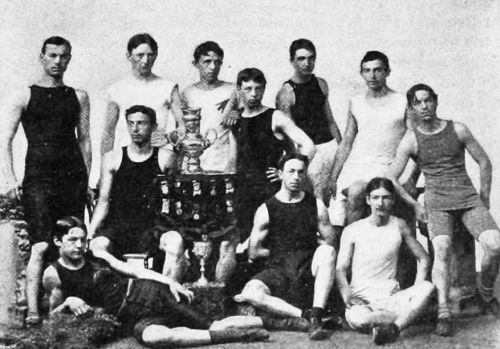
Of the eleven point-winners from the Adelphi Academy, Brooklyn, at the Long Island Interscholastic Games on May 11th, six will return to school next year. These are Gunnison, who took three firsts in the championship games, Mooler, Beasley, Topping, and both Forneys. Of the others, Simpson expects to enter West Point, Opp will go to the Columbia Law School, while Munson, Romer, and Jewell will go into business. The last-named will be the greatest loss to the team, as he made almost as good a showing at Eastern Park as Gunnison. Nevertheless, there is plenty of good material left in the school, and with the nucleus that remains Adelphi ought to be able to build up another champion team.
The Interscholastic Games of the New England Association, which are to be held on Holmes Field, Cambridge, next Saturday, will bring together a larger number of contestants than have appeared at any interscholastic event this season. The New England I.S.A.A. includes about thirty schools, and more than twenty will send representatives to strive for the cup. While it is not so very difficult to guess the probable winners of first place in the principal events on the card, the general result of the day is by no means a certainty, for the smaller schools always manage to send one or two "dark horses" who upset the closest calculations of the best judges. Nevertheless, the championship probably rests with the Worcester High-School, or the Boston English High-School, or the Phillips Academy, Andover. The W.H.-S. team won the in-door meeting last March by scoring 19 points, and most of the winners of that day will compete on Holmes Field this week. Andover did not send a full team to the in-door games, and the E.H.-S. was crippled by the absence of some of its best athletes on that occasion, but both schools have been training their strongest men for the past few weeks, and will surely be well represented.
The 100-yards dash will be won by Roche of W.H.-S., Clarke of Worcester Academy, or Dunbar of E.H.-S. These three sprinters breasted the tape almost together in the 40-yard dash at the winter meeting, Roche winning by a few inches only. I consider Ferguson the surest man for the high hurdles, although Chase of Andover will be close upon him. The low hurdles will make a pretty race for Fuller, Cambridge L.S., Heine, P.A., and Seaver, Brookline H.-S. Fuller's success will largely depend on whether he has to run the 220 flat before he takes the hurdles. In that case Heine and Seaver will have a slight advantage. But if Fuller does run the 220 before this, he ought to win it, with Roche and Dunbar behind him. There will be no fast time made in the quarter, and the race will furnish a good opportunity for a surprise by some unknown quantity. Fish, W.A., Carleton, Milton Academy, Purtell, E.H.-S., and Howe, W.H.-S., are about equal in ability for that distance. Albertson, W.H.-S., and Batchelder, R.L.S., will have a close race in the half-mile, and I have no doubt that the record will be lowered. Cunningham of Hopkinson ought to be third.
If Laing of Andover were not kept out of the contest by the age limit ruling he would, beyond any doubt, take the mile for P.A. He ran it at the Interscholastics last year in 4 min. 32-2/5 sec. And so, unless Andover sends down another good man, Dow of E.H.-S. will probably win the event. Moore of Newton H.-S. ought to take the walk, with Delaney of W.H.-S. second, and Barstow of Hopkinson third. For the field events Holt and Dole of Roxbury Latin, and Henderson of E.H.-S., will divide the honors in the high jump, while the broad will be contested by Purtell, E.H.-S. and Holt, R.L.S. The shot event will be won by O'Brien, E.H.-S., with Jordan, W.H.-S. and Holt, P.A., in the places. Johnson, W.A., should win the pole-vault, although Thenoin, R.L.S., may push him. The hammer rests with Seargent of Hopkinson, Coan, E.H.-S., or Barney, R.L.S. With so many men competing from such a large number of different schools, it is not probable that the winning score will be much greater than 25, and the winner of second place ought to come close to the same figure.
The New York Interscholastic Tennis Tournament, under the auspices of Columbia College, had a large entry list that required three days to be played off. The games were all characterized by steady work rather than by any particularly brilliant play, and the championship was won by Waltz of the Leal School, Plainfield. He met Wigham of Harvard School in the finals, and had a comparatively easy time of it, defeating the New-Yorker in three straight sets—6-1, 6-2, 6-4. He will go to Newport for the big Interscholastic tournament this summer, and will meet the other school league champions, Ware of the N.E.I.S.A.A., Sheldon of the Connecticut I.S.A.A., and Beaman, who won in the Pennsylvania I.A.L. Tournament at Princeton. I consider Ware the strongest player of this quartet, and expect to see him win at Newport. He will be heard from at the Longwood Tournament next Saturday too.
The prospects of Lawrenceville being victorious over Andover in the baseball game to-morrow have been daily increasing, and I believe now that the Jerseymen will win. Andover does not seem to be able to reduce the average of errors made in her games so far, and her players on the left-field side must play a sharp game if they wish to offset Lawrenceville's good batters. St. Mark's School, with little over a hundred boys to pick a nine from, defeated the Phillips Academy team, two weeks ago, by the score of 6-3, and the latter suffered another bad defeat from the Yale Freshmen a few days later. St. Mark's victory was in a considerable measure due to the effective pitching of White, who held the Andover men down to six hits. The features of the game, besides White's work in the box, were the catching of Drew, Andover's Captain, and the fielding of Folger. Mills, too, made a beautiful running catch of a long fly. I am surprised that the St. Mark's batters were able to get seven hits off Greenway, as it has been Andover's boast that their battery is as good as any in the schools. It is; and I surmise that Greenway had an off-day at Southboro. He must do better to-morrow or Lawrenceville will have an easy time with their Massachusetts rivals. The Jersey players have greatly improved the past week, especially in team-work. They have won within the past fifteen days two games from the Pennington Seminary's strong team, they have defeated the Princeton Freshmen, and they got excellent practice out of their match with the Princeton 'Varsity. Andover will have the advantage of home grounds and the crowd, but they will need more than that to pile up the runs.
A new invention by Professor E. W. Scripture, of Yale, will be interesting to all track athletes. The apparatus is one that will measure a runner's "reaction time." This time is that which elapses between the moment the pistol is discharged and the moment the sprinter starts. The brief period between these two moments is taken up by nature in transmitting the sound from the ear to the brain, and the impulse to run from the brain to the muscles of the legs. Professor Scripture believes that the length of reaction time is frequently an important factor, and he argues that with a runner it must be reduced to the shortest possible limit, as one-fifth of a second counts in a race. By experiments the inventor has proved to his own satisfaction that the time which elapses between the firing of the starter's pistol and the actual start of the runner is long enough to influence the winning of a race. The reaction time of a runner may vary from one-sixth to one-third of a second. The new invention is an arrangement by which a runner's reaction time may be measured to within the one-thousandth part of a second. The starter's pistol is arranged so that an electric contact is broken when the pistol goes off. A thread is attached to the right foot of the runner, and this thread breaks an electric contact the moment he starts. The distance marked on a cylinder by these two contacts measures the individual's reaction time. Sport may soon reach such a scientific stage of advancement that sprinters will be handicapped with reference to their "reaction time."
The Graduate.
Charlotte Cushman, a celebrated actress, was filling an engagement at the opera-house in B——. A man in the gallery created such a disturbance that it seriously impeded the progress of the play, and finally brought it to a standstill. Immediately the audience, furious with anger, cried: "Throw him over! Throw him over!"
Miss Temple stepped to the edge of the footlights, and in a sweet and gentle voice exclaimed: "No, I pray you, don't throw him over. I beg of you, dear friends, don't throw him over, but kill him where he is!"
An Irishman was on trial for committing a burglary, and had conducted his own case. The evidence against him was strong, and the judge, after summing up, remarked, while looking at the prisoner, that he could detect the rascal and villain in his face. "Hold there!" shouted the prisoner. "I object; that is a personal reflection."