A PLEASANT DISAPPOINTMENT.
Reading edition
BY J. SANFORD BARNES, JUN.
I don't believe that Mr. Henry ever thought what a queer combination of nicknames his son would have when he named him Thomas Richard. Some called him "Tom," some "Dick," and others, instead of calling him by his last name, Henry, changed that, too, to "Harry," so he became Tom, Dick, and Harry rolled into one.
Mr. Henry was a great sportsman, and many a time had Tom listened to his father and one of his friends plan out a day's shooting. Tom had often made his little plans, only to be carried out in his dreams. But at last, one September evening, in his twelfth year, dreams could no longer satisfy him. As he sat in his father's "den" after supper, looking for the hundredth time through the book of colored sporting incidents and game-birds, taking occasional long glances at the little sixteen-bore which hung over his father's head, as he sat at his desk reading the Forest and Stream, Tom was really developing a plan. He must go shooting, and with a real gun of some kind. "Sling-shots" he was done with; then he knew if he asked permission, what the answer would be, and therefore he decided that his hunting-trip must be made "on the sly," and this alone was one cause for the rather restless night which followed. As he turned the pages of the big book he began to imagine himself in the place of the tall man in the picture just taking a partridge from his dog's mouth, and on the next page he was the short thick-set man in brown hunting-coat walking up to his dogs, who were "stiff" and "stanch" on a covey of quail, which in pictures you can always see hiding in the clump of bushes.
Now, Tom, Dick, and Harry had a friend, and that friend had a Flobert rifle, and on that friend's willingness to lend he was counting strongly. The game did not seem to worry him; he kept thinking of a certain patch of blackberry bushes just outside a small piece of woods, where he had often started up an old cock partridge, in fact, he knew so much about that partridge that once he crept up on him, and almost got a shot at him with the now-to-be-despised "sling-shot"; and with a Flobert—even if his father had said that no true sportsman would shoot a bird on the "sit"—he felt sure he could get him, and if he did he'd come home, own up, and trust to luck for the rest, but he was somewhat doubtful as to the reception he would meet.
The morning was bright and clear as Tom left the house to go down and "see what Jim Vail was going to do that day," and once outside the gate excitement again got hold of him, and he broke into a run; it was well he did, for about ten minutes later, as he turned into Mr. Vail's place, Jim was on the point of mounting his bicycle to start for a ride.
"Say, Jim," he shouted, "wait a second; I want to ask you something."
"Well, Tommy," he answered, "what can I do for you to-day? I'm going to get some exercise and get in shape for football at school; I got a letter from Ted yesterday, and he asked me to. I guess he's written to the rest of last year's team to do the same thing. I suppose you're going to ride your pony. But, really, what do you want?"
"Jim," said Tom, "I'm going to ask a favor of you. But first I want you to say you won't tell anybody anything about it. You won't, will you?"
"Of course not; but what it is?" replied Jim.
"Well," said Tom, slowly, "I'm going shooting, and I want you to lend me your Flobert rifle; you don't use it very much since your father gave you that beauty gun. I'll be careful, and I'll clean it all up for you when I'm done. Say, will you do it?"
Jim saw a chance for a little lecture, and came near giving it, but he thought of his popularity with the small boys and resisted.
"But, Tom," he answered, "how are you going to work it? I'll lend it to you, of course, but I don't want to get into any scrape with your father, and you'd better be careful, too. Now, what's your plan?"
Tom had this all arranged the moment he had seen Jim and the bicycle.
"I've got that all fixed," said Tom. "Say, you don't mind where you ride, do you? Now, I tell you what you do; just give me some cartridges, and then you start off with the rifle on your 'bike' and ride down the hill by 'Daddy Wilson's'—that's where I'm going to go shooting. When you get to the bridge, get off just a minute, and go down under the bridge and leave it on top the highest log under the boards on this side the brook, and then ride on and forget all about it. Catch?"
Jim "caught," and after another word of warning to be very careful, both in regard to the rifle and getting caught, he started, having left a box of Flobert cartridges with Tom.
HE CAUGHT A GLIMPSE OF A CERTAIN FAMILIAR WHITE HORSE.
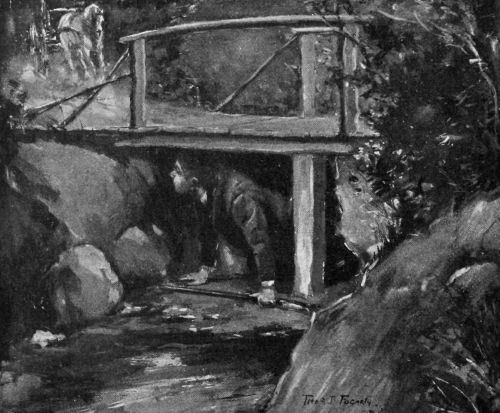
"Daddy Wilson's" was quite a mile and a half from Jim's house; but it did not take Tom long to cover the distance, and in a very short time he was under the bridge and out again on the other side with the rifle under his arm. His experience had been very limited with firearms, but he had a natural gift of being "handy" with almost anything, and he acted as though hunting were an old pastime, and the gun a companion of years. However, he thought it best to try and see how it went, and was just taking aim at a little yellow chipmunk, when the sound of an approaching carriage made him change his mind, and dart under the bridge and wait; he had caught a glimpse of a certain familiar white horse, and as it trotted over the bridge, shaking a little stream of dust through the cracks and down his neck, he realized he had had a narrow escape. After it had gone by, he tried his aim on an old green frog, and laid him out "flatter'n a pan-cake," as he said to himself. Two or three more trials were made, and he started through the woods for his blackberry patch, first walking very carefully, and finally creeping on all fours; but whatever the reason, that wily cock partridge had had his breakfast and declined to be found, and Tom was disappointed and cast down; he had counted on that bird to ease the reception he would meet at home, and now he would have to return empty handed. However, he made up his mind "he'd shoot something," and for an hour or more be popped ineffectually at chipmunks and small birds, and was really enjoying the sport, when it struck him that late to dinner would require an explanation, and thus greatly increase the chances of the very thing which he now wanted to avoid. So he hurried towards home, and went in through the place by a back way, intending to leave the rifle at the stable. The coachman was a good friend of his, and would clean and return it, and everything would be all right again. Now it happened that Mr. Henry was having built a small shed and tool-house behind his house, and, as luck would have it, he was watching its progress at the very moment when Tom emerged from behind some bushes, and unconsciously was walking down this back road towards the stable with the Flobert held close along his leg on the side farthest away from the house, so that "no one could guess he had anything." All looked smooth sailing. Suddenly he was startled by a familiar voice,
"Hey, Tom!" it called; "what you got there?"
There was no escape.
"A rifle, sir," replied Tom, in a rather muffled voice.
"A what!" cried the voice.
"A rifle, sir," replied Tom, again.
"Bring it here," was the short reply, and over across the field went Tom to his doom.
"Go back there and get one of those carpenters to give you a good sized shingle," said Mr. Henry, "and give me the gun."
"Well," said Tom to himself, "I knew I was taking risks," and he returned in a moment with the shingle, and looking his father straight in the eye waited the next command.
"Now," said Mr. Henry, in his severest tones, "take that shingle and put it up against that big tree, and give me a cartridge."
Surprise and wonder are no names for the feelings that ran through Tom's mind; it made him tingle up and down his backbone—he couldn't say a single word; but there were more surprises to follow.
"What you been shooting, Tommy? Elephants, hey?" said Mr. Henry, after firing all the cartridges Tom had left; "or was it only small game—a panther or lynx—you were after this morning?"
Tom's courage began to return, and as he found his father in such a splendid mood he was not going to allow himself to be bluffed.
"I went out after partridges, sir," he said, "and I thought I'd have one for supper to-night for mamma; but he wasn't there. I was sure I'd get one."
In a short time Mr. Henry had the whole story, and not a word of fault was found, and Tom thought he had the finest father in the world; he thought so before, but after this incident there was no doubt about it.
On the evening of the same day Tom was again devouring the "bird book," as he had always called it. Mr. Henry, who had been writing at his desk, pushed himself back, and looking at Tom, a smile crept over his face. His son was exactly as he had been at that age, and the reason of his lenient treatment of what many fathers would have given a severe punishment for was because he knew a good deal of the world, and especially how to treat a boy who had inherited a sportsman's love of woods and guns, and was not to blame for it. Tom was bending close over the book to see whether it was a woodcock or a quail the dog was pointing, when Mr. Henry startled him as he said with a laugh,
"My boy, did you really think you'd get a partridge? Why, Dr. Carver himself couldn't shoot a partridge with a rifle; why didn't you come and ask me for my gun?"
"'Cause I didn't think you'd lend it to me," said Tom, "and I was afraid you'd suspect something. I'll come to you to-morrow," he added, as a quiet joke on his father.
But the way his father took his little joke nearly made him "have a fit," as he told Jim Vail afterwards.
"All right, Tommy," said Mr. Henry, "come to me after breakfast and I'll fix you out."
Another restless night followed by another beautiful morning, and down across the field trudged Tom, Dick, and Harry, but it looked like a brown shooting-coat walking by itself with two setters following after it through curiosity. There went Tom with a real gun—the little sixteen-bore—a real hunting-coat, sleeves rolled up and pinned to hold them, and down below his knees, to be sure; real cartridges in his pocket, and to make it complete two real bird-dogs. He was going to be the man in the "bird book," and best of all there was no "on the sly" about it.
Down back of the place beyond the "muck pond," where Tom had often caught live bait for his father, and had slaughtered many a fine fat frog, to say nothing of the turtles and lizards which had been the starting of a small museum of which he was sole proprietor, down beyond this pond he struck into the woods and let "Jet" the Gordon and "Bang" the Irish setter run. He followed them closely. Soon they came to a point, and he walked towards them. But here's where there was a difference between the picture and his position at that moment; he looked in vain for the bird; in the picture he could see it, but, try his best, he could not see it in life. The dogs worried a little, he stepped on a twig which cracked; whir! and up got Mr. Partridge from the bushes—not exactly where Tom had expected—and whirled off, Tom crouching down to see where he lit, to try him again. Time and again the same thing happened, but Tom never could seem to see the bird till he got up, and he never thought to try him flying. The dogs got tired of this kind of shooting and came in "to heel," and finally, rather discouraged and decidedly tired, Tom sat down to decide whether he would go home or not. He was sitting under a large pine-tree and thinking what his father would say, when out of the branches above his head sailed, with a quiet, subdued whir, the very bird he had been chasing so long. It settled not more than thirty yards off on the roots of an upturned birch-tree and began a gentle cluck, spreading its fanlike tail and shaking its feathers, but only for a moment. Tom's chance had come. A hurried and excited aim, a loud bang, and the partridge was fluttering on the ground, and Tom was stooping over it; the gun was back where he had shot from; he had gotten to the bird before the dogs. What he wanted was a partridge in his coat pocket; he did not seem so anxious to have the dogs hand it to him, as his dreams had made him.
Tell the truth, Tom ran most of the way home. He met his father on the driveway, and a sudden composure took hold of him.
"Say, Pop," he said, "it ain't so easy as one thinks, is it?"
"I'll bet you didn't get anything, not even a chipper bird," said Mr. Henry; "now did you?"
Tom braced himself, his heart was beating fast, and the shivers were again making him jump and wriggle.
"I only got one decent shot," replied Tom, beginning very coolly, "but I got him, and mamma'll have that bird I didn't get yesterday to-night for supper. Look at that!" he shouted the last part of his sentence, and swinging the bird in front of his father's face, darted past to show and tell all in the house, leaving Mr. Henry in blank astonishment. What he was saying to himself was:
"I'll get that boy the prettiest gun in the city for Christmas, that's what I'll do; he'll be giving me points before long."